
Once the Little Comfort corner of old Abington, where a farmer dug a mill tunnel in 1745, Whitman became the town of South Abington in 1875, a busy place of tacks, steel shanks and fine calf boots, and took its present name in 1886.
Whitman then and now
The same town 137 years apart. Click either map to look closer.
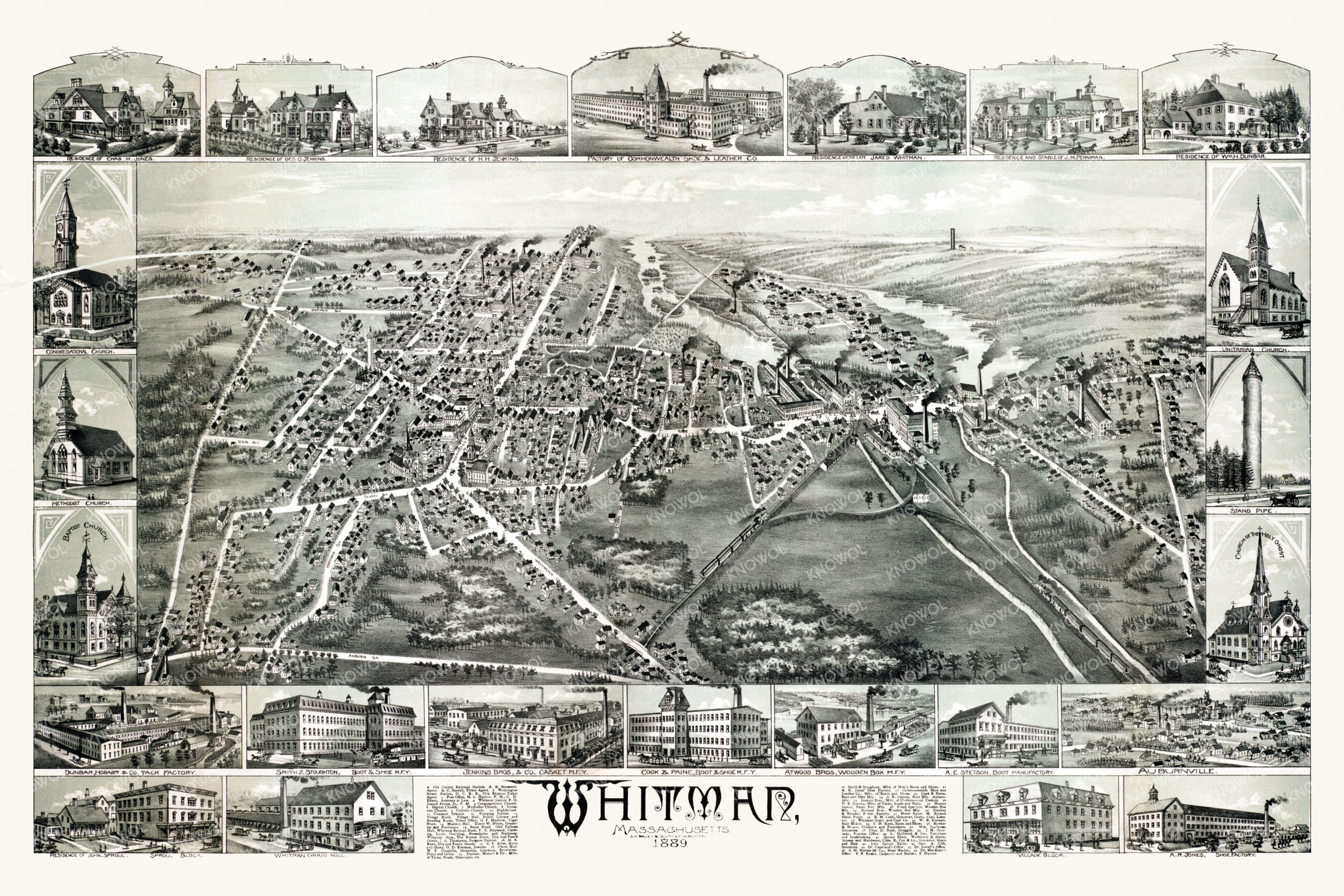
Whitman in 1889
By O. H. Bailey
A bird's eye view of the town three years after it took the name Whitman, with the Old Colony Railroad station, the Whitman Grain Mill, Bates Block, Union Hall, the Jenkins Brothers casket works, the Atwood Brothers box factory and Auburnville.6
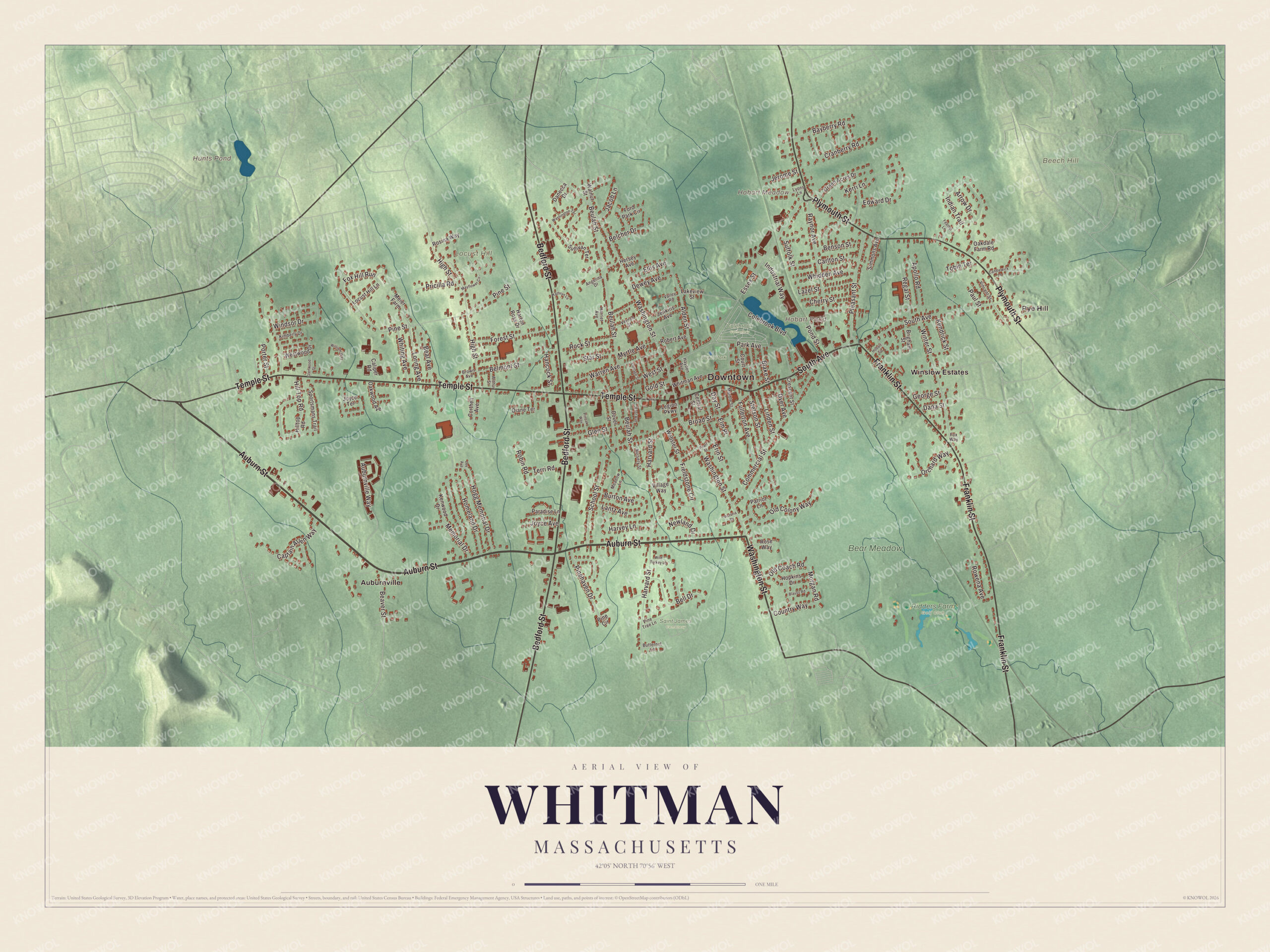
Whitman today
By KNOWOL
Whitman drawn from real geographic data, printing Auburn Street, Washington Street, South Avenue, Bedford Street, Temple Street and Plymouth Street, with Hobart Pond, Hunts Pond, Bear Meadow and Hobart Meadow.7
The history of Whitman, Massachusetts
Timber and a tunnel at Little Comfort
Before it was a town, this corner of Abington was called Little Comfort, and its first sawmill went up in 1698. Its tall white oaks went to the shipyards. Capt. Obadiah Hersey of South Abington supplied white oak planks, seven inches thick and over forty feet long, for the frigate Constitution, built at Boston. Three of the squared logs made a load, and the trip to Boston and back took two days. In 1745 a farmer, Isaac Hobart, dug a canal a mile long and a walled tunnel nearly fifteen rods long, in places twenty feet deep, to join two streams at his mill. Neighbors let him take three quarts of corn for grinding a bushel instead of the legal two. His grandson Benjamin wrote that, so far as he knew, it was the first tunnel dug in this country.38910
Tacks for the world
Benjamin Hobart began making tacks here in 1810, while the old hand process was still in use, and he was the first to put the new tack machines into wide operation. His old factory burned in 1859, and in 1864 new works went up beside the Old Colony Railroad for a hundred thousand dollars. By 1884 Dunbar, Hobart & Whidden shipped tacks to the Pacific coast, Canada, England, South America, Australia and New Zealand, and a 1928 county history says the factory was at one time the largest tack factory in the world. In the same years Jenkins Brothers made up to eighty thousand pairs of steel shoe shanks a day, and Auburnville lived on fine calf boots. In 1883 the town raised an iron water tower 140 feet tall, filled from Hobart Pond, that could be seen for miles.11121314154
A new town and a new name
A committee of South Abington men worked so hard for a town of their own that Governor Gaston signed the bill at twenty minutes past twelve on March 4, 1875. The first town meeting met in Village Hall two weeks later. That April the new town and Brockton traded pieces of land, and a 1928 history jokes that the two have swapped people ever since: Brockton shoemakers lived in Whitman for backyard gardens and poultry, and Whitman shoemakers lived in Brockton to be near the taxi stands and movie houses. In 1886 South Abington became Whitman. The same history says the name honors Augustus Whitman, born here in 1821, who gave the land for Whitman Park. The Olmsted Brothers laid out the park in 1900, and Albert H. Brigham gave it a playground and a tennis court.216171819
Whitman, Massachusetts through the years
24 moments from 1670 to today.
- 1670European settlement begins on land that is now Whitman.7
- 1698The first sawmill goes up at Little Comfort.3
- 1701Christopher Dyer is born; a 1928 history calls him the first child born in old Abington, and he lies in Mount Zion Cemetery.20
- 1712Abington, Little Comfort included, is set off from Bridgewater as a town.3
- 1745Isaac Hobart digs a mile-long canal and an underground tunnel to power his mill.9
- 1790Wooden box making begins, a local trade that lasts until 1927.21
- 1807Sixteen members of the East Bridgewater church organize South Abington's Congregational church on August 19.22
- 1810Benjamin Hobart begins making tacks, while the old hand process is still in use.11
- 1844The South Abington post office opens, with William Bonney as postmaster.23
- 1859The old Hobart tack factory is destroyed by fire.11
- 1864New tack works go up beside the Old Colony Railroad at a cost of $100,000.11
- 1865M. S. Reed starts making fine calf boots at Auburnville.15
- 1872Jenkins Brothers & Co. begin making steel shoe shanks.14
- 1875South Abington is incorporated on March 4 from parts of Abington and East Bridgewater.2
- 1875On April 24 the new town and Brockton trade pieces of land.16
- 1879The public library opens in August with 1,400 volumes.24
- 1880Augustus Whitman gives the land for a town park.18
- 1883The water works open, with an iron tower 140 feet high filled from Hobart Pond.4
- 1886South Abington takes the name Whitman on May 3.16
- 1894L. C. Bliss & Co., makers of Regal shoes, move their plant from Brockton to Whitman.25
- 1900The Olmsted Brothers' design for Whitman Park is carried out.18
- 1912Schoolchildren of Abington, Rockland and Whitman parade in Whitman for old Abington's 200th birthday.26
- 1926Whitman counts 7,774 people, 1,715 houses and 1,240 automobiles.27
- 1927Wooden box making, a Whitman trade since 1790, ends in the summer.21
Places to see in Whitman, Massachusetts
Places worth a visit in Whitman today.
- DowntownWashington Street and Route 27. The town's business center.
- Town ParkWhitman and Park avenues. Augustus Whitman's gift, laid out by the Olmsteds.
- Hobart PondNear the town center. Fed the town's 1883 water works.
- AuburnvilleWhitman. Village of fine calf boots from 1865.
- Rye HillWhitman. One of the town's named neighborhoods.
- Hobart MeadowNorth of the center. Marsh along the stream through town.
- Bear MeadowSouth of the center. Marsh along the stream through town.
- Hunts PondWhitman. A pond printed on the 2026 map.
Whitman on the National Register of Historic Places
All 2 places in Whitman on the National Register of Historic Places that still stand today, oldest first, and why each one matters.5
-
Commonwealth Shoe and Leather Co.
This factory complex was the original home of the Commonwealth Shoe and Leather Company, formed by a merger of Charles H. Jones & Co. and the Bay State Shoe & Leather Co. It made the popular Bostonian shoe, known for quality and comfort, a brand Clarks still sells.28
-
Whitman Park
Augustus Whitman gave the land in 1880, and the Olmsted Brothers designed the park, carried out in 1900, as woodland with open fields, paths, a wading pool, a bandstand and a drinking fountain. The firm came back in 1931 to fit in the 1908 Civil War monument and fix the drainage.18
Whitman in their words
“There is here a spirit of push and enterprise that is seldom met with”
History of Plymouth County, 188429
“Elm, maple and chestnut trees, some very large, adorn the village streets, and shade many an old mansion.”
A gazetteer of the state of Massachusetts, 189030
“Brockton shoemakers live in Whitman so they can have backyard gardens and raise poultry. Whitman shoemakers live in Brockton so they can be nearer the taxi stands, and moving picture houses.”
History of Plymouth, Norfolk and Barnstable counties, 192816
Towns near Whitman, Massachusetts
Sources for the history of Whitman
- Whitman, Massachusetts, Wikipedia
- History of Plymouth County, Massachusetts (1884), on the incorporation of South Abington, Internet Archive
- A gazetteer of the state of Massachusetts (1890), on Abington and Little Comfort, Internet Archive
- History of Plymouth County, Massachusetts (1884), on the South Abington water works, Internet Archive
- National Register of Historic Places list, Wikipedia
- Beautifully restored map of Whitman, MA from 1889, restored by KNOWOL
- Map of Whitman, Massachusetts in 2026, KNOWOL
- History of the town of Abington, Plymouth County, Massachusetts (1866), on sawmills and the Constitution's planks, Internet Archive
- History of Plymouth County, Massachusetts (1884), on Isaac Hobart's tunnel and canal, Internet Archive
- History of the town of Abington, Plymouth County, Massachusetts (1866), on Isaac Hobart's tunnel, Internet Archive
- History of Plymouth County, Massachusetts (1884), on the Hobart tack works, Internet Archive
- History of Plymouth County, Massachusetts (1884), on the trade of Dunbar, Hobart & Whidden, Internet Archive
- History of Plymouth, Norfolk and Barnstable counties, Massachusetts (1928), on Whitman's tack factory, Internet Archive
- History of Plymouth County, Massachusetts (1884), on Jenkins Brothers & Co., Internet Archive
- History of Plymouth County, Massachusetts (1884), on the Auburnville boot factory, Internet Archive
- History of Plymouth, Norfolk and Barnstable counties, Massachusetts (1928), on Whitman and Brockton, Internet Archive
- History of Plymouth, Norfolk and Barnstable counties, Massachusetts (1928), on Augustus Whitman, Internet Archive
- Whitman Park, Wikipedia
- Genealogical and biographical records of American families: Massachusetts (1928), on Albert H. Brigham, Internet Archive
- History of Plymouth, Norfolk and Barnstable counties, Massachusetts (1928), on Christopher Dyer, Internet Archive
- History of Plymouth, Norfolk and Barnstable counties, Massachusetts (1928), on Whitman's box makers, Internet Archive
- History of Plymouth County, Massachusetts (1884), on the South Abington Congregational church, Internet Archive
- History of Plymouth County, Massachusetts (1884), on the South Abington post office, Internet Archive
- History of Plymouth County, Massachusetts (1884), on the South Abington public library, Internet Archive
- A history of Rehoboth, Massachusetts (1918), on L. C. Bliss and the Regal Shoe Company, Internet Archive
- Official program of the two hundredth anniversary of the incorporation of the town of Abington (1912), Internet Archive
- History of Plymouth, Norfolk and Barnstable counties, Massachusetts (1928), on Whitman in 1926, Internet Archive
- Commonwealth Shoe and Leather Co., Wikipedia
- History of Plymouth County, Massachusetts (1884), on South Abington, Internet Archive
- A gazetteer of the state of Massachusetts (1890), on Whitman, Internet Archive