
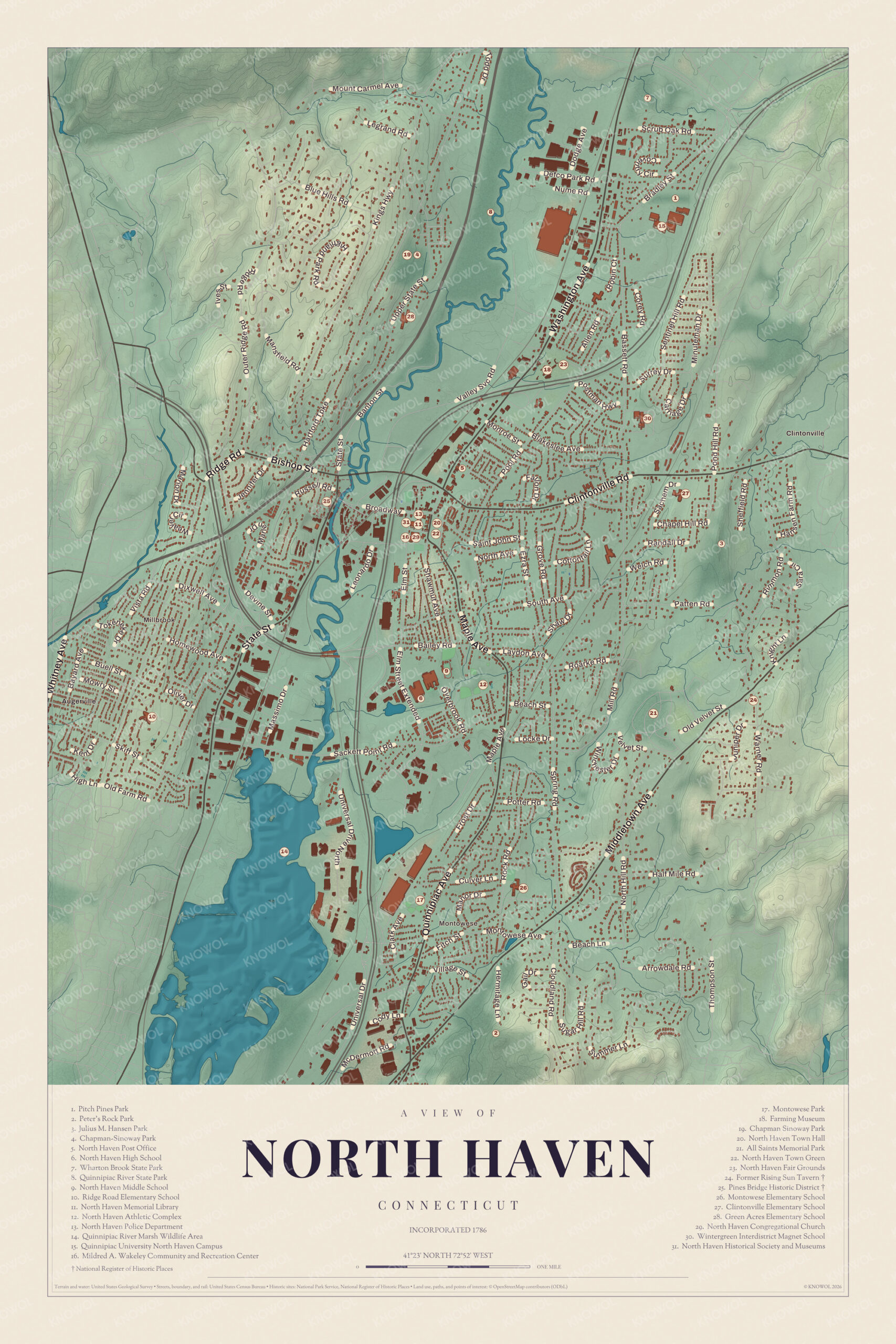
The old Northeast Parish of New Haven, a farm town on both banks of the Quinnipiac whose clay beds made it one of Connecticut's great brickmaking places, with Montowese and Clintonville to the east and Peter's Rock to the south.
North Haven on the map
Click the map to look closer.
North Haven today
By KNOWOL
Shaded land from Augerville to the traprock of Peter's Rock, the Quinnipiac running through the middle, every street by name, Montowese, Clintonville and Millbrook, and a guide of 31 numbered landmarks with the National Register sites marked.4
The story of North Haven
Sixteen million bricks a year
Under the Quinnipiac meadows lay beds of clay on both sides of the river, and North Haven made bricks from them for two centuries. Nathaniel Thorp opened the first yard about 1720, north of where the railroad station would stand. In the 1850s Horace P. Shares went prospecting along the valley for better clay, found it, and set up his own yards. When he started, a million bricks a year was a good season. Around 1900 his two yards made nine million. The biggest works belonged to I. L. Stiles & Son, which in 1891 made about 16 million bricks a year with some 150 men and 60 horses. After the Civil War the yards drew workers from Ireland, Germany, Italy and Poland.56214
Ships, shad and a famous tavern
Long before the railroad, the river was North Haven's road to the world. Before 1665 men dug bog iron in the swamps and boated it to the ironworks at East Haven. About 1760 a shipyard below the bridge began building small seagoing craft, and some sailed as far as the West Indies. Every spring, companies set their nets for shad at places with names like Duck Cove, Red Bank and Sackett's Point, and those fishing rights were bought and sold like land. On the old green, the Andrews Tavern took in travelers day and night, and its fame was carried to New York and Boston. When the New Haven and Hartford Railroad came through, the tavern's busy days were over.789
Parson Trumbull's parish
Before 1716, people here were still part of New Haven's church, and some women walked all the way there with a baby in their arms, sat through two long services and walked home again. Then the parish got its own meeting house on the land James Pierpont had left it. In 1760 the Rev. Benjamin Trumbull came, and he stayed 60 years. He served as an army chaplain, and in the winter of 1777 he marched as a captain at the head of 60 men from Mount Carmel and North Haven. He also wrote a history of Connecticut. When St. John's Episcopal church went up on land he'd wanted, he said it didn't matter much, since he'd soon have it for a barn.10111121314
Through the years
25 moments from 1638 to today.
- 1638The sachem Montowese sells the land north of New Haven to the colonists, keeping a piece where the village of Montowese now stands.15
- 1665By this year bog iron ore is being dug near The Pool and carried to the ironworks at East Haven.7
- 1670Settlers from New Haven take up land at the village center and at Muddy River, now Montowese.16
- 1714The Rev. James Pierpont leaves 8 acres to the Northeast Parish for a meeting house, training field and burying ground.1
- 1716The parish is organized, with about forty households.17
- 1720About this year Nathaniel Thorp opens the first brickyard.5
- 1722The first meeting house is finished on the green.1
- 1760About this year a shipyard below the bridge starts building small vessels, some bound for the West Indies.7
- 1761St. John's Episcopal church is dedicated on December 27.14
- 1770About this year Timothy Andrews opens the Andrews Tavern on the old green.9
- 1777The Rev. Benjamin Trumbull marches as captain of 60 men from Mount Carmel and North Haven.12
- 1786North Haven becomes a town in October, and Bishop Seabury holds a confirmation at St. John's.1819
- 1790The first federal census counts 1,236 people. The Grand List of 1789 had counted 1,620 sheep.1
- 1798The Hartford Turnpike is built through town.1
- 1811The Baptist church at Montowese is gathered.20
- 1831David Clinton and Jude B. Smith build a farm-tool factory at Smithtown, later Clintonville.21
- 1835The brick Congregational meeting house is dedicated.22
- 1838The New Haven and Hartford Railroad lays its tracks along the river.1
- 1872Frederick L. Clinton starts printing cards, a trade that spreads through town.23
- 1881The Clintonville farm-tool works move to New Jersey.24
- 1891The Stiles brickworks turn out about 16 million bricks a year.2
- 1901New Haven businessmen build The Hermitage lodge on top of Peter's Rock.25
- 1919Wharton Brook State Park opens on August 1 as the first of the state's wayside parks.26
- 1948Quinnipiac River State Park is created.27
- 2007Quinnipiac University buys its 104-acre North Haven campus.1
Places to see
The numbers match the landmark guide printed on the 2026 map.
- 2Peter's Rock ParkNear the East Haven line. Traprock summit with views to the Sound.
- 7Wharton Brook State ParkWallingford line. The state's first wayside park, 1919.Visit their website
- 8Quinnipiac River State ParkNorth of the center. Six miles of protected river.
- 15Quinnipiac University North Haven CampusNortheast. Medical, law and nursing schools.
- 20North Haven Town HallBy the green. The town's offices beside the green.
- 22North Haven Town GreenTown center. Half of Pierpont's 1714 gift.
- 24Former Rising Sun TavernEastern North Haven. Turnpike tavern with a 1738 sign.
- 25Pines Bridge Historic DistrictBroadway at the Quinnipiac. Brickmakers' homes by the old bridge.
- 29North Haven Congregational ChurchTown center. The old parish church, near the green.
- 31North Haven Historical Society and MuseumsBroadway. Town history in the Cultural Center.
On the National Register
All 2 places in North Haven on the National Register of Historic Places that still stand today, oldest first, and why each one matters.3
-
Rising Sun Tavern
A well-preserved 18th-century tavern house on the old turnpike road, with a rising sun sign dated 1738. The Todd family kept the tavern from 1786 until the 1860s and also took tolls on the Middletown Turnpike.28
-
Pines Bridge Historic District
The village that grew up around a bridge at the head of navigation on the Quinnipiac, first a stop for travelers on the Hartford road, then a brickmaking center after the railroad came. Fine houses, most from the first half of the 1800s, line State and Bishop Streets.29
In their words
“The East river was alive with fish, the woods with game.”
History of New Haven County, 1892, on North Haven's first settlers10
“Clinton's implements became renowned. They met with ready sale through the country and were found wherever farms were worked.”
History of New Haven County, 1892, on the Clintonville farm-tool works21
“In its history, for energy, integrity and worth, its sons have well borne their part along with the towns of the state to uphold the honor and dignity of the commonwealth.”
History of New Haven County, 1892, closing its chapter on North Haven30
Nearby towns
Sources
- North Haven, Connecticut, Wikipedia
- History of New Haven County, Connecticut (1892), on the brickmakers and I. L. Stiles & Son, Internet Archive
- National Register of Historic Places listings in New Haven County, Connecticut, Wikipedia
- Map of North Haven, Connecticut in 2026, KNOWOL (USGS elevation, Census Bureau roads)
- History of New Haven County, Connecticut (1892), on the first brickyards, Internet Archive
- Commemorative biographical record of New Haven County, Connecticut (1902), on Horace P. Shares, Internet Archive
- History of New Haven County, Connecticut (1892), on the mills, shipyard and bog iron, Internet Archive
- History of New Haven County, Connecticut (1892), on the fishing rights, Internet Archive
- History of New Haven County, Connecticut (1892), on the Andrews Tavern, Internet Archive
- History of New Haven County, Connecticut (1892), on early life in the parish, Internet Archive
- History of New Haven County, Connecticut (1892), on Rev. Benjamin Trumbull's pastorate, Internet Archive
- History of New Haven County, Connecticut (1892), on Trumbull in the Revolution, Internet Archive
- History of New Haven County, Connecticut (1892), on Trumbull's histories, Internet Archive
- Sketches of church life in colonial Connecticut (1902), on St. John's, North Haven, Internet Archive
- History of New Haven County, Connecticut (1892), on Montowese, Internet Archive
- History of New Haven County, Connecticut (1892), on the first settlers of North Haven, Internet Archive
- History of New Haven County, Connecticut (1892), on the North Parish of 1716, Internet Archive
- The public records of the State of Connecticut (1894), the 1786 act making North Haven a town, Internet Archive
- Sketches of church life in colonial Connecticut (1902), on Bishop Seabury's 1786 confirmation, Internet Archive
- History of New Haven County, Connecticut (1892), on the Baptist church at Montowese, Internet Archive
- History of New Haven County, Connecticut (1892), on the Clintonville Agricultural Works, Internet Archive
- History of New Haven County, Connecticut (1892), on the Congregational meeting houses, Internet Archive
- History of New Haven County, Connecticut (1892), on card printing, Internet Archive
- History of New Haven County, Connecticut (1892), on the end of the Clintonville works, Internet Archive
- Peter's Rock, Wikipedia
- Wharton Brook State Park, Wikipedia
- Quinnipiac River State Park, Wikipedia
- Rising Sun Tavern (North Haven, Connecticut), Wikipedia
- Pines Bridge Historic District, Wikipedia
- History of New Haven County, Connecticut (1892), closing words on North Haven, Internet Archive