
A stony hill town on the Willimantic River, first called Wellington, where the old common still crowns Willington Hill and the mill villages below once made glass flasks, silk and some of the first spool thread in America.
Willington on the map
Click the map to look closer.
Willington today
By KNOWOL
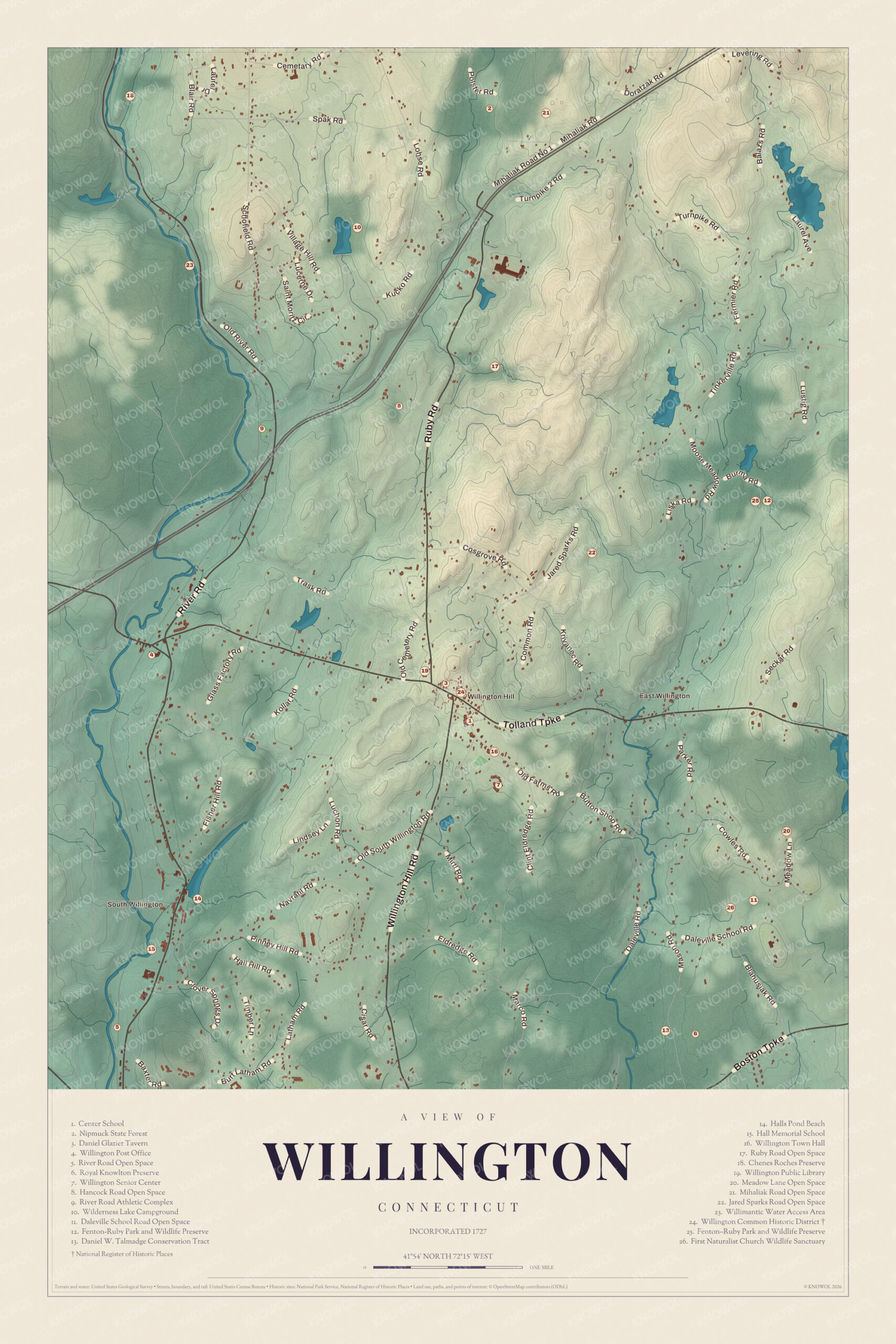
Shaded hills from Willington Hill down to South Willington and the Willimantic River valley, every street from Boston Turnpike to Pinney Hill Road, and a guide of 26 numbered landmarks with the National Register site marked.2
The story of Willington
The fifer on the soldiers' shoulders
When word of the fighting at Lexington reached Willington in 1775, thirty men left town at once. Early in the war a company of fifty more marched under Capt. John Parker. One of them was an eleven-year-old fifer, the son of Rev. Gideon Noble, the town's second minister. His friends expected him home by the time the company reached New York, but he stayed with it through the whole war. He was so small the soldiers often carried him on their shoulders on the march. Abraham Weston, just fourteen, was the drummer. At home, a Mrs. Sanger sent her husband and two sons back to the army, and then she and her daughters husked the corn, threshed the rye, felled trees and hauled in the winter's wood with the oxen.46
Glass, silk and spool thread
Willington was a farming town first, but its brooks and rivers kept mills busy. John Cady was sawing lumber on Conant Brook by about 1725. A glassworks in the western part of town made demijohns and flasks from 1815 to 1871. In the 1840s Dale & Co. built a silk mill on the Fenton River, and the village of Daleville grew up around it. When that business failed the neighborhood stood so empty that an 1884 writer compared it to Goldsmith's Deserted Village, until a new company started making beaver cloth in the old mill. Down in South Willington, the Willington Thread Company of 1840 was one of the first spool-thread works in the country. Gardiner Hall Jr. began making thread there in 1860, and his company kept the mill running until 1954.21678
The meetinghouse on the hill
In 1720 the colony sold this township to Roger Wolcott and seven partners for 510 pounds, and it was first called Wellington. Families moved in one after another, and in September 1728 Rev. Daniel Fuller was ordained in John Merrick's house, because there was no meetinghouse yet. Its frame went up on top of Willington Hill in 1734, and neighbors gave the land around it that became the common. Fuller gave the town its old burying ground on the hill and was buried there after smallpox took him. The church started a Sunday school in 1815 that was said to be the oldest in Tolland County. Later its pastor, Hubbel Loomis, became a Baptist and took nearly half the church with him. Their meeting house of 1829 still faces the common.392
Through the years
24 moments from 1718 to today.
- 1718Frances Fenton, son of Frances and Ann Fenton, is the first birth in the town's records.2
- 1720The colony sells the township to Roger Wolcott and seven partners for 510 pounds, and it's named Wellington.3
- 1725About this year John Cady is running a sawmill on Conant Brook in South Willington.2
- 1727The General Assembly incorporates the town on May 11 and writes its name Willington.2
- 1728Rev. Daniel Fuller is ordained in John Merrick's house, since there's no meetinghouse yet.9
- 1734The meetinghouse frame goes up on top of Willington Hill.2
- 1750Nehemiah Parker runs a grist mill at the site later called Eldredge Mills.10
- 1758Rev. Daniel Fuller falls sick with smallpox and dies; he's buried in the burying ground he gave the town.9
- 1775Thirty men leave Willington at once on hearing of the fighting at Lexington.4
- 1790The first federal census counts 1,200 people in 208 households.11
- 1815The Congregational church starts a Sunday school, said to be the oldest in Tolland County.9
- 1815A glassworks opens that will make demijohns and flasks until 1871.1
- 1829The Baptist Meeting House, built by Albert Sharp, goes up on the south side of the common.2
- 1840Origen Hall and partners found the Willington Thread Company, one of the first spool-thread works in the country.8
- 1840sDale & Co. build a silk mill on the Fenton River, and the village of Daleville grows up around it.7
- 1850The railroad comes through, with depots in South Willington and West Willington.2
- 1860Gardiner Hall Jr. starts making thread in South Willington.8
- 1876The Congregational Church and the Old Town Hall are built on the common.2
- 1884A state history calls South Willington the most flourishing part of town.7
- 1890Willington has 906 people and five post offices, one of them at Moose Meadow.12
- 1922Hall Memorial School is built on River Road in memory of three men of the Hall family.2
- 1954The Hall thread company ends its long run at the South Willington mill.8
- 2006The public library opens in its own new building.2
- 2017The South Willington Historic District is listed on the National Register.8
Places to see
The numbers match the landmark guide printed on the 2026 map.
- 3Daniel Glazier TavernWillington Hill. Turnpike tavern with an upstairs ballroom.
- 6Royal Knowlton PreserveSouth. Open space to the south.
- 12Fenton-Ruby Park and Wildlife PreserveEast Willington. Wildlife preserve created in 1994.
- 14Halls Pond BeachSouth Willington. Town beach on Hall's Pond.
- 15Hall Memorial SchoolRiver Road. Built 1922 in memory of the Halls.
- 16Willington Town HallSouth of the hill. Today's seat of town government.
- 18Chenes Roches PreserveNorthwest. Woods in the northwest corner.Visit their website
- 19Willington Public LibrarySouth of the hill. In its own building since 2006.Visit their website
- 23Willimantic Water Access AreaWillimantic River. On the river along the western edge.
- 24Willington Common Historic DistrictWillington Hill. The old town green, listed 1990.
On the National Register
All 3 places in Willington on the National Register of Historic Places that still stand today, oldest first, and why each one matters.5
-
Willington Common Historic District
The original town center on Willington Hill, a rectangular green ringed by two churches, the Old Town Hall, a parsonage and old houses that once served as stores and taverns. Its 32 buildings, sites and objects date from the 1700s and 1800s, some designed by the local builder Albert Sharp.13
-
Eldredge Mills Archeological District
Nehemiah Parker ran a grist mill here from 1750, and Elijah Eldredge's family ran grist, saw, fulling and shingle mills on the site from 1813 to 1845. The last mill shut about 1925; foundations of seven buildings and the old mill pond survive in the woods.10
-
South Willington Historic District
A 19th-century mill village that grew around the Hall thread company, which made thread here until 1954. The Halls built the workers' housing, a school and a church, and the district includes the mill, Hall's Pond, Hall Memorial School and the Clara Hall Elliott Memorial Church of 1911.8
In their words
“There were brave women as well as brave men in those days in Willington.”
The historical, statistical and industrial review of the state of Connecticut, 18844
“Willington should be proud of her daughter, Mrs. Eliza Kent Fuller, known far and wide as one of Connecticut's most able temperance champions”
John Merrick, a Willington native, quoted in A modern history of Windham County, 192014
“Willington was not backward in doing its part for the defense and welfare of the Colonies during the Revolutionary period.”
The historical, statistical and industrial review of the state of Connecticut, 18844
Nearby towns
Sources
- Willington, Connecticut, Wikipedia
- Map of Willington, Connecticut in 2026, KNOWOL (USGS elevation, Census Bureau roads)
- Connecticut historical collections (1837), on Willington, Internet Archive
- The historical, statistical and industrial review of the state of Connecticut (1884), on Willington in the Revolution, Internet Archive
- National Register of Historic Places listings in Tolland County, Connecticut, Wikipedia
- The historical, statistical and industrial review of the state of Connecticut (1884), on the boy fifer and the glass factory, Internet Archive
- The historical, statistical and industrial review of the state of Connecticut (1884), on Daleville and South Willington, Internet Archive
- South Willington Historic District, Wikipedia
- The historical, statistical and industrial review of the state of Connecticut (1884), on Willington's churches, Internet Archive
- Eldredge Mills Archeological District, Wikipedia
- History of the Town of Willington, Town of Willington (Mark A. Palmer, Municipal Historian)
- Register and manual of the state of Connecticut (1896), Internet Archive
- Willington Common Historic District, Wikipedia
- A modern history of Windham County, Connecticut (1920), on Eliza Kent Fuller, Internet Archive