
The old Lynn End of Lynn, two villages under one town meeting, where a meetinghouse of about 1714 still stands on the common and Suntaug Lake and Pillings Pond once drew hotel guests, summer campers and Civil War recruits.
Lynnfield on the map
Click the map to look closer.
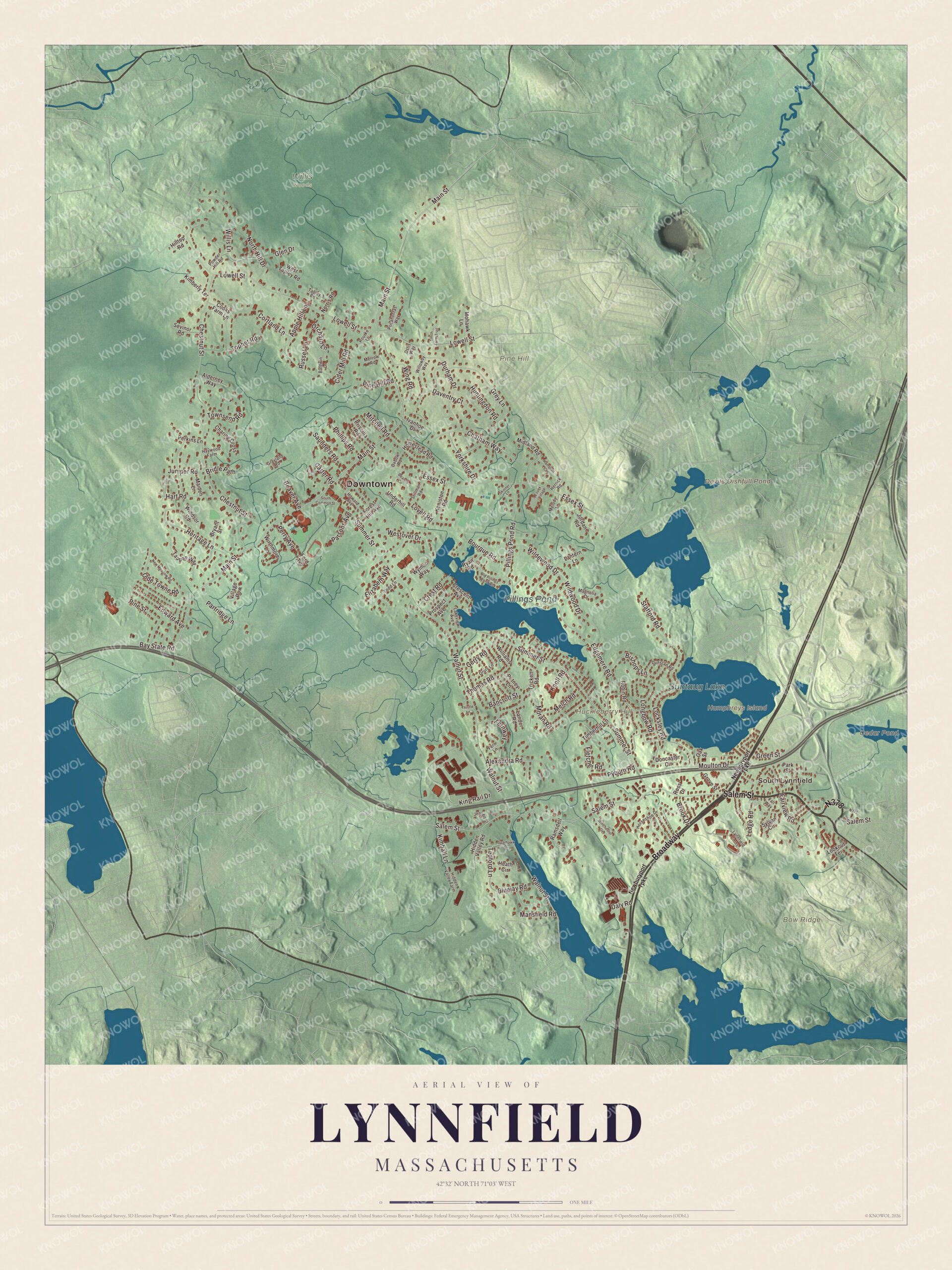
Lynnfield today
By KNOWOL
Lynnfield Center and South Lynnfield with Main, Summer, Salem, Lowell and Walnut Streets and Broadway, and Suntaug Lake, Pillings Pond, Cedar Pond and Devils Dishfull Pond, drawn over shaded hills and wetlands.6
The story of Lynnfield
The summer of 1850
The county history of 1888 keeps a year-by-year record of Lynnfield, and 1850 crowds the page. In July a ten-year-old son of Joseph Ramsdell killed a rattlesnake five feet long with eleven rattles. On August 1 a tornado tore a narrow path through the west part of town in the middle of the afternoon, and by luck no building stood in its way. Two weeks later, on August 15, a church picnic from Lynn went out in a large flat-bottomed boat on Lynnfield Pond, the lake now called Suntaug. The boat tipped and thirteen people drowned. On August 31 the railroad through South Lynnfield opened, and the Centre got its own line in 1854.78
Pewter bullets at Lynn End
On the night before the Battle of Lexington, the story goes, neighbors crowded into Daniel Townsend's kitchen at Lynn End. They brought all the old pewter they could spare and their bullet molds, and they ran bullets. Townsend lived near the shore of what's now Pillings Pond with his wife, Zerviah. On April 19, 1775, he was among the Americans killed as the British marched back toward Boston. He was buried at home, and lines about him are cut on his gravestone. In 1922 one of those bullet molds was still kept at the old Perkins homestead on Chestnut Street, and a children's patriotic chapter named for Townsend came to hold exercises in the old church and visit his grave.9101112
From Lynn End to Lynnfield
For most of a century, families at Lynn End traveled six or eight miles to worship on Lynn Common. A committee once picked a hill halfway between, but Lynn wouldn't move the meetinghouse. So in 1712 the north end was set off as its own parish, and in 1714 it agreed to buy the land that's now the town common and build its own meetinghouse. The church was formed in 1720. Lynn End became the district of Lynnfield on July 3, 1782, and a town on February 28, 1814. In 1900, Lynn's anniversary book called that meetinghouse one of the three oldest in Massachusetts still holding services. It still stands on the common.13141516217
Through the years
25 moments from 1635 to today.
- 1635The General Court grants John Humfrey 500 acres, taking in the pond later called Suntaug Lake.15
- 1638European settlement begins in the outlying farms of Lynn.1
- 1639Lynn is granted land six miles into the country, the territory long called Lynn End.15
- 1712On November 17, Lynn End is set off from Lynn as a separate parish.15
- 1714The parish agrees to buy the land that's now the town common and build a meetinghouse.16
- 1719On December 17 the northern lights are seen for the first time, and people are badly frightened.15
- 1720The First Church of Lynnfield is formed, with Rev. Nathaniel Sparhawk as minister.15
- 1749A hot summer brings drought and swarms of grasshoppers.18
- 1775Daniel Townsend of Lynn End is killed on April 19, and is buried at home.10
- 1782Lynn End becomes the district of Lynnfield on July 3.2
- 1812Lynnfield is drawn into the district the Boston Gazette names the Gerry-mander.1
- 1814Lynnfield is incorporated as a town on February 28.2
- 1850Thirteen people at a picnic drown on Lynnfield Pond on August 15.7
- 1850The railroad through South Lynnfield opens on August 31.7
- 1852Lynnfield's first church bell goes up on the South Village church.7
- 1854The railroad through Lynnfield Centre opens on October 23.7
- 1861Camp Schouler opens at Lynnfield on July 10 to gather and drill volunteer regiments.19
- 1861The 22nd Massachusetts camps on an old race track near the Lynnfield Hotel from September 2.20
- 1869Lynnfield-born David Hewes gives the gold spike that completes the transcontinental railroad.21
- 1879President and Mrs. Hayes are the guests of Lynnfield-born David Hewes at his home in Oakland, California.22
- 1880Boston families keep summer villas in the groves above Suntaug Lake, past the old Lynnfield Hotel.23
- 1874The town has a saw-mill and a mill grinding barberry root for dye.24
- 1890The Gerry Cider Mill ships thousands of barrels of cider and vinegar a year.3
- 1922About a hundred summer camps line Pillings Pond.25
- 1976The Meetinghouse Common District joins the National Register.16
Places to see
Places worth a visit in Lynnfield today.
- Old Meeting HouseLynnfield Center common. The parish meetinghouse of about 1714.
- Meetinghouse Common DistrictSummer, South Common and Main Streets. The common and fifteen historic buildings.
- Suntaug LakeSouth Lynnfield. Humfrey's Pond, once ringed by summer villas.
- Pillings PondNear the Center. Summer camps and canoes by 1922.
- Reedy MeadowWest of the Center. Wetland crossed by the rail trail.
- Wakefield-Lynnfield Rail TrailAlong the old Newburyport Railroad. Trail on the old rail bed.
- Lynn Woods ReservationSoutheast corner. A corner of Lynn's great woods.Visit their website
- Camp Curtis GuildNorthwest corner. National Guard land shared with neighbors.
- Middleton HillNorth Lynnfield. The highest ground in town.
- South LynnfieldAlong the old Newburyport Turnpike. The crossroads village on Route 1.
On the National Register
All 3 places in Lynnfield on the National Register of Historic Places that still stand today, oldest first, and why each one matters.5
-
Hart House
A First Period saltbox with a central chimney, probably built by John Perkins, who owned the property from 1695 to 1719, and given its rear leanto not long after. John Hart bought it in 1838 and his family kept it until 1945.26
-
Henfield House
A First Period saltbox whose oldest part, with the central chimney, went up about 1700; the left side followed early in the 1700s. It's named for the Henfield family, who owned it for much of the 18th century.27
-
Meetinghouse Common District
The town common of Lynnfield Center and the Old Meeting House, which the parish voted to build in 1714 and which its write-up calls the second oldest Puritan meetinghouse still standing in Massachusetts, after Hingham's Old Ship. Fifteen nearby religious, civic, commercial and residential buildings and sites are part of the district.16
In their words
“Rustic jewel, calm, steady, and serene.”
Toast to Lynnfield at Lynn's 250th anniversary, 187928
“The town is free from debt, and is a most desirable place of residence for those who would enjoy, in the vicinity of cities, the quiet delights of rural life.”
A gazetteer of the state of Massachusetts, 187424
“Keeping its village characteristics of the best type, it is yet a sharer in, and a contributor to, the life of the larger towns and cities which surround it.”
Municipal history of Essex County in Massachusetts, 192229
Nearby towns
Sources
- Lynnfield, Massachusetts, Wikipedia
- Vital records of Lynnfield, Massachusetts, to the end of the year 1849 (1907), Internet Archive
- A gazetteer of the state of Massachusetts (1890), Internet Archive
- A history of Massachusetts in the Civil War (1868), Internet Archive
- National Register of Historic Places listings in Essex County, Massachusetts, Wikipedia
- Map of Lynnfield, Massachusetts in 2026, KNOWOL (USGS elevation, Census Bureau roads)
- History of Essex County, Massachusetts (1888), Lynnfield chronology 1850 to 1858, Internet Archive
- History of Lynn, including Lynnfield, Saugus, Swampscot, and Nahant (1865), on the 1850 picnic, Internet Archive
- Municipal history of Essex County in Massachusetts (1922), on Daniel Townsend, Internet Archive
- The Essex antiquarian (1897), Internet Archive
- History of the town of Arlington, Massachusetts (1880), on Daniel Townsend, Internet Archive
- Municipal history of Essex County in Massachusetts (1922), on Townsend's descendants, Internet Archive
- History of Lynn, including Lynnfield, Saugus, Swampscot, and Nahant (1865), on the second parish meetinghouse, Internet Archive
- History of Saugus, Massachusetts (1916), on Harmony Hill, Internet Archive
- History of Essex County, Massachusetts (1888), Lynnfield chronology to 1731, Internet Archive
- Meetinghouse Common District, Wikipedia
- City of Lynn, Massachusetts semi-centennial of incorporation (1900), Internet Archive
- History of Essex County, Massachusetts (1888), Lynnfield chronology 1720 to 1759, Internet Archive
- Memorial history of the Seventeenth Regiment, Massachusetts Volunteer Infantry (1911), Internet Archive
- Henry Wilson's regiment: History of the Twenty-second Massachusetts infantry (1887), Internet Archive
- Golden spike, Wikipedia
- Municipal history of Essex County in Massachusetts (1922), on David Hewes, Internet Archive
- The North Shore of Massachusetts Bay: An Illustrated Guide and History (1880), Internet Archive
- A gazetteer of the state of Massachusetts (1874), Internet Archive
- Municipal history of Essex County in Massachusetts (1922), on inns and Pillings Pond, Internet Archive
- Hart House, Wikipedia
- Henfield House, Wikipedia
- Proceedings in Lynn, Massachusetts, June 17, 1879: the 250th anniversary of the settlement (1880), Internet Archive
- Municipal history of Essex County in Massachusetts (1922), on Lynnfield, formerly Lynn End, Internet Archive