
The old Saugus plantation that grew into the Shoe City, where High Rock looks down on a downtown rebuilt after the fire of 1889, a 2,200-acre city forest and the electric works that helped found General Electric.
Then and now
The same town 122 years apart. Click either map to look closer.
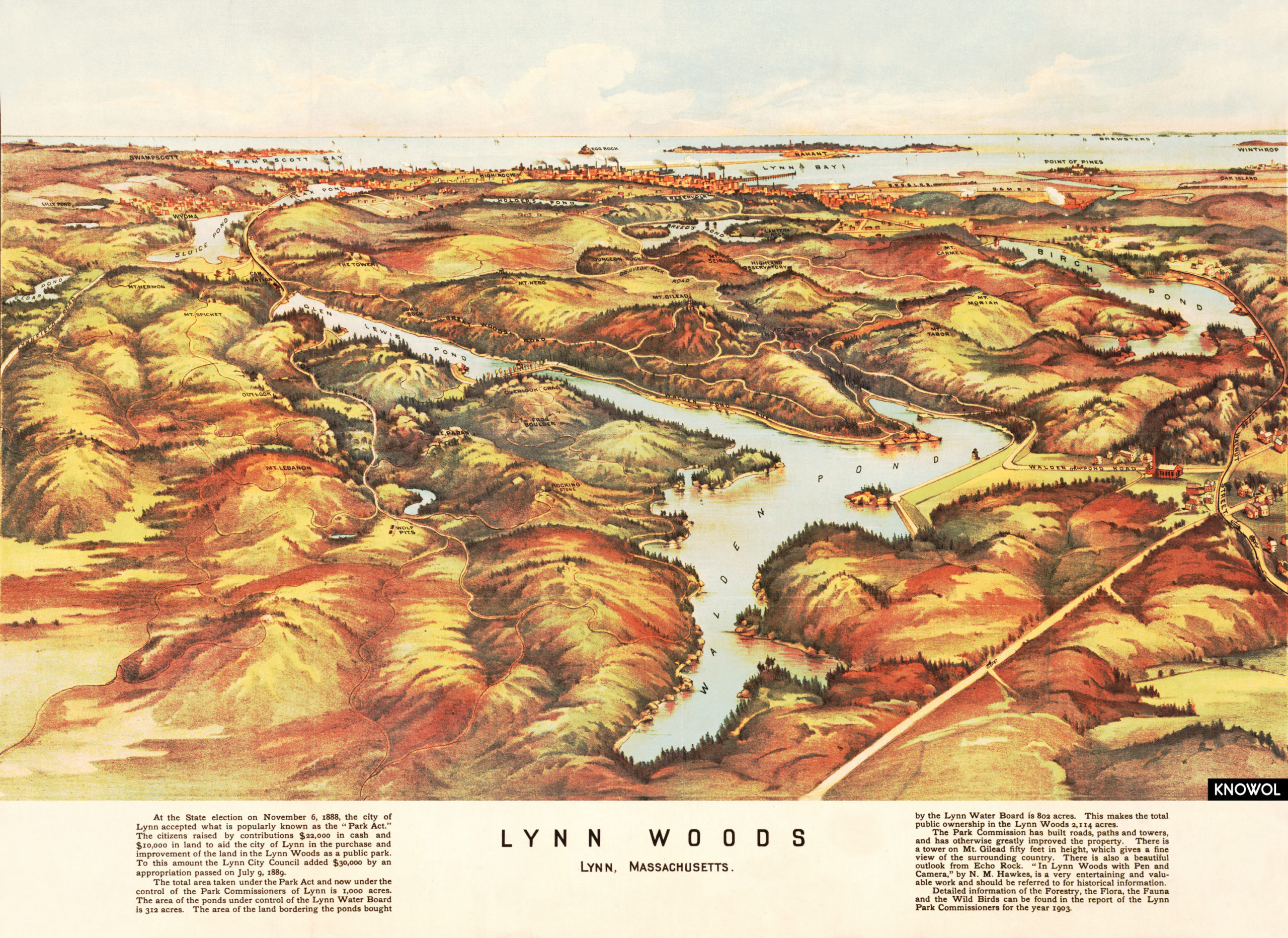
Lynn Woods in 1904
By George H. Walker
A map of Lynn Woods, the city forest in the northwest part of Lynn, showing Walden Pond, Mt. Gilead, Glen Lewis Pond, Mt. Nebo, Dungeon Rock and the Highland Observatory.5
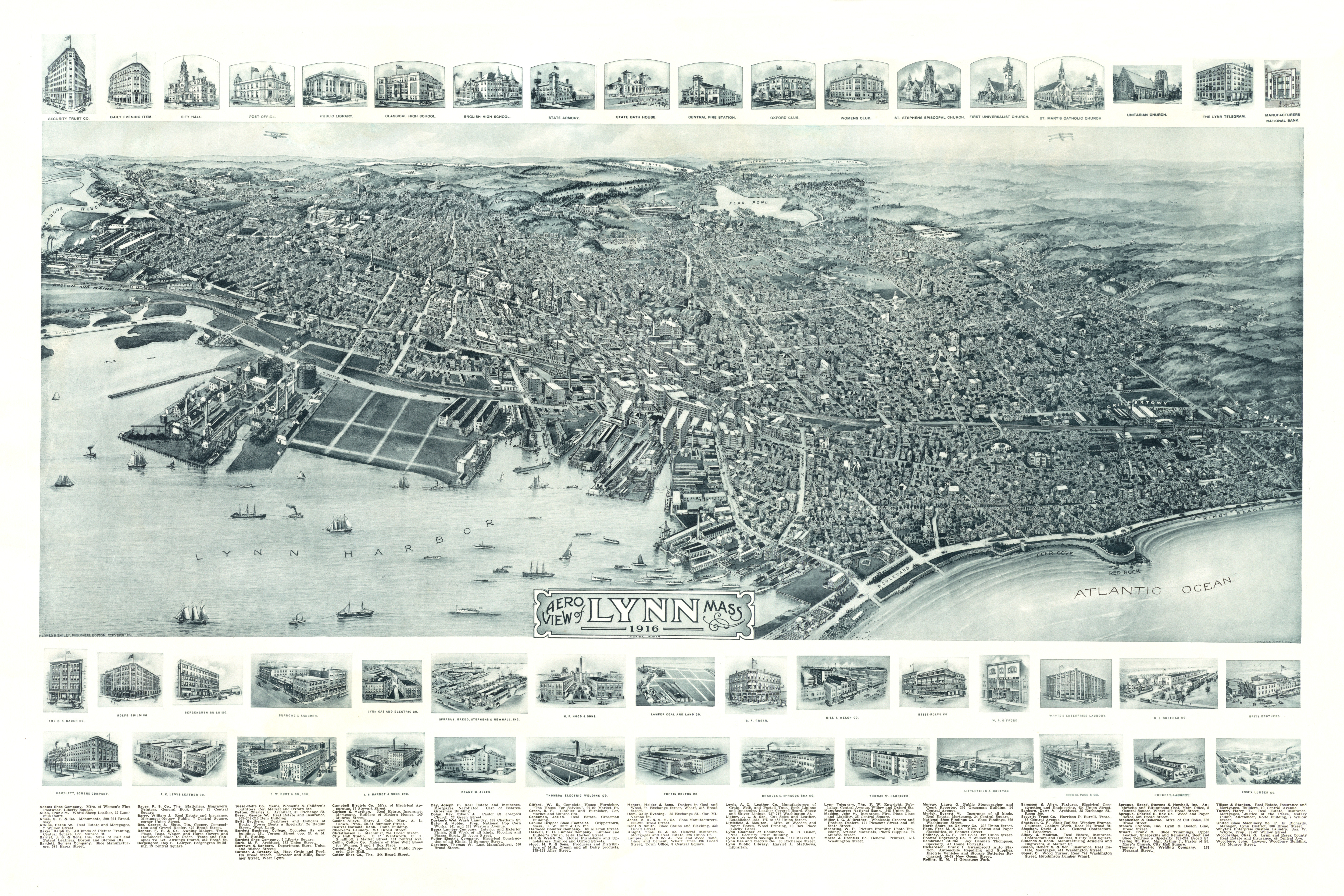
Lynn in 1916
By Fowler & Downs
Lynn when about 90,000 people lived here, with a directory of landmarks that includes the State Armory, the State Bath House, the Central Fire Station, the Oxford Club and St. Stephen's Episcopal Church.6
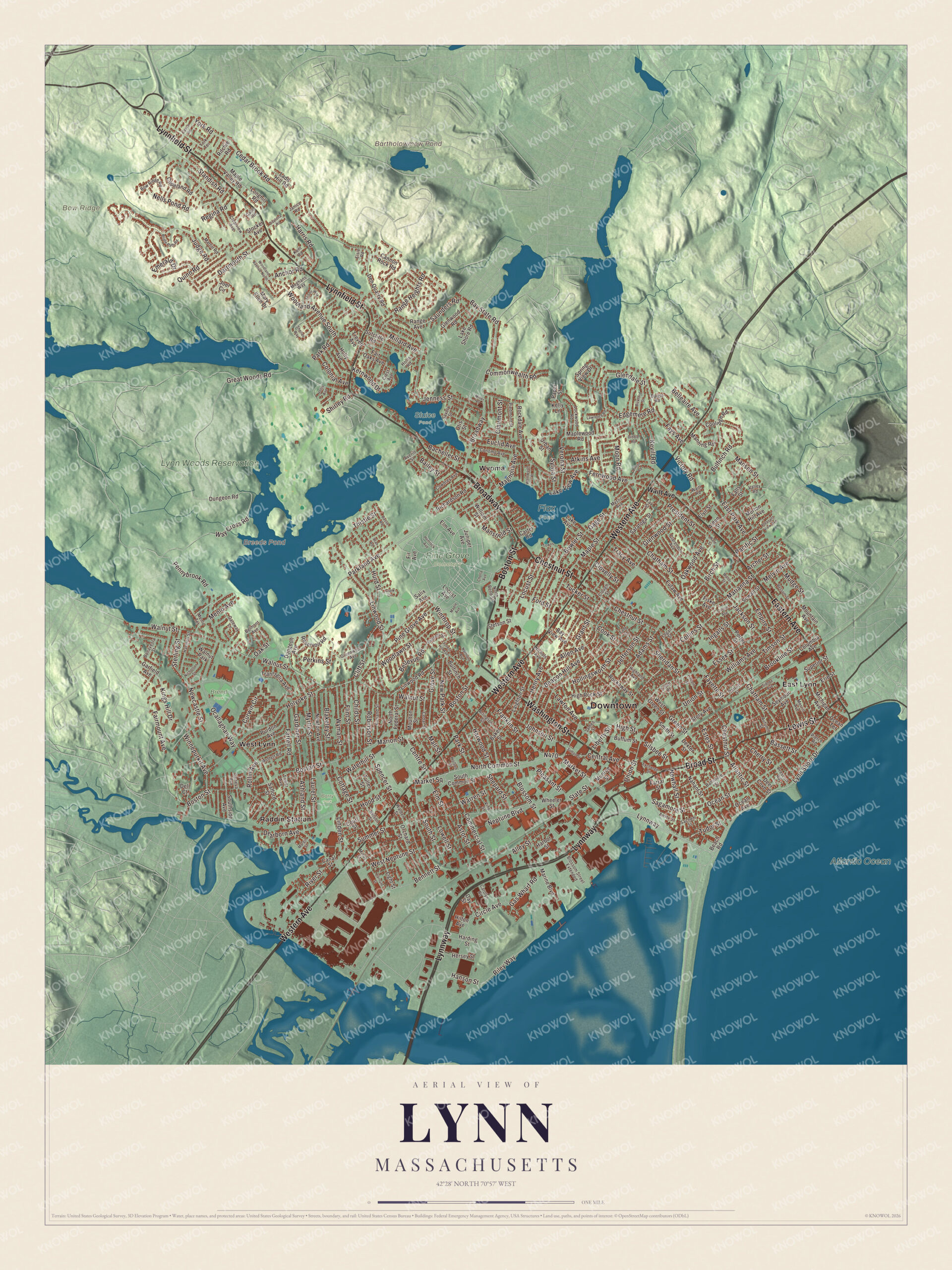
Lynn today
By KNOWOL
Shaded relief from USGS elevation data with Chestnut Street, Broad Street, Boston Street, Lewis Street, Washington Street and Broadway, plus Breeds Pond, the Lynn Woods Reservation and the Atlantic Ocean.7
The story of Lynn
When shoes grew in Lynn
People used to say that shoes grew spontaneously in Lynn, and the town's old books show how they grew. Philip Kertland, counted as the first shoemaker, came in 1635 and lived near today's Summer and South Streets. In 1750 a Welsh shoemaker, John Adam Dagyr, settled here and gave the trade a new start with his fine work, though he died in the almshouse. By 1795 Lynn was making 170,000 pairs a year. A worker took home a week's leather, made each shoe from the lasting to the final burnishing with his own hands, and brought it back on Saturday night, paid mostly in supplies. Then in June 1862 a new machine went to work at Stephen Oliver Jr.'s shop on Shepard Street, and a foreman said it would take fifty men to keep out of its way.8910211
The cliff, the cottage and the dungeon
High Rock is the porphyry cliff above Central Square, and an 1874 gazetteer says it had a well of never-failing water near its summit. At its foot stood the plain cottage of Moll Pitcher, the fortune-teller whose callers came from near and far until she died in 1813 at seventy-five. Later the Hutchinson Family Singers made the hill their home, and in 1905 the city finished the 85-foot stone tower that still stands there. Out in Lynn Woods, Edwin Marble spent years helping his father blast a way into Dungeon Rock, and in September 1856 a charge went off early and broke his arm. The woods now cover 2,200 acres, and Dungeon Rock and the old Wolf Pits are still there to find.121013147
The fire that made a new downtown
In November 1889 a fire that began in the Mower brothers' shoe factory swept through downtown Lynn. It destroyed 296 buildings, among them 142 homes, the Central Square depot, four banks and four newspaper buildings, and a history of 1894 counted more than 7,000 people put out of work. Lynn rebuilt fast. The Mowers raised a new brick block on the same site in 1891, the Lynn Bank Block went up in the new Colonial Revival style, and the Lynn Realty Company built tall factories like the eight-story Vamp Building of 1903. When the city turned fifty in 1900, a Worcester paper wrote that the fire had been a blessing and that the burned district had blossomed into the finest commercial district in Lynn.11516171819
Through the years
25 moments from 1629 to today.
- 1629Edmund Ingalls begins English settlement on Naumkeag land, and the place is first called Saugus.1
- 1635Philip Kertland, remembered as Lynn's first shoemaker, arrives and settles near today's Summer and South Streets.9
- 1637The town takes the name Lynn, after King's Lynn in England, home of its minister Samuel Whiting.1
- 1750John Adam Dagyr, a Welsh shoemaker, settles in Lynn and gives the trade a new start.8
- 1795Lynn turns out 170,000 pairs of shoes a year, every one made by hand.2
- 1805The new Lynn Academy opens on the south side of the Common.20
- 1808A worried committee of citizens calls on Benjamin Merrill, the first lawyer to open an office in town.20
- 1813Moll Pitcher, the fortune-teller who lived at the foot of High Rock, dies at seventy-five.10
- 1825Charles F. Lummus opens the office of the Lynn Mirror, the town's first newspaper.21
- 1836Henry A. Breed builds a brick silk and calico printing works at Water Hill, and acres of mulberry are planted.21
- 1841Frederick Douglass, who had escaped slavery, moves to Lynn, where he writes his first autobiography.1
- 1850Lynn is incorporated as a city on May 14.1
- 1856A blasting charge goes off early at Dungeon Rock in Lynn Woods and breaks Edwin Marble's arm.14
- 1860On February 22 Lynn's shoemakers hand in their tools and start the New England Shoemakers Strike.1
- 1861Two Lynn companies leave for the war on April 16, five hours after President Lincoln's call for troops.22
- 1862A new shoe machine goes to work at Stephen Oliver Jr.'s factory on Shepard Street, and crowds come to see it.11
- 1864On June 25 the thermometer reaches 104 degrees in the shade, the hottest day on record, and the city's first steam fire engine arrives in August.23
- 1883The Thomson-Houston electric works open in Lynn, and the west side of the city starts to boom.24
- 1886St. Stephen's chimes ring for the first time on Easter Day, the first set of bells Lynn ever had.25
- 1889The great fire of November destroys 296 buildings downtown.1
- 1892Thomson-Houston merges with Edison's company to form General Electric, with plants in Lynn and Schenectady.1
- 1905The 85-foot stone High Rock Tower is finished and dedicated on December 16.13
- 1910Lynn Shore Drive opens along the water and sets off a wave of building in the Diamond District.1
- 1918On June 6 the first airship with regular mail lands in the Lynn postal district.26
- 1981Lynn's last shoe factory closes.1
Places to see
Places worth a visit in Lynn today.
- Central SquareDowntown. Heart of the rebuilt Burned District.
- Diamond Historic DistrictAlong the shore. Old summer houses beside the sea.
- Lynn Woods ReservationNorthwest Lynn. A 2,200-acre city forest.Visit their website
- Breed's PondLynn Woods. Dammed for industry in the 1840s.
- Dungeon RockLynn Woods. The rock the Marbles blasted into.
- Walden PondLynn Woods. No tie to the one in Concord.
- High Rock TowerThe Highlands. Stone tower of 1905 with ocean views.
- Frederick Douglass ParkExchange Street. Bronze relief of Douglass, dedicated 2021.
- Lynn Shore DriveAlong Nahant Bay. Seaside drive opened in 1910.
On the National Register
20 of the 30 places in Lynn on the National Register of Historic Places that still stand today, oldest first, and why each one matters. See the full list of National Register places in Lynn.4
-
Old Lynn High School
The two story wood frame Italianate building was built in 1850 and opened to students in 1851. Originally five window bays in length, it was extended in 1876 by the addition of three bays to reach its present size, measuring 45 feet (14 m) by 95 feet (29 m).27
-
Mary Baker Eddy House
National Historic Landmark
The first home Mary Baker Eddy owned, where she lived from 1875 to 1882 while founding Christian Science. It is a National Historic Landmark, open for tours by Longyear Museum.28
-
Lydia Pinkham House
National Historic Landmark
The home where Lydia Pinkham developed her Vegetable Compound. Its address, 285 Western Avenue, became known across the country because women everywhere wrote to her here for advice. It is a National Historic Landmark.29
-
St. Stephen's Memorial Church
A Romanesque Revival church by Ware & Van Brunt, completed in 1881 of granite from Enoch Reddington Mudge's Swampscott estate as a memorial to his children. Its chimes, first rung on Easter Day 1886, were the first set of bells in Lynn.30
-
G.A.R. Hall and Museum
Union veterans of the Grand Army of the Republic built this four-story Romanesque hall in 1885 as a meeting place and Civil War memorial. It was lit from the start by electric lights from the Thomson-Houston company, which had moved to Lynn two years before.31
-
Mowers' Block
It was built in 1891 for the Mower & Brother shoemaking firm. The brick and granite building was built on the site of the Mower's old factory, in which the Great Lynn Fire of 1889 started, destroying not just their factory but a large swath of downtown Lynn as well.16
-
Lynn Armory
It is one of the best examples of Romanesque Revival architecture in the city. It was built in 1893 out of red sandstone to a design by Wheeler & Northend.32
-
Old Post Office Building
The two-story Colonial Revival building was built in 1897 to serve as the growing city's new post office. It is one of the city's best examples of Colonial Revival styling, and features distinctive copper sheathed domes.33
-
Lynn Item Building
It was built in 1900-1901 to a design by local architect Henry Warren Rogers. It was home to The Daily Item, the city's leading newspaper, until 2014, and is the city's only surviving 19th-century purpose-built newspaper building.34
-
Lynn Public Library
A Renaissance Revival library on the Common by local architect George A. Moore, begun in 1898 and opened in 1900 at a cost of $175,000 with no public money. In 1900 it commissioned the first mural of the artist F. Luis Mora.35
-
Vamp Building
The eight-story brick building was built in 1903 as the Lynn Realty Company Building #4 to a design by local architect Henry Warren Rogers, and was extended over the next four years to occupy the entire city block bounded by Washington Street, Union Street, and Liberty Square.18
-
High Rock Tower-High Rock Cottage and Daisy Cottage
The 85-foot stone High Rock Tower, finished in 1905, crowns a park the Olmsted Brothers designed in 1907, with views to the ocean. It replaced a wooden tower built for Jesse Hutchinson of the Hutchinson Family Singers, who had built the two Gothic Revival cottages here by 1851.13
-
Capitol Diner
A diner built in 1928 by the J. G. Brill Company, believed to be that company's last operating diner. It sits on Union Street in the Central Square area, just southeast of the railroad viaduct.36
-
Lynn Memorial City Hall and Auditorium
A large Art Deco building of 1948 to 1949 that holds the city offices, memorializes Lynn's fallen in the nation's wars, and houses an auditorium seating more than 2,000.37
-
Central Square Historic District
The area is at the confluence of a number of city streets, and includes buildings that border on Central Avenue, Willow Street, Munroe Street, Lake Street, Almont Street. It is a small part of Lynn's "Burned District", a large area of the downtown that was destroyed by fire in 1889.38
-
Lynn Common Historic District
The Lynn Common Historic District encompasses the town common of Lynn, Massachusetts and the surrounding buildings which face it. Although its establishment dates to the late 17th century, the area's time of development is predominantly in the 19th century, when the common was transformed into a park.39
-
Diamond Historic District
The Diamond Historic District is a seaside, 69.5-acre (28.1 ha) National Register historic district in Lynn, Massachusetts.40
-
Lynn Woods Historic District
A 2,200-acre city forest park founded in 1881 that covers nearly a fifth of Lynn's land, with ponds, ledges, towers and Dungeon Rock. The part inside the city line joined the National Register in 1996.3
-
Munroe Street Historic District
The Munroe Street Historic District encompasses some of the few commercial buildings to survive in downtown Lynn, Massachusetts from the mid 19th century. The district includes properties on Munroe Street between Market and Washington Streets, which was spared by the 1889 fire that destroyed much of Lynn's downtown area.41
-
Pine Grove Cemetery
It was established in the mid-19th century and it consists of 82 developed acres. There are approximately 88,000 to 90,000 interments at the cemetery.42
In their words
“It led to the saying that shoes grew spontaneously in Lynn.”
Shoes and shoemaking illustrated, 18978
“I came down from the Rock impressed with the fact that God and man had wrought to make this one of the most favored places on the Atlantic coast.”
A speaker at Lynn's fiftieth birthday as a city, 190043
“The whole country seemed to have their eyes momentarily turned on Lynn.”
History of Lynn, 1865, on the shoemakers' strike of 186044
Nearby towns
Sources
- Lynn, Massachusetts, Wikipedia
- Industries of Massachusetts: historical and descriptive review of Lynn, Lowell, Lawrence and others (1886)
- Lynn Woods Historic District, Wikipedia
- National Register of Historic Places listings in Lynn, Massachusetts, Wikipedia
- Beautiful vintage map of Lynn Woods, Massachusetts (1904), restored by KNOWOL
- This is how Lynn, Massachusetts looked in 1916, restored by KNOWOL
- Map of Lynn, Massachusetts in 2026, KNOWOL (USGS elevation, Census Bureau roads)
- Shoes and shoemaking illustrated (1897)
- Standard history of Essex County, Massachusetts (1878)
- History of Essex County, Massachusetts (1888)
- Standard history of Essex County, Massachusetts (1878)
- A gazetteer of the state of Massachusetts (1874)
- High Rock Tower-High Rock Cottage and Daisy Cottage, Wikipedia
- History of Lynn, Essex County, Massachusetts, including Lynnfield, Saugus, Swampscott and Nahant (1865)
- Professional and industrial history of Suffolk County, Massachusetts (1894)
- Mowers' Block, Wikipedia
- Lynn Bank Block, Wikipedia
- Vamp Building, Wikipedia
- City of Lynn, Massachusetts semi-centennial of incorporation (1900)
- Standard history of Essex County, Massachusetts (1878)
- Standard history of Essex County, Massachusetts (1878)
- History of Lynn, Essex County, Massachusetts, 1629 to 1893 (1890)
- History of Lynn, Essex County, Massachusetts, including Lynnfield, Saugus, Swampscot and Nahant (1865)
- History of Lynn, Essex County, Massachusetts, 1629 to 1893 (1890)
- History of Lynn, Essex County, Massachusetts, including Lynnfield, Saugus, Swampscott and Nahant (1890)
- Municipal history of Essex County in Massachusetts (1922)
- Old Lynn High School, Wikipedia
- Mary Baker Eddy House, Wikipedia
- Lydia Pinkham House, Wikipedia
- St. Stephen's Memorial Church, Wikipedia
- G.A.R. Hall and Museum, Wikipedia
- Lynn Armory, Wikipedia
- Old Post Office Building, Wikipedia
- Lynn Item Building, Wikipedia
- Lynn Public Library, Wikipedia
- Capitol Diner, Wikipedia
- Lynn Memorial City Hall and Auditorium, Wikipedia
- Central Square Historic District, Wikipedia
- Lynn Common Historic District, Wikipedia
- Diamond Historic District, Wikipedia
- Munroe Street Historic District, Wikipedia
- Pine Grove Cemetery, Wikipedia
- City of Lynn, Massachusetts semi-centennial of incorporation (1900)
- History of Lynn, Essex County, Massachusetts, including Lynnfield, Saugus, Swampscott and Nahant (1865)