
The Chair City, pieced together in 1785 from the edges of four older towns, where James Comee's one-room chair shop of 1805 grew into the Heywood works and a million chairs a year, on the hills around Crystal Lake.
Gardner then and now
The same town 146 years apart. Click either map to look closer.
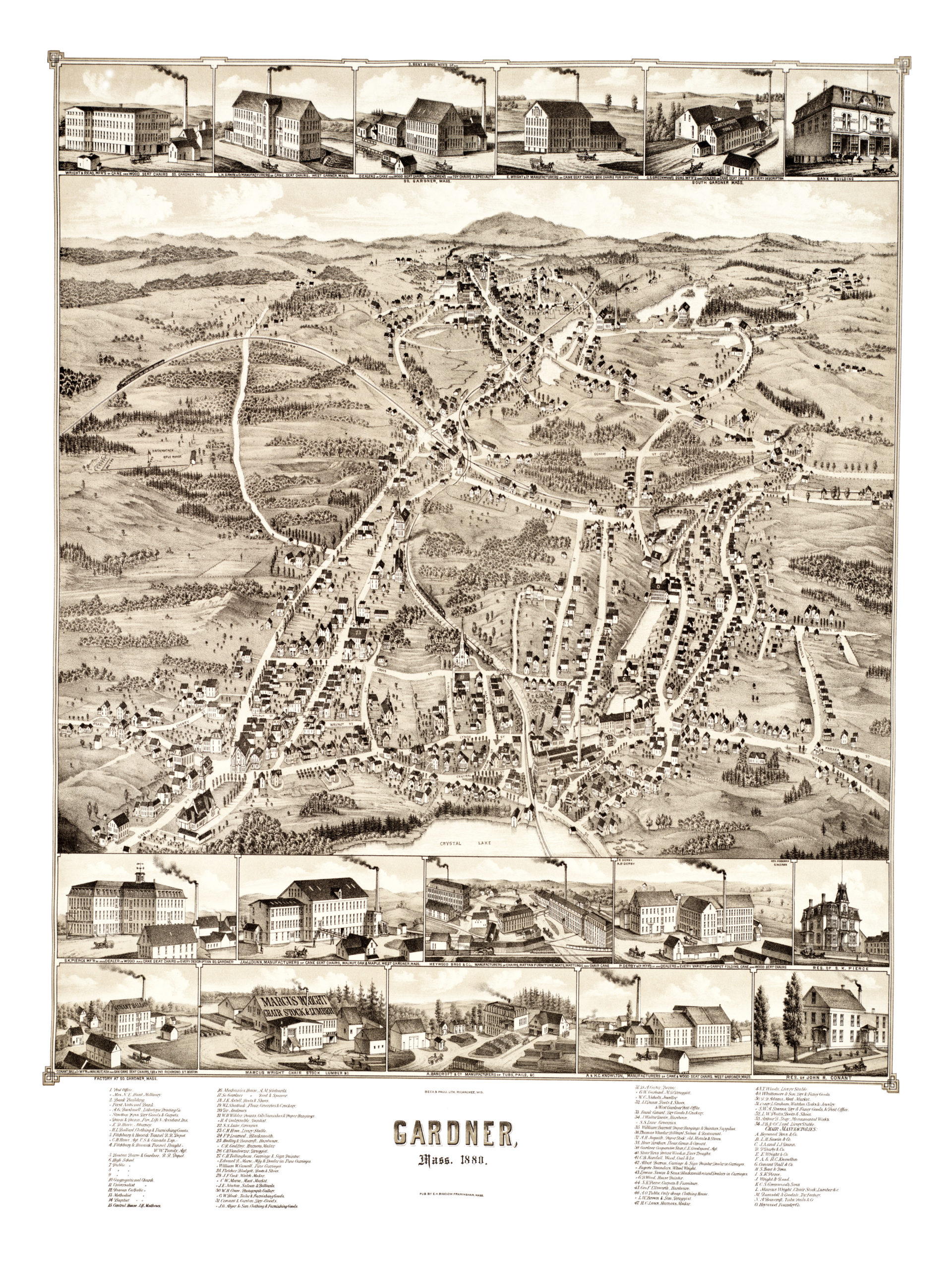
The bird's-eye view
By Beck & Paul and the E.H. Bigelow Publishing Company
Gardner drawn as if from the sky in 1880, picking out its homes and businesses, among them the W.H. Cowee Photograph Company, J.F. Cook the watch maker, C.W. Morse's meat market, S.S. Lane's groceries and A. & H.C. Knowlton, makers of cane and wood seat chairs.4
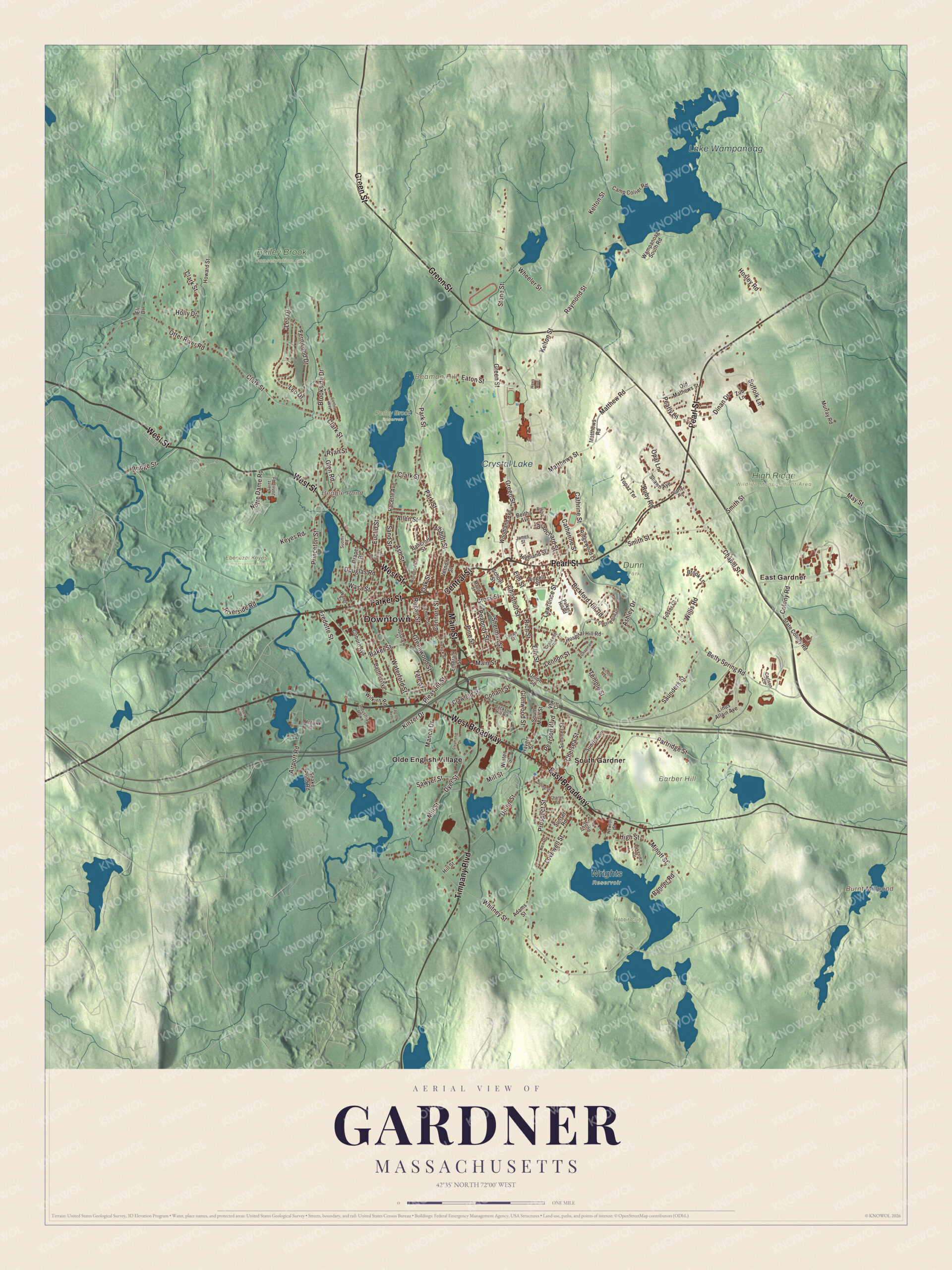
Gardner today
By KNOWOL
Shaded hills from United States Geological Survey elevation data, with Central Street, Pearl Street, Parker Street, Timpany Boulevard and the two Broadways, Crystal Lake, Lake Wampanoag, Beagle Pond, Perley Brook, Barber Hill, Beaman Hill and the Olde English Village.5
The history of Gardner, Massachusetts
How Gardner learned to cane a chair
Gardner's chair trade started in a farmhouse. About 1805 James M. Comee began making chairs in one room of his house, first with plank seats and soon with seats woven from cattail flag that grew in the marshes. For years he hauled them by horse team to Worcester, Lowell, Springfield and Boston, sometimes selling them door to door. The cane seat came later. In 1832 or 1833 John Cowee, who worked for chair maker Elijah Putnam, visited the Connecticut State Prison, watched prisoners seating chairs, bought a seat and took it apart in Putnam's shop to learn how it was done. Soon frames and cane were put out to families around town to weave at home. By 1879 the cane came from Singapore by rail, and Gardner made more than a million chairs a year.2678
A town made from four towns
Gardner was pieced together in 1785 from the edges of four older towns. Westminster gave about six thousand acres, Winchendon forty-five hundred, Ashburnham twenty-eight hundred and Templeton seven hundred. The old lines still explain the map. The first meetinghouse and the common sat on Ashburnham land, Crystal Lake on Winchendon's, and all of South Gardner on Westminster's. The new town first met on August 15, 1785, at John Glazier's house. Money was so scarce that in 1787 the town took taxes in butter at seven pence a pound, and the butter went to the committee buying nails for the meetinghouse. Gardner was small but it wasn't shy. In 1786 its delegate to a county convention at Paxton carried instructions to ask that the General Court be moved out of Boston into some country town.91011
The railroad that almost missed Gardner
When the Vermont and Massachusetts Railroad was planned in the 1840s, Gardner people bought stock expecting the line to come through town. Then they learned that Alvah Crocker of Fitchburg and his allies meant to lay it through Winchendon instead. At a town meeting on July 22, 1845, Gardner chose Levi Heywood, Samuel S. Howe and Edwin E. Glazier to fight it, and with help from Templeton they won. An act of 1846 put the main line through Gardner. For years afterward the engine was still reversed at South Ashburnham while passengers turned their seats around. A second fight came later, when four rival railroads tried to block a line north to Winchendon. Gardner won again, and the first train ran through to Winchendon on Thanksgiving Day, 1873.12
Gardner, Massachusetts through the years
25 moments from 1764 to today.
- 1764Europeans first settle the land that will become Gardner, then part of four older towns.1
- 1775Col. Thomas Gardner of Cambridge, the town's namesake, is mortally wounded at Bunker Hill.13
- 1785On June 27 Gardner is incorporated from parts of Westminster, Ashburnham, Winchendon and Templeton.1
- 1785The new town holds its first meeting on August 15, at John Glazier's house.9
- 1786Gardner's delegate to the Paxton convention carries orders to ask that the General Court leave Boston for some country town.11
- 1787With money scarce, the town takes taxes in butter at seven pence a pound.10
- 1791Rev. Jonathan Osgood becomes the town's pastor, and its schoolmaster and doctor too.14
- 1799The Fifth Massachusetts Turnpike is chartered, running through the South Village.12
- 1805James M. Comee starts making chairs in one room of his house.2
- 1826Walter Heywood begins making chairs in a little shop in his father's yard.15
- 1832In 1832 or 1833 John Cowee learns caning at the Connecticut State Prison and seats Gardner's first cane chair.7
- 1834Fire destroys the Heywood brothers' chair shop.1
- 1846After a town fight, the legislature puts the Vermont and Massachusetts Railroad's main line through Gardner.12
- 1860By this year the town has voted to call its big pond Crystal Lake.16
- 1870On July 4 an excursion train runs from Worcester to Gardner on the new Boston, Barre and Gardner road.12
- 1874Heywood Brothers and Company start making reed and rattan chairs and furniture.15
- 1879Gardner's chair shops turn out more than a million chairs a year.2
- 1880Beck & Paul and E.H. Bigelow publish a bird's-eye view of Gardner.4
- 1885On June 27 the town marks its hundredth birthday and unveils its granite Soldiers' Monument.17
- 1894Edward G. Watkins, an engineer at Heywood-Wakefield, invents the first practical time clock.1
- 1897Heywood Brothers merges with the Wakefield company, forming what becomes Heywood-Wakefield.5
- 1922Gardner-born illustrator Harrison Cady designs the city seal.1
- 1923Gardner becomes a city.1
- 1954The Miss Toy Town Diner, now the Blue Moon, is moved from Winchendon to Main Street.18
- 2009The first Annual Chair Luge sends homemade chairs on wheels racing through downtown.1
Places to see in Gardner, Massachusetts
Places worth a visit in Gardner today.
- Crystal LakeNorthwest of the old Common. Once Wells' Pond, then Gardner Pond.
- South GardnerSouth part of the city. The old South Village, on Westminster land.
- Gardner Public LibraryWest Lynde Street. Opened 1885; first building now a museum.Visit their website
- Blue Moon DinerMain Street. Worcester Lunch Car diner of 1949.
- Dunn State ParkPearl Street. 132 acres around a 20-acre pond.Visit their website
- Mount Wachusett Community CollegeGreen Street. Founded 1963, on a 269-acre campus.Visit their website
- Barber HillSoutheast part of the city. An early settler's farm on its slope.
- Beaman HillNorth part of the city. A northern hill near Crystal Lake.
Gardner on the National Register of Historic Places
All 14 places in Gardner on the National Register of Historic Places that still stand today, oldest first, and why each one matters.3
-
Jabez Partridge Homestead
Its oldest part, the ell, dates to about 1772 and was built by Jabez Partridge, an early settler who signed the petition to incorporate the town in 1785. His descendants kept the farm until 1927, and its land has stayed in farming.19
-
Whitney Tavern
Joshua Tucker built its oldest part about 1782 as a tavern on the road between Templeton and Gardner, and the Whitney family kept it until the 1850s. The house stands in East Templeton, and part of its land lies in Gardner.20
-
First Minister's House
The house was built in 1792 and served as the church parsonage for Rev. Jonathan Osgood, pastor of Gardner's First Congregational church and also a physician. It is one of Gardner's finest examples of late Georgian architecture.21
-
Heywood-Wakefield Company Complex
Levi Heywood built a chair shop here in 1835, pulling the town's business center to West Gardner. Fire largely destroyed the early works in 1860, and building 5 of 1863 is the oldest that survives. Heywood merged with the Wakefield Rattan Company in 1897, and the plant closed in 1978.22
-
Sylvester K. Pierce House
Built between 1873 and 1875 for chair maker Sylvester K. Pierce, across the street from his South Gardner factory, it's a showpiece of Second Empire style with a four-story tower. His son later ran it as an inn.23
-
Lake Street Fire Station
Built in 1884 to house a school and a fire company, it served as a school for just a few years, and as a fire station until the 1980s. It is architecturally distinguished as a good local example of late Victorian architecture.24
-
Garbose Building
Guy Garland put it up in the mid-1880s as a Second Empire block with stores, offices and an auditorium. It was restyled in red brick and marble Colonial Revival between 1907 and 1921, and later took its name from Abe and Samuel Garbose, who ran a clothing store there.25
-
Levi Heywood Memorial Library Building
Fuller & Delano of Worcester designed this Richardsonian Romanesque library, completed in 1886 and named for chair maker Levi Heywood. It served as the public library until 1978 and now houses the city's history museum.26
-
F.W. Smith Silver Company
Frank W. Smith, trained as a silversmith by his uncle William Durgin, built this factory in 1892 for his sterling silver flatware. Its tower roof is capped by a finial shaped like a knife.27
-
Elm Street Fire Station
Built in 1897, it is a little-altered example of a Late Victorian fire station, with a number of distinctive period features. The station was listed on the National Register of Historic Places in 1980, at which time it was still in active service.28
-
Gardner News Building
Built in 1906, it has served since its construction as the home of the Gardner News, a mainstay of the local news industry. The building was listed on the National Register of Historic Places on November 14, 1979, and included in the West Gardner Square Historic District on December 30, 1985.29
-
Miss Toy Town Diner
The Worcester Lunch Car Company built it in 1949 for Winchendon, where it was the Miss Toy Town Diner, and it was moved to Main Street in Gardner in 1954. Now the Blue Moon Diner, it keeps its barrel roof, porcelain enamel panels, marble counter and fourteen stools.18
-
West Gardner Square Historic District
The West Gardner Square Historic District encompasses the historic commercial, civic and industrial downtown area of Gardner, Massachusetts. Developed industrially beginning in the early 19th century, the area now boasts a concentration of late 19th and early 20th century commercial, civic, and industrial architecture.30
-
Gardner Uptown Historic District
The old town common, an early cemetery and the brick First Congregational Church mark Gardner's first civic center, the heart of town from 1785 until town offices moved to West Gardner beginning in the late 1920s.31
Gardner in their words
“Crystal Lake, the pride of Gardner, is a thing of beauty, a joy forever.”
History of the town of Gardner, 187832
“Enterprise is characteristic of the business men of this place.”
History of Worcester County, 1879, on Gardner's chair makers33
“One may journey long and far to look upon a more picturesque and lovely sight than there reveals itself to the eye and mind, turn him whichsoever way he may.”
History of Worcester County, 1889, on the view from Gardner's hills34
Towns near Gardner, Massachusetts
Sources for the history of Gardner
- Gardner, Massachusetts, Wikipedia
- History of Worcester County, Massachusetts (1879), Gardner chapter by Rev. William D. Herrick, on the chair business, Internet Archive
- National Register of Historic Places list, Wikipedia
- Bird's eye view of Gardner, Massachusetts in 1880, restored by KNOWOL
- Map of Gardner, Massachusetts in 2026, KNOWOL
- History of Worcester County, Massachusetts (1889), Gardner chapter by Rev. William S. Heywood, on the first chair makers, Internet Archive
- History of Worcester County, Massachusetts (1889), Gardner chapter, on the first cane seats, Internet Archive
- History of Worcester County, Massachusetts (1879), Gardner chapter, on cane from Singapore, Internet Archive
- History of Worcester County, Massachusetts (1889), Gardner chapter, on the land from four towns, Internet Archive
- History of Worcester County, Massachusetts (1889), Gardner chapter, on taxes paid in butter, Internet Archive
- History of Worcester County, Massachusetts (1879), Gardner chapter, on the town's instructions of 1786, Internet Archive
- History of Worcester County, Massachusetts (1889), Gardner chapter, on the turnpike and railroads, Internet Archive
- History of Worcester County, Massachusetts (1889), Gardner chapter, on Col. Thomas Gardner, Internet Archive
- A gazetteer of Massachusetts (1847), on Gardner, Internet Archive
- History of Worcester County, Massachusetts (1889), Gardner chapter, on Heywood Brothers and Company, Internet Archive
- History of Gardner, Massachusetts, from its earliest settlement to 1860 (1860), on naming Crystal Lake, Internet Archive
- History of Worcester County, Massachusetts (1889), Gardner chapter, on the centennial and the Soldiers' Monument, Internet Archive
- Miss Toy Town Diner, Wikipedia
- Jabez Partridge Homestead, Wikipedia
- Whitney Tavern, Wikipedia
- First Minister's House, Wikipedia
- Heywood-Wakefield Company Complex, Wikipedia
- Sylvester K. Pierce House, Wikipedia
- Lake Street Fire Station, Wikipedia
- Garbose Building, Wikipedia
- Levi Heywood Memorial Library Building, Wikipedia
- F.W. Smith Silver Company, Wikipedia
- Elm Street Fire Station, Wikipedia
- Gardner News Building, Wikipedia
- West Gardner Square Historic District, Wikipedia
- Gardner Uptown Historic District, Wikipedia
- History of the town of Gardner, Worcester County, Mass. (1878), on Crystal Lake, Internet Archive
- History of Worcester County, Massachusetts (1879), Gardner chapter, on its business men, Internet Archive
- History of Worcester County, Massachusetts (1889), Gardner chapter, on the town's scenery, Internet Archive