
A Charles River town, once the west side of Medfield, where Factory Village spun some of the state's earliest cotton, West Medway made boots and shoes around Rabbit Hill, and the carpet weavers of Chicken Brook moved off to Lowell.
Medway then and now
The same town 139 years apart. Click either map to look closer.
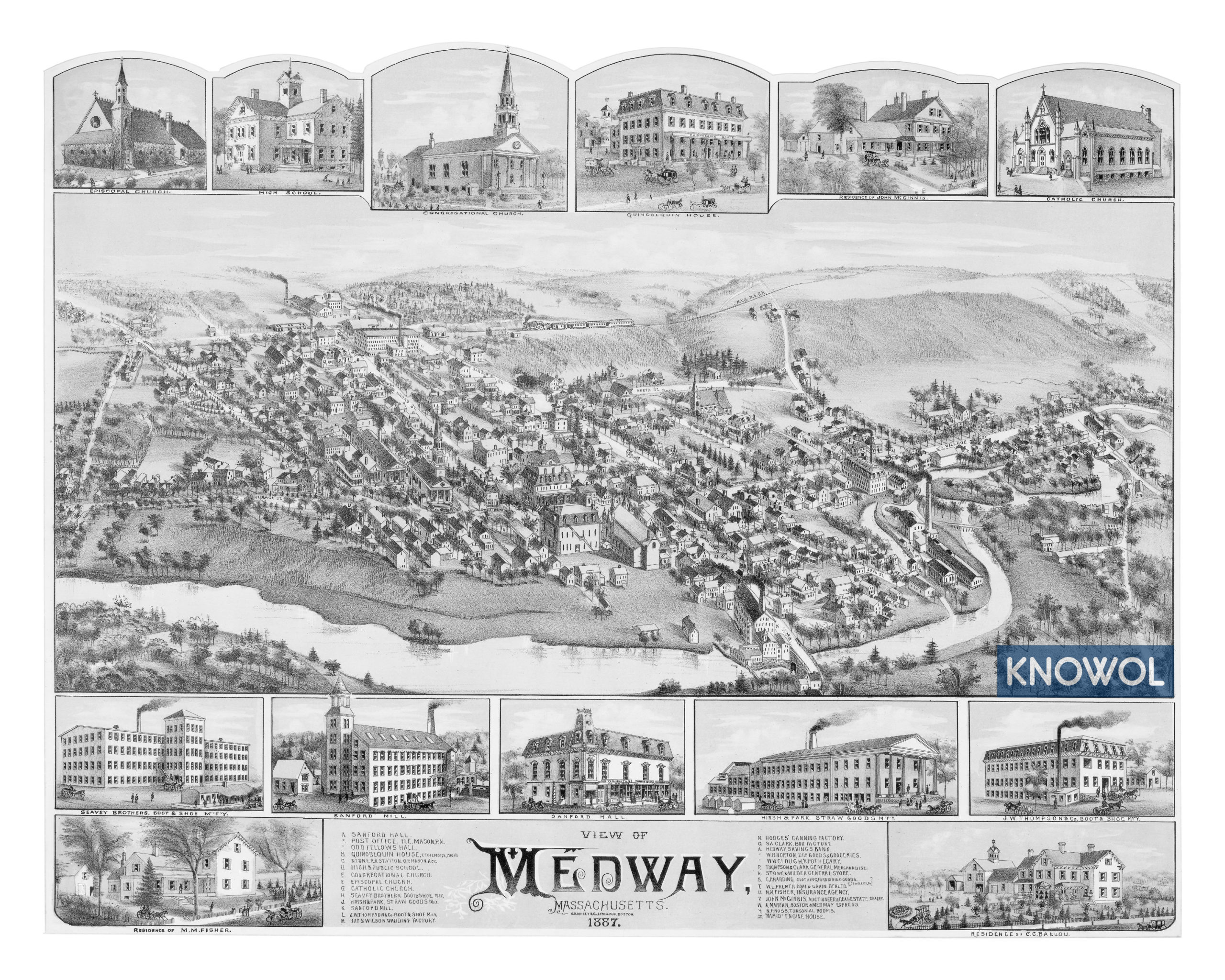
The bird's-eye view
By O.H. Bailey
Medway drawn as if from the sky in 1887, with the Sanford Mill, Sanford Hall, Clough Apothecary, the Seavey Brothers boot and shoe factory, Hirsch and Park, the straw goods manufactory, the Quinobequin House, Hodges' Canning Factory, the Rapid Engine House and the railroad station.5
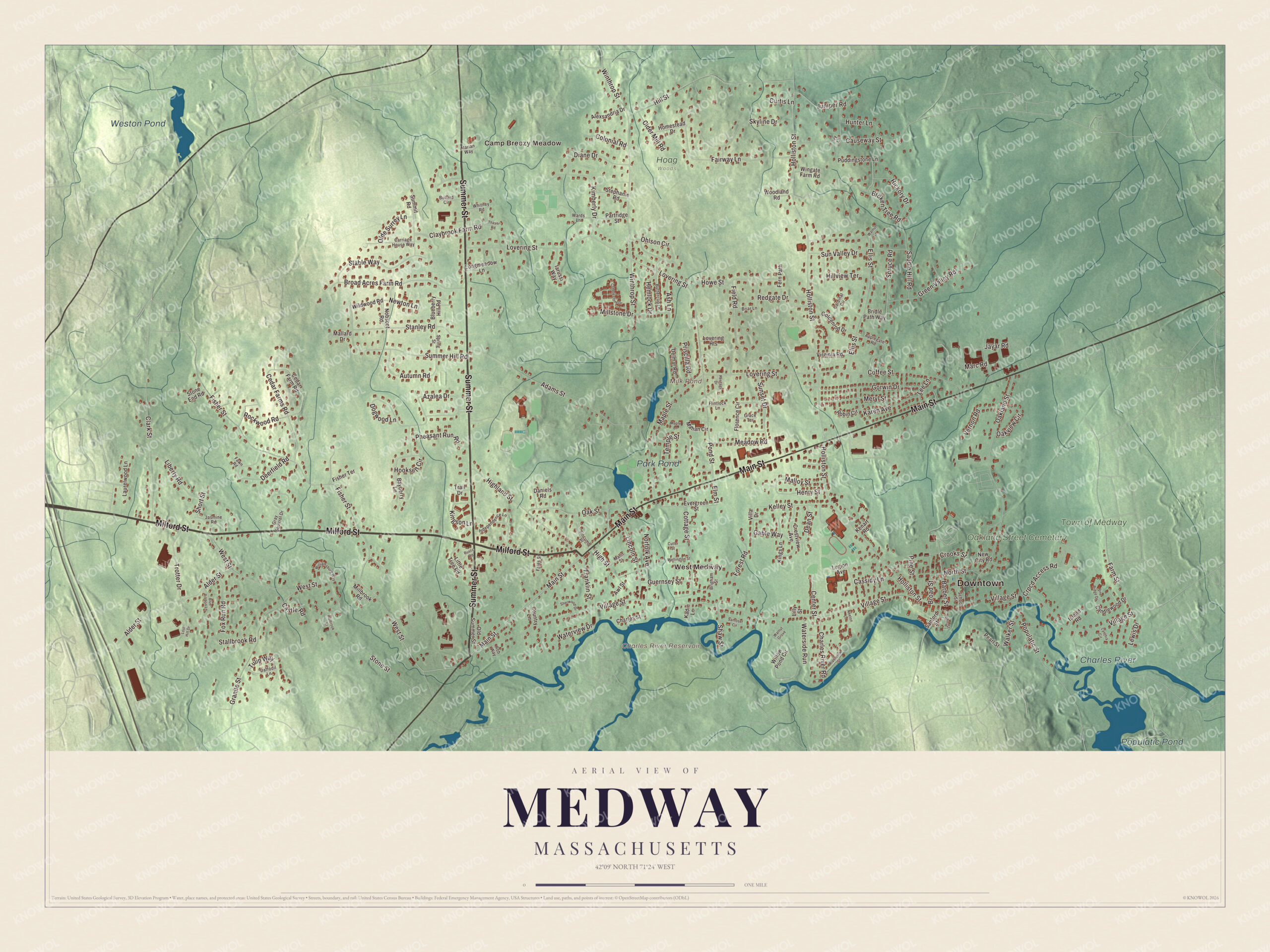
Medway today
By KNOWOL
Main Street, Summer Street, Milford Street, West Street, Hill Street and Franklin Street, with Populatic Pond, Milk Pond, Weston Pond, Park Pond and the Charles River Reservoir, styled after the town plates in an old atlas.6
The history of Medway, Massachusetts
The Medway Colony
In the 1820s a young Scot named Alexander Wright set up carpet looms in a small mill on Chicken Brook in West Medway. He had been making coach lace in Medway since 1820, and he sailed to Scotland for three looms, coming home with two weavers on a ship badly damaged by storms. Peter Lawson, the pattern designer, later remembered ten ingrain looms, one Brussels loom and one finger-rug loom, and called the works the first of its kind in the United States. In 1827 Frederick Cabot, George W. Lyman and Patrick T. Jackson bought the business, and in 1829 everyone who worked there except Burdett moved to Lowell. Lawson called them the Medway Colony. Wright stayed on as agent of the Lowell Manufacturing Company until he died in 1852.783
Factory Village on the Charles
In 1711 Nathaniel Whiting came from Wrentham and built a grist mill at the falls of the Charles, and his family kept the spot until 1864. In 1805 seven partners, among them Philo Sanford, Luther Metcalf and John Blackburn, who had worked for Samuel Slater, joined to spin cotton on the old mill site. Their two-story mill started in March 1807 with 820 spindles, burned in 1811 and ran again by year's end. In 1812 a boom put up three mills, two large tenements and a store, and people began calling the place Factory Village. Captain William Felt kept the first post office in his store from 1803 and began making straw hats in 1810. In 1881 the old cotton mill sold at auction for a dollar and fifty cents, and the Sanford Mills went up in its place.9210
Rabbit Hill and the Second Church
West Medway grew up around its own church. The western precinct gathered the Second Church in 1750 and laid out a burying ground the same year, now the oldest part of Evergreen Cemetery. In 1814 the parish built a new meeting house on Rabbit Hill and, the town's 1913 handbook says, bought its bell from Paul Revere. Timbers from the first meeting house went into a parish house across the way, which became the home of the Medway Historical Society in 1903. In 1822 Charles C. Allen, seventeen years old, made a brass clock that was still keeping time in the meeting house in 1913. Rev. Jacob Ide, installed in 1814, marked fifty years as pastor in 1864. The Rabbit Hill neighborhood joined the National Register in 1988.111213
Medway, Massachusetts through the years
25 moments from 1657 to today.
- 1657European settlement begins on the land west of the Charles that will become Medway.1
- 1659The General Court grants Medfield the New Grant, which takes in West Medway and most of today's Medway.14
- 1670The road that becomes Village Street, long called Old Mendon Road, is laid out.1
- 1711Nathaniel Whiting builds a grist mill at the falls of the Charles.9
- 1713On October 25 the General Court incorporates Medway, a farming town of 233 people.1
- 1750West Medway's Second Church is organized, and its burying ground, now Evergreen Cemetery, is laid out.11
- 1775After the Lexington alarm, Lieutenant Moses Adams marches the West Medway company of 36 men to Roxbury.15
- 1803The first post office opens at Medway Village, in Captain William Felt's store.10
- 1807The Medway Cotton Manufactory starts running in March with 820 spindles.2
- 1810Captain William Felt starts making straw hats, hiring women to sew them.9
- 1812A boom at Factory Village puts up three mills, two large tenements and a store.9
- 1814The Second Church builds a meeting house on Rabbit Hill, with a bell cast by Paul Revere.11
- 1826Alexander Wright and Eben Burdett start ingrain carpet looms in Medway.3
- 1829The carpet workers move to Lowell, remembered there as the Medway Colony.3
- 1838Cephas Thayer builds a stone mill on Chicken Brook out of one huge boulder.7
- 1853The Medway Branch, the town's first railroad, opens with its terminus in Medway Village.16
- 1859The Union Base Ball Club beats Upton's Excelsiors 100 to 78 in a two-day game at Ashland.17
- 1861Fifty-four Medway men leave for Brook Farm and become Company E of the Second Massachusetts.15
- 1869The town officially names its streets, and the Old Hartford Turnpike becomes Main Street.1
- 1872Sanford Hall is dedicated in Medway Village on December 31.18
- 1882The Sanford Mills are finished on the old cotton mill site, and a nine o'clock curfew rings there.9
- 1885East Medway breaks away as the town of Millis.1
- 1887O.H. Bailey publishes his bird's-eye view of Medway.5
- 1896The soldiers' monument is dedicated in Evergreen Cemetery on May 16.19
- 1911Sanford Hall burns with the 10,000-volume Dean Library, and town water is first used.17
Places to see in Medway, Massachusetts
Places worth a visit in Medway today.
- Medway Village Historic DistrictVillage Street, southeastern Medway. Mill village of more than 240 buildings.
- Village StreetAlong the Charles River. The oldest road, laid out in 1670.
- Holliston StreetMedway Village. Meets Village Street at the village center.
- West MedwayWestern part of town. Rabbit Hill, Chicken Brook and the Second Church.
- Chicken BrookWest Medway. Once turned carpet looms and mills.
- Charles RiverSouthern edge of town. Water power for Factory Village.
- Populatic PondMedway and Millis line. A widening of the Charles River.
- Main StreetThrough West Medway. The Old Hartford Turnpike until 1869.
Medway on the National Register of Historic Places
All 3 places in Medway on the National Register of Historic Places that still stand today, oldest first, and why each one matters.4
-
Evergreen Cemetery
Founded in 1750 by Medway's western precinct on a half acre bought from Henry Guernsey, and enlarged to about 13 acres by 1876. Its oldest section, on a small hill, holds at least 50 stones cut by the regional carver Joseph Barbur Jr., who is buried here, along with veterans of the Revolution and the Civil War.12
-
Rabbit Hill Historic District
About 40 acres of the 19th-century village that grew up around the Second Congregational Church, now the West Medway Community Church, with mills along the Charles River just outside it. Most of its houses are Federal or Greek Revival.13
-
Medway Village Historic District
The industrial village that grew up around the textile mills on the Charles River from the late 1700s through most of the 1800s. It covers 60 acres and more than 240 historic buildings, most of them built between 1831 and 1897.20
Medway in their words
“West Medway, extensively engaged in the manufacture of shoes, is one of the prettiest of New-England villages.”
A gazetteer of the state of Massachusetts, 187421
“From the cotton-mill of Medway, it is said, 'graduated many of the men who were to lay the foundations of Lowell, Manchester, and other manufacturing places, and build for themselves colossal fortunes.'”
History of Norfolk County, Massachusetts, 18842
“Our old town lies beneath the hill, Its shady streets are wide and still.”
Rev. J. O. Knowles, verse printed at the front of The handbook of Medway history, 191322
Towns near Medway, Massachusetts
Sources for the history of Medway
- Medway, Massachusetts, Wikipedia
- History of Norfolk County, Massachusetts (1884), on the Medway Cotton Manufactory, Internet Archive
- Illustrated History of Lowell and Vicinity, Massachusetts (1897), Peter Lawson on the Medway Colony, Internet Archive
- National Register of Historic Places listings in Norfolk County, Massachusetts, Wikipedia
- Beautifully detailed map of Medway, Massachusetts from 1887, restored by KNOWOL
- Map of Medway, Massachusetts in 2026, KNOWOL
- The handbook of Medway history (1913), on the carpet mill and the stone mill on Chicken Brook, Internet Archive
- Historic homes and places and genealogical and personal memoirs relating to the families of Middlesex County, Massachusetts (1908), on Alexander Wright, Internet Archive
- The handbook of Medway history (1913), on Whiting's mill, Factory Village and the Sanford Mills, Internet Archive
- History of Norfolk County, Massachusetts, 1622-1918 (1918), on Medway's first post office, Internet Archive
- The handbook of Medway history (1913), on West Medway's Second Church and Rabbit Hill, Internet Archive
- Evergreen Cemetery, Wikipedia
- Rabbit Hill Historic District, Wikipedia
- The handbook of Medway history: a condensed history of the town of Medway, Massachusetts (1913), by Orion T. Mason, on the early land grants, Internet Archive
- The military history of Medway, Mass. 1745-1885 (1886), Internet Archive
- History of Norfolk County, Massachusetts (1884), on Medway's first railroad, Internet Archive
- The handbook of Medway history (1913), on the ball club of 1859 and the Sanford Hall fire of 1911, Internet Archive
- History of Norfolk County, Massachusetts (1884), on Sanford Hall, Internet Archive
- Monuments, tablets and other memorials erected in Massachusetts to commemorate the services of her sons in the war of the rebellion (1910), Internet Archive
- Medway Village Historic District, Wikipedia
- A gazetteer of the state of Massachusetts (1874), Internet Archive
- The handbook of Medway history (1913), verse by Rev. J. O. Knowles, Internet Archive