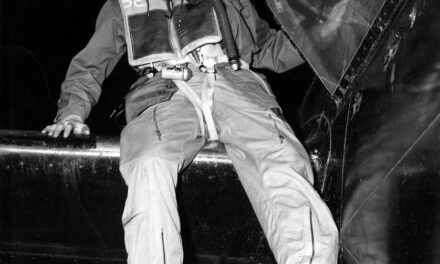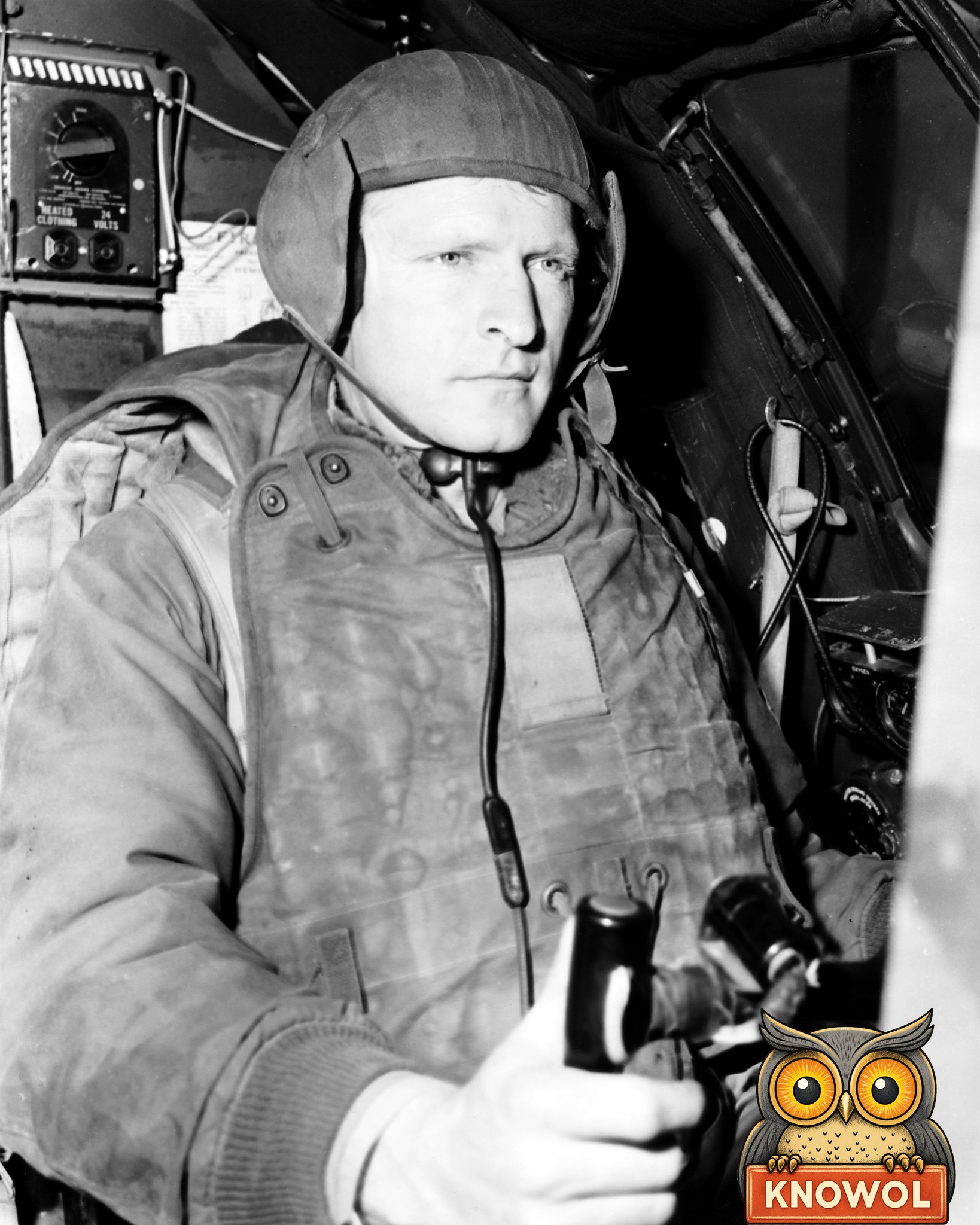
Captain Melvin E. Jarvis of Salt Lake City, Utah, at the controls of his B-29 before a mission over North Korea, May 1951. U.S. Air Force photo, National Archives. Click the photo to see it larger. The KNOWOL logo doesn’t appear on prints.
This U.S. Air Force photo was taken in May 1951 in the cockpit of a B-29 Superfortress bomber on Okinawa. The pilot is Captain Melvin E. Jarvis of Salt Lake City, Utah, and he’s about to take off on a mission against Communist positions in North Korea. The Air Force’s caption calls him “normally a good-sized man” who “looks gigantic” in the more than 105 pounds of flight gear he needed for a combat mission.
What to Look For
Jarvis wears a cloth flying helmet with flaps over his ears. At his throat, the two small round pickups of a throat microphone press against his neck, and their cord runs down the front of a heavy padded vest. The vest closes with snaps at the shoulder, over a jacket with knit cuffs, and his bare right hand grips a black control handle. On the wall behind him, a panel marked “HEATED CLOTHING 24 VOLTS” has a dial and two outlets, where crewmen plugged in electrically heated flying clothes. A paper notice is tacked up beside it, and the frames of the cockpit windows rise at the right.
From Florida to Okinawa
Jarvis flew with the 307th Bomb Group, a Strategic Air Command unit based at MacDill Air Force Base, Florida. North Korea invaded South Korea on June 25, 1950, and the group’s orders to move to the Far East went out on August 1. Its B-29s began landing at Kadena Air Base on Okinawa within days, and on August 8 the group flew its first mission, against the rail yards at Pyongyang. Kadena’s tent city grew more and more crowded, and its base staff had to manage the traffic of nearly 100 four-engine bombers.
The B-29 was designed in 1940 to outclass the B-17 and B-24, the heavy bombers of its day. Fully loaded, it weighed 140,000 pounds and could carry as much as 20,000 pounds of bombs, and its wings spanned 141 feet. Its crew of eleven rode in three pressurized compartments joined by crawl spaces. The pilot sat in the front one, with the copilot, navigator, bombardier and radar operator.
May 1951: The Spring Offensive
On the night of April 22, 1951, Communist forces launched a massive spring offensive. In early May, the B-29s bombed rail and highway bridges, airfields, and supply and troop centers in North Korea. On the night of May 15, the Communists opened the second phase of the offensive against South Korean troops in the east. They attacked only at night, because of the air attacks they faced by day.
Bomber Command, which ran the B-29s for the Far East Air Forces, then turned nearly its entire effort to close air support, bombing enemy troops near the front lines. From May 17 to 22, the B-29s flew 94 sorties against enemy ground forces, most of them at night. That was far more close support than they’d flown in any stretch of the war so far. Since early 1951, radar units on the ground had guided the bombers to the point where they should drop their bombs over enemy positions. By the end of May, UN forces had pushed the front 15 to 30 miles north. The Archives dates this photo only to May 1951, and its record doesn’t name the mission Jarvis was about to fly.
The MiGs
Over North Korea, the B-29s also faced the MiG-15, a Soviet-built jet fighter. On April 12, 1951, between 100 and 125 MiGs met 46 B-29s attacking the Yalu River bridge at Sinuiju, shot down three bombers and damaged seven more. Five months after this photo, the 307th flew into one of the bloodiest air battles of the war. On October 23, 1951, eight of its B-29s flew to bomb Namsi airfield in North Korea and met about 50 MiGs.
The MiGs fatally damaged the lead bomber, but its aircraft commander, Captain Thomas L. Shields, still bombed the target before heading for the coast. His efforts let his crew bail out, but he lost his own life. In a twenty-minute fight, the 307th lost three B-29s, and most of the others came home badly damaged, with dead or wounded men aboard. In November 1951, the Air Force’s top general, Hoyt Vandenberg, backed Bomber Command’s move to bombing at night.
What the War Cost
The armistice that stopped the fighting was signed on July 27, 1953. By then, Bomber Command’s B-29s had flown about 21,000 sorties and dropped 167,000 tons of bombs, flying almost every day of the war. More than 6,000 men flew on its combat crews. Of them, 635 were killed or missing, 96 came home wounded, and more than 100 were taken prisoner and released in 1953.
About This Photo
- Archive title: “CLAD IN HIS ARMOR. Normally a good-sized man, Captain Melvin E. Jarvis, 1318 Roberta Street, Salt Lake City, Utah, pilot of a B-29 “Superfort” of the 307th Bomb Group, based on Okinawa, looks gigantic after donning over 105 pounds of flight gear necessary for combat missions. Captain Jarvis is shown at the controls of his B-29 just prior to take-off on a mission on Communist positions in North Korea.”
- Date: May 1951 (the Archives gives the month only)
- Place: Okinawa, where the 307th Bomb Group flew from Kadena Air Base
- Photographer: Not named, U.S. Air Force
- Collection: Photographs of Activities, Facilities and Personnel, Records of U.S. Air Force Commands, Activities, and Organizations (Record Group 342), National Archives at College Park, Maryland
- Photo number: 342-FH-4A(29066), National Archives Identifier 542352. The Archives holds it as a photographic print.
- Rights: Public domain, a work of the U.S. government
- Restoration: KNOWOL, 2026, from the Archives’ highest resolution scan
KNOWOL prints this restored photo on luster photo paper in 8 x 10 and 16 x 20 inch sizes, plain or in a black or white wood frame. Click here to get your copy of the B-29 pilot on Okinawa photo.

Sources
- National Archives catalog, 342-FH-4A(29066)
- A. Timothy Warnock, editor, The United States Air Force in Korea: A Chronology, 1950-1953 (Air Force History and Museums Program, 2000)
- Steadfast and Courageous: FEAF Bomber Command and the Air War in Korea, 1950-1953 (Air Force History and Museums Program, 2000)