On the evening of Tuesday, November 17, 1896, the clouds hung low over Sacramento, California. On the east side of town, a light so bright came through people’s windows that some of them ran to look, thinking a neighbor’s house was on fire. What they saw was a white light moving slowly over the rooftops. The next morning the San Francisco Call ran the story under the headline “Claim They Saw a Flying Airship.” Residents said it was an airship “which, seemingly under perfect control, passed over the city, going in the direction of San Francisco.”
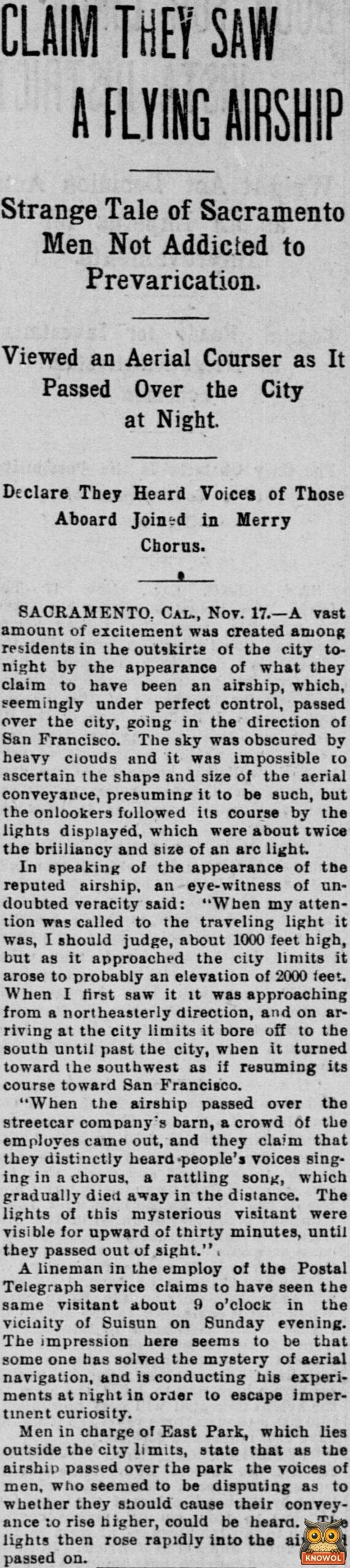
“Claim They Saw a Flying Airship,” the San Francisco Call, November 18, 1896, page 3. Library of Congress, Chronicling America. Click the clipping to read it full size.
A song in the clouds
Witnesses said the light was about twice the size and brightness of an arc light, the big electric lamps that lit city streets. When it passed over the streetcar company’s barn, the workers ran outside, and they said they “distinctly heard people’s voices singing in a chorus, a rattling song, which gradually died away in the distance.” The light stayed in sight for about half an hour.
Four men on the wheels
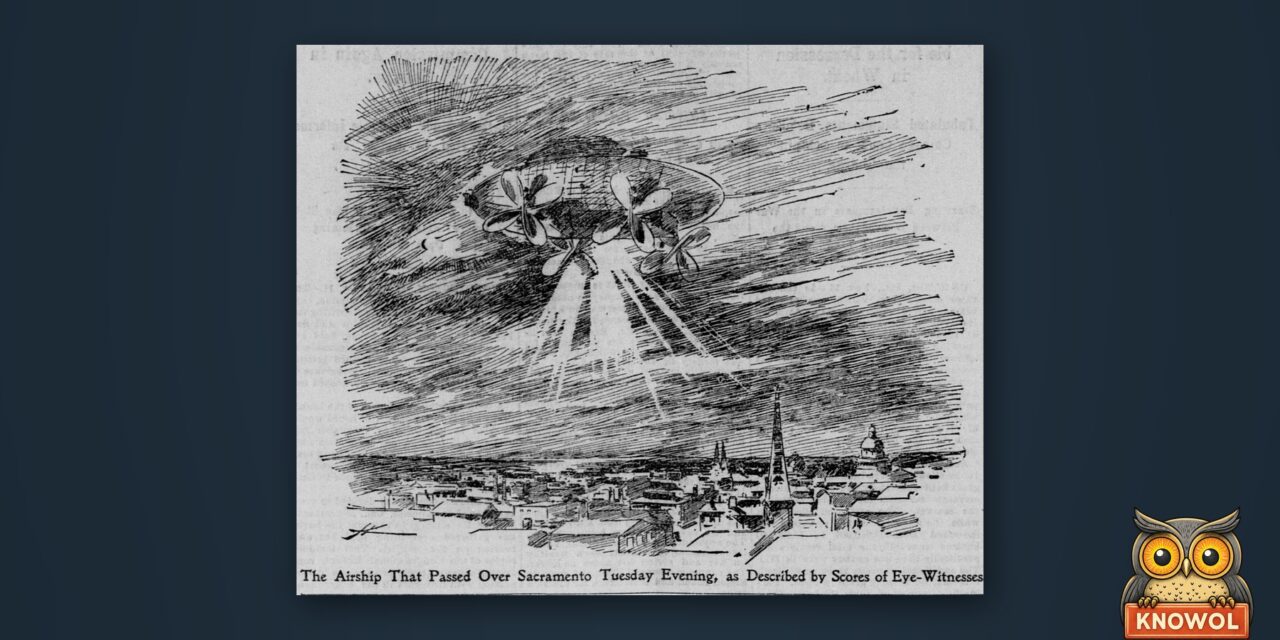
The next day, the Call put the airship across its front page with a big drawing, “as Described by Scores of Eye-Witnesses.” People described an egg-shaped body with fan-like wheels on each side and a searchlight hanging underneath. One man, R. L. Lowry, said he could make out four men turning the wheels, working away like bicycle riders pedaling down a boulevard.
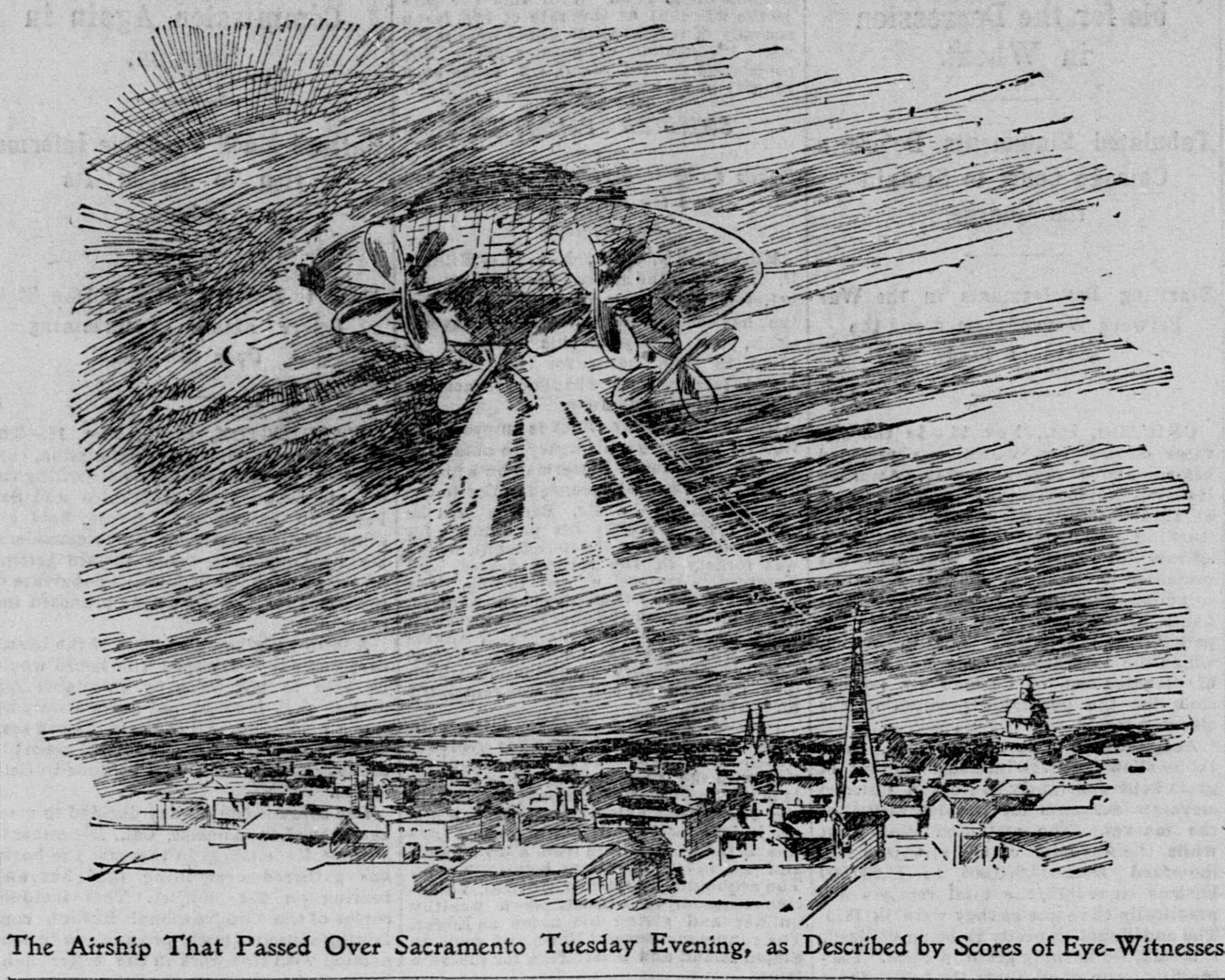
“The Airship That Passed Over Sacramento Tuesday Evening, as Described by Scores of Eye-Witnesses,” the San Francisco Call, November 19, 1896, page 1. Library of Congress, Chronicling America. Click the picture to see it full size.
A horse trainer at Agricultural Park said he heard a voice up there say the ship was too low and to send her up higher. The Sacramento Evening Bee, quoted in the same story, had voices in the sky calling out as the light dipped toward the housetops: “Lift her up, quick; you are making directly for that steeple.” On the line out to Oak Park, a motorman stopped his crowded streetcar so his passengers could listen.
“Have you seen the airship?”
Two days later, it was still almost all anyone in Sacramento talked about. The Call reported that “the leading greeting is: ‘Have you seen the airship?'” People who had missed it laughed it off and blamed toy balloons or birds with lanterns tied on.
The lawyer and the man from Oroville
Soon people were reporting the light over Oakland, San Jose, Berkeley and Chico. Then, on November 23, a lawyer from Alameda named George D. Collins told the Call that his client had built the airship. The inventor, he said, was a wealthy man from Oroville, about 47 years old. Collins admitted he laughed out loud the first time the man said the word “airship,” and he told the reporter what he had asked him: “What kind of whisky have you been drinking?” By November 25, a former state attorney general, W. H. H. Hart, had taken over the case, and he said the airship would be used to help the rebels fighting Spain in Cuba. Hart admitted he had never seen it himself, and nobody ever showed the machine.
The night Venus fooled San Francisco
Around 6 o’clock on the evening of November 24, a cry went up on Market Street in San Francisco that the airship’s light was in the western sky. Crowds gathered on the corners. Society people came out on the California Street hill in elegant wraps, some with lorgnettes, the little eyeglasses on a handle, while down at the waterfront people brought out binoculars. It was the planet Venus. Professor Davidson got out his telescope that night and knew it right away. “It is safe to assume that Venus has been acting just as she did last night for many years past,” the Call said, “but never before, as far as can be learned, has she been mistaken for an airship.”
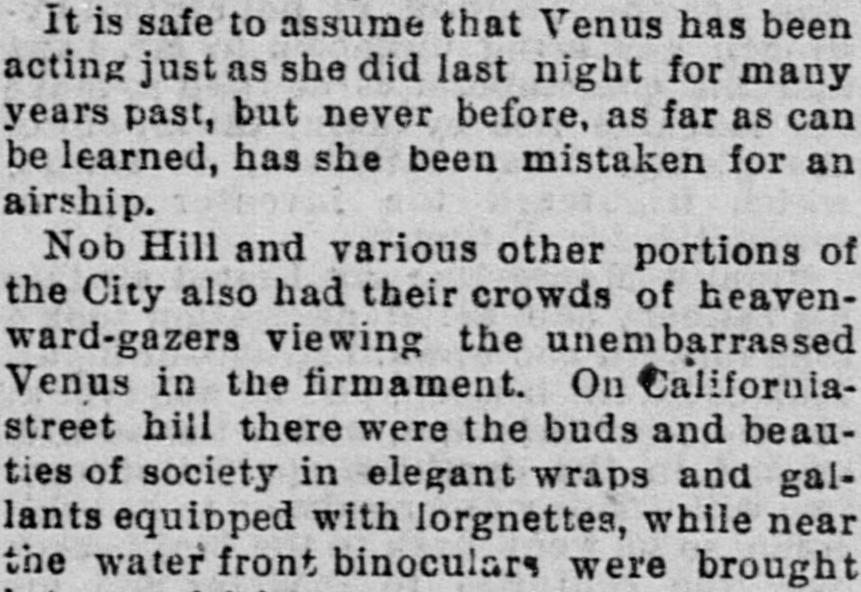
The San Francisco Call, November 25, 1896, page 1. Library of Congress, Chronicling America. Click the clipping to read it full size.
The airship heads east
By spring, the airship had moved on. In April 1897, newspapers from Nebraska and Kansas to Illinois and Wisconsin filled up with reports of a mystery light in the night sky. On the night of April 11, thousands of people in Chicago stood in the streets and on the housetops staring at a light they called the Kansas airship. An astronomer at Northwestern said it was a bright star. A Chicago paper still reported that the airship was thought to have started out from California.
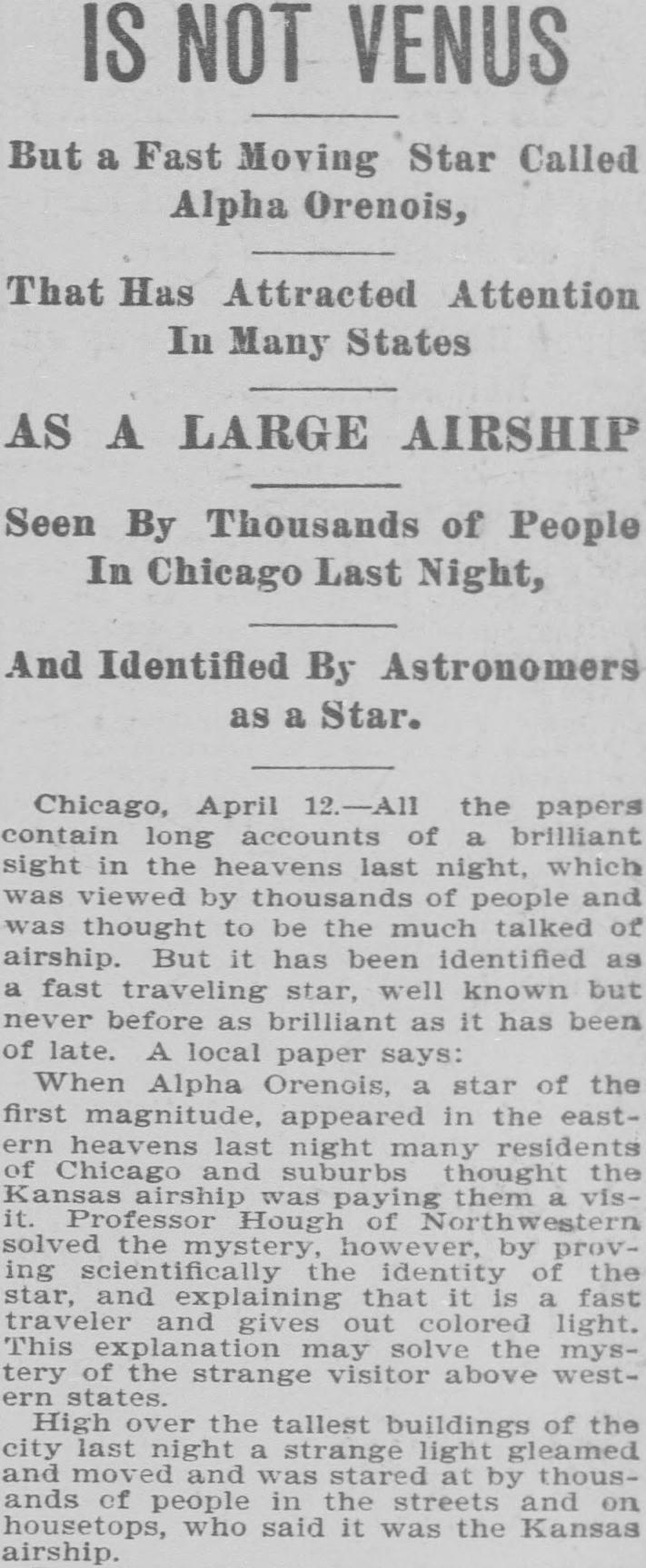
The Topeka State Journal, Topeka, Kansas, April 12, 1897, page 1. Library of Congress, Chronicling America. Click the clipping to read it full size.
The machine nobody ever showed
No airship ever landed in Sacramento, and neither lawyer ever produced the man from Oroville or his machine. Seven years later, on December 17, 1903, the Wright brothers made the first powered airplane flight, at Kitty Hawk, North Carolina. It lasted twelve seconds and covered 120 feet, in broad daylight.
Sources
- The San Francisco Call (San Francisco, Calif.), November 18, 1896, page 3, November 19, 1896, page 1, November 20, 1896, page 1, November 23, 1896, page 1 and November 25, 1896, page 1.
- The Topeka State Journal (Topeka, Kan.), April 12, 1897, page 1, quoting the Chicago Times-Herald.
- Library of Congress, Chronicling America search for “airship seen,” April 1 to 20, 1897 (322 pages).
- Smithsonian National Air and Space Museum, 1903 Wright Flyer, for the date of the first flight.
- All newspaper images, including the 1896 drawing: Library of Congress, Chronicling America. No known copyright restrictions.
- Cover: “The Airship That Passed Over Sacramento Tuesday Evening, as Described by Scores of Eye-Witnesses,” the San Francisco Call, November 19, 1896, page 1. Library of Congress, Chronicling America.