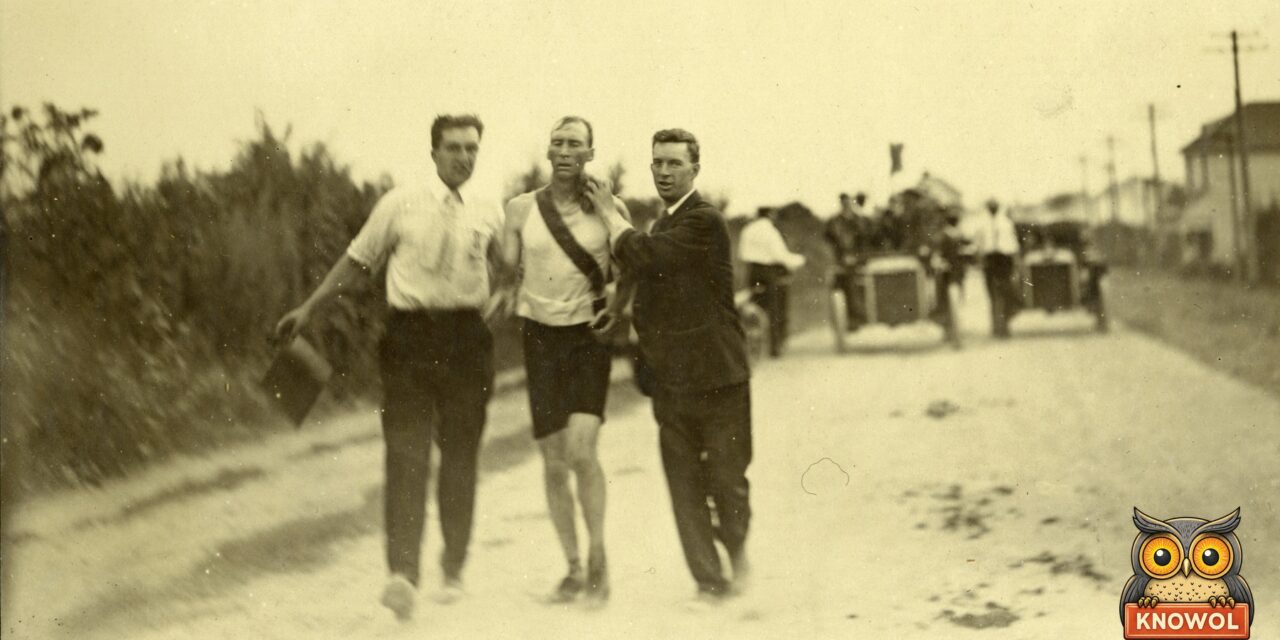
At 3 o’clock on the afternoon of Tuesday, August 30, 1904, the president of the World’s Fair fired a starting gun inside the Olympic stadium in St. Louis, Missouri, and 31 runners set off on the Olympic marathon. It was the hottest day in weeks. Ahead of them lay about 25 miles of country roads that, one St. Louis paper said later, “were inches deep in dust, covered with cracked stones for six miles.”
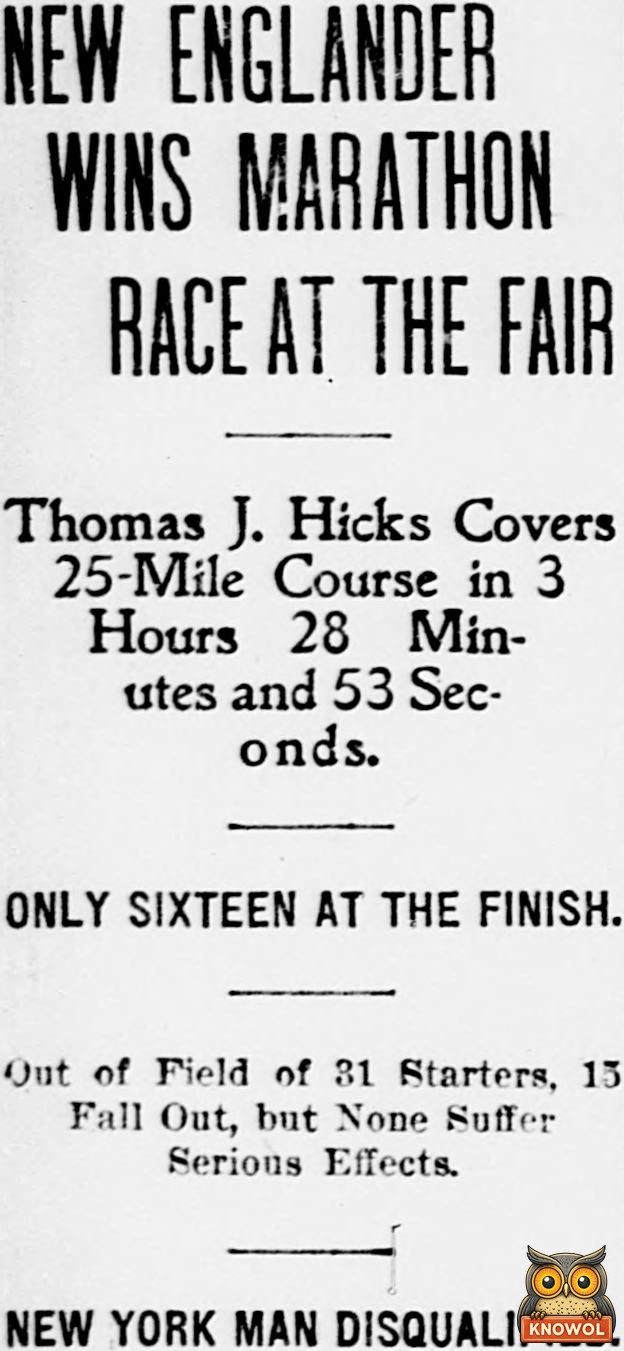
“New Englander Wins Marathon Race at the Fair,” St. Louis Republic, St. Louis, Missouri, August 31, 1904, page 1. Library of Congress, Chronicling America. Click the clipping to read it full size.
Officials, reporters and doctors followed in automobiles, and their wheels kicked up even more dust. Runners started dropping out. One of them, William Garcia of San Francisco, was found about four miles from the fairgrounds “lying by the roadside, bleeding and in an unconscious condition.” A couple following the race in their own automobile lifted him in and raced him back to the fairgrounds for help. By that night he was out of danger.
The first man home
More than three hours after the start, the crowd jumped up. A runner was coming into the stadium. Fred Lorz of New York “finished amid the cheers of the crowd,” the St. Louis Republic reported, “but after he had crossed the tape, he was disqualified by the judges for having rode four miles on an automobile.”
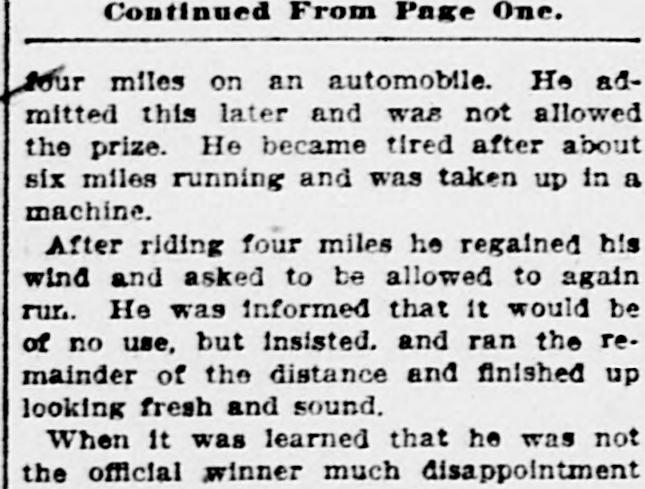
How Fred Lorz finished first, St. Louis Republic, August 31, 1904, page 5. Library of Congress, Chronicling America. Click the clipping to read it full size.
Lorz had worn out after about six miles and “was taken up in a machine.” After riding four miles, “he regained his wind and asked to be allowed to again run.” He finished “looking fresh and sound.” Nobody could agree on how far he rode. The Associated Press said he “coolly announced that he rode half a mile,” and another report said about three miles.
Strychnine and the white of an egg
The real winner was Thomas J. Hicks of Cambridge, Massachusetts, and he barely made it. The next spring, the St. Louis Republic printed what his helpers had done. “At twenty-one miles Hicks wanted to ‘lay down,'” it said, and they knew that if he sat down, he’d never get up. So they slowed him to a walk and sponged him with hot water. “One-sixtieth of a grain of sulphate of strychnine was given by the mouth, and the white of one egg.” Two miles later he got “more sponging, strychnine, egg and brandy.” Strychnine is a poison, but in tiny doses doctors of the day used it as a stimulant.
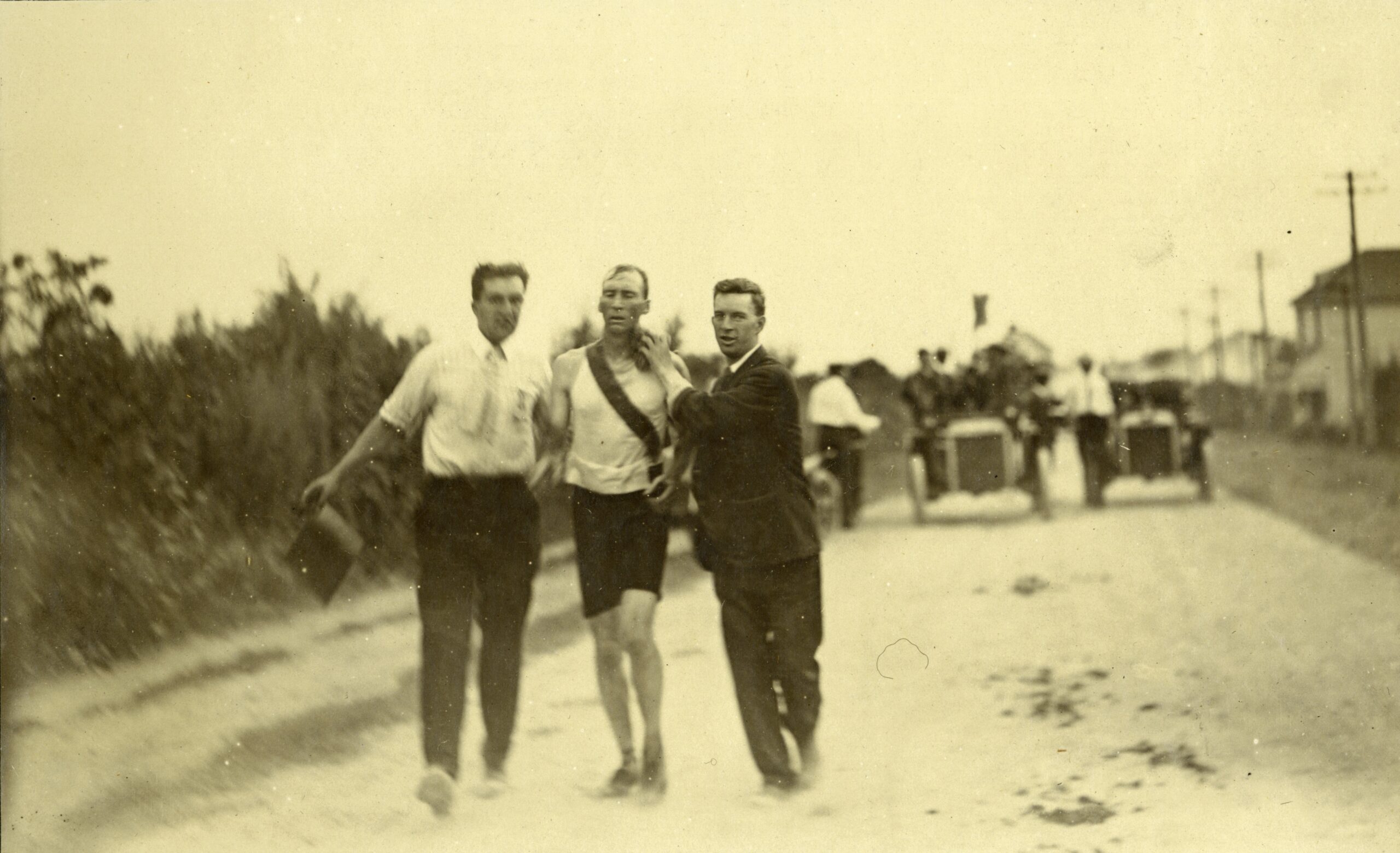
Thomas J. Hicks of Cambridge, Massachusetts, “being sponged by attendants” on the course, with automobiles following behind, August 30, 1904. Photograph by Jessie Tarbox Beals. Missouri Historical Society, via Wikimedia Commons (public domain). Click the picture to see it full size.
Hicks kept going, and he kept thinking about food. About three miles from the finish he told his trainer, “Do me a favor. When we get to the grounds have a big meal ordered for me.” He crossed the line in 3 hours, 28 minutes and 53 seconds. “I lost ten pounds as it was,” he said afterward, “and you can see that I could not push myself any faster and lose more.”
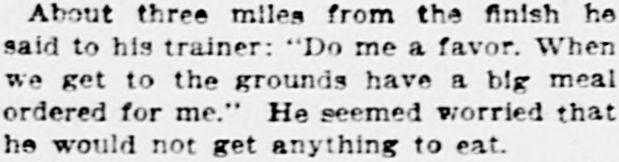
Hicks’s request, St. Louis Republic, August 31, 1904, page 5. Library of Congress, Chronicling America. Click the clipping to read it full size.
The runner in street shoes
Felix Carvajal of Cuba ran in “a faded pongee shirt, trousers cut at the knees and low-cut street shoes with high heels,” the Associated Press reported. He “won the sympathy of the crowd in the Stadium and raised his hat each time he passed the stand,” the Republic said. He finished fourth.
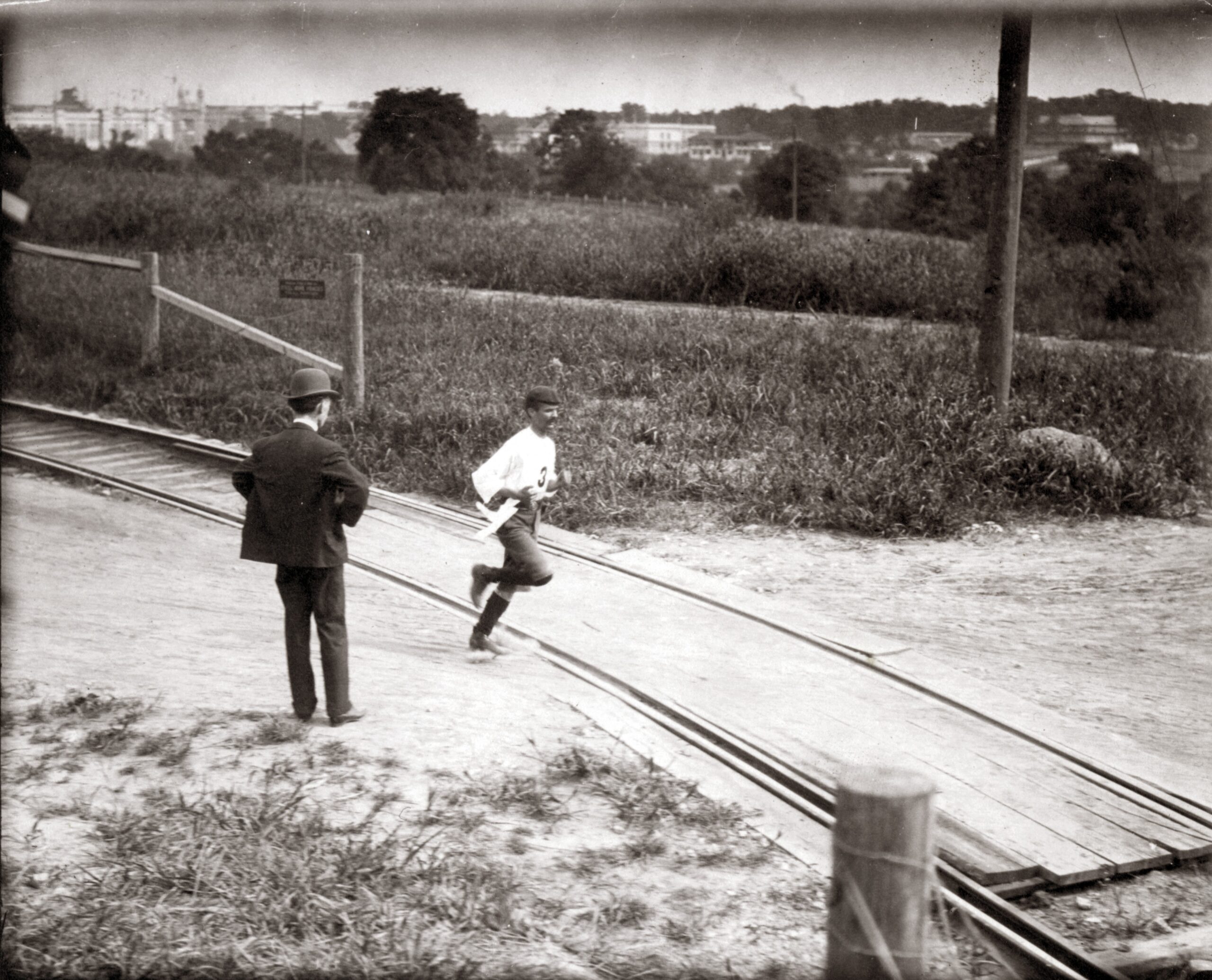
Felix Carvajal of Cuba, running in street shoes and cut-off trousers, crosses the railroad tracks during the 1904 Olympic marathon. Missouri Historical Society, via Wikimedia Commons (public domain). Click the picture to see it full size.
In 1906, the New York sportswriter Robert Edgren told a story about that run. Carvajal hadn’t eaten in two days, he wrote, and “a few miles out, saw an orchard.” Then “over the fence he climbed, and for a space of many minutes he stuffed himself with fruit.” The Evening World ran it under the heading “Stopped to Eat Apples.”
Pay again to stay
People who sat through the whole race didn’t get to see the end of it. After the first three men finished, a “barker” ordered everyone out of the stadium and announced “that those wishing to remain in their seats would have to purchase tickets at the box office.” The Republic said those who wouldn’t pay again “were cheated out of seeing the result of one of the greatest athletic contests in the world.”
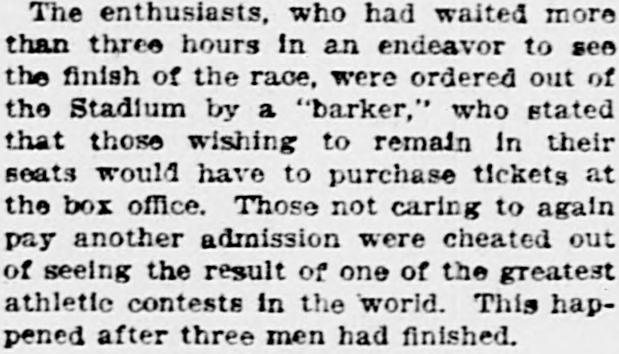
St. Louis Republic, August 31, 1904, page 5. Library of Congress, Chronicling America. Click the clipping to read it full size.
What came next
Eight months later, on April 19, 1905, Fred Lorz ran the Boston Marathon. He won it in 2 hours, 38 minutes and 25 2-5 seconds.
Carvajal kept running, too. In the spring of 1906, Cuba picked him again, for the Olympic games in Athens. As the Evening World put it, “The Government is sending Felix Carvajal this time, with a trainer and plenty to eat.”
Sources
- The St. Louis Republic (St. Louis, Mo.), “New Englander Wins Marathon Race at the Fair,” August 31, 1904, page 1, continued on page 5.
- The Washington Times (Washington, D.C.), Associated Press report, August 31, 1904, page 10.
- Burlington Weekly Free Press (Burlington, Vt.), “Great Marathon Race,” September 1, 1904, page 6.
- The St. Louis Republic (St. Louis, Mo.), “Marathon Race Last Summer Run Under Adverse Conditions,” April 2, 1905, page 35.
- New-York Tribune (New York, N.Y.), “Lorz Wins Race,” April 20, 1905, page 7.
- The Evening World (New York, N.Y.), Robert Edgren, “Cuba Well Represented,” March 24, 1906, page 8.
- All newspaper images: Library of Congress, Chronicling America. No known copyright restrictions.
- Cover: Jessie Tarbox Beals’s photograph of Thomas J. Hicks on the course, Missouri Historical Society, via Wikimedia Commons. Public domain.
- Photographs: Missouri Historical Society, “T.J. Hicks … being sponged by attendants” and “Felix Carbajal de Soto of Cuba … running in street shoes and street clothes”, via Wikimedia Commons. Public domain.