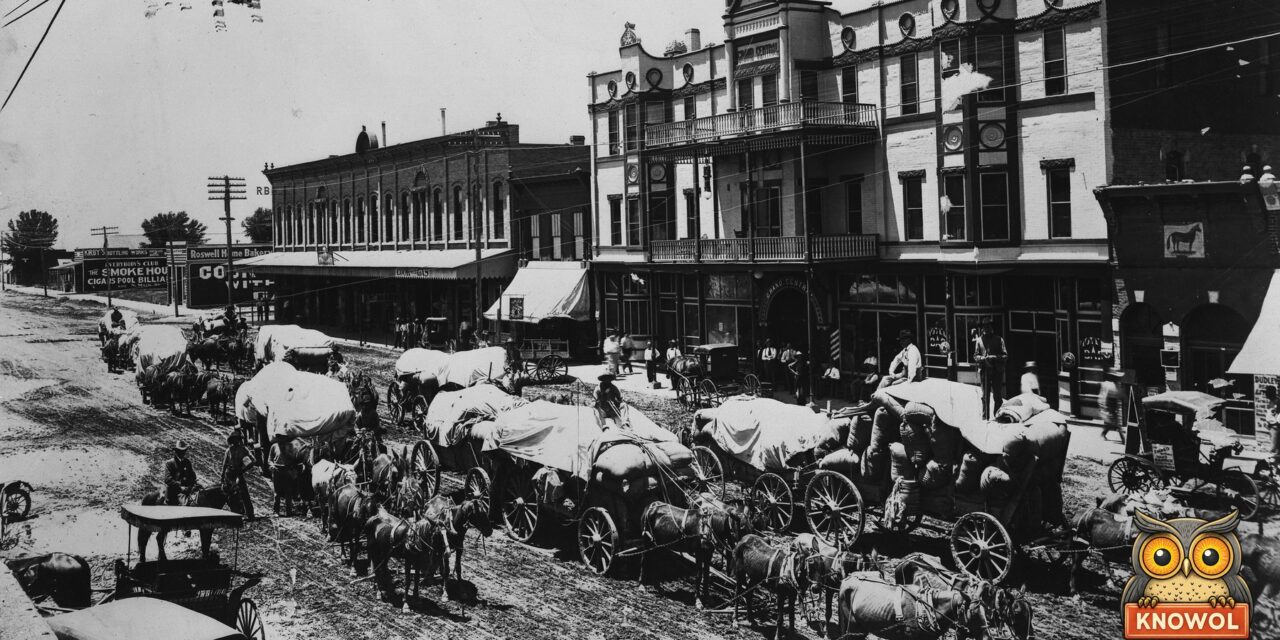
Every morning in the spring of 1904, boys on horseback rounded up the town’s cows in Roswell, New Mexico and drove them through the streets to pasture outside town. Every afternoon they drove them home again. Along the way the cows found the new lawns and young trees that people had just planted, and one reader of The Roswell Daily Record had seen enough.
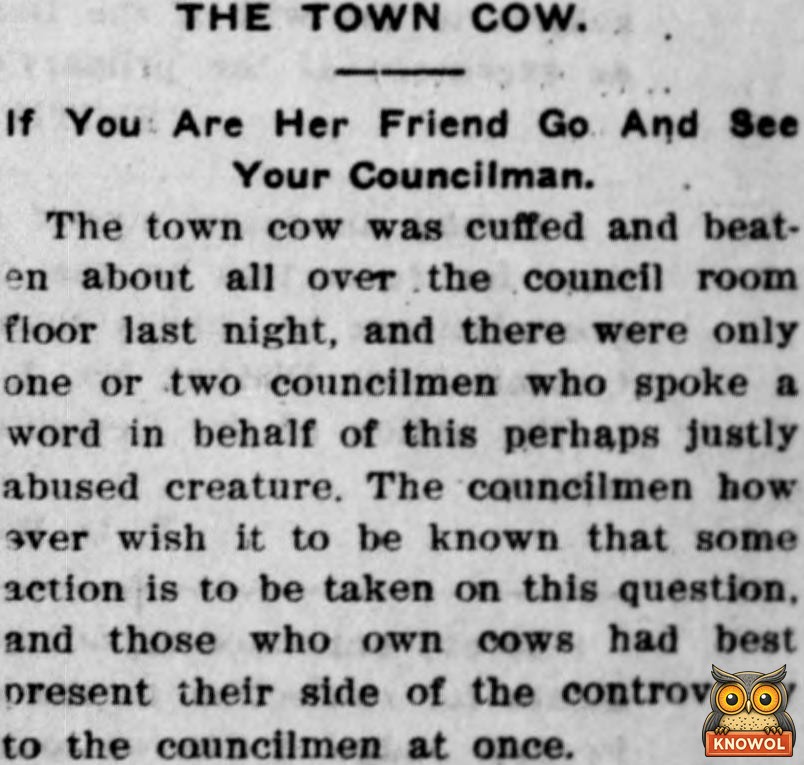
“The Town Cow,” The Roswell Daily Record, Roswell, New Mexico, May 4, 1904, page 1. Library of Congress, Chronicling America. Click the clipping to read it full size.
Shade trees or cows
On April 30, a letter signed “Citizen” asked the editor to open his “Kicker Kolumn” and “give the people a chance to kick the town cow.” The cows, he wrote, “seem to think shade trees were planted especially for the purpose of being destroyed by them,” and “thousands of nice young shade and fruit trees” had gone in that year. Roswell already had a law that kept the old hen from dusting herself in the street, and one against cows running loose. But if a boy ran a cow through your garden, he complained, you’d need a lawyer and “your wife in court as a witness” to do anything about it.
He ended with a choice. “The question is squarely up to us. Shade trees or cows. We cannot have both on the same streets. As for my part, I will take the trees and keep my cow in the lot.”
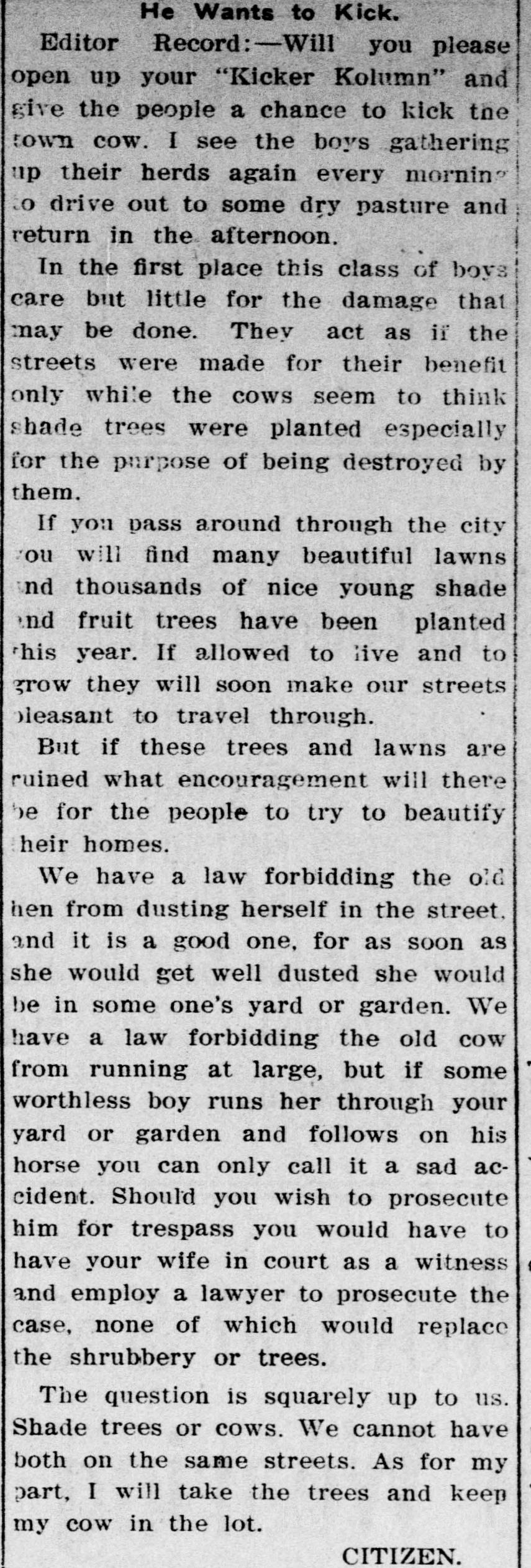
“He Wants to Kick,” a letter signed Citizen, The Roswell Daily Record, Roswell, New Mexico, April 30, 1904, page 4. Library of Congress, Chronicling America. Click the clipping to read it full size.
Cuffed and beaten about
The city council met three days later. The Record called it “the longest session held for many moons,” and the aldermen didn’t go home until 12:37 in the morning. Among the business was a petition, signed by nearly every businessman in town, asking for protection “against the depredations of the town cow, and loose stock.” Aldermen Wyllys and Ogle were told to draw up an ordinance.
The next day’s Record put it this way: “The town cow was cuffed and beaten about all over the council room floor last night, and there were only one or two councilmen who spoke a word in behalf of this perhaps justly abused creature.” The headline gave her friends some advice: “If You Are Her Friend Go And See Your Councilman.”
Led, not driven
On May 5 the editor took the side of the trees, gently. “Roswell has ceased to be a village, and it is time for her to put aside village ways,” he wrote. “It was not long ago that the beef steer and his sister could roam at will through the streets and by-ways of the village and do little damage.” Now there were lawns, flowers and good streets to protect. “The town cow it seems must go and when she goes she must be led through the streets and not driven.”
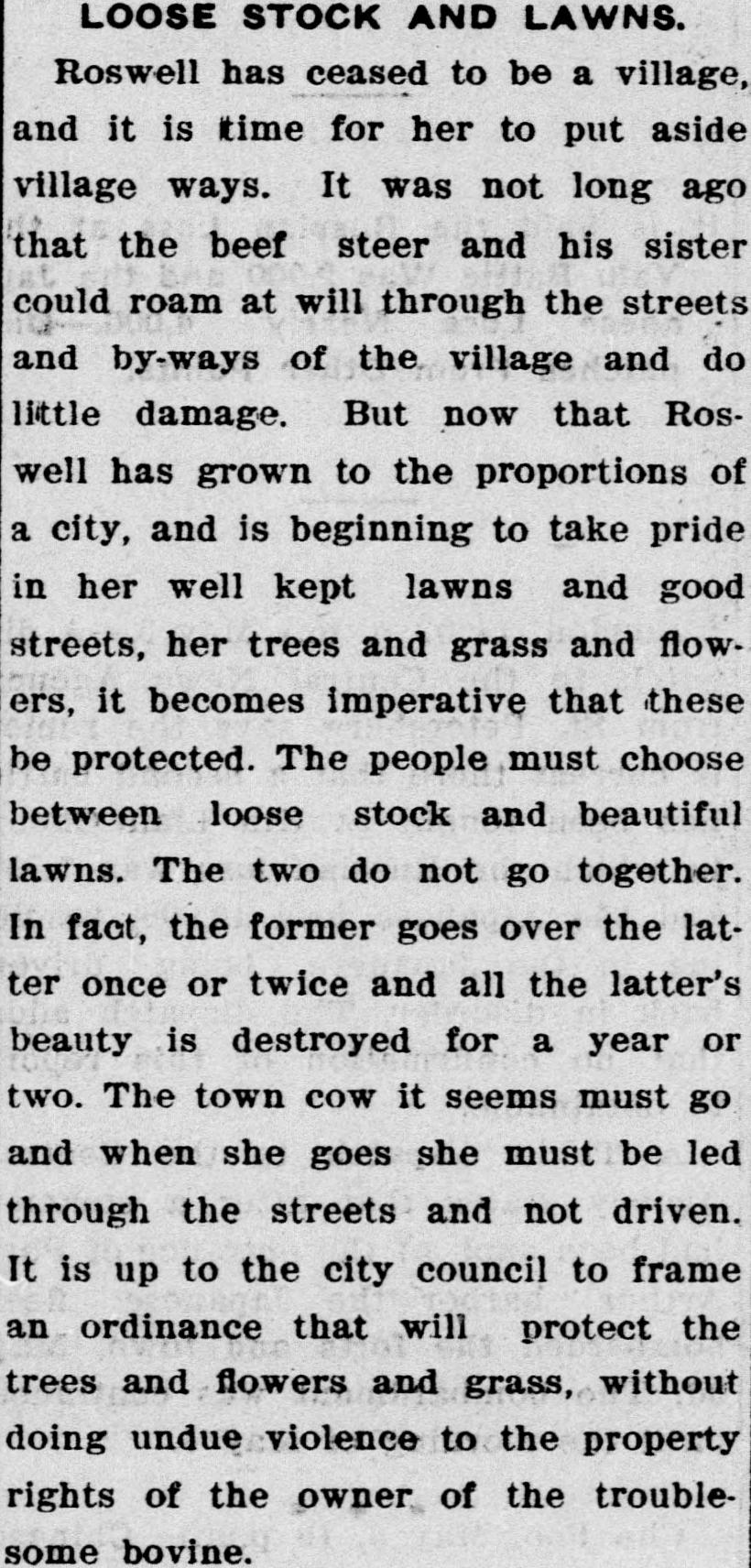
“Loose Stock and Lawns,” The Roswell Daily Record, Roswell, New Mexico, May 5, 1904, page 2. Library of Congress, Chronicling America. Click the clipping to read it full size.
Fifty cents a day at the pound
In June the council published Ordinance No. 212, which changed the city’s law on animals running at large and set what the pound keeper could charge: “fifty cents per day for each horse, mule or neat cattle and twenty-five cents per day for each burro, goat, sheep or hog.” Neat cattle simply meant cows and oxen. Any animal “fed night and morning” counted as a full day, and the owner paid another fifty cents just for the impounding. In August the council passed one more ordinance “relative to live stock running at large on the streets.”
A cow thrown in
Getting the cows off the streets didn’t mean getting rid of them. They gave the town its milk. The same June 14 paper that printed the ordinance carried a rental ad for a “Seven room house, furnished, cow thrown in.” In July, George M. Slaughter advertised a “Fresh Jersey cow for sale. Gives three gallons.”
Other New Mexico towns had the same quarrel. In 1906 the Clayton Enterprise reported, “The town cow now wears the smile that won’t come off.” The next year the Alamogordo News put its foot down: “The town cow has no physical or moral right to prowl our streets. We can’t keep trees growing and at the same time accommodate the town cow.”
Some kind words
By August the Record had softened. “The cow is a much abused creature, and the town cow in particular is the target of much municipal legislation and individual execration,” it wrote. “When she tramples green lawns, and destroys young growing trees she is indeed a nuisance. But after all she is most useful and helpful, and deserving at least now and then some kind words.” Then it reprinted an auctioneer’s long speech in praise of the cow, which was more than most councilmen had offered her that spring.
Sources
- The Roswell Daily Record (Roswell, New Mexico), April 30, 1904, page 4 (“He Wants to Kick”), May 4, 1904, page 1 (council report and “The Town Cow”), May 5, 1904, page 2 (“Loose Stock and Lawns”), June 14, 1904, page 3 (Ordinance No. 212 and the “cow thrown in” ad), July 8, 1904, page 4 (Jersey cow ad), August 3, 1904, page 1 (council report) and August 5, 1904, page 2 (“The Helpful Cow”).
- Clayton Enterprise (Clayton, New Mexico), September 14, 1906, page 1.
- The Alamogordo News (Alamogordo, New Mexico), June 15, 1907, page 2.
- All newspaper images: Library of Congress, Chronicling America. Published 1904 to 1907, public domain.
- Cover: “An 85,000 wool clip, Roswell, N.M.,” photograph of Main Street, copyright 1909 (cropped). Library of Congress Prints and Photographs Division, 95501247. Published 1909, public domain.