Late on Friday, July 14, 1905, two special trolley cars full of New Haven businessmen stopped on a siding just outside Meriden, Connecticut. They were on their way home from a day at Lake Compounce, and they had a brass band with them. The music brought a crowd of children to the cars, and one of the men, a New Haven grocer named William H. Unmack, of 134 Olive Street, handed out small coins among them. By accident he missed one little boy, and that boy didn’t let it go.
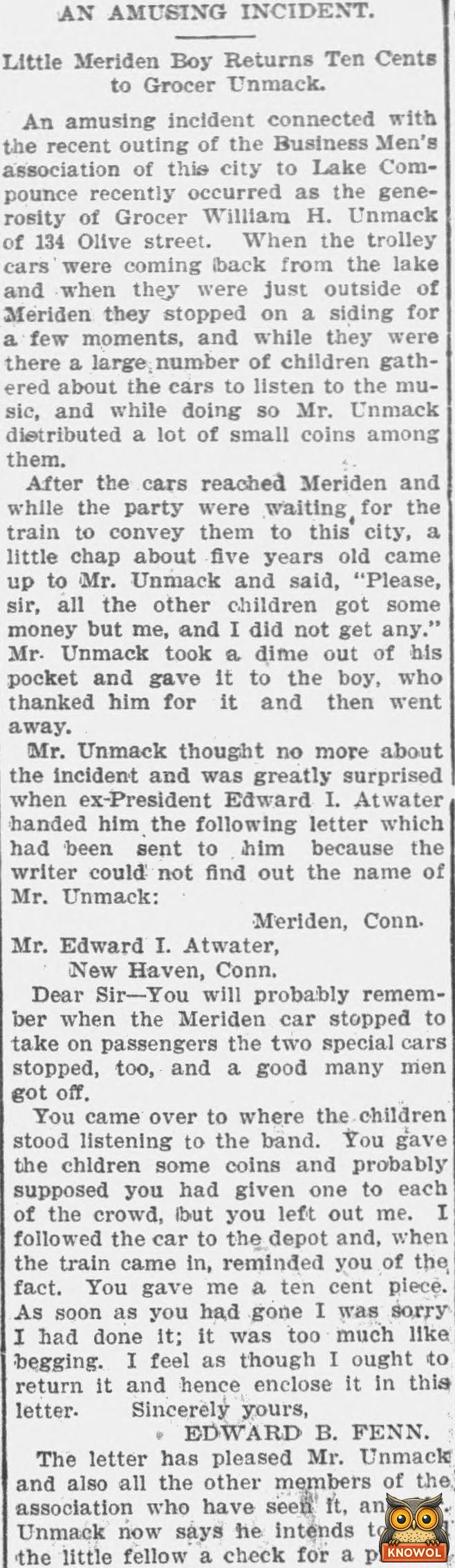
“An Amusing Incident,” The Daily Morning Journal and Courier, New Haven, Connecticut, July 19, 1905, page 3. Library of Congress, Chronicling America. Click the clipping to read it full size.
A sheep bake for $1.50
The trip was the second annual outing of the New Haven Business Men’s Association. That morning more than 100 members and guests met at the New Haven depot with the full City band, which “furnished a concert in the depot” while they waited for the 9:45 train. In Meriden they marched behind the band to two large special trolley cars for the ride through Southington to the lake. A ticket cost $1.50, “to cover railroad and trolley fares and the dinner,” and for dinner Pierce & Norton served one of their “sheep bakes.”
Lake Compounce had bowling, pool, rowing and a summer theater. After dinner the “Up Town” and “Down Town” businessmen played a ball game, and both managers had promised to use no “ringers.” The Up Towns won 28 to 2 in about four innings. The Journal and Courier said the game “was a most amusing one and every time an error was made there was much applause. It is needless to say that the applause was continuous.”
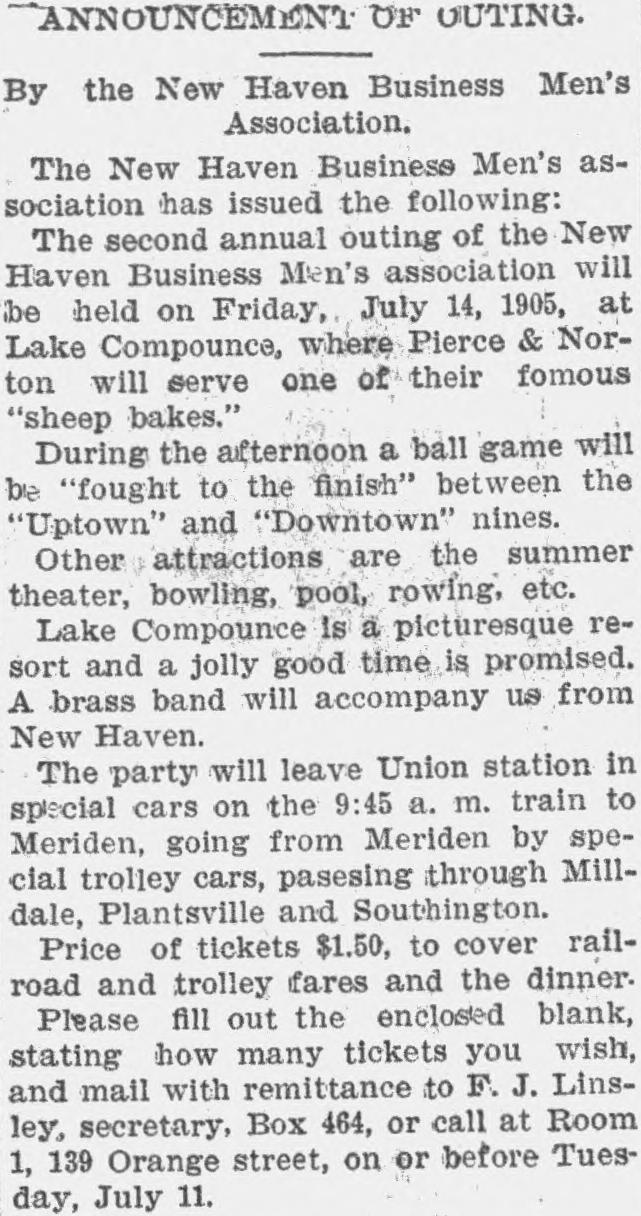
The association’s announcement of the outing, with the $1.50 ticket, the sheep bake and the trolley route. The Daily Morning Journal and Courier, New Haven, Connecticut, July 11, 1905, page 3. Library of Congress, Chronicling America. Click the clipping to read it full size.
“Please, sir”
On the way home, when the cars reached the Meriden depot, the party had to wait for the train to New Haven. That’s when “a little chap about five years old” walked up to Mr. Unmack. “Please, sir, all the other children got some money but me, and I did not get any,” he said. The grocer took a dime out of his pocket and gave it to him. The boy thanked him and went away, and Unmack thought no more about it.
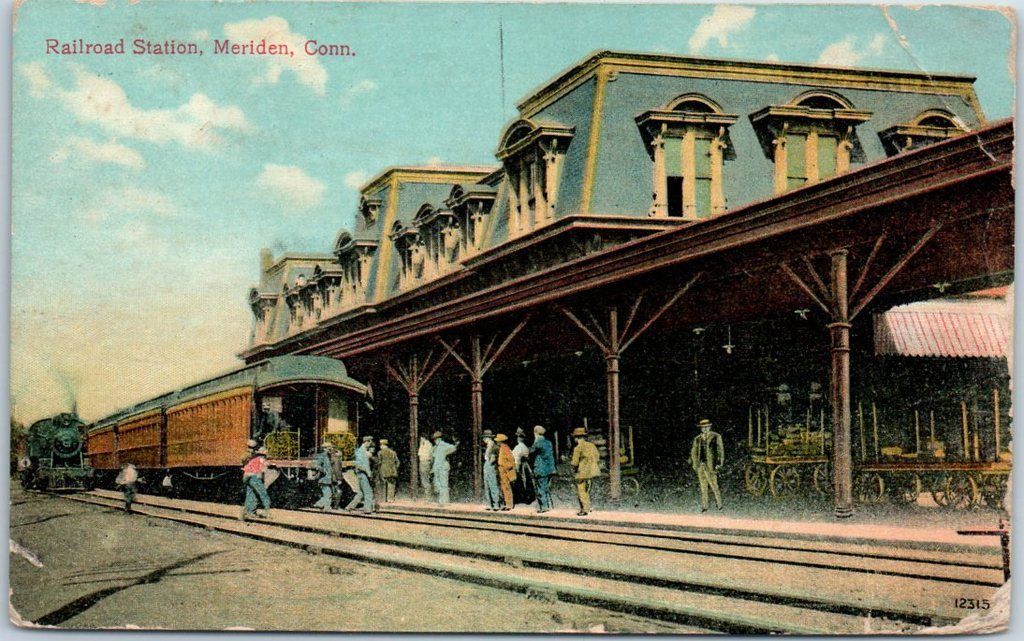
“Railroad Station, Meriden, Conn.,” postcard, about 1908. Wikimedia Commons, public domain. Click the picture to see it full size.
The dime came back
A few days later Edward I. Atwater, a former president of the association, handed Unmack a letter. It came from Meriden, and it had been sent to Atwater because the writer couldn’t find out the grocer’s name. After “Dear Sir,” it read:
You will probably remember when the Meriden car stopped to take on passengers the two special cars stopped, too, and a good many men got off.
You came over to where the children stood listening to the band. You gave the children some coins and probably supposed you had given one to each of the crowd, but you left out me. I followed the car to the depot and, when the train came in, reminded you of the fact. You gave me a ten cent piece. As soon as you had gone I was sorry I had done it; it was too much like begging. I feel as though I ought to return it and hence enclose it in this letter.
Sincerely yours, EDWARD B. FENN.
The dime was inside. The letter pleased Unmack “and also all the other members of the association who have seen it,” the paper said, and the grocer said he intended “to send the little fellow a check for a present.”
Who the boy was
The Journal and Courier printed the story on Wednesday, July 19, under the headline “Little Meriden Boy Returns Ten Cents to Grocer Unmack.” The next evening the Meriden Journal copied it and told its readers whose boy he was: “Edward B. Fenn is the son of Dr. Ava H. Fenn of this city.” On July 21 the New Haven paper passed that news back in a short follow-up called “Who the Boy Was,” and this time it called Unmack “the genial grocer.”
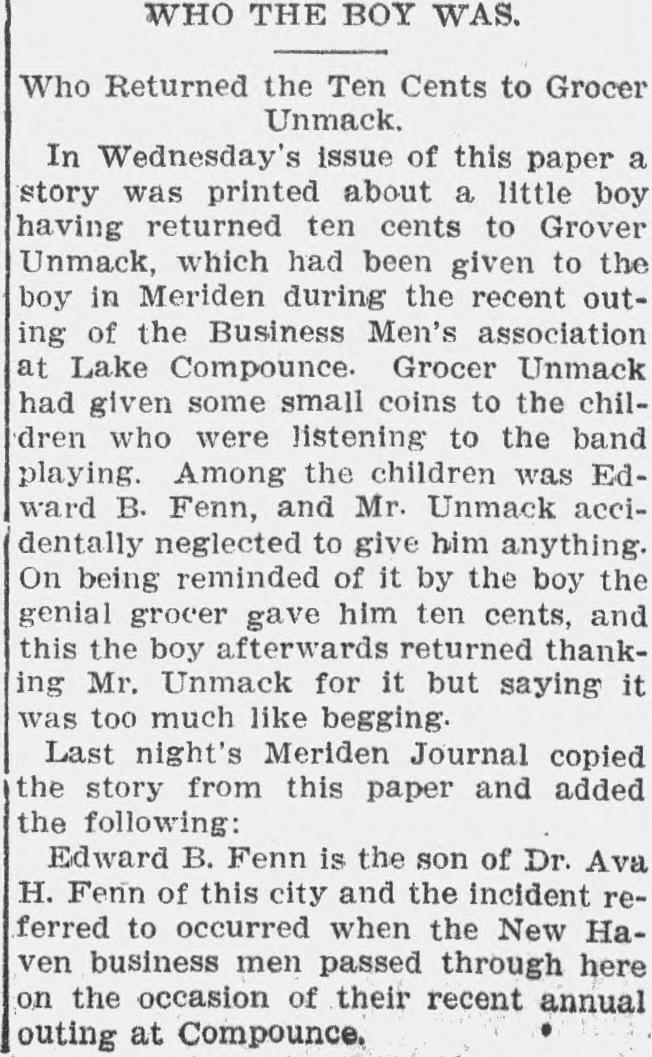
“Who the Boy Was,” The Daily Morning Journal and Courier, New Haven, Connecticut, July 21, 1905, page 8. Library of Congress, Chronicling America. Click the clipping to read it full size.
A dime was a fifteenth of what each of those men had paid for a whole day of train rides, trolley rides, baseball and a sheep bake. The boy had a fair claim to it, since every other child got a coin, and he still decided it was too much like begging. The papers never said whether the grocer’s check ever reached Meriden, but they printed the boy’s letter word for word, and that’s why we can still read it.
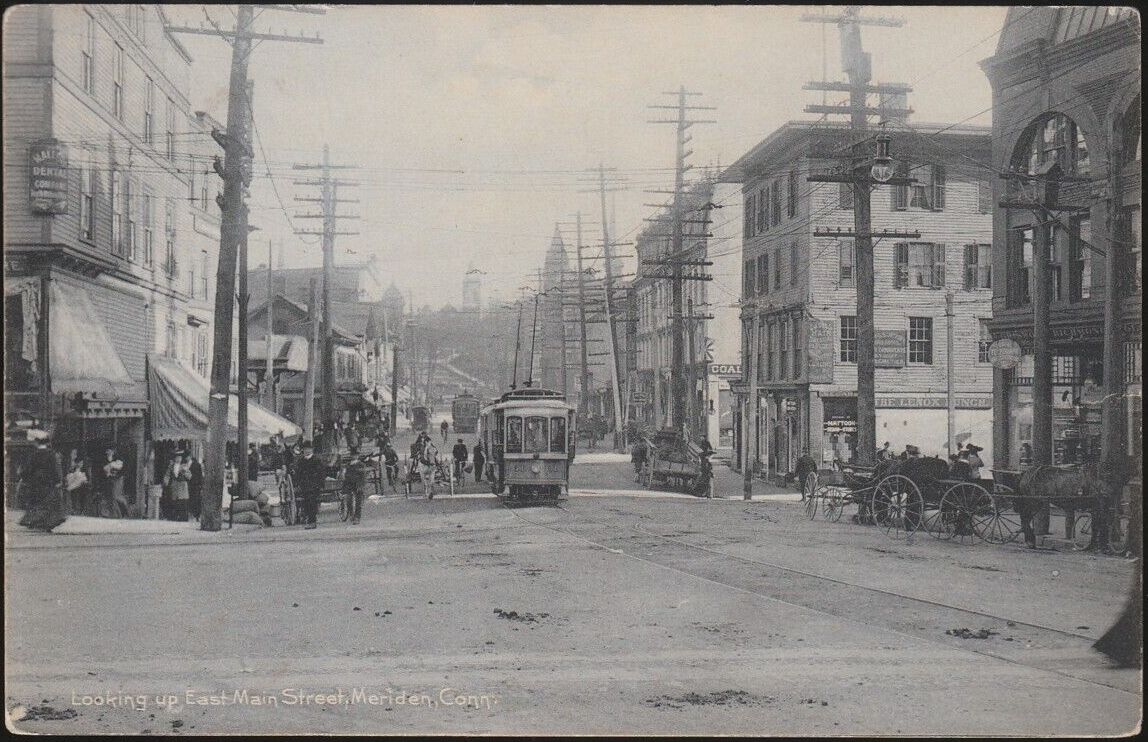
“Looking up East Main Street, Meriden, Conn.,” postcard, about 1901 to 1907, with a streetcar in the middle of the street. Wikimedia Commons, public domain. Click the picture to see it full size.
Sources
- The Daily Morning Journal and Courier (New Haven, Conn.), July 11, 1905, page 3 (“Announcement of Outing”), July 14, 1905, page 3 (“For Annual Outing”), July 15, 1905, page 1 (“Local Business Men Enjoy Annual Outing”), July 19, 1905, page 3 (“An Amusing Incident”) and July 21, 1905, page 8 (“Who the Boy Was,” quoting the Meriden Journal).
- All newspaper images: Library of Congress, Chronicling America. Published 1905, public domain.
- Postcard: “Railroad Station, Meriden, Conn.,” about 1908, Wikimedia Commons, public domain.
- Postcard: “Looking up East Main Street, Meriden, Conn.,” about 1901 to 1907, Wikimedia Commons, public domain.
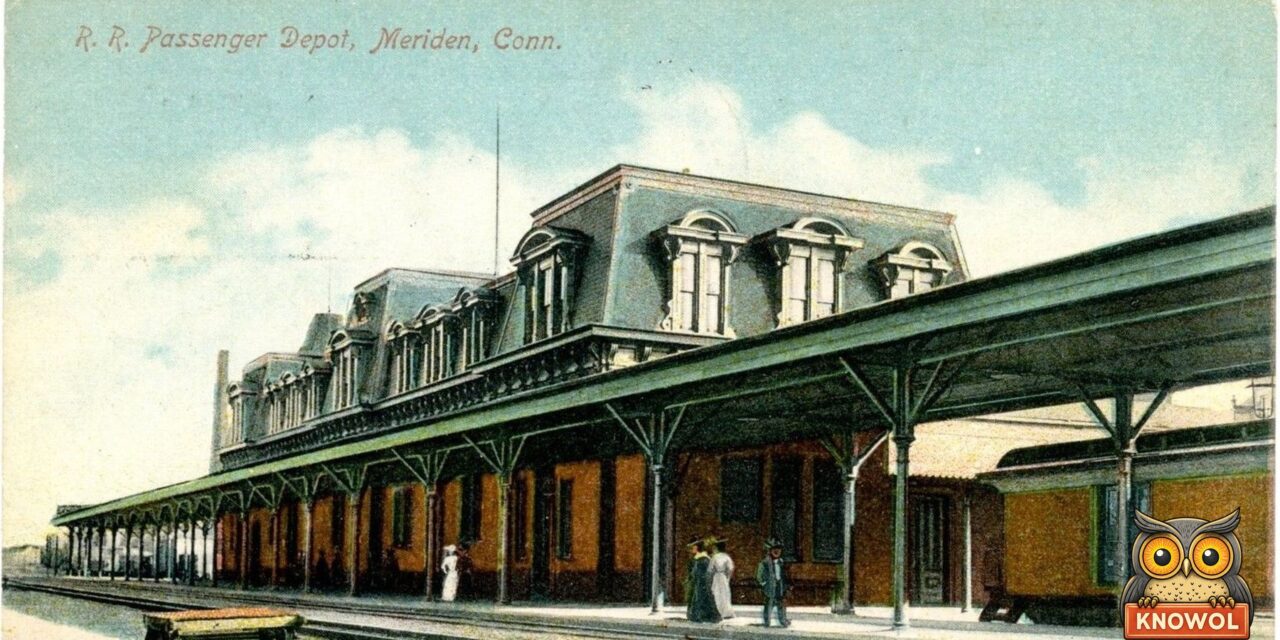
- Cover: Postcard: “R. R. Passenger Depot, Meriden, Conn.,” postmarked 1914, the depot where the boy asked for his dime. Wikimedia Commons, public domain.