Every evening, a man near Mitchell’s Station in Culpeper County, Virginia, went out to his front steps and called a frog. And the frog came. “My father had admired it for years on account of its size and color, and he visited it every evening, when it would come forth at his summons,” his son, Mr. Yager, said in the fall of 1867. The father fed it bugs until it grew so tame that “it would come to the candle and look up as if expecting to be taken up and brought to the table and fed on insects of all sorts.”
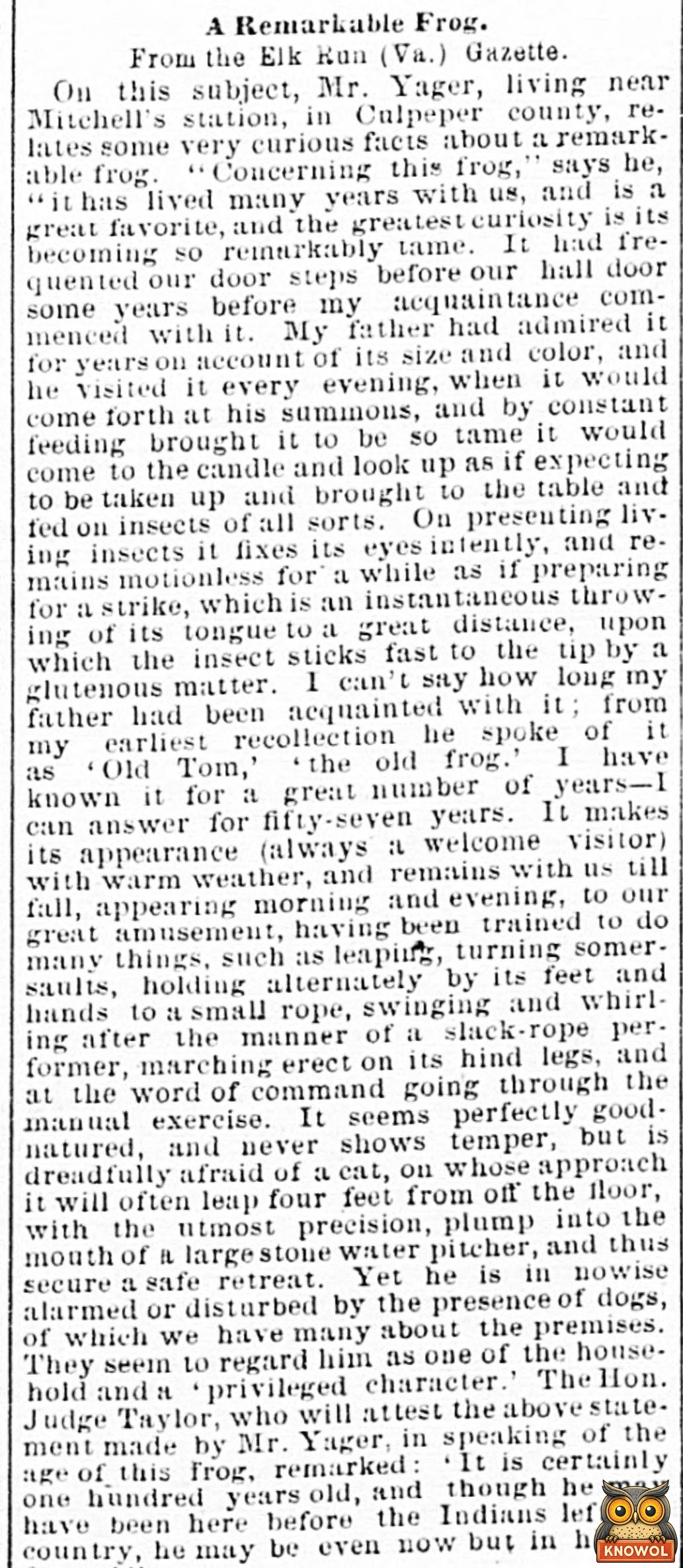
“A Remarkable Frog.” The Daily Dispatch, Richmond, Virginia, October 25, 1867, page 5. Library of Congress, Chronicling America. Click the clipping to read it full size.
Old Tom
The son grew up with that frog, though he couldn’t say how long his father had known it. “From my earliest recollection he spoke of it as ‘Old Tom,’ ‘the old frog,'” he said. The frog was still coming to the door. “I can answer for fifty-seven years,” Mr. Yager said. Old Tom was “always a welcome visitor.” He showed up each year when the weather turned warm and stayed until fall.
Fifty-seven years is a long time to know anybody. If the son met Old Tom as a small boy, he was past sixty when he told this story.
Supper, the frog way
Mr. Yager watched Old Tom eat, and he told it well. When you held out a live bug, the frog “fixes its eyes intently, and remains motionless for a while as if preparing for a strike.” Then came “an instantaneous throwing of its tongue to a great distance, upon which the insect sticks fast to the tip by a glutenous matter.” Glutenous means sticky, like glue.
That part is right on the money. A frog’s or toad’s tongue is hooked on at the front of the mouth, not the back. It flips out like a party noisemaker, and the bug sticks to it.
The tricks
Here is where the story takes a big jump of its own. Mr. Yager said Old Tom had been “trained to do many things, such as leaping, turning somersaults, holding alternately by its feet and hands to a small rope, swinging and whirling after the manner of a slack-rope performer, marching erect on its hind legs, and at the word of command going through the manual exercise.”
A slack-rope performer was a circus act that swung and balanced on a loose rope. The manual exercise was the drill soldiers did with their muskets, moving the gun through set steps when an officer called out each order. So Mr. Yager said his frog could swing like a circus star and drill like a soldier.
Old Tom had one enemy. He was “dreadfully afraid of a cat, on whose approach it will often leap four feet from off the floor, with the utmost precision, plump into the mouth of a large stone water pitcher, and thus secure a safe retreat.” The family’s dogs didn’t scare him at all. “They seem to regard him as one of the household and a ‘privileged character.'”
A judge weighs in
The story came with a witness. “The Hon. Judge Taylor” would “attest the above statement,” and he had his own guess about the frog’s age. “It is certainly one hundred years old,” the judge said. Then he added that Old Tom “may be even now but in his infancy.” In other words, a hundred might be just getting started.
How Old Tom traveled
The tale first ran in a little paper called the Elk Run Gazette. We could not find that paper itself. We know the story only because other papers copied it, which is how news traveled in 1867. The Alexandria Gazette printed it on October 17, with a typesetter’s slip in the headline: “A REMARAKBLE FROG.” The Daily Dispatch in Richmond ran it on October 25.
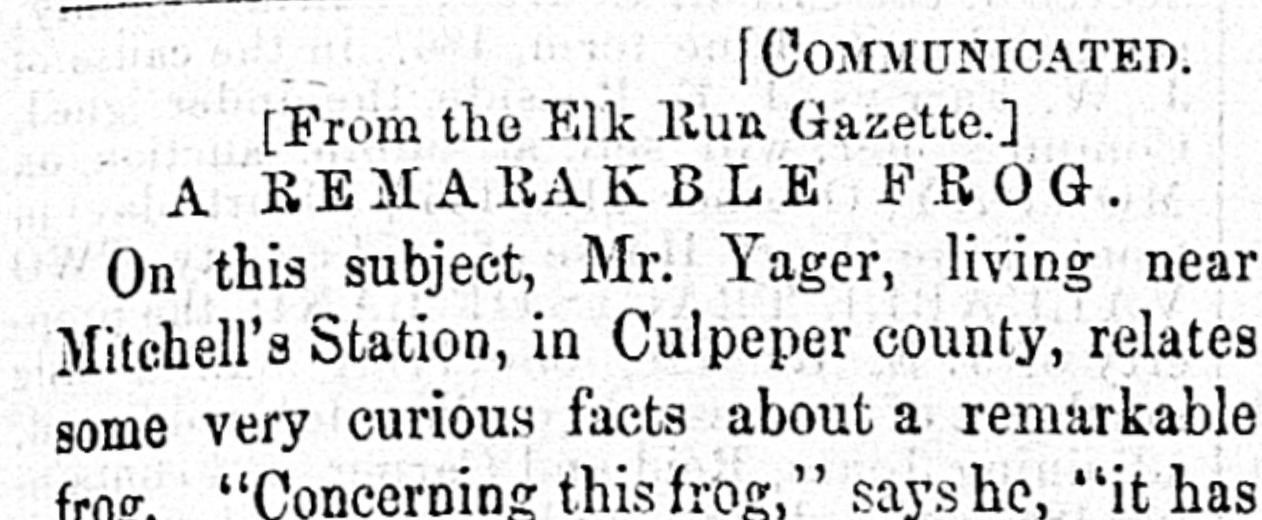
The headline with the slip in it: “A Remarakble Frog.” Alexandria Gazette, Alexandria, Virginia, October 17, 1867, page 1. Library of Congress, Chronicling America. Click the clipping to read it full size.
By November 14, Old Tom had hopped all the way to Manitowoc, Wisconsin, about 600 miles away as the crow flies. The editor there called it “A Curious Frog Story.” Somewhere along the way the Elk Run Gazette got moved to Delaware.
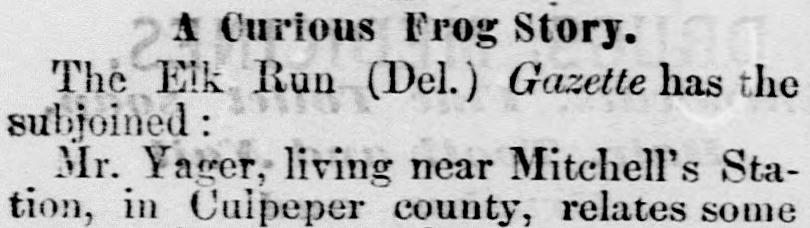
“The Elk Run (Del.) Gazette has the subjoined.” The Manitowoc Tribune, Manitowoc, Wisconsin, November 14, 1867, page 3. Library of Congress, Chronicling America. Click the clipping to read it full size.
What a frog scientist said
So how much of it could be true? In 1906 a naturalist named Mary C. Dickerson wrote The Frog Book, with more than 300 photographs she took of live frogs and toads. She had answers for a lot of Mr. Yager’s story.
Tame? Yes. “Frogs and toads can be tamed somewhat,” she wrote. “They will come out of their burrows for food at a given time and will take it from the fingers.”
The doorstep? Yes again. She described sitting on the steps of a country house on a summer evening. “A fat toad comes out from under the doorstep, where he has been quietly sleeping all day.” She went on: “Night after night, summer after summer, toads come out in search of food. They become a part of the place.”
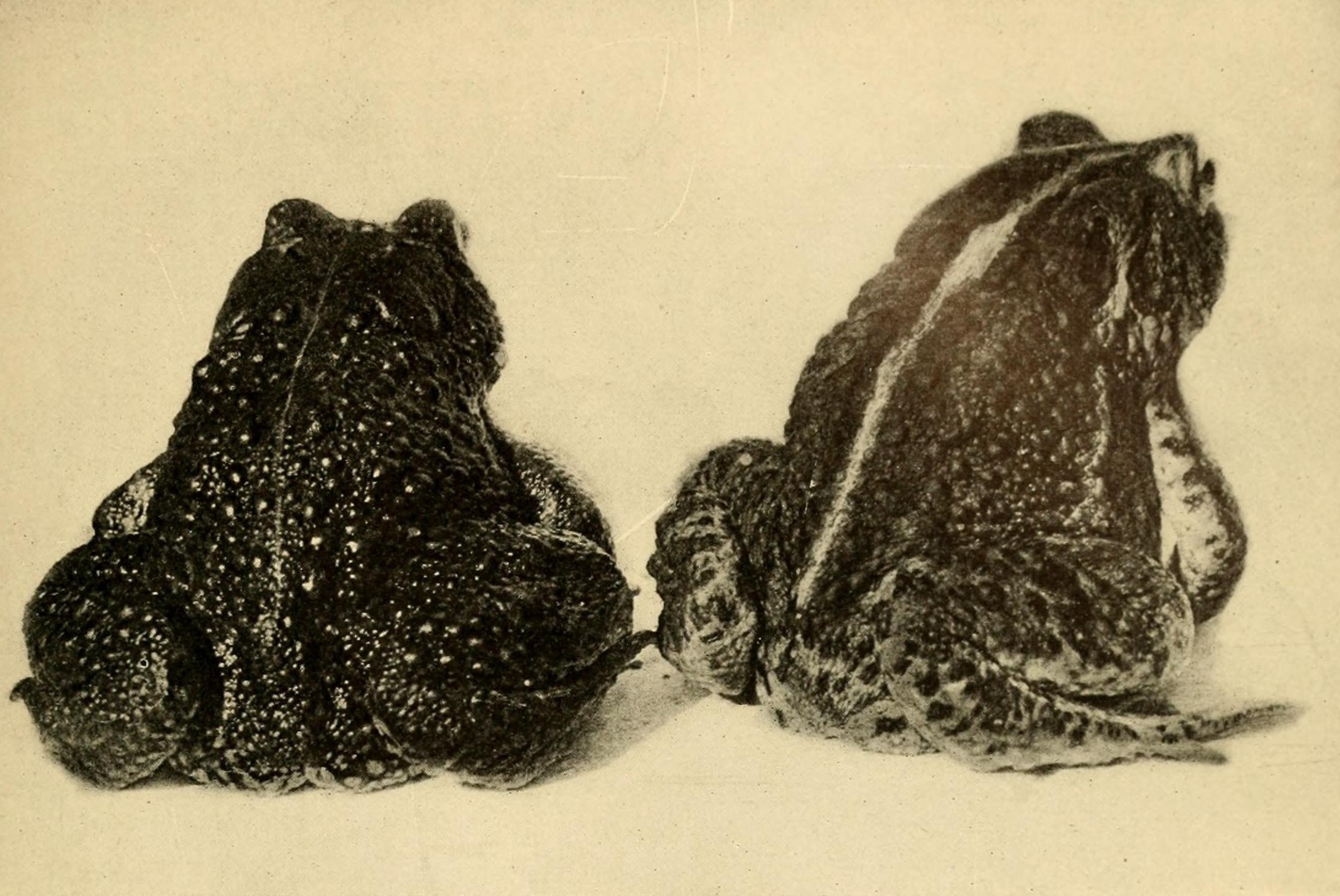
Two American toads heading off for the evening, a male on the left and a female on the right. Mary C. Dickerson called this picture “We watch their retreating backs.” The Frog Book, 1906, Plate XVII. Smithsonian Libraries copy, Internet Archive. Click the picture to see it full size.
A long life? Partly. “Toads live to be very old,” Dickerson wrote. The oldest one she could vouch for “lived to be thirty-six years of age.” That’s a long time for a toad, but it is not 57 years, and it is nowhere near 100.
And the somersaults and the musket drill? Dickerson’s book says nothing like that. A frog that lived on the doorstep, came when it was called, and took bugs from a man’s hand sounds a lot like the toads Dickerson loved. The rope swinging sounds like a family having a little fun with a good story.
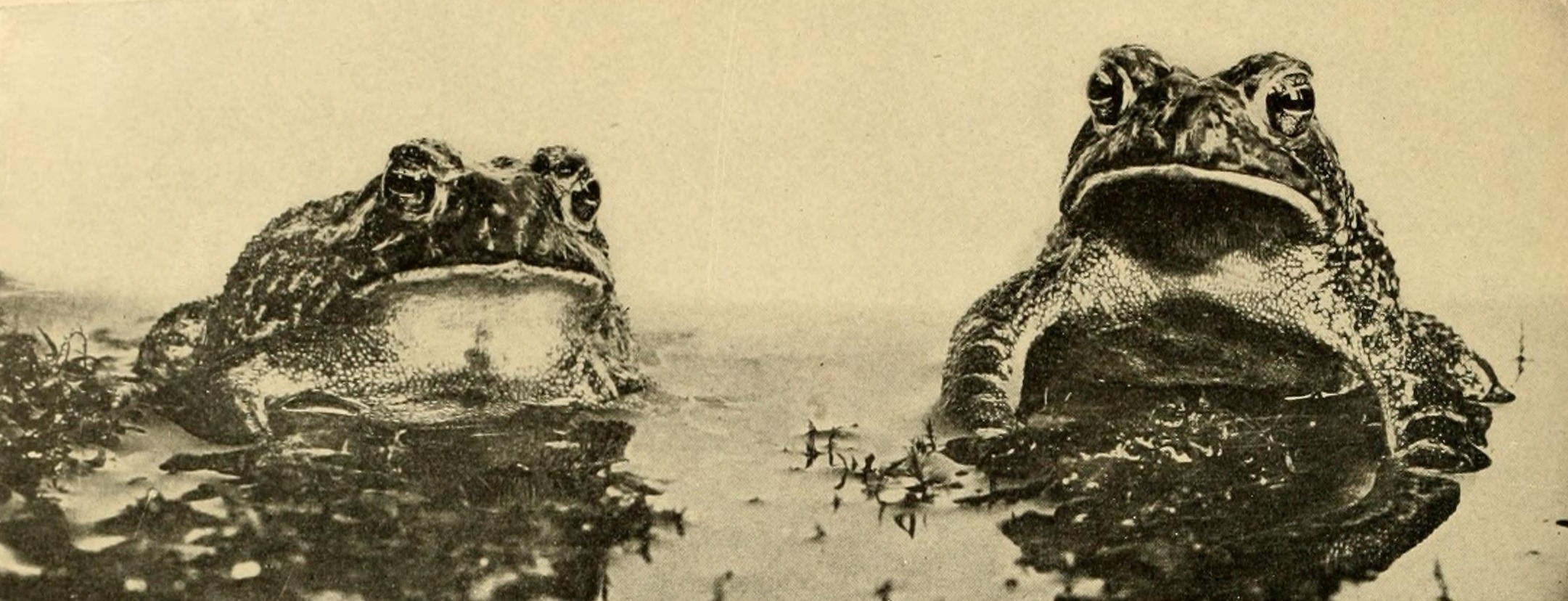
Two American toads in a pond in early May, from The Frog Book by Mary C. Dickerson, 1906, Plate X. Smithsonian Libraries copy, Internet Archive. Click the picture to see it full size.
The part that rings true
Maybe Old Tom never marched or drilled. Maybe there was more than one Old Tom over all those summers, and nobody could tell them apart. But a father in Culpeper County went out every evening and called a frog by name. His son kept on doing it for most of his life, and he wanted people to hear about it. That much sounds like the truest thing in the story.
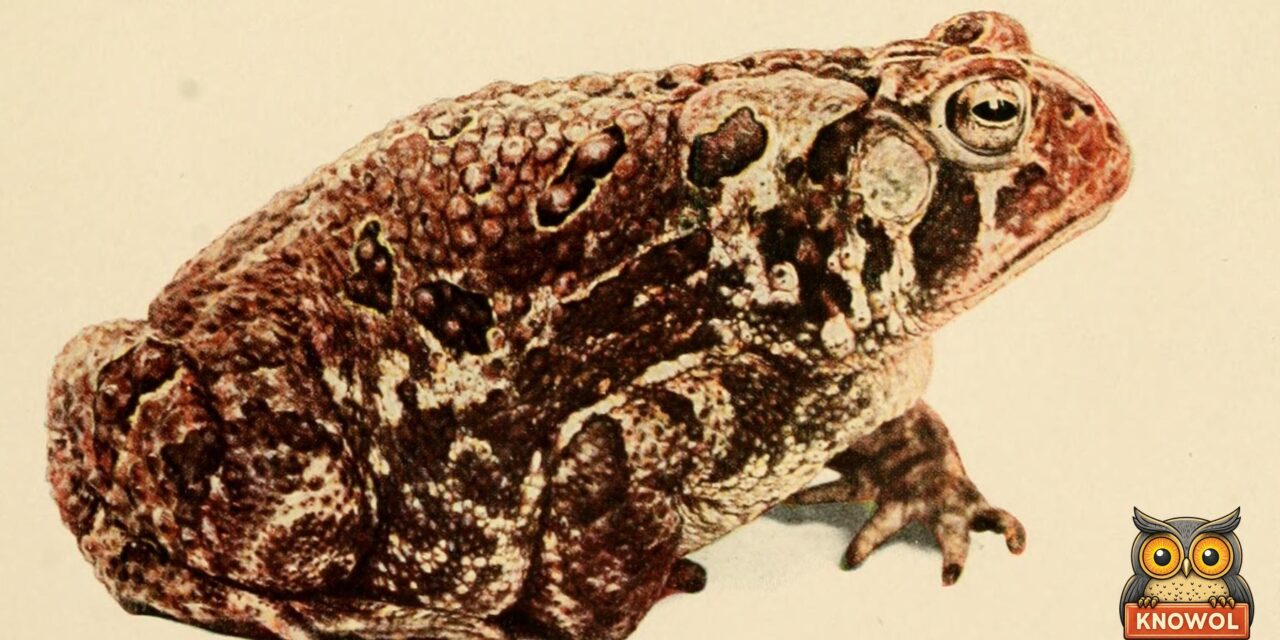
The picture at the top of this story is an American toad, photographed in color by Mary C. Dickerson for The Frog Book in 1906. It is not Old Tom, and nobody knows exactly what kind of frog he was.
Sources
- The Daily Dispatch (Richmond, Virginia): “A Remarkable Frog,” October 25, 1867, page 5.
- Alexandria Gazette (Alexandria, Virginia): “A Remarakble Frog,” October 17, 1867, page 1.
- The Manitowoc Tribune (Manitowoc, Wisconsin): “A Curious Frog Story,” November 14, 1867, page 3.
- Mary C. Dickerson, The Frog Book: North American Toads and Frogs (New York: Doubleday, Page, 1906), pages 35, 73 and 78, Plates X and XVII and Color Plate III. Smithsonian Libraries copy on the Internet Archive. Published 1906, public domain.
- Philip Slaughter, Genealogical and Historical Notes on Culpeper County, Virginia (1900), which lists Mitchell’s Station among the county’s villages: Internet Archive.
- All newspaper images: Library of Congress, Chronicling America. Published 1867.
- Cover: Color Plate III, The American Toad, from The Frog Book (1906), Internet Archive, public domain. It shows an American toad, not Old Tom.