On a Sunday afternoon in January 1914, the Theatorium picture show in Ardmore, Oklahoma, was full. That had never happened before. The Daily Ardmoreite said it was the first time in the history of the movies in Ardmore that the Theatorium was “full up” for an afternoon show. Folks had come to see a picture called “War on the Cattle Range.” There was just one problem. The picture wasn’t there yet.
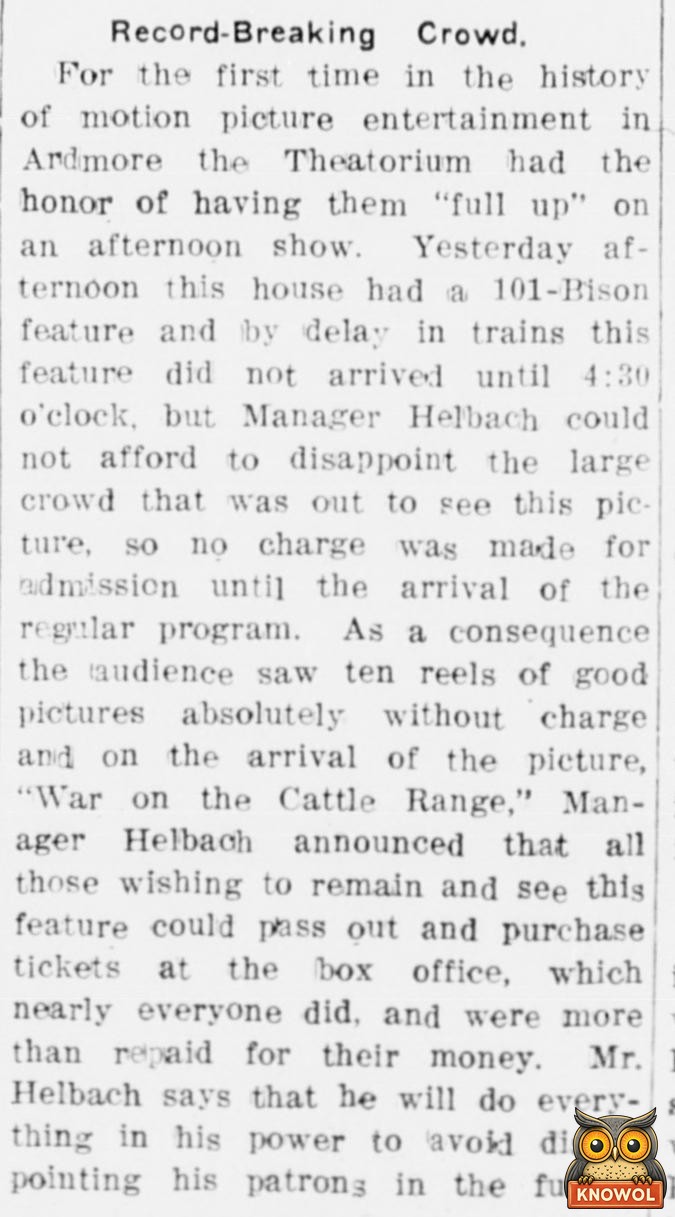
“Record-Breaking Crowd.” The Daily Ardmoreite, Ardmore, Oklahoma, January 19, 1914, page 5. Library of Congress, Chronicling America. Click the clipping to read it full size.
Stuck on a late train
In 1914 a movie didn’t come over a wire. It came on reels, big rolls of film packed in flat metal cans and sent from town to town by train. One reel ran about 10 to 15 minutes. That Sunday the trains were late, and “War on the Cattle Range” didn’t get to Ardmore until 4:30.
The manager was R. Helbach. He had a full house, a quiet screen and no big picture. He could have sent everyone home. Instead, the paper said, he “could not afford to disappoint the large crowd that was out to see this picture, so no charge was made for admission until the arrival of the regular program.” He ran other films while they waited. By the time the late reels came in, the crowd had seen “ten reels of good pictures absolutely without charge.” That’s a couple of hours of free movies.
Then the box office opened
When the cans arrived, Helbach made an offer. Anyone who wanted to stay for the late picture could “pass out and purchase tickets at the box office.” Pass out meant step outside. Everybody in that room had just had a free show. They could have walked home happy and kept their dimes.
Nearly everyone went and bought one anyway. In the paper’s words, “nearly everyone did, and were more than repaid for their money.” Helbach told the Ardmoreite that he would “do everything in his power to avoid disappointing his patrons in the future.” A man was fair to his town that day, and his town was fair right back.
What a dime bought
A movie at the Theatorium cost 5 or 10 cents. The theater was proud of that. In March 1914 it showed a two-reel detective picture called “The Mysterious Leopard Lady,” and the paper said the owners would keep “their usual custom of never raising prices, no matter what it costs them to get a picture.”
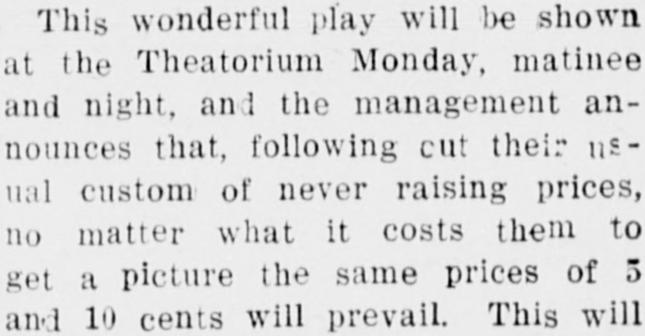
“The same prices of 5 and 10 cents will prevail.” The Daily Ardmoreite, Ardmore, Oklahoma, March 29, 1914, page 8. Library of Congress, Chronicling America. Click the clipping to read it full size.
That dime bought a lot of excitement. The Leopard Lady was part of a series called “My Lady Raffles.” Raffles was a famous gentleman burglar in English story books, so a Lady Raffles was a clever lady thief. In each picture she tried to fool the police, and Detective Phil Kelly tried to catch “the famous female crook.” This time a gang catches Kelly instead, and he is “bound and placed in a cage of untrained lions.” The paper added: “A big dirigible balloon plays an important part.” A dirigible is a long balloon with a motor that a pilot can steer.
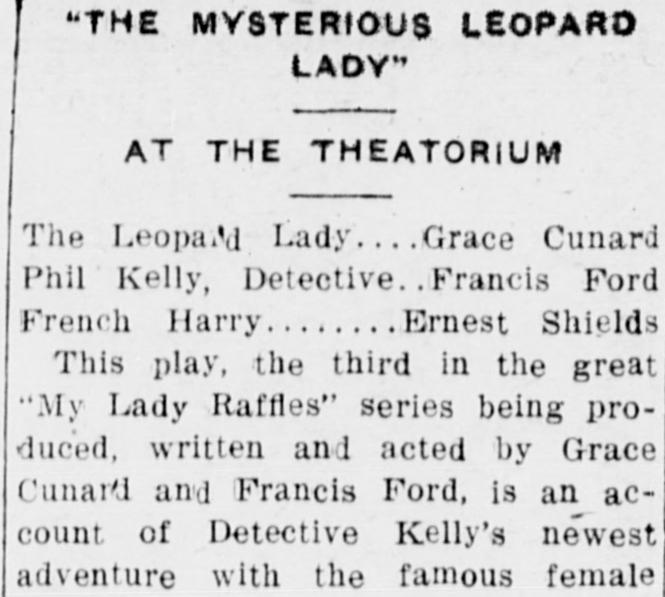
“The Mysterious Leopard Lady at the Theatorium.” The Daily Ardmoreite, Ardmore, Oklahoma, March 29, 1914, page 8. Library of Congress, Chronicling America. Click the clipping to read it full size.
The star who wrote the story
The Ardmoreite said the picture was “written and acted by Grace Cunard and Francis Ford.” Cunard played the Leopard Lady, and Ford played the detective. Moving Picture World, the movie business’s weekly magazine in New York, said the story was “written by Grace Cunard.” Then its reviewer had a little fun: “The yarn is so ridiculous in places that it almost becomes burlesque. There is a Lady Raffles, a deep-dyed villain, a fearless hero and plenty of wild animals.” Burlesque means a silly spoof. Ardmore saw the picture on March 30, less than a week after it came out, and nobody there seemed to mind.
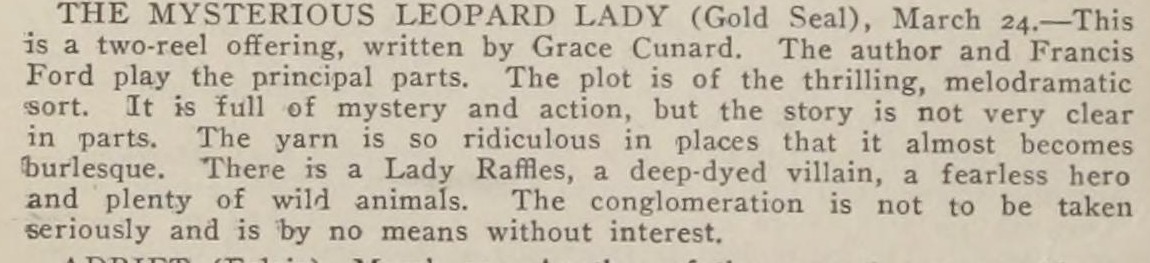
The review of “The Mysterious Leopard Lady.” Moving Picture World, New York, March 28, 1914, page 1682. Internet Archive, public domain. Click the clipping to read it full size.
Grace Cunard became a hometown favorite. In November 1914 the Ardmoreite said “she is immensely liked by the women and that speaks volumes for her ability.” In 1916 a newspaper in Toronto, Canada, held a contest for the most popular movie star, and Cunard “has held the lead for many weeks over Mary Pickford,” the biggest movie star of the day. The Ardmoreite told its readers: “Miss Cunard has hundreds of friends in Ardmore who will be interested to know she is so popular with our Canadian cousins.” She wasn’t afraid of big cats off the screen, either. In 1915 a movie magazine ran a photo of her petting a lioness and called it one of her “animal friends.”
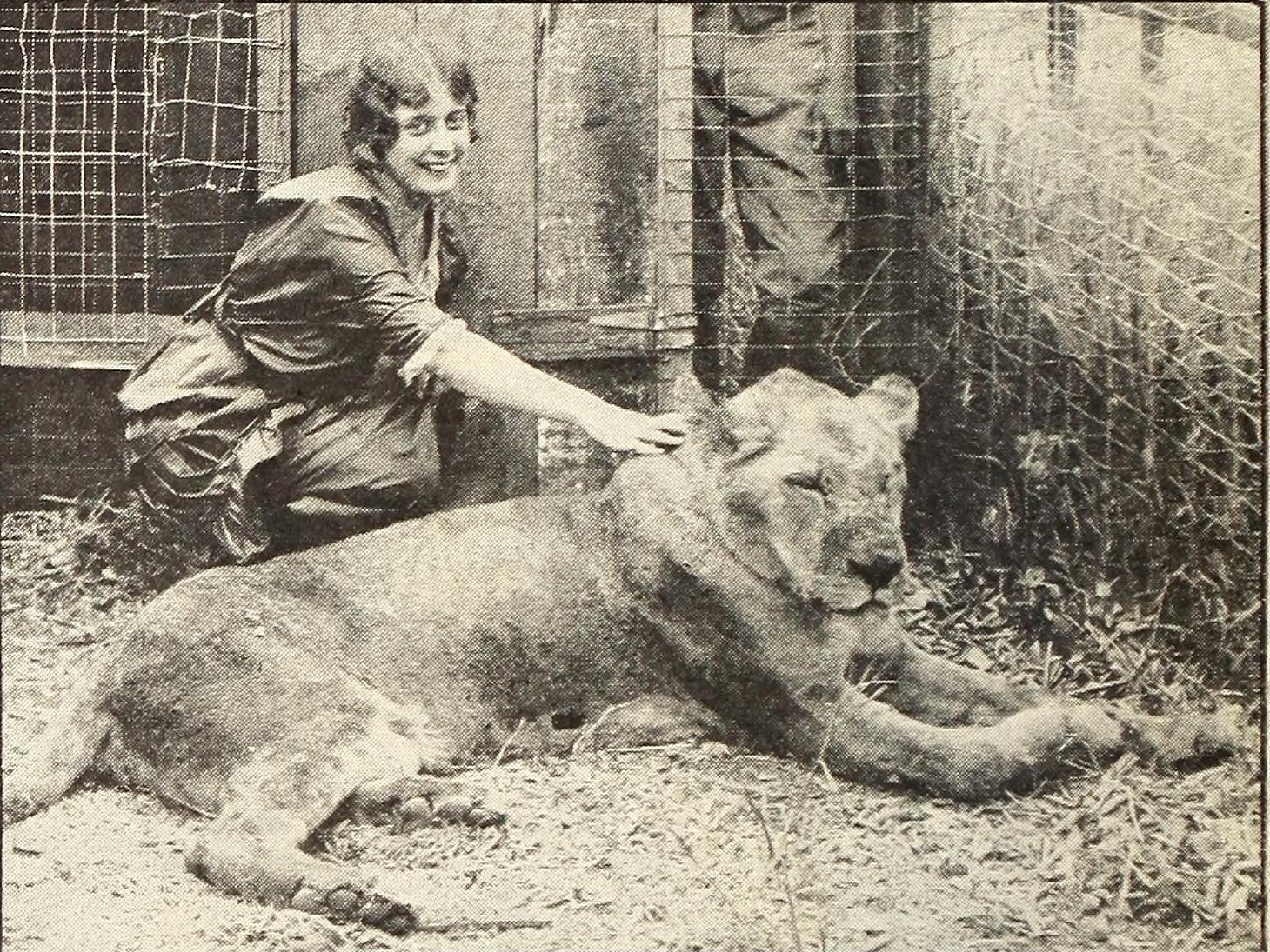
“Grace Cunard and one of her animal friends.” Picture-Play Weekly, New York, August 14, 1915, page 26. Internet Archive, public domain. Click the picture to see it full size.
How the Theatorium kept them coming
Helbach and the Theatorium kept finding new ways to bring folks in. The paper wrote them all down.
- **Music.** Movies had no sound yet, so theaters played music to go with them. In September 1913 the Theatorium got an “Electric Piano Orchestra.” It held “the different instruments used in a large orchestra, assembled in a single magnificent case,” and played “just like a human orchestra.”
- **Soft seats.** In October 1914 the theater put in “leather-seated opera chairs.” The paper said that made it “one of the most comfortably finished theaters in this part of the state.”
- **A bale of cotton.** In the fall of 1914 cotton prices fell hard, and farm families were hurting. The same page of the paper said cotton sold in Hillsboro, Texas, “at from six to six and a half cents” a pound. Helbach bought a bale “at ten cents per pound from a widow woman of the county,” Mrs. Redman, who lived near Lone Grove, Oklahoma, and “has to support five children.” The bale weighed 505 pounds, so that was about $50. He set it out in front of the theater for everyone to see.
- **A free ticket in the paper.** In February 1915 he printed a coupon under his ad. It was a “free ticket to the show” for the first chapter of a serial, a movie told a little at a time, week after week. That night, “676 coupons were presented at the door.”
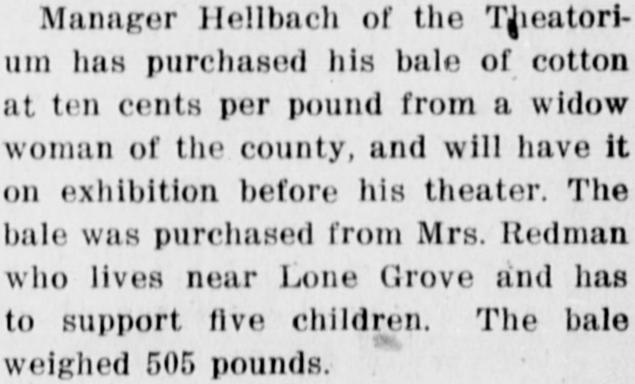
“Manager Hellbach of the Theatorium has purchased his bale of cotton.” The Daily Ardmoreite, Ardmore, Oklahoma, October 15, 1914, page 5. Library of Congress, Chronicling America. Click the clipping to read it full size.
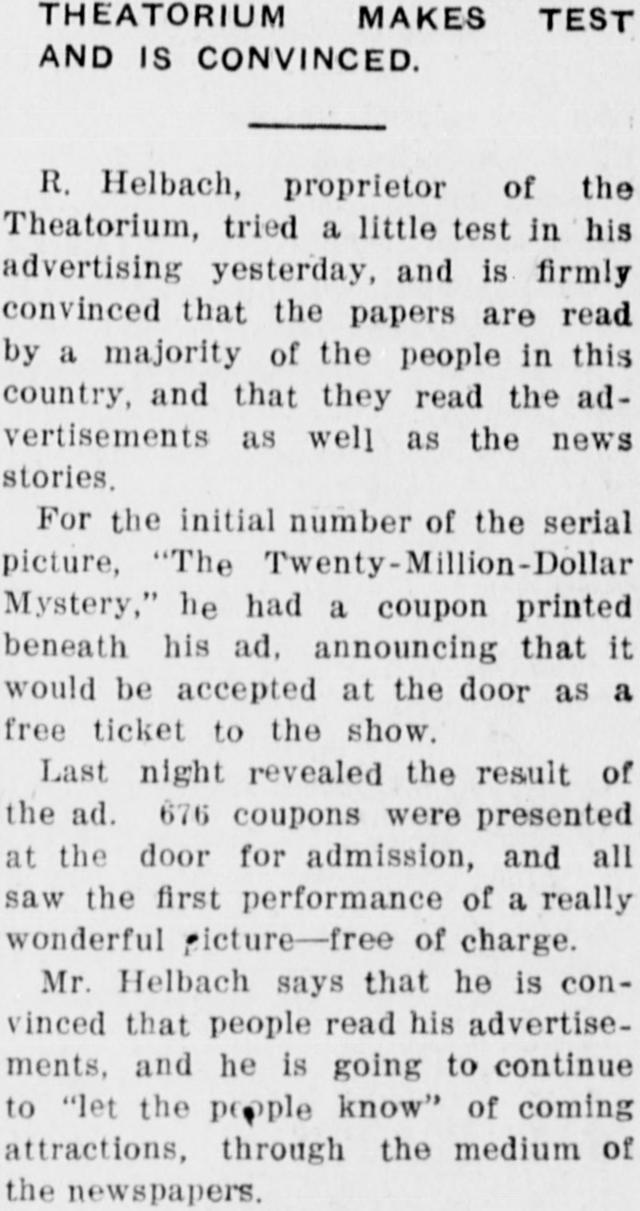
“Theatorium Makes Test and Is Convinced.” The Daily Ardmoreite, Ardmore, Oklahoma, February 26, 1915, page 1. Library of Congress, Chronicling America. Click the clipping to read it full size.
A record crowd
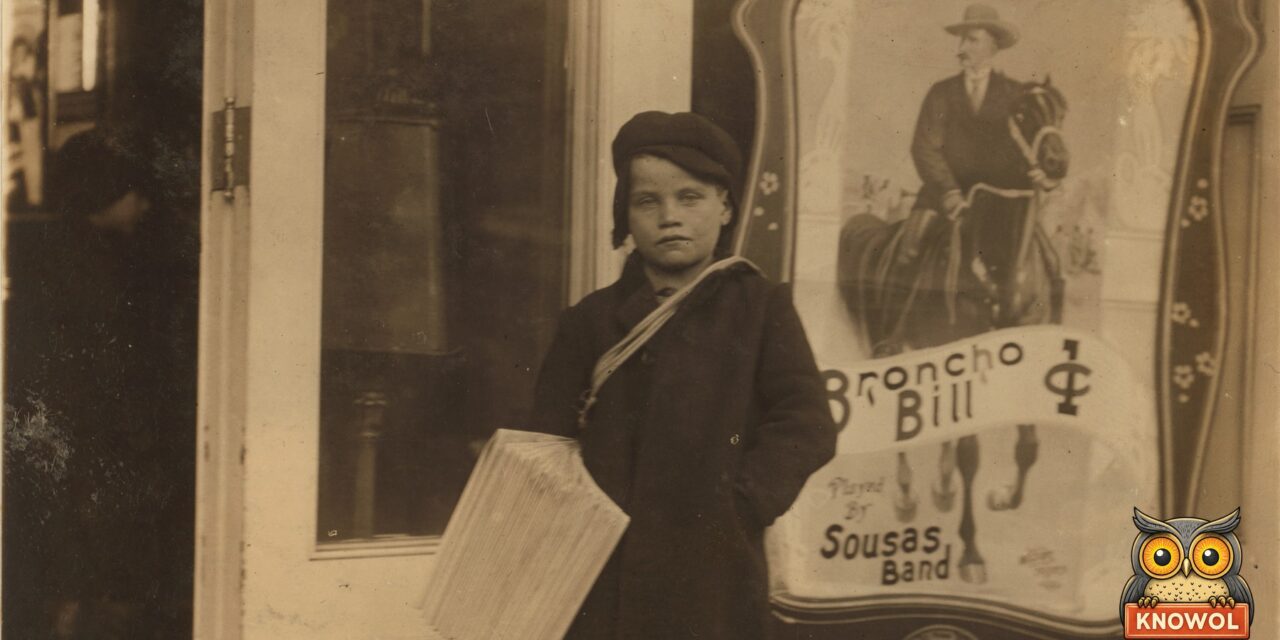
We could not find a photo of the Theatorium. The picture at the top of this story shows a different picture show, in Schenectady, New York, in 1910. Lewis Hine photographed a ten-year-old newsboy with his papers at its door, beside a poster that says “Broncho Bill.” Back in Ardmore, the crowd of January 1914 got a free afternoon of pictures, and then most of them paid for the late show anyway. The paper called it a record-breaking crowd. It may have been a record for fair play, too.
Sources
- The Daily Ardmoreite (Ardmore, Oklahoma), all on the Library of Congress page server: January 19, 1914, page 5 (“Record-Breaking Crowd”); March 29, 1914, page 8 (“The Mysterious Leopard Lady at the Theatorium”); October 7, 1914, page 4 (“Something New at Theatorium”); October 15, 1914, page 5 (the bale of cotton, and cotton prices in Hillsboro); November 30, 1914, page 7 (“Grace Cunard and Francis Ford, Theatorium Tomorrow”); February 26, 1915, page 1 (“Theatorium Makes Test and Is Convinced”); September 17, 1913, page 1 (“Orchestra at Theatorium”); May 26, 1916, page 2 (the Toronto popularity contest).
- Moving Picture World (New York), March 28, 1914, page 1682, review of “The Mysterious Leopard Lady,” on the Internet Archive.
- Photo: “Favorite Pets of Favorite Players,” Picture-Play Weekly (New York), August 14, 1915, page 26, on the Internet Archive. Published 1915; the Library of Congress copy is marked not in copyright.
- All newspaper images: Library of Congress, Chronicling America. Published 1913 to 1916.
- Cover: Lewis Hine, “Newsie, ten years old. Going into a moving picture theatre with his papers. Location: Schenectady, New York (State),” 1910, National Child Labor Committee Collection, Library of Congress, no known restrictions on publication.