Late on the night of August 14, 1903, Whitaker Street in Savannah, Georgia, filled up with people. They stood shoulder to shoulder in the dark in front of the office of the Savannah Morning News. Nobody there could see a thing worth seeing. They had come to listen. Clear across the country, about 2,400 miles away, two of the most famous boxers in America were about to fight for the heavyweight championship of the world. The only way Savannah could follow it was one voice, shouting through a megaphone.
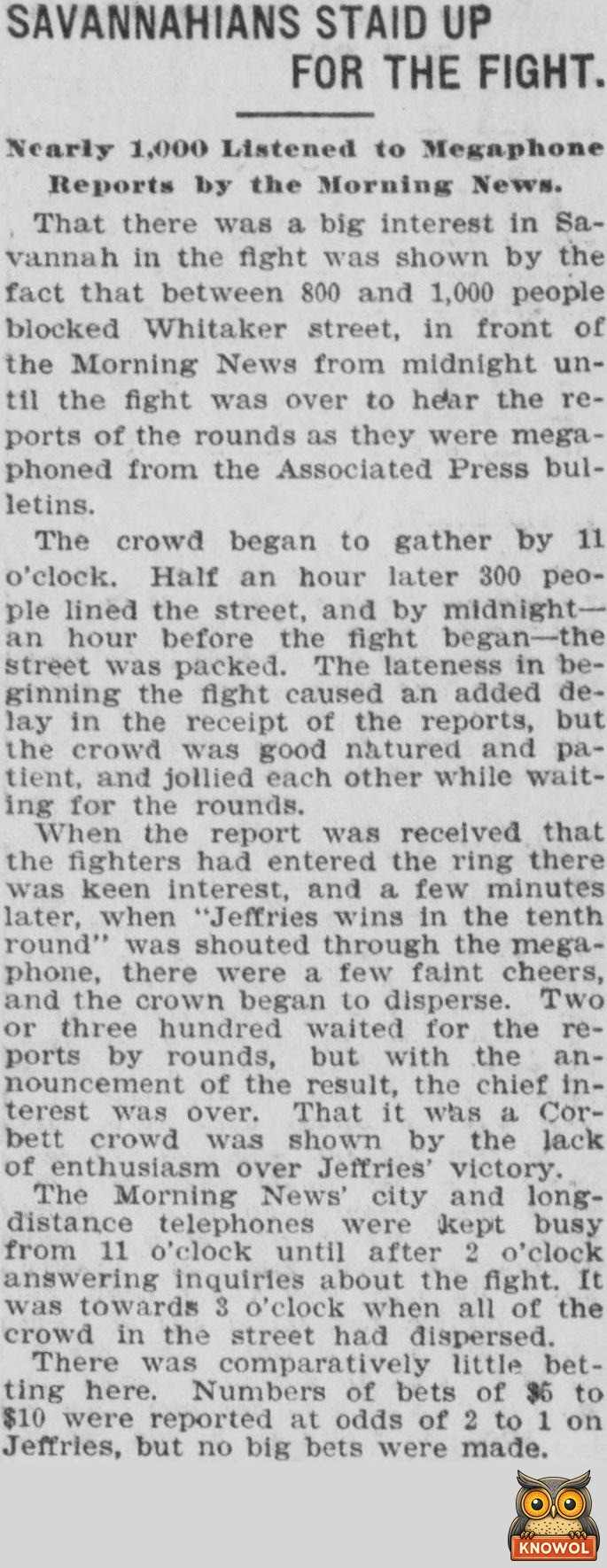
“Savannahians Staid Up for the Fight.” The Savannah Morning News, Savannah, Georgia, August 15, 1903, page 5. Library of Congress, Chronicling America. Click the clipping to read it full size.
The big fight
The fight was in San Francisco, California. On one side was James J. Jeffries, the heavyweight champion of the world. On the other was Jim Corbett, who had been champion before him and wanted his title back. The Morning News said “Ten Thousand People Saw Big Fight in San Francisco.” Everybody else in the country would have to wait for the news.
There were no radio stations in 1903 and no TV. A newspaper was the fastest way most people got news, and newspapers got it by telegraph. So on fight night, papers in big cities did something special. They read the news out loud to the street the moment it arrived.
A thousand people on Whitaker Street
The paper said the crowd “began to gather by 11 o’clock.” Half an hour later, 300 people lined the street. By midnight, the street was packed, and that was still “an hour before the fight began.” The paper counted “between 800 and 1,000 people” on Whitaker Street.
The fight started late, so the news came late too. Nobody seemed to mind. The paper said the crowd “was good natured and patient, and jollied each other while waiting for the rounds.” To jolly someone means to joke around with them and tease them in a friendly way. Picture hundreds of people kidding each other in the middle of the night, all waiting on one window.
How a fight got from San Francisco to Savannah
It worked like a very long relay race. At the fight, a telegraph operator tapped out what happened in Morse code, a language of short and long clicks. The clicks raced along wires strung on poles across the country. The Associated Press, a news service that many newspapers shared, sent out short reports called bulletins. In Savannah, the paper said, the rounds “were megaphoned from the Associated Press bulletins.”
A megaphone is a big cone, like a giant ice cream cone with both ends open. You shout into the small end, and your voice comes out the wide end louder and farther. It needs no electricity, just a strong pair of lungs.
The same thing was happening in other towns that night. In St. Louis, Missouri, a man from The St. Louis Republic newspaper stood at an upper window and read off each round. The Republic told how it worked: “As fast as the news was ticked in the telegraph-room, sent by a special wire from San Francisco, it was read off from the window of the office.” Its crowd packed the corner of Seventh and Olive streets and spilled far down the block both ways.
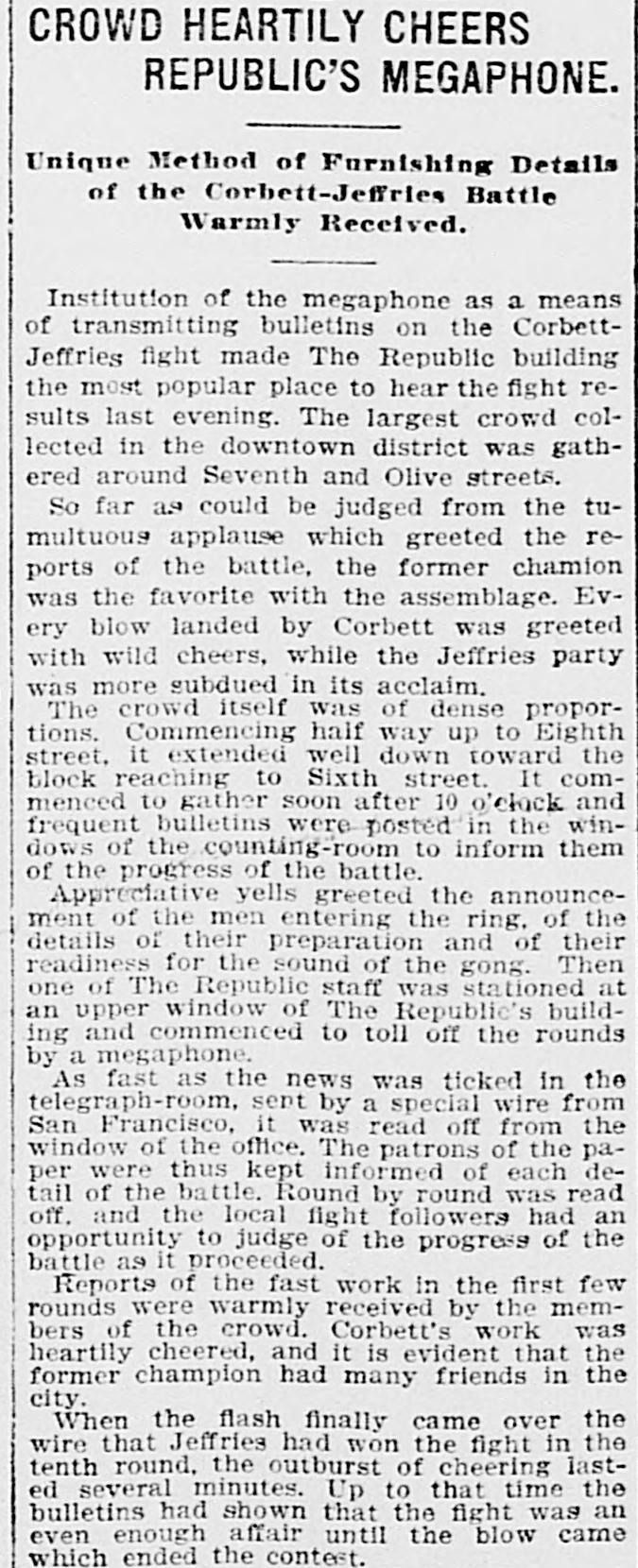
“Crowd Heartily Cheers Republic’s Megaphone.” The St. Louis Republic, St. Louis, Missouri, August 15, 1903, page 2. Library of Congress, Chronicling America. Click the clipping to read it full size.
The ending came first
In Savannah, the news came in a strange order. First came word that the boxers had climbed into the ring, and there was “keen interest.” Then, the paper said, “a few minutes later,” the megaphone shouted the ending: “Jeffries wins in the tenth round.” It looks like the short message with the winner had beaten the longer reports of each round to Savannah.
Most of the crowd liked Corbett, so there were only “a few faint cheers.” Then people began to head home. They had waited about two hours for one sentence. But not everybody left. “Two or three hundred waited for the reports by rounds,” the paper said. They already knew how it ended, and they stayed to hear how it happened anyway.
What happened in the ring
The fight itself ended with a punch to the stomach. Jeffries knocked Corbett down twice in the tenth round. Then Corbett’s helpers in his corner asked the referee to stop it. The paper’s front page said they did it “to save their man from needless punishment.” Its big headline gave Corbett the last word: “It is my last fight.”
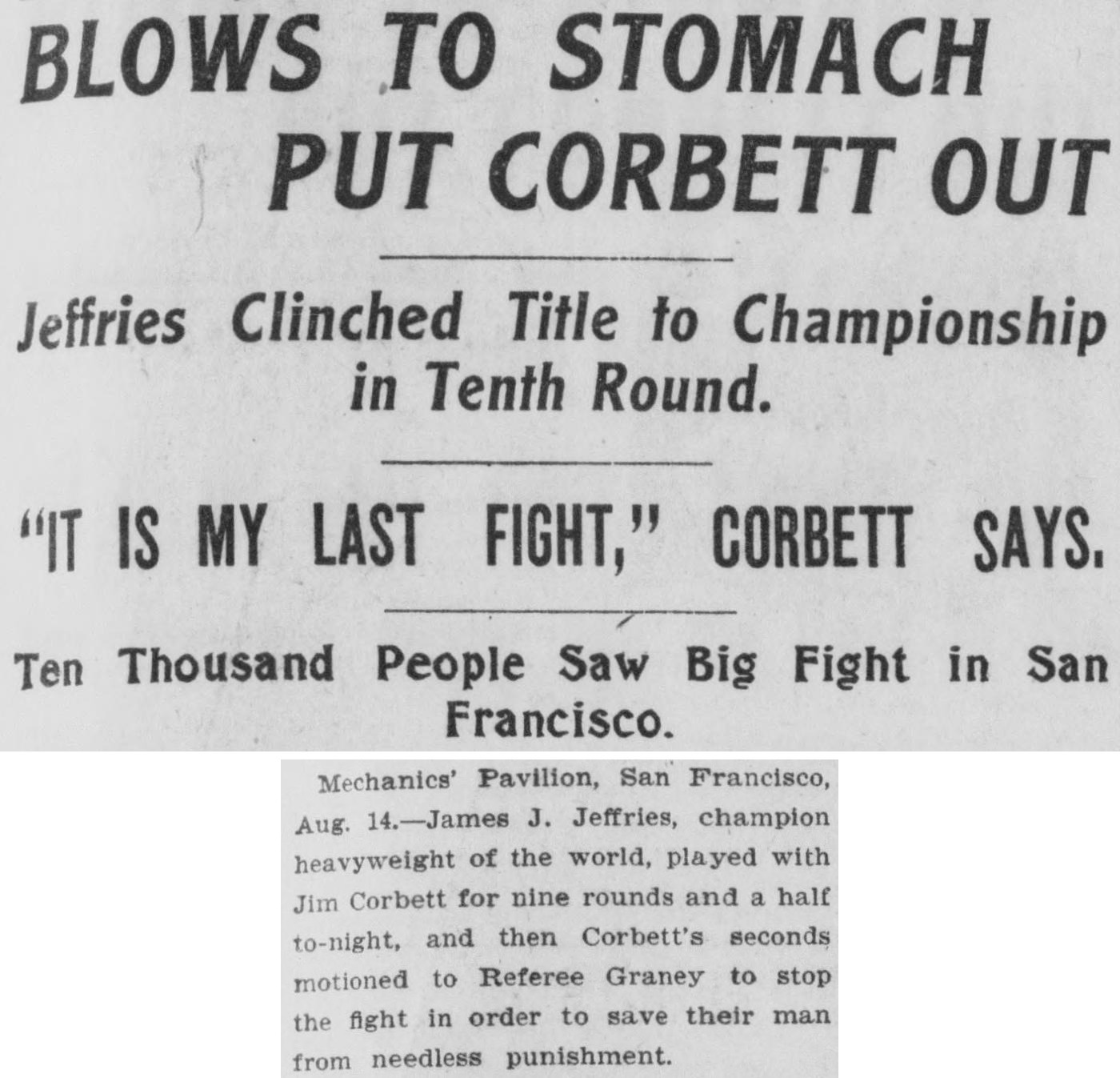
“Blows to Stomach Put Corbett Out.” The Savannah Morning News, Savannah, Georgia, August 15, 1903, page 1. Library of Congress, Chronicling America. Click the clipping to read it full size.
The phones kept ringing
Plenty of people in Savannah stayed home in bed. They still wanted to know who won. So they called the newspaper. The Morning News said its city and long-distance telephones “were kept busy from 11 o’clock until after 2 o’clock answering inquiries about the fight.” In 1903, calling the paper was how you looked up a score.
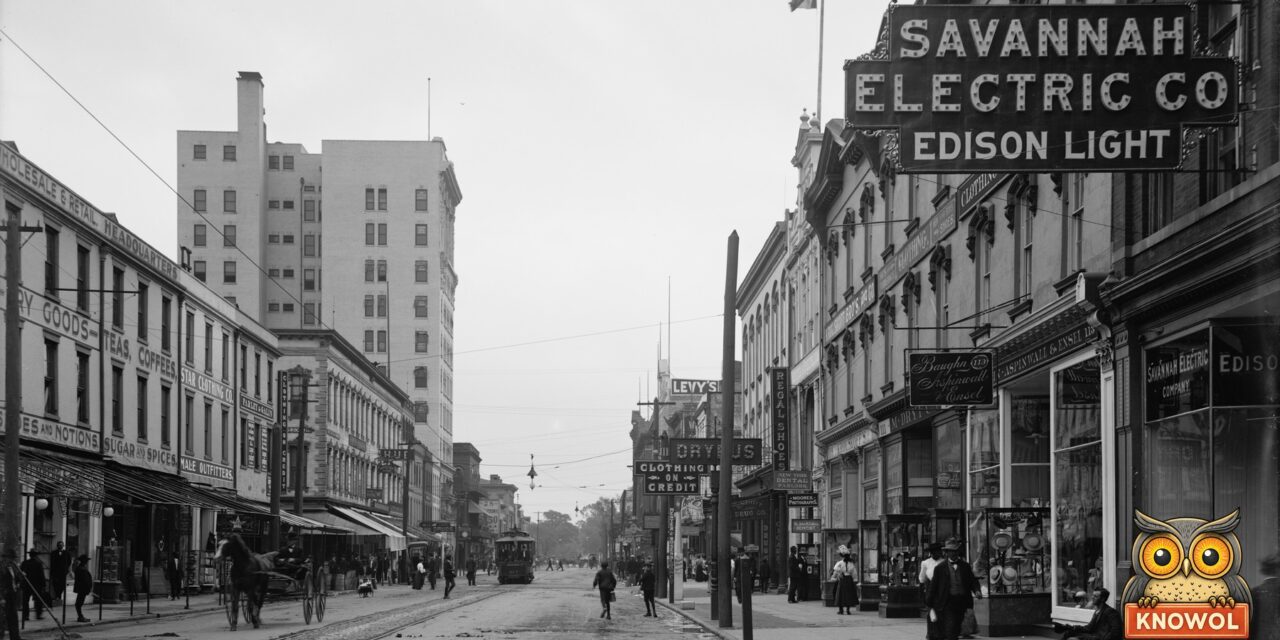
The picture at the top of this page shows Broughton Street, Savannah’s busy shopping street, photographed by the Detroit Publishing Company sometime between 1900 and 1910. Whitaker Street, where the crowd stood, crosses it downtown. In the daytime, streets like these were full of buggies, streetcars and shoppers.
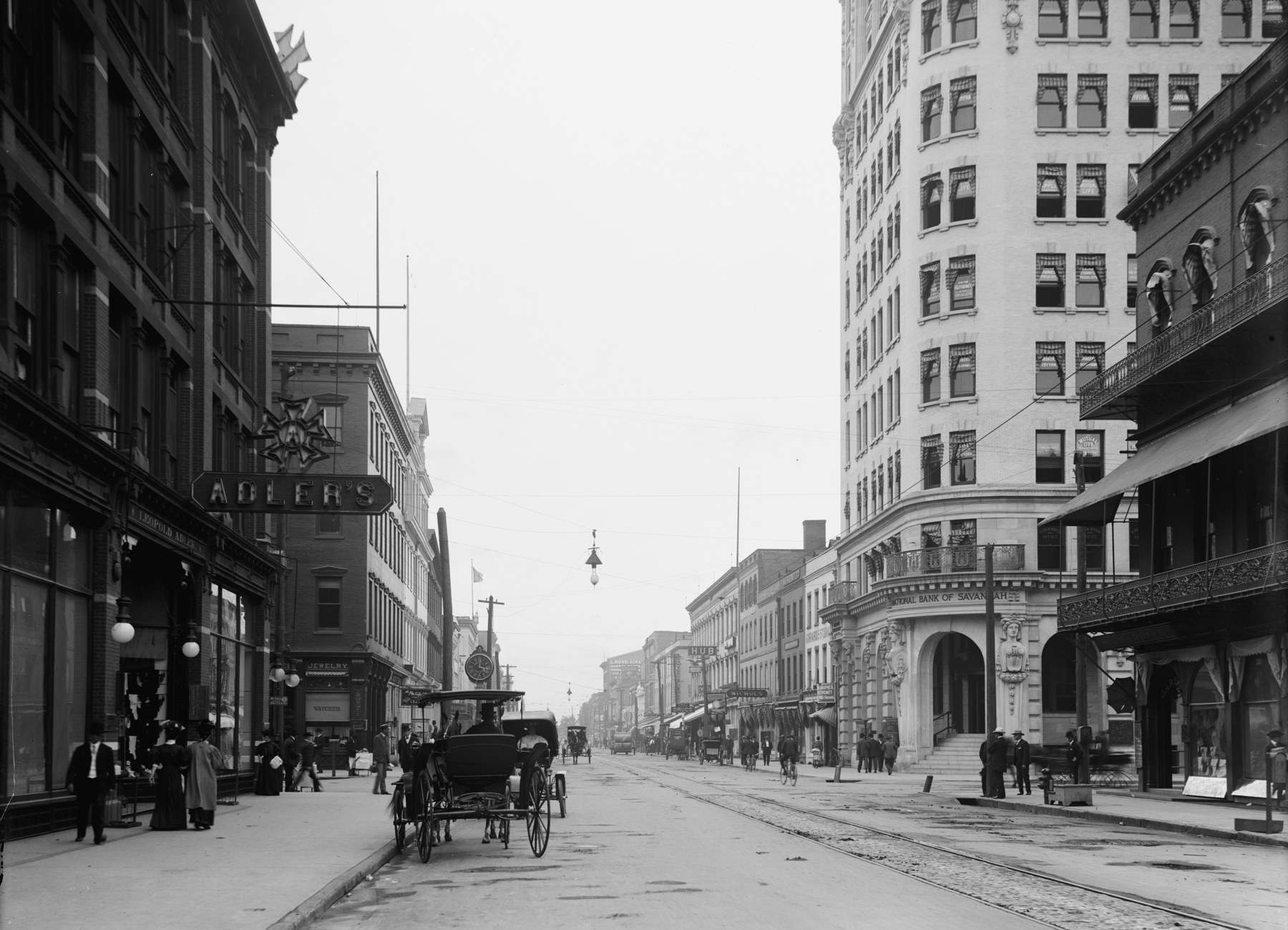
Broughton Street, looking west, Savannah, Georgia, about 1907, with the National Bank of Savannah on the right. Detroit Publishing Co., Library of Congress. Click the picture to see it full size.
On that August night, Whitaker Street belonged to the listeners. The paper said it was “towards 3 o’clock” in the morning before the last of them went home. Today you can watch a game on a phone from anywhere. In 1903, nearly a thousand people in Savannah stood together in the dark and listened to a fight they would never see, one shout at a time.
Sources
- The Savannah Morning News (Savannah, Georgia): August 15, 1903, page 5 (“Savannahians Staid Up for the Fight”) and August 15, 1903, page 1 (“Blows to Stomach Put Corbett Out”).
- The St. Louis Republic (St. Louis, Missouri): August 15, 1903, page 2 (“Crowd Heartily Cheers Republic’s Megaphone”).
- Detroit Publishing Co., “Broughton Street, looking west, Savannah, Ga.,” about 1907, Library of Congress, no known restrictions on publication.
- All newspaper images: Library of Congress, Chronicling America. Published 1903.
- Cover: Detroit Publishing Co., “Broughton Street, looking east, Savannah, Ga.,” between 1900 and 1910, Library of Congress, no known restrictions on publication. It shows downtown Savannah in the same years as the story, not the fight-night crowd.