In the summer of 1905, a Boston swimmer named Henry S. Horan went for his daily swim off the L Street Bath in South Boston, Massachusetts. After a while he lay back to float and rest, the way good swimmers do. Then Henry Horan did something nobody expected. He fell asleep in the ocean.
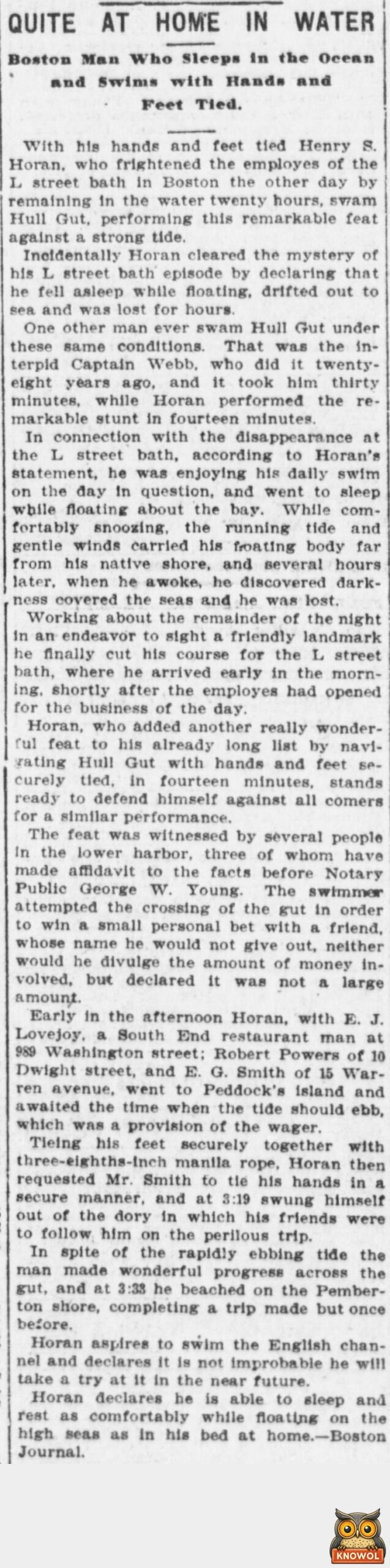
“Quite at Home in Water.” Omaha Daily Bee, Omaha, Nebraska, September 25, 1905, page 5, reprinted from the Boston Journal. Library of Congress, Chronicling America. Click the clipping to read it full size.
Asleep on the water
The Boston Journal told what happened next, and a paper as far away as Omaha, Nebraska, printed it. “While comfortably snoozing, the running tide and gentle winds carried his floating body far from his native shore.” A tide is the ocean’s slow, daily rise and fall, and in a harbor it moves water in and out like a river. Horan drifted along with it.
Hours went by. When he finally woke up, “he discovered darkness covered the seas and he was lost.” Picture it: no lights in the water, no shore in sight, and nobody knowing where you are.
A long night swimming home
Horan kept swimming. He spent “the remainder of the night in an endeavor to sight a friendly landmark,” the paper said. In plain words, he swam around in the dark until he spotted something he knew. He reached the L Street Bath “early in the morning, shortly after the employes had opened for the business of the day.” (Employes was an old spelling of employees.)
By then he had “frightened the employes of the L street bath,” the Journal said, by staying in the water twenty hours. His explanation was the plain truth: he had dozed off.
The L Street Bath was one of Boston’s city bathhouses, on the South Boston shore. The city’s own record book for 1898 lists it as the bath for South Boston boys.
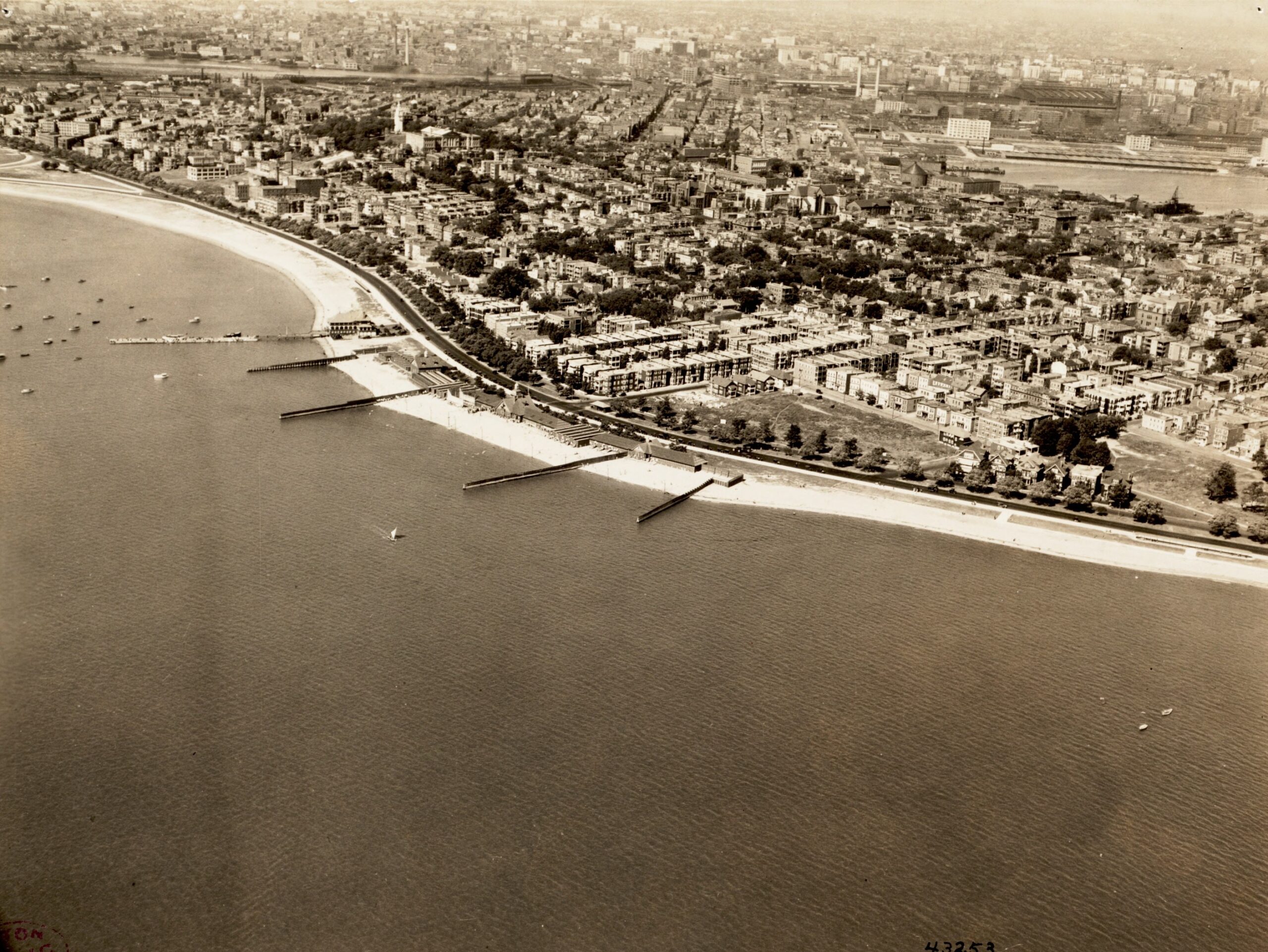
“Columbia Road, So. Boston, showing public baths,” seen from an airplane in 1925, twenty years after Horan’s nap. This is the South Boston shore where the L Street Bath stood. Fairchild Aerial Surveys, Boston Public Library, via Digital Commonwealth. No known copyright restrictions. Click the picture to see it full size.
A bet with a rope
Next came a bet with a friend. Horan would swim across Hull Gut with his hands and feet tied.
Hull Gut is the narrow channel between Peddock’s Island and the tip of the town of Hull, Massachusetts, in the lower part of Boston Harbor. An 1888 guidebook to the harbor called it a rushing strait, a quarter of a mile wide. That’s about as long as four football fields set end to end. When the tide turns, a lot of the harbor’s water rushes through that gap.
Horan would not tell who the friend was. “Neither would he divulge the amount of money involved,” the paper said, “but declared it was not a large amount.” To divulge means to tell. One rule of the bet made it harder: he had to wait until the tide began to ebb, or run back out to sea, so the water would be racing through the Gut.
Fourteen minutes, tied up tight
Horan went out to Peddock’s Island with three friends: E. J. Lovejoy, “a South End restaurant man at 989 Washington street,” Robert Powers of Dwight Street, and E. G. Smith of Warren Avenue. They waited for the tide.
Then he tied “his feet securely together with three-eighths-inch manila rope.” That’s rope a little thicker than a pencil, made from the tough fibers of a plant. He asked Mr. Smith to tie his hands, too. At 3:19 in the afternoon he “swung himself out of the dory,” a small rowboat, and his friends rowed along behind him.
The paper doesn’t say how he moved. With no arms to pull and no legs to kick, he had to push himself along with his whole body, and the tide was pulling against him. Yet he “made wonderful progress across the gut, and at 3:33 he beached on the Pemberton shore.” Pemberton was the point of Hull, where a big summer hotel stood. That’s fourteen minutes.
There were witnesses, too. Three of the people who watched from the lower harbor signed an affidavit, a written promise that a story is true, before a notary public named George W. Young. The Journal said only one other man had ever crossed the Gut that way: “the intrepid Captain Webb,” and he took thirty minutes. Intrepid means fearless.
Next stop, the English Channel
Horan had a bigger dream. “Horan aspires to swim the English channel,” the paper said, “and declares it is not improbable he will take a try at it in the near future.” The English Channel is the strip of sea between England and France, about twenty miles across at its narrowest. A famous Englishman, Captain Matthew Webb, had been the first person to swim it, in 1875. We found no report that Horan ever tried.
Still swimming ten years later
Horan didn’t stop. In July 1915, the Seattle Star in Washington State ran a big headline about him: “It’s Just Play for This Man.” It called him “a former physical instructor at Harvard.” He had just swum across Elliott Bay, from West Seattle to Pier 1, in a little more than two hours, on another bet. Then “he stepped into a rowboat and rowed himself back to West Seattle.”
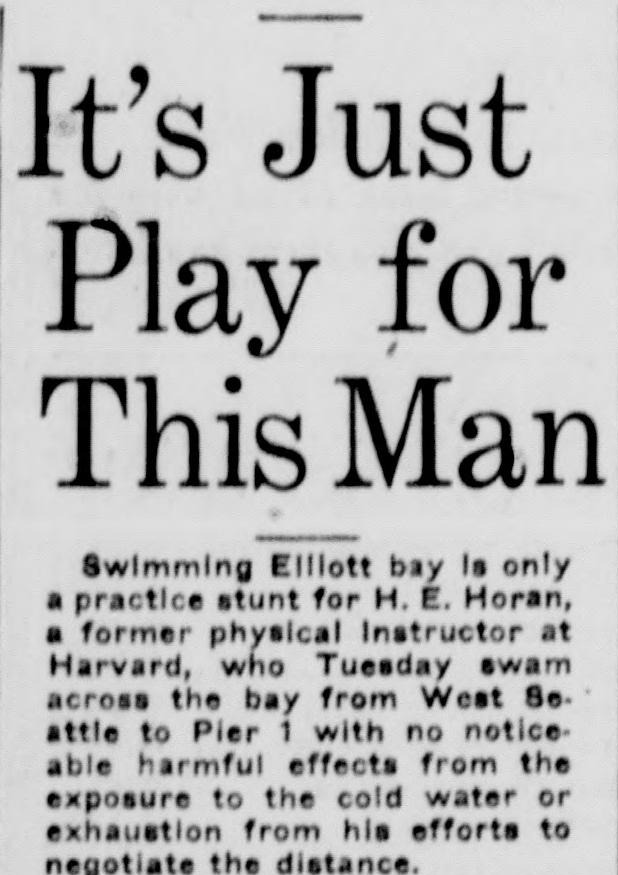
Horan in Seattle, ten years later. The Seattle Star, Seattle, Washington, July 14, 1915, page 7. Library of Congress, Chronicling America. Click the clipping to read it full size.
The Star said he was “6 ft. 1 in. tall” and weighed “225 lbs.” It still remembered his Boston swims, including the one “across Hull Gut … with his hands and feet tied.” The Star said he spent “over 24 hours in the water without rest or nourishment” that night in Boston Harbor. The Boston paper in 1905 had said twenty, so the story had grown a little. The Seattle paper also called him H. E. Horan instead of Henry S. Horan, but it told the same two Boston stories. He was planning to swim Elliott Bay tied up, too.
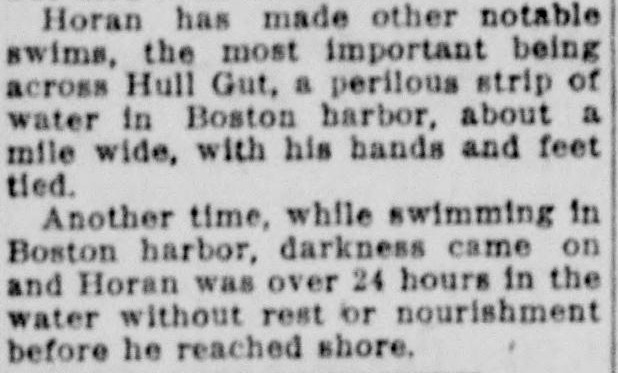
The Seattle Star remembers Hull Gut and the night in Boston Harbor. The Seattle Star, Seattle, Washington, July 14, 1915, page 7. Library of Congress, Chronicling America. Click the clipping to read it full size.
A calmer swim
Most swimming in Hull looked a lot calmer. On Nantasket Beach, on the ocean side of town, women waded into the surf in long dark bathing dresses, and nobody swam with a rope around their feet.
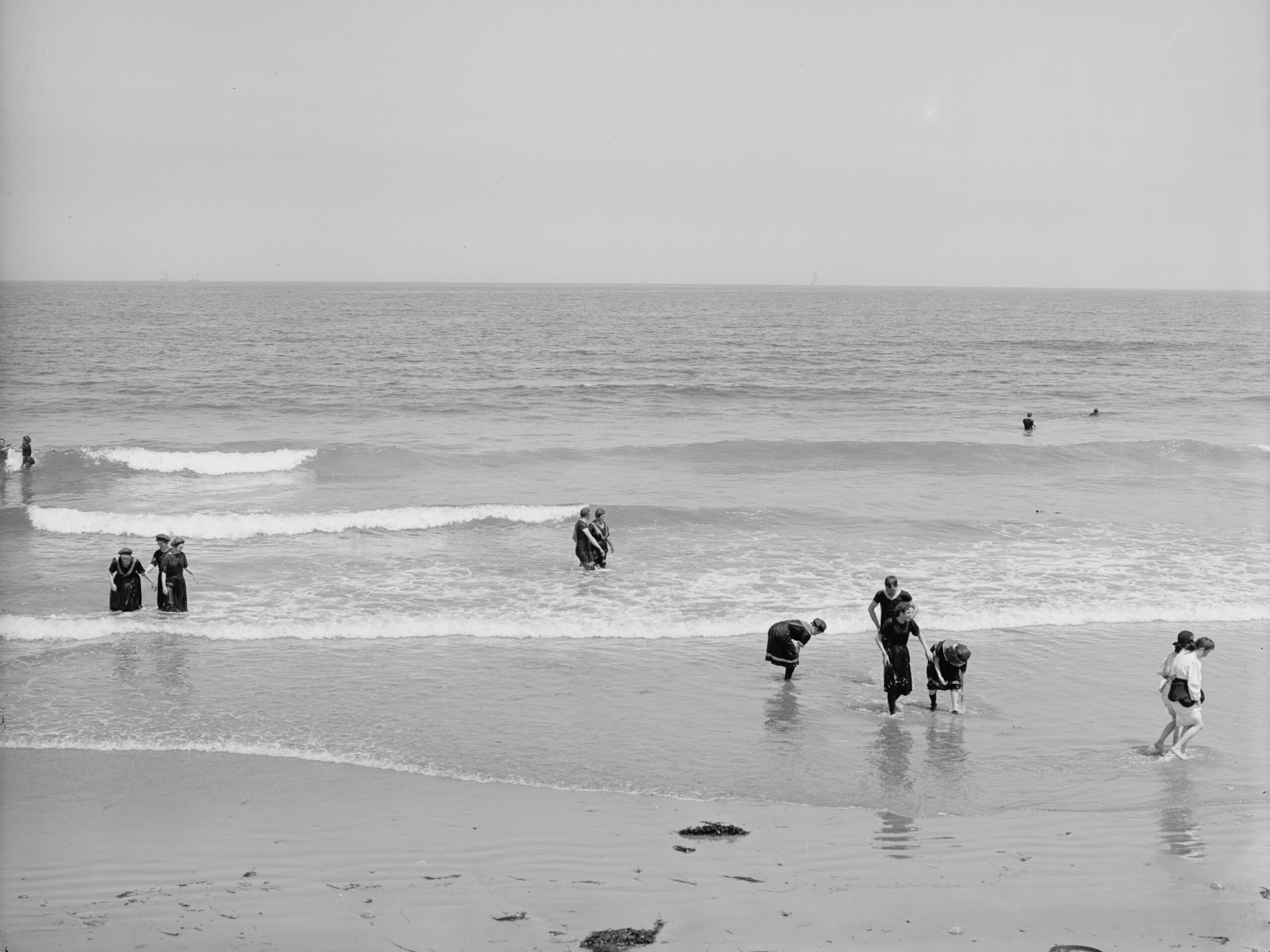
“In the surf, Nantasket Beach, Mass.,” between 1900 and 1910. Nantasket Beach is in Hull, on the ocean side, a short way from Hull Gut. Detroit Publishing Co., Library of Congress. No known restrictions on publication. Click the picture to see it full size.
Sleeping like a log
Today’s lifeguards would tell anyone not to try either stunt. Even Horan had three friends rowing right behind him for the bet. But he never seemed worried about the water. The Journal saved his own words for the very end of the story. “Horan declares he is able to sleep and rest as comfortably while floating on the high seas as in his bed at home.” For most of us, the ocean is a place to swim. For Henry Horan, it was also a place to take a nap.
About the pictures
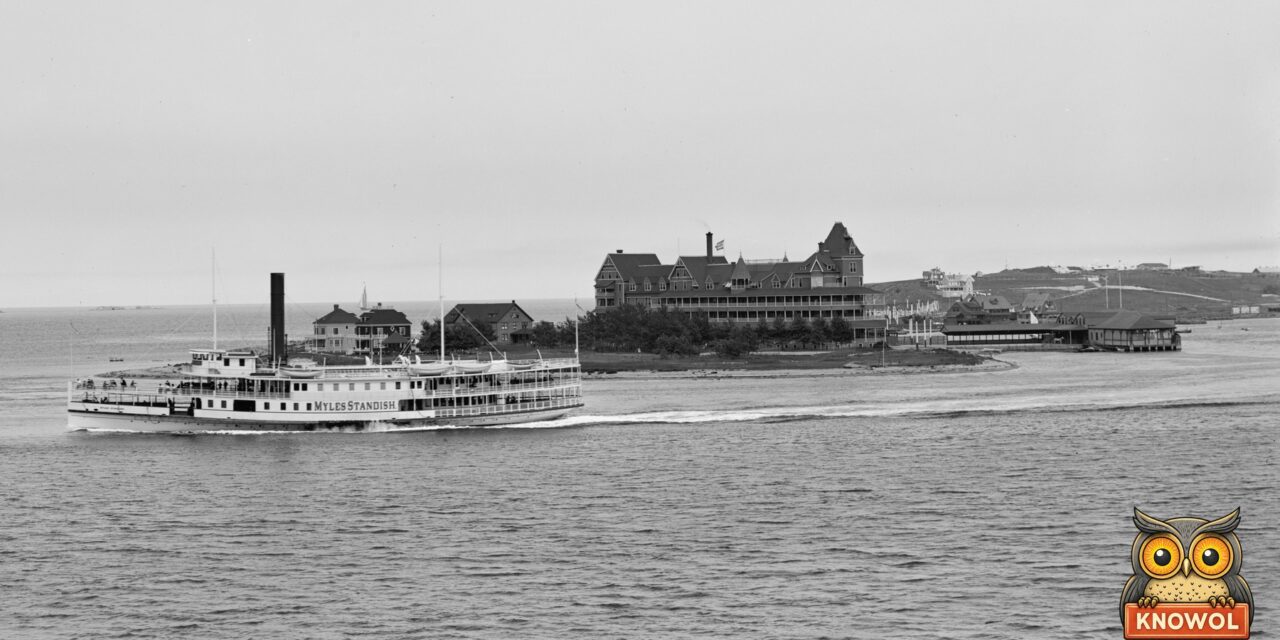
The cover is a 1901 photograph by the Detroit Publishing Co. taken from Peddock’s Island and looking across Hull Gut at Hull. The steamboat Myles Standish is steaming through the channel, and the big building on the point is the Hotel Pemberton. Horan landed on that same Pemberton shore four years later. No photograph of his swim has turned up.
Sources
- Omaha Daily Bee (Omaha, Nebraska): “Quite at Home in Water,” September 25, 1905, page 5, reprinted from the Boston Journal.
- The Seattle Star (Seattle, Washington): “It’s Just Play for This Man,” July 14, 1915, page 7.
- Hull Gut’s width: King’s Handbook of Boston Harbor (1888), Internet Archive.
- The L-street bath: City Record, Boston (1898), Internet Archive.
- All newspaper images: Library of Congress, Chronicling America. Published 1905 to 1915.
- Cover: “Hull, Mass., from Paddock’s Island,” Detroit Publishing Co., 1901, Library of Congress, no known restrictions on publication.
- Nantasket Beach photo: Detroit Publishing Co., Library of Congress, no known restrictions on publication.
- South Boston aerial photo, 1925: Fairchild Aerial Surveys, Boston Public Library, Digital Commonwealth, no known copyright restrictions.