On Monday, October 19, 1903, a ghost came to Americus, Georgia. Nobody ran. Nobody screamed. The men at the railroad yards had been waiting for it all month. The next morning the Americus Times-Recorder put it on page four: “CENTRAL’S GHOST IN AMERICUS. This Silver Spirit Dispenses Numerous Dollars.” Dispenses means hands out. The ghost was the railroad’s pay car, and it was full of money.
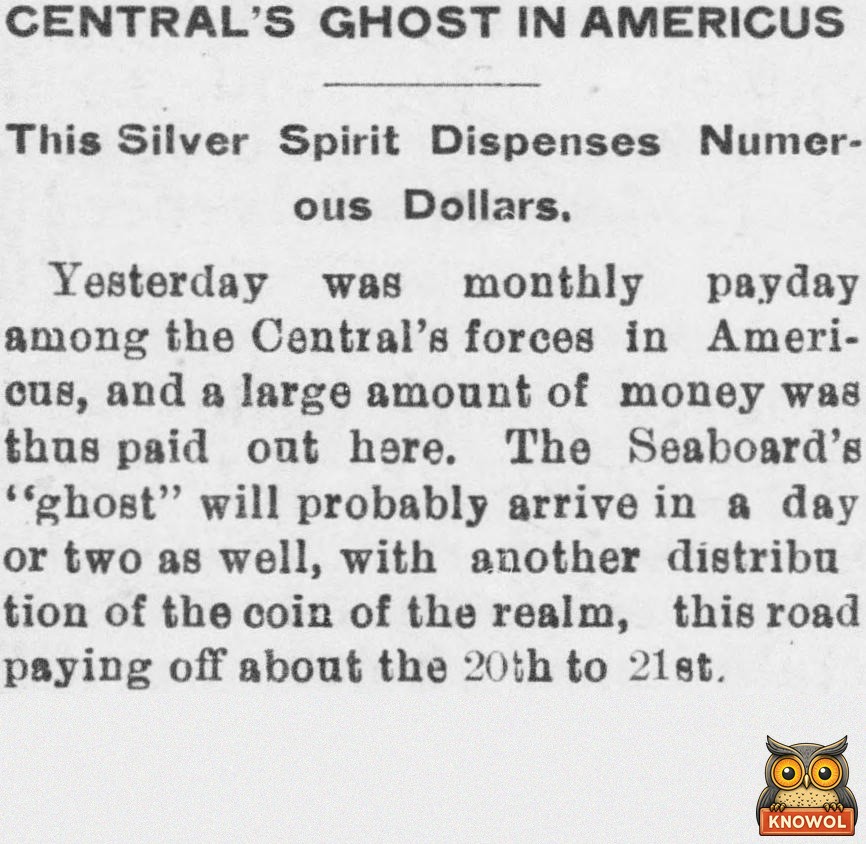
“Central’s Ghost in Americus.” Americus Times-Recorder, Americus, Georgia, October 20, 1903, page 4. Library of Congress, Chronicling America. Click the clipping to read it full size.
Why they called it a ghost
Railroad men did not invent the ghost. Actors did. In 1892 the Aberdeen Herald, a Washington newspaper, explained the slang. “The Ghost walks” meant “salaries are paid.” The story went back to a company of English traveling actors whose “salaries had been long in arrears.” In arrears means they had not been paid in a long time. They were rehearsing Hamlet, the play where a ghost walks the castle walls at night. When Hamlet said his line, “Perchance ’twill walk again,” the actor playing the Ghost shouted back that the Ghost would not walk any more until the salaries were paid.
By the 1900s, working people all over the country said “the ghost walks” when payday came. Railroad towns had the best reason to say it, because on the railroad, payday really did arrive on wheels.
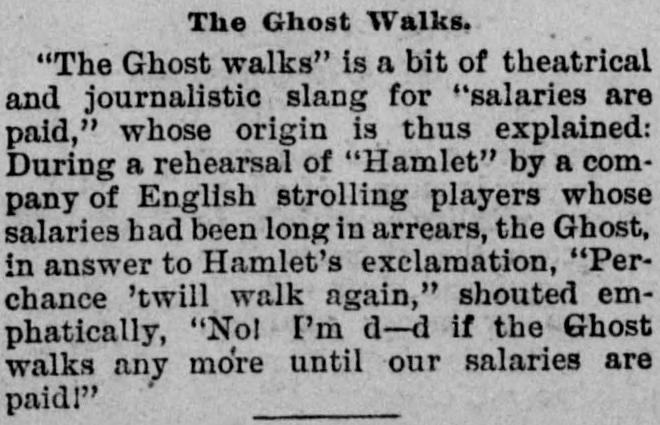
“The Ghost Walks.” Aberdeen Herald, Aberdeen, Washington, August 25, 1892, page 1. Library of Congress, Chronicling America. Click the clipping to read it full size.
A bank on wheels
Railroad workers were spread out along hundreds of miles of track. So the money came to them. In 1900 the Springfield Republican, in Massachusetts, told how it worked. In the early days the paymaster was “trundled over the line on a hand-car,” the little flat cart that two men pump along the rails. At each stop the track gang lined up, and “in a few minutes the men were at work again with a quantity of clinking metal in their trousers pockets.”
As the railroads grew, the paymaster got “a traveling office,” the pay car, “a counting-room on wheels.” A counting-room was an office where money was counted. The pay car was “fitted up inside with all the ordinary equipment of an office with counter and cashier’s window.” It went “drawn by a special engine, stopping wherever men were at work and allowing opportunity for them to come aboard and draw their money.” A worker climbed up, gave his name at the little window, and climbed down with a month’s wages in coin. No checks. No bank. Real silver and gold.
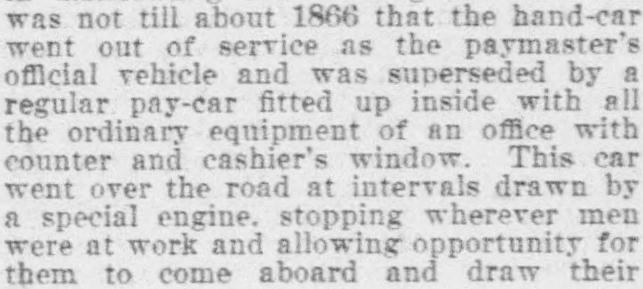
The pay car had a “counter and cashier’s window.” The Springfield Weekly Republican, Springfield, Massachusetts, July 27, 1900, page 5. Library of Congress, Chronicling America. Click the clipping to read it full size.
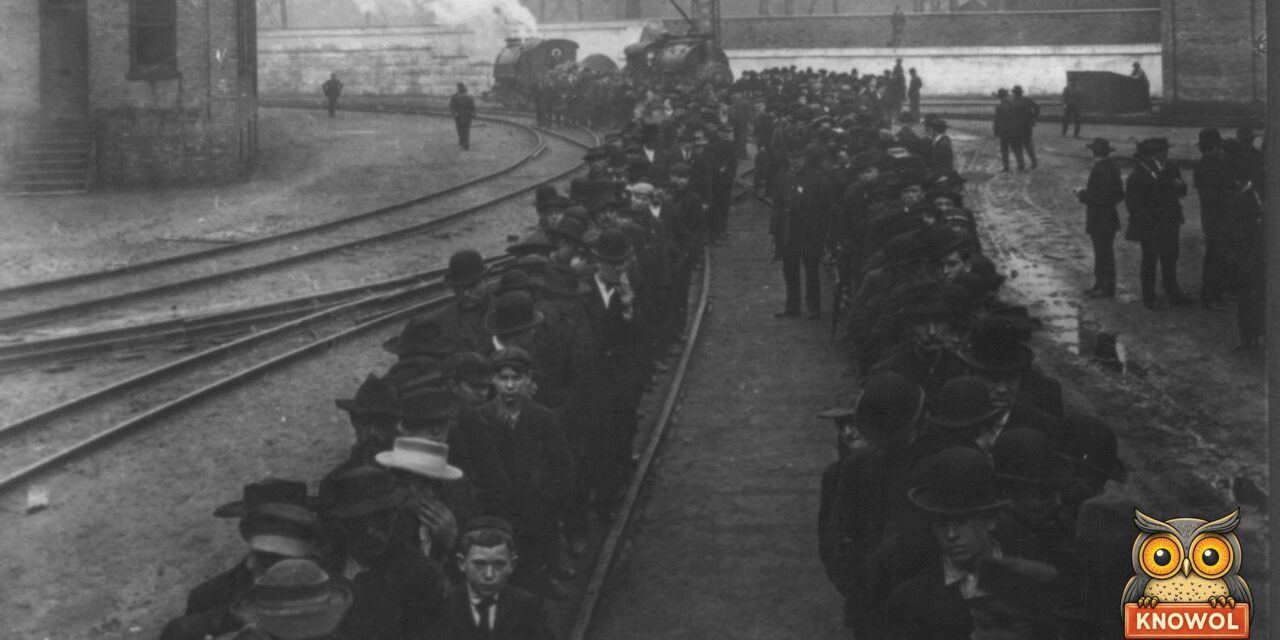
The picture at the top of this story shows payday at a steel mill in Homestead, Pennsylvania, in 1907. Two long lines of men and boys in hats are walking toward the pay car. It is not a railroad, but the idea was the same: line up at the car, go home with cash.
Two ghosts a month
Americus was a town of about 7,600 people in southwest Georgia, and it was a railroad town. Two railroads ran through it, the Central of Georgia and the Seaboard Air Line. The Seaboard also kept its big repair shops there. In 1900 the Times-Recorder called them the “largest owned by the Greater Seaboard” and said “Some 350 men find employment there.”
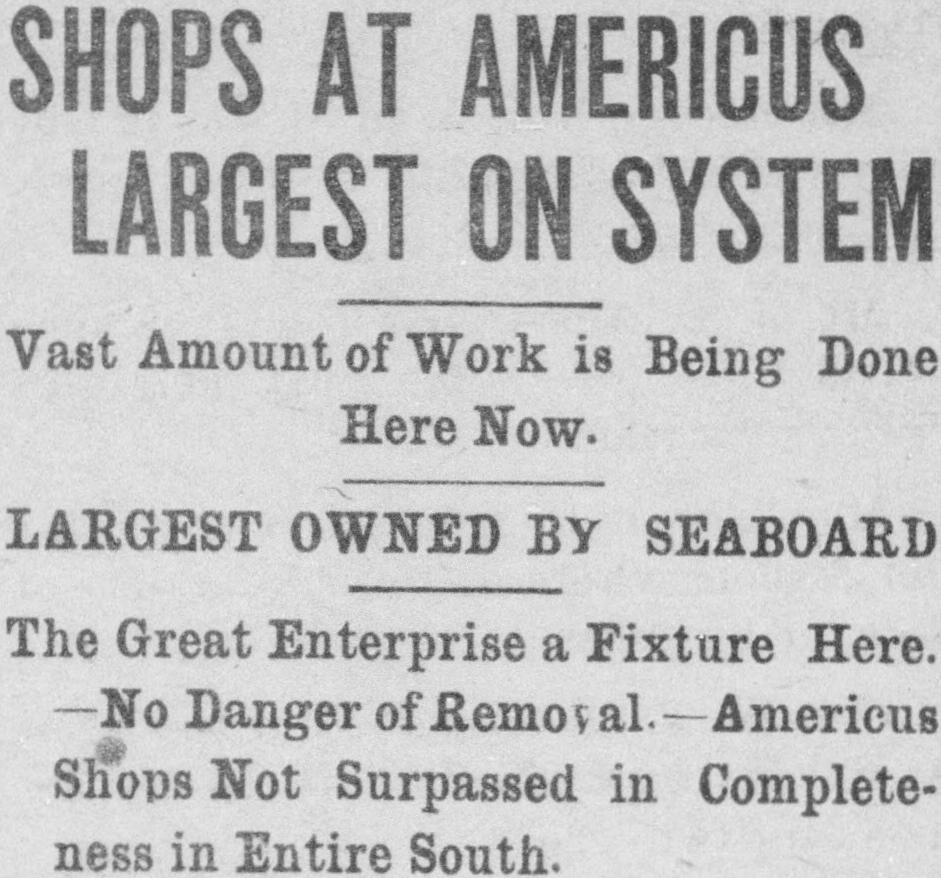
“Shops at Americus Largest on System.” Americus Times-Recorder, Americus, Georgia, July 26, 1900, page 4. Library of Congress, Chronicling America. Click the clipping to read it full size.
So Americus had two ghosts. The Central’s came first. Then, the paper said, “The Seaboard’s ‘ghost’ will probably arrive in a day or two as well, with another distribution of the coin of the realm, this road paying off about the 20th to 21st.” Coin of the realm is an old way of saying the country’s money.
The local news column followed the ghost the way it followed the weather. “It is about ‘pay time’ again with the Seaboard, and the merry ghost with the money bags is expected to arrive here either today or tomorrow,” it said in February 1903. In August: “The Seaboard ‘ghost’ did not walk yesterday, but this financial spirit will manifest its presence on Monday next.”
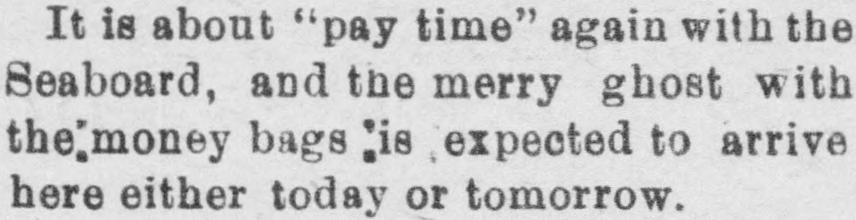
“The merry ghost with the money bags.” Americus Times-Recorder, Americus, Georgia, February 20, 1903, page 4. Library of Congress, Chronicling America. Click the clipping to read it full size.
By the numbers
The paper counted the money for the whole town, not just for the men. In January 1902 it ran the headline “GHOST WALKS AT THE SHOPS. Shekels are Distributed Among the Employes.” Shekels is an old word for money. That payday, “the distribution of perhaps $20,000 here served to put the several hundred men in the shops, yards and offices in a pleasant frame of mind.” Twenty thousand dollars in one day, in a town of 7,600 people.
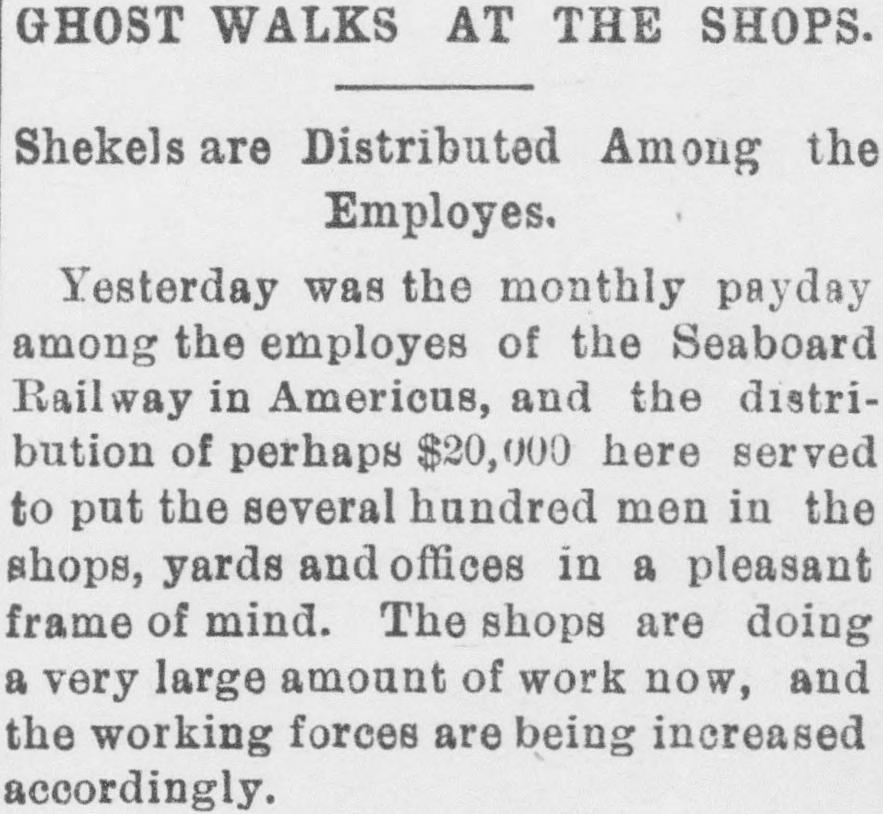
“Ghost Walks at the Shops.” Americus Times-Recorder, Americus, Georgia, January 19, 1902, page 4. Library of Congress, Chronicling America. Click the clipping to read it full size.
In October 1903, two days after the Central paid, the column said, “Railway employes are looking for the ‘ghost’ to walk today, in which event many thousands of bright dollars will be circulated here.” Downtown, where stores filled the block around the brick Windsor Hotel, business was already good. “Merchants here were busy, very busy yesterday,” the same column said. “Scores of people came to town to make fall purchases, and many stores were thronged.”
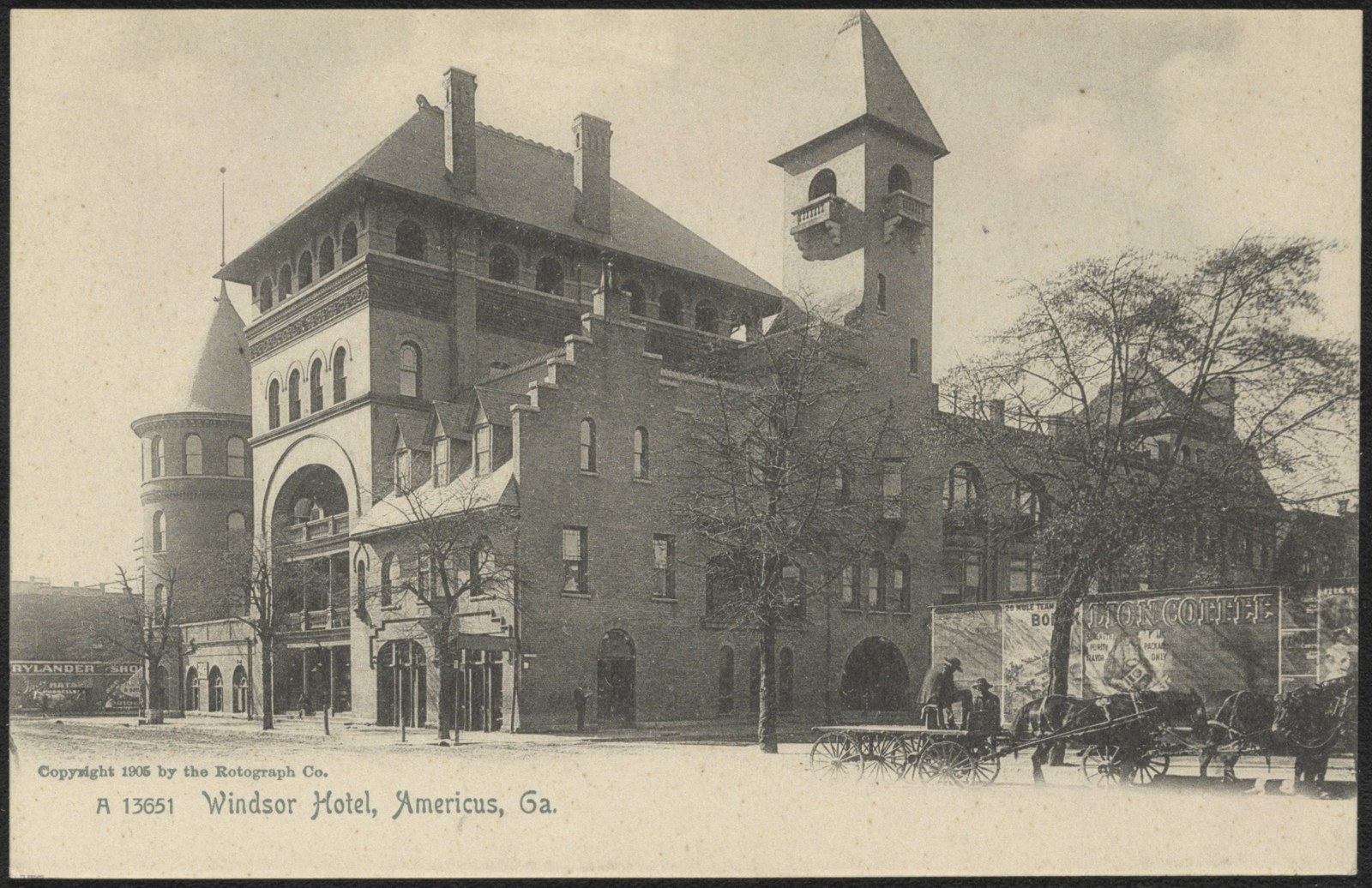
The Windsor Hotel in downtown Americus, Georgia, on a 1905 postcard by the Rotograph Co. Library of Congress. Click the picture to see it full size.
The best ghost of all came at Christmas. On December 22, 1904, “The Seaboard’s Christmas ‘ghost’ walked to town yesterday and brought gold wrought and silver lined cheer to the hundreds of employes of the company in Americus.” That time it was “About $25,000,” and the paper added, “old Santa smiles in consequence.”
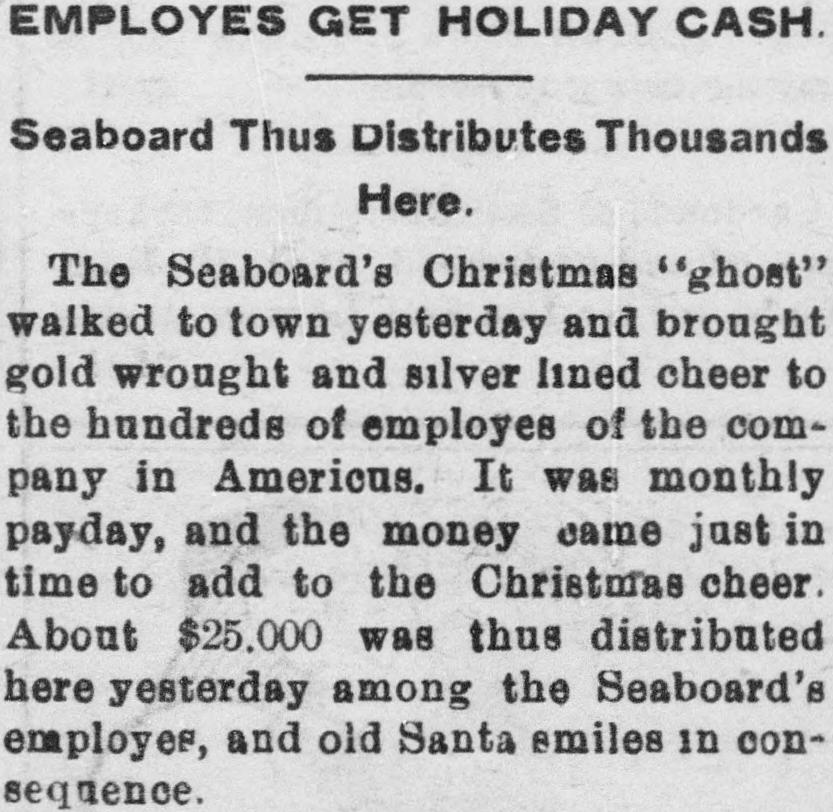
“Employes Get Holiday Cash.” Americus Times-Recorder, Americus, Georgia, December 23, 1904, page 3. Library of Congress, Chronicling America. Click the clipping to read it full size.
Two visitors in one morning
The ghost was not the only visitor in the paper that morning. A little farther down the same column was another headline: “JACK CAME TO TOWN AT LAST. First Frost of the Season Observed Yesterday.” Jack Frost had shown up “only in low, damp places,” and “vegetation was not in the least injured.” So Americus woke up that Tuesday with a light frost on the ground and silver in its pockets. The paper treated both as good news.
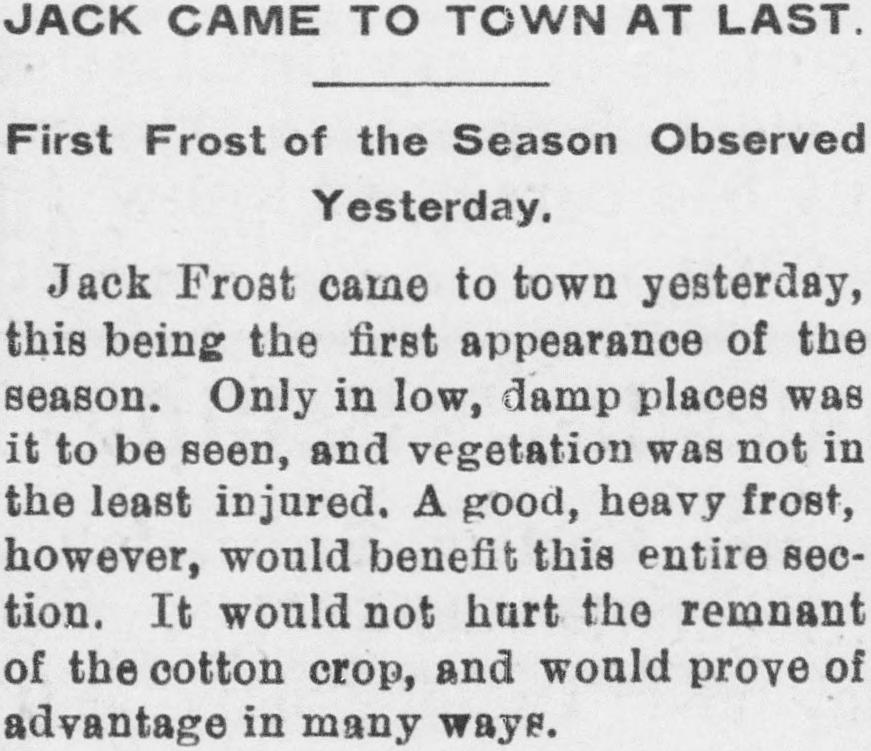
“Jack Came to Town at Last.” Americus Times-Recorder, Americus, Georgia, October 20, 1903, page 4. Library of Congress, Chronicling America. Click the clipping to read it full size.
The ghost kept walking for years. In November 1903 the paper noted that “The walking of the Seaboard ghost yesterday was a subject of interest to many here. The usual goodly sum of dollars were distributed.” Payday still comes around, of course. But it comes as a check or a deposit now, not as a railroad car with a cashier’s window. Nobody waits at the yard for a ghost with money bags, and nobody calls it merry.
Sources
- Americus Times-Recorder (Americus, Georgia): October 20, 1903, page 4 (“Central’s Ghost in Americus” and “Jack Came to Town at Last”); January 19, 1902, page 4 (“Ghost Walks at the Shops”); October 24, 1902, page 5 (the pay car a day or two late); February 20, 1903, page 4 (“the merry ghost with the money bags”); August 22, 1903, page 3 (“this financial spirit”); October 22, 1903, page 3 (“many thousands of bright dollars”); November 24, 1903, page 4 (“The walking of the Seaboard ghost”); December 23, 1904, page 3 (“Employes Get Holiday Cash”); July 26, 1900, page 4 (“Shops at Americus Largest on System”).
- Aberdeen Herald (Aberdeen, Washington): August 25, 1892, page 1 (“The Ghost Walks,” where the slang came from).
- The Springfield Weekly Republican (Springfield, Massachusetts): July 27, 1900, page 5 (“Paying Off on the Railroad,” how the hand-car and the pay car worked).
- Georgia Department of Agriculture, Georgia: Historical and Industrial (Atlanta, 1901): Americus had 7,647 people, and the Seaboard Air Line shops were among the county’s industries.
- Allen D. Candler and Clement A. Evans, editors, Georgia: Comprising Sketches of Counties, Towns, Events, Institutions, and Persons (Atlanta, 1906): Americus sat on the Central of Georgia and the Seaboard Air Line.
- Cover: H. C. White Co., “Payday at the steel works – lines of men and boys approaching pay car, Homestead, PA,” stereograph, 1907, Library of Congress, no known restrictions on publication. It shows a Pennsylvania steel mill, not Americus.
- Rotograph Co., “Windsor Hotel, Americus, Ga.,” postcard, 1905, Library of Congress, no known restrictions on publication.
- All newspaper images: Library of Congress, Chronicling America. Published 1892 to 1904.