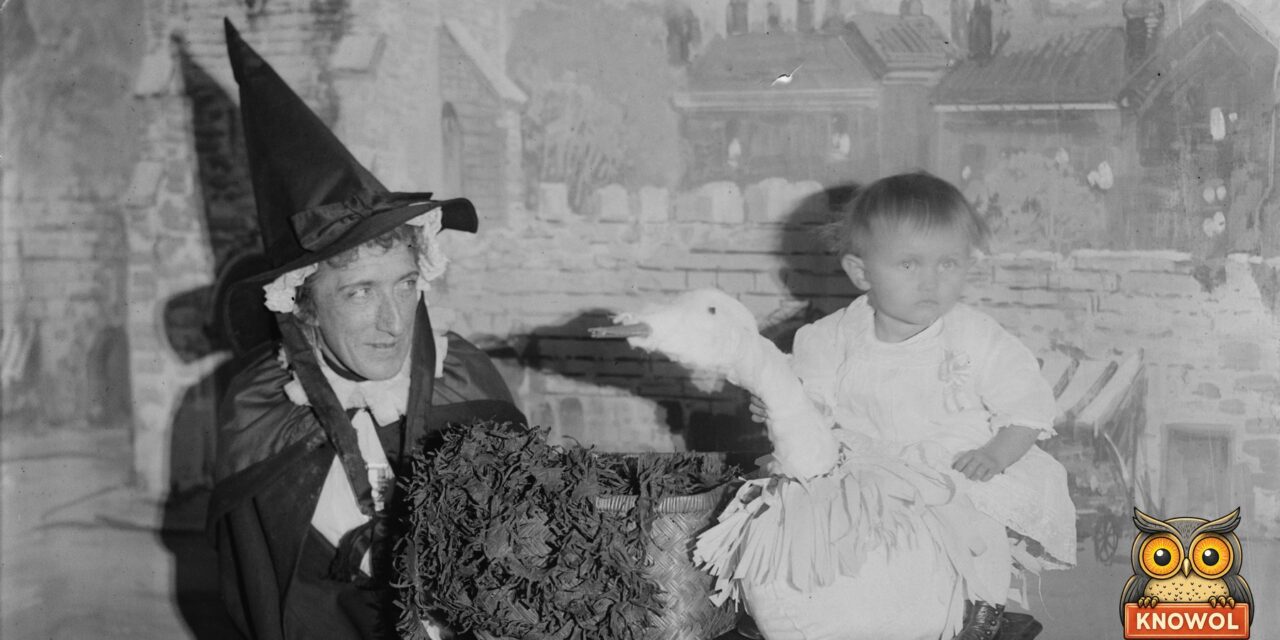
On Friday night, October 30, 1896, every seat in Franklin Hall in Willimantic, Connecticut was full. The high school was throwing its Halloween party. Miss Buchanan stood up and read a short opening speech to explain the show. Then Mother Goose walked out, and behind her came about forty high school students dressed as the people in her nursery rhymes. Not one of them said a word.
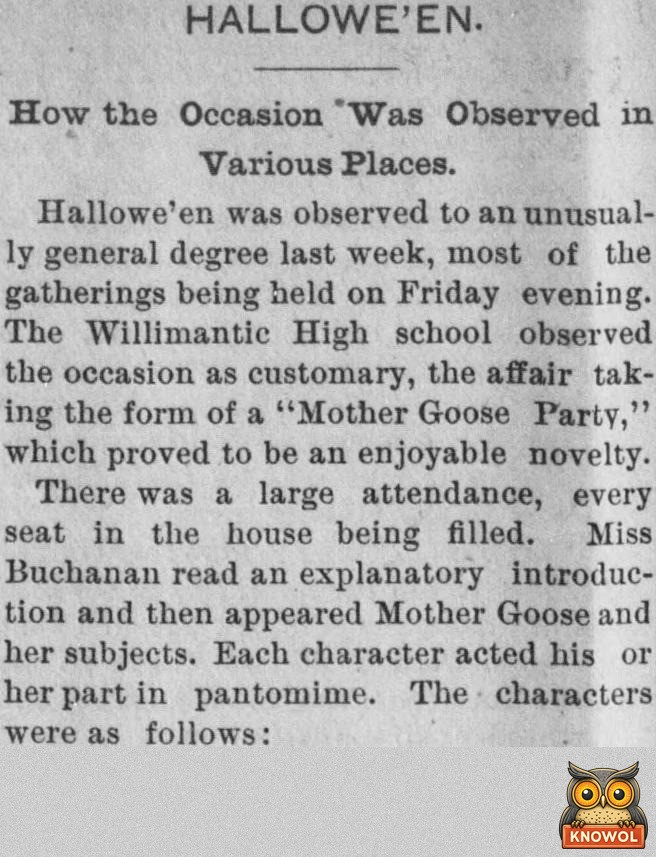
“Hallowe’en.” The Willimantic Journal, Willimantic, Connecticut, November 6, 1896, page 8. Library of Congress, Chronicling America. Click the clipping to read it full size.
A show with no talking
The party was a “Mother Goose Party.” The Willimantic Journal put it this way: “Each character acted his or her part in pantomime.” Pantomime is acting with no words at all. You tell the story with your face, your hands and your feet, and the crowd figures out the rest.
Here is the funny part. Mother Goose was played by a teacher, Miss Rossiter. A week before the party, the Journal said she was the high school’s “instructor in elocution and physical culture.” Elocution meant speaking well out loud. Physical culture was the 1896 name for gym class. So the school’s speaking teacher led a show where nobody spoke.
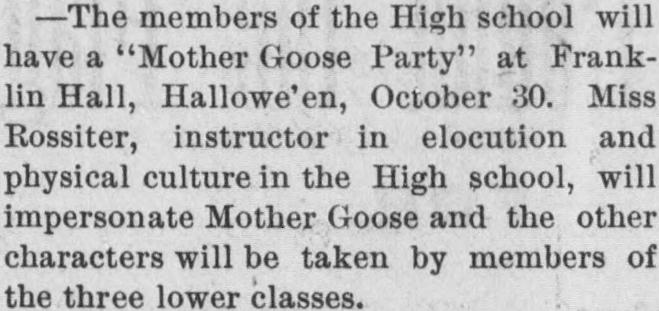
The party is coming. The Willimantic Journal, Willimantic, Connecticut, October 23, 1896, page 5. Library of Congress, Chronicling America. Click the clipping to read it full size.
The paper had said the actors would come from the three younger classes. The seniors ran the party itself. A committee of nine seniors made the plans, and Mr. Graham did the decorations, which the paper called “beautiful and appropriate.”
Three boys, one tub
A week after the party, families could open the Journal and find every name. The cast list reads like a book of rhymes come to life.
Old King Cole was Mr. McFarlane. He had a page (a young helper) and his fiddlers three, played by three boys named Jordan, Scripture and Leonard. Jack and Jill were Miss Lakin and Mr. Purdee. Little Boy Blue was Mr. Hyde, and Simple Simon was Mr. Lincoln. Then came the line that is hard to read without smiling: “Rub-a-Dub-Dub, three men in a tub, Messrs. Larkin, Latham and Sullivan.” Messrs. is the old short way to write “Misters.”
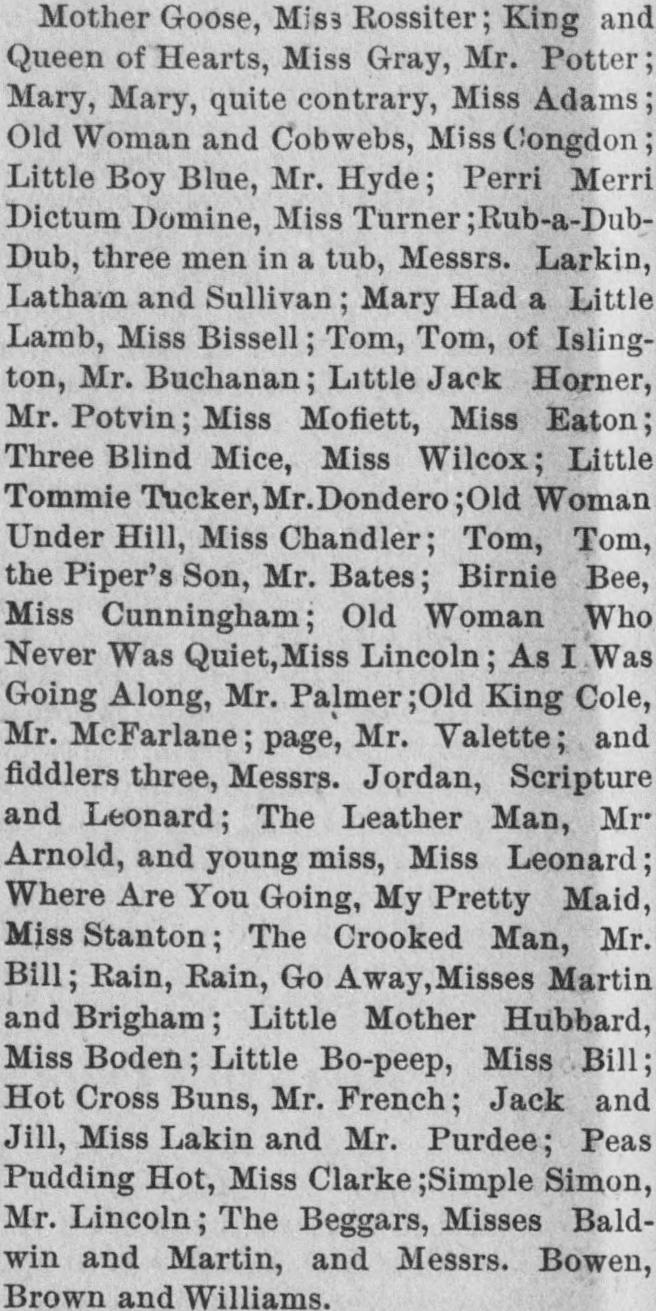
The whole cast, from Mother Goose to the Beggars. The Willimantic Journal, Willimantic, Connecticut, November 6, 1896, page 8. Library of Congress, Chronicling America. Click the clipping to read it full size.
Some parts must have been fun to watch. “Three Blind Mice” was played by just one student, Miss Wilcox. And the Old Woman Who Never Was Quiet was played by Miss Lincoln, in a show with no talking. The paper’s verdict on the whole idea was short and happy: it “proved to be an enjoyable novelty.” A novelty is something new and different.
When the rhymes were done, the dancing began. Harry Royce played the music. Someone named Macfarlane ran a snack stand. In the paper’s words, Macfarlane “dispensed refreshments from a booth in a corner.”
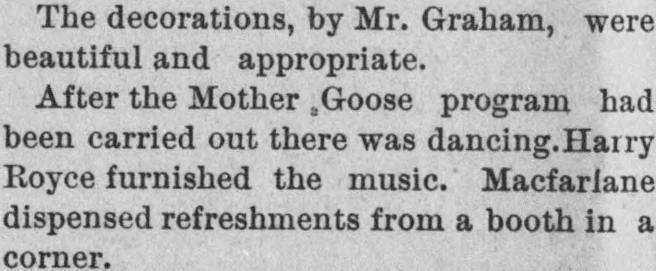
After the show. The Willimantic Journal, Willimantic, Connecticut, November 6, 1896, page 8. Library of Congress, Chronicling America. Click the clipping to read it full size.
Halloween before trick-or-treat
In 1896, nobody went door to door asking for candy. That custom came much later. Halloween was a night for parties, and that year Willimantic had a lot of them. The Journal said the holiday “was observed to an unusually general degree,” which means almost everybody joined in.
Willimantic was a busy mill town on the Willimantic River. Its big mills made thread. The town also had the State Normal School, a college that trained young people to be teachers. Its students practiced teaching real children in a “Model school.”
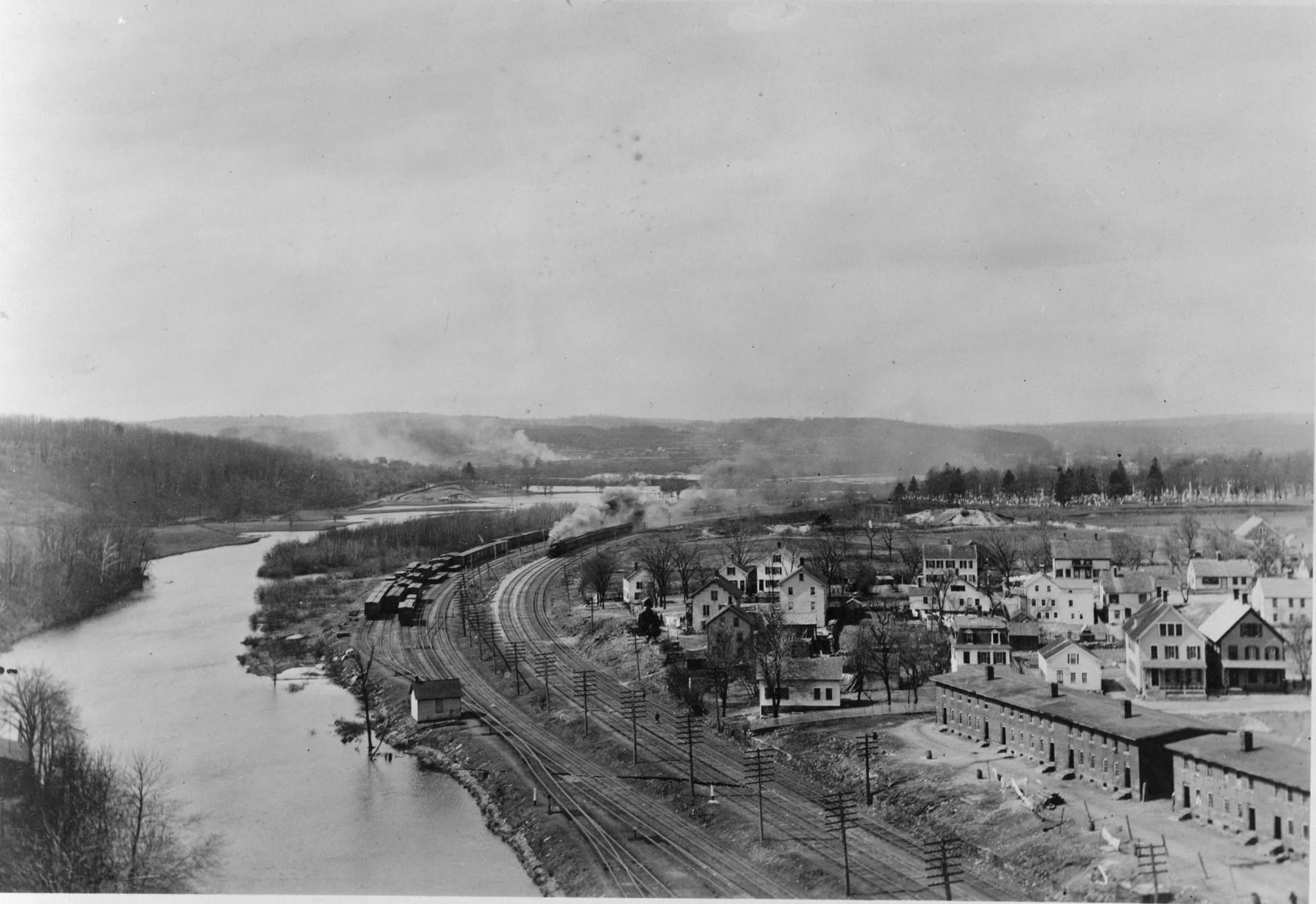
Willimantic, Connecticut, looking west, with the Willimantic River, the railroad tracks and rows of houses. Photo taken between 1900 and 1909. Library of Congress Prints and Photographs. Click the picture to see it full size.
The Normal school had its own party too. The juniors invited the seniors and the teachers, and nearly one hundred people came. They filled the gym with pine branches and fall leaves. There was a grand march, six dances and a violin solo. Best of all, “Miss Benedict, who represented a ghost, told fortunes.” Telling fortunes was a Halloween favorite. Guests wanted to know who they would marry or what next year would bring.
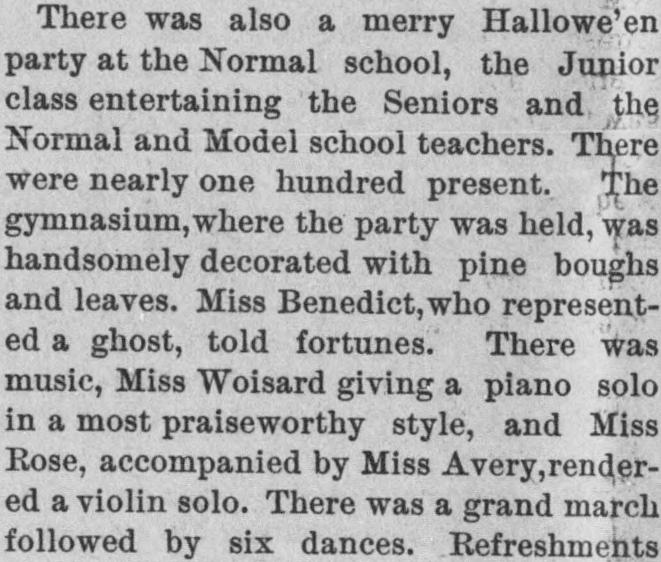
A ghost who told fortunes, at the State Normal School. The Willimantic Journal, Willimantic, Connecticut, November 6, 1896, page 8. Library of Congress, Chronicling America. Click the clipping to read it full size.
The loudest party in South Coventry
A few miles away, in South Coventry, the younger kids had a party of their own. The pupils of the grammar school (the grades below high school) met in G.A.R. hall, the meeting hall of the town’s Civil War veterans. Those kids were not doing pantomime. The South Coventry news in the Journal said some people walking by, and some neighbors, “thought it came nearer to a hollere’en.” Today South Coventry is a village in the town of Coventry, Connecticut.
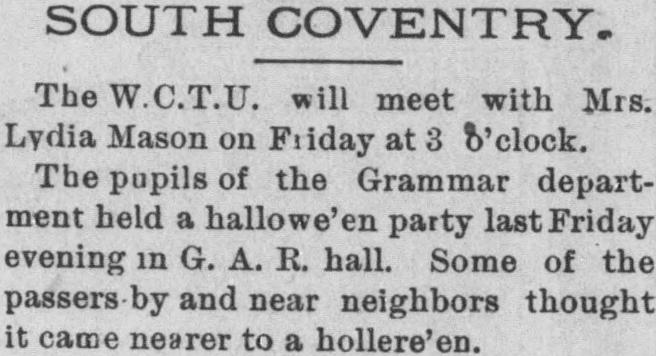
“Nearer to a hollere’en.” The South Coventry news, The Willimantic Journal, Willimantic, Connecticut, November 6, 1896, page 8. Library of Congress, Chronicling America. Click the clipping to read it full size.
Every name, still there
The cover photo at the top of this page is not from Willimantic. It was taken for the Bain News Service, a New York photo company, sometime between about 1915 and 1920. It shows a costumed Mother Goose in a tall pointed hat, beside a big pretend goose and a baby the old caption calls “Baby May.” It gives an idea of how a Mother Goose looked on stage in those years.
Nobody took a picture of Willimantic’s party, as far as we know. But the town paper did something almost as good. It printed every part and every name, from the King of Hearts to the Beggars, so each family could find its own student. Those names are still there on page 8, 130 years later: the teacher who taught talking and didn’t say a word, one girl playing three mice, and three boys sharing one tub.
Sources
- The Willimantic Journal (Willimantic, Connecticut): November 6, 1896, page 8 (“Hallowe’en,” and the South Coventry news).
- The Willimantic Journal (Willimantic, Connecticut): October 23, 1896, page 5 (the party at Franklin Hall announced).
- “Willimantic, Conn.–Looking west from new clearing(?),” between 1900 and 1909, Library of Congress, no known restrictions on publication.
- Willimantic Linen Company mills, Historic American Buildings Survey, Library of Congress.
- All newspaper images: Library of Congress, Chronicling America. Published 1896.
- Cover: Bain News Service, “Mother Goose & Baby May,” between about 1915 and 1920, Library of Congress, no known restrictions on publication. It shows a costumed Mother Goose, not the Willimantic party.