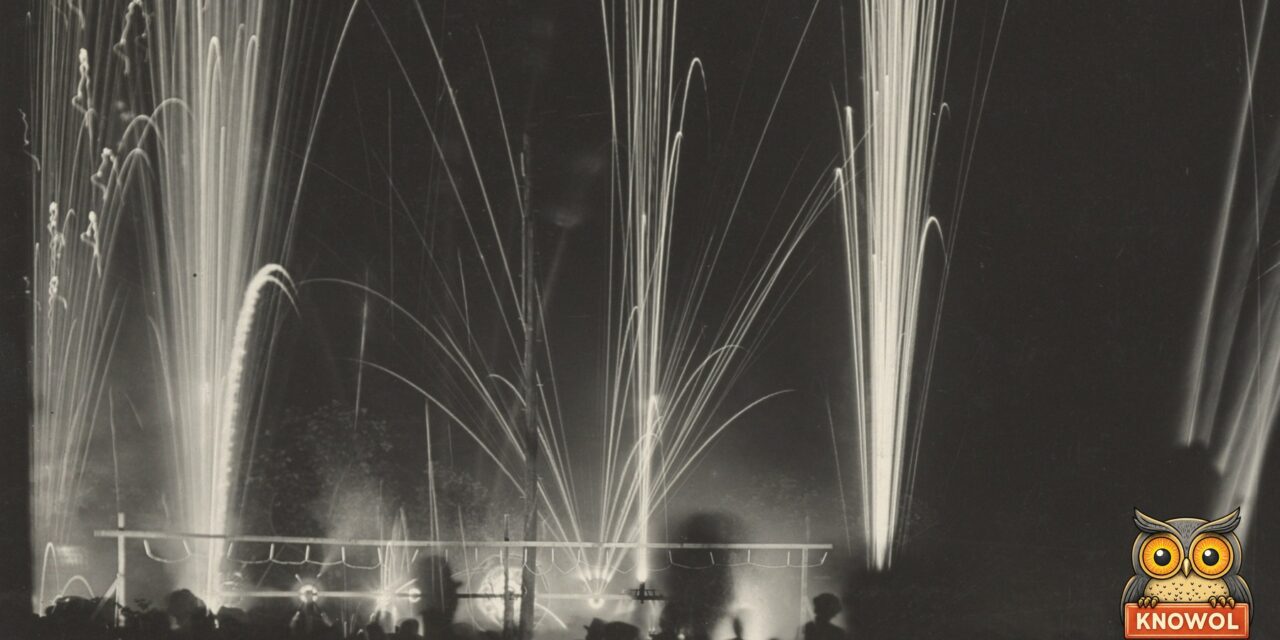
On Wednesday night, September 23, 1908, nearly twelve hundred people passed through the gates of the fair grounds in Grand Junction, Colorado. They had paid a quarter each. The program called for the Palisade band at 7:15 and the fireworks at 7:45. Everybody was waiting for one picture in particular. The fireworks company had promised a giant portrait made of fire, showing “the most prominent man in Grand Junction.” Nobody in the crowd knew who it would be. The paper said the name was being kept secret “until the very last.”
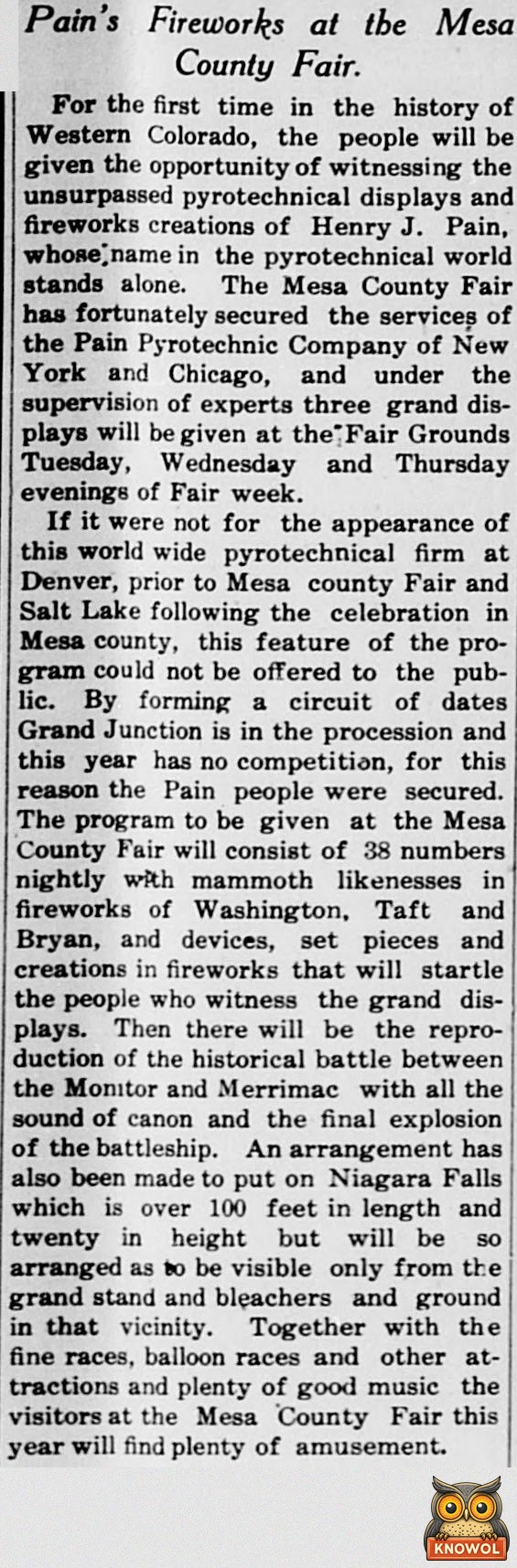
“Pain’s Fireworks at the Mesa County Fair.” The Delta Independent, Delta, Colorado, September 4, 1908, page 7. Library of Congress, Chronicling America. Click the clipping to read it full size.
A big-city show comes west
Grand Junction was a young farm town on the Western Slope, the dry side of the Rocky Mountains. Each fall it held the Mesa County Fair, with horse races, prize fruit and balloon races. In 1908 the fair landed something new: the Pain Pyrotechnic Company of New York and Chicago. The man behind it, Henry J. Pain, was a man “whose name in the pyrotechnical world stands alone,” as one paper put it. Pyrotechnics is a fancy word for fireworks.
How did a small Colorado town get a big New York show? Luck and a map. Pain’s was already coming west to put on fireworks in Denver, and it was heading to Salt Lake City after that. Grand Junction sat on the railroad in between. The Delta Independent, a paper in the next county over, explained it this way: “By forming a circuit of dates Grand Junction is in the procession.” The paper said it would be “the first time in the history of Western Colorado.”
The paper promised “mammoth likenesses in fireworks of Washington, Taft and Bryan.” It promised a “Niagara Falls” of fire “over 100 feet in length and twenty in height.” And it promised a Civil War sea battle between the iron ships Monitor and Merrimac, “with all the sound of canon and the final explosion of the battleship.”
How you draw a face with fire
A fireworks picture was called a set piece. Workers built a huge wooden frame on the ground. Along the lines of the drawing they fastened rows of small paper tubes filled with colored fire. A quick fuse ran from tube to tube. When it was lit, the whole picture blazed up at once and glowed against the night.
The photo at the top of this page shows a frame like that, near the bottom, behind the crowd’s heads. That photo is a stand-in: it was taken at Dellwood Park, an amusement park in Illinois, in 1910. No photo of the Grand Junction show has turned up. Pain’s company also showed off its set pieces in its own advertising pictures, like this one from a world’s fair in Buffalo, New York. Look for the glowing waterfall at the left.
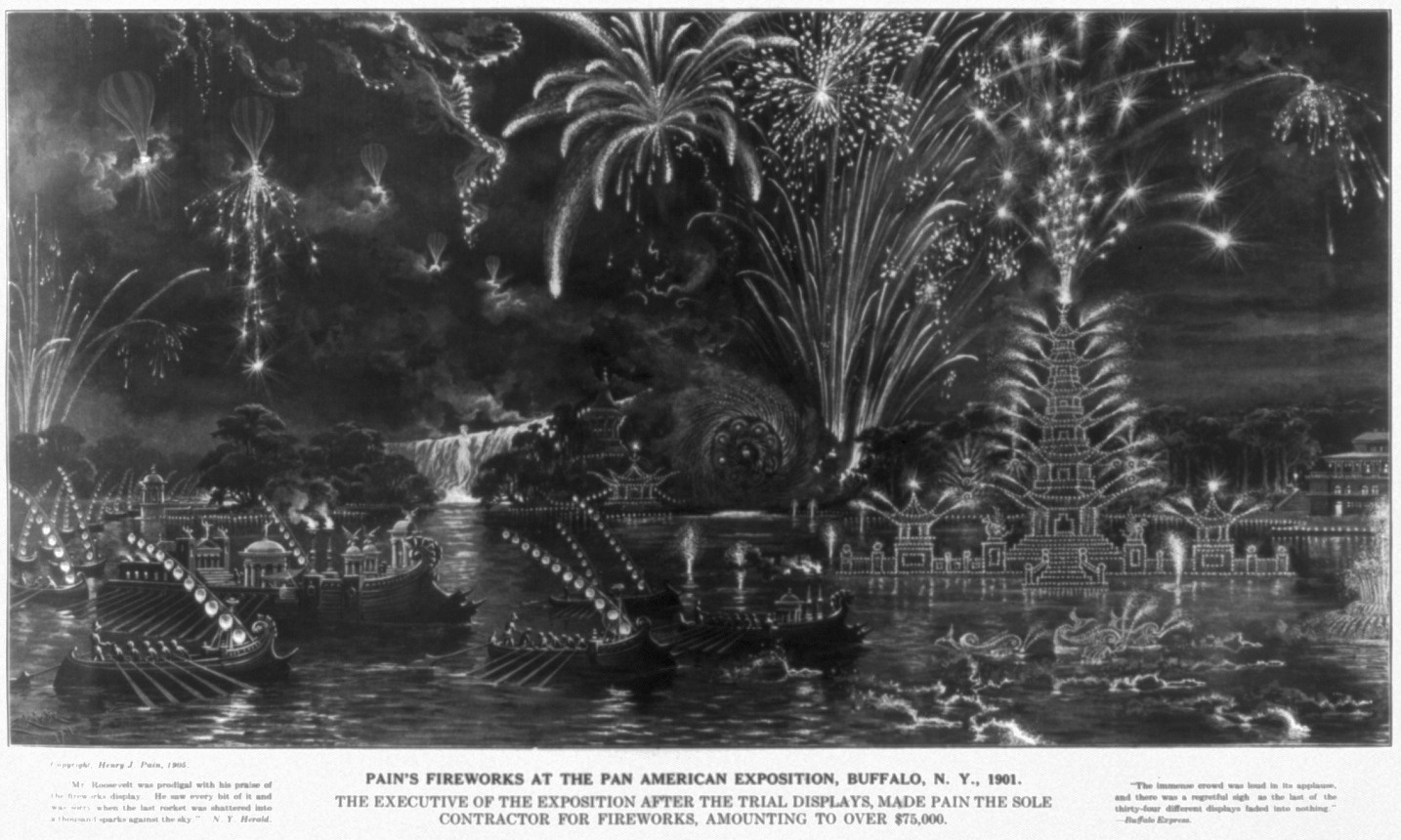
“Pain’s Fireworks at the Pan American Exposition, Buffalo, N.Y., 1901.” An advertising print by Henry J. Pain, 1905. Library of Congress. Click the picture to see it full size.
Night one: a teddy bear does tricks
The first show was Tuesday, September 22. Over a thousand people came. The set pieces had names. One was “The Father of His Country,” a fire portrait of George Washington. Another was “The American Rose.” Then came “Niagara Falls,” and “The Acrobatic Teddy Bear.” Teddy bears were the hot new toy of those years, named for President Theodore Roosevelt (here’s how a bear hunt in Mississippi started it all).
The Daily Sentinel, Grand Junction’s own paper, called the big pieces “beautiful beyond description.” There were fire wheels and “showers of serpents,” giant rockets, and two balloons sent up early in the evening. It cost 25 cents to get in, with no extra charge for the grand stand. For such a show, the paper said, the price “is very low indeed.”
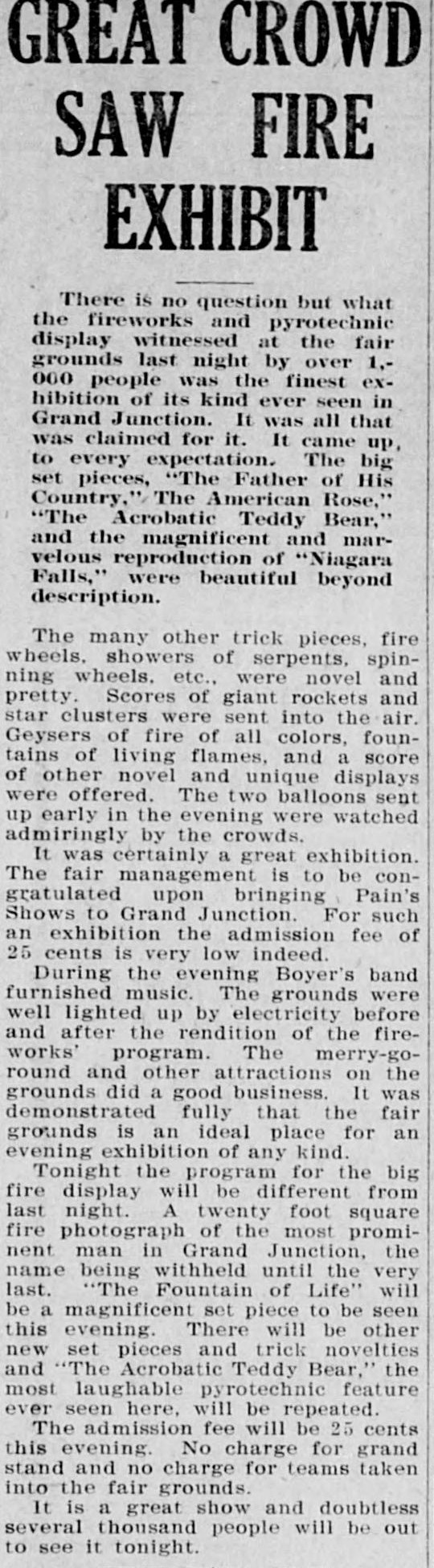
“Great Crowd Saw Fire Exhibit.” The Daily Sentinel, Grand Junction, Colorado, September 23, 1908, page 9. Library of Congress, Chronicling America. Click the clipping to read it full size.
That same story let the town in on the next night’s surprise. There would be “a twenty foot square fire photograph of the most prominent man in Grand Junction.” That’s a face as tall as a two-story house. And the teddy bear, “the most laughable pyrotechnic feature ever seen here,” would come back too.
Night two: the mayor’s face
The presidential election was six weeks away. William Jennings Bryan, a Democrat, was running against William Howard Taft, a Republican. On Wednesday night, Bryan’s giant face “brought forth a storm of applause and cheering,” the Sentinel said.
And then there was the secret. The fiery face belonged to the town’s own mayor, J. R. Wentworth. Grand Junction had elected him the year before. The crowd cheered him, too, and the paper praised the fire artists’ work: “It was a splendid likeness of the chief executive officer of the city.”
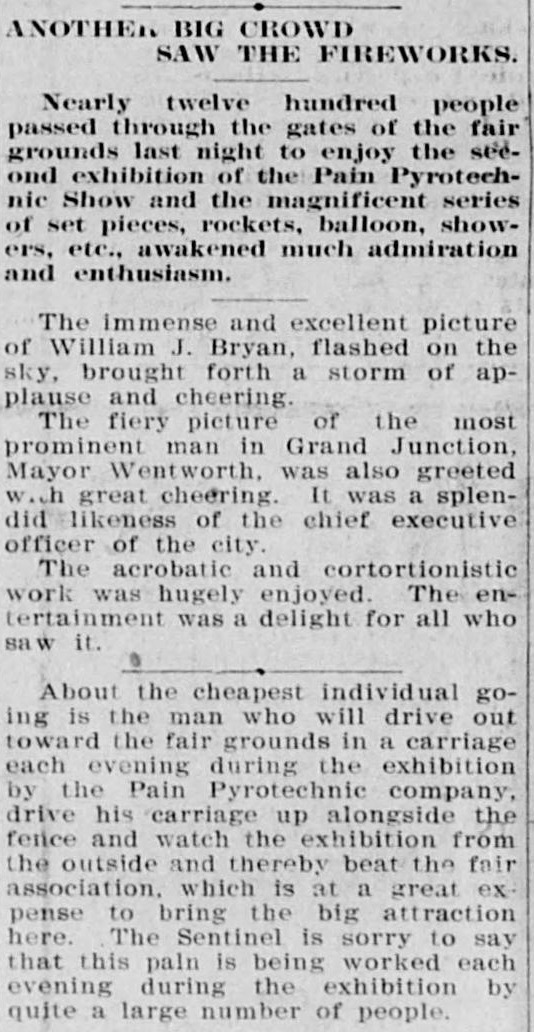
“Another Big Crowd Saw the Fireworks.” The Daily Sentinel, Grand Junction, Colorado, September 24, 1908, page 4. Library of Congress, Chronicling America. Click the clipping to read it full size.
Visitors came from nearby towns, too. A group of young women from Fruita, Colorado, rode in on the evening train just to see the fireworks. But not everyone paid their quarter. Some people drove their carriages out to the fair grounds, parked by the fence and watched the show from outside for free. The Sentinel was not amused. It wrote, “About the cheapest individual going is the man who will drive out toward the fair grounds in a carriage.”
Rain, cold and a battle in fire
On Thursday night, it rained. “No exhibition was given last night on account of the rain,” the Sentinel reported on Friday. So Friday became the last night, with a double program. It promised “A portrait in fire of William H. Taft” and the great sea battle.
In 1862, during the Civil War, the Monitor and the Merrimac had fought the first battle ever between two iron-covered warships. Now Pain’s men staged it again in fire. The Sentinel called it “the most magnificent pyrotechnic display ever seen in the city.”
But the weather turned cold, and the sky looked like more rain. Only about 800 people came. “The big drop in temperature and the threatening aspect of the weather last night kept hundreds of people away from the big display,” the paper said.
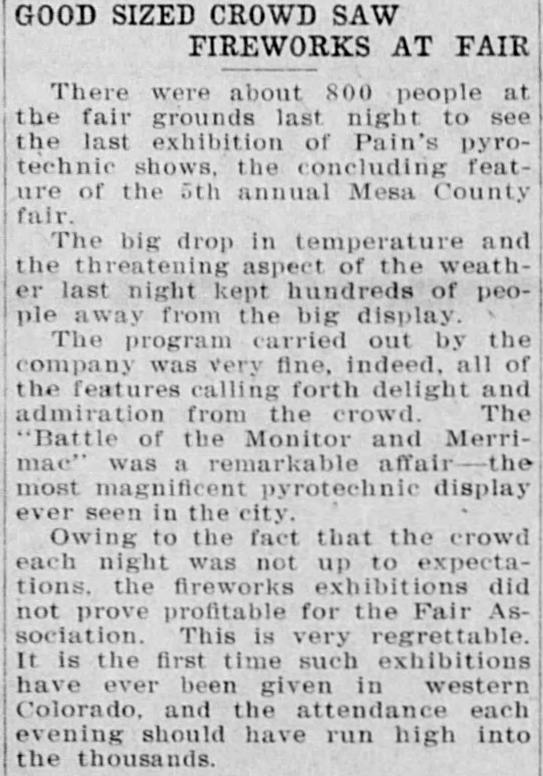
“Good Sized Crowd Saw Fireworks at Fair.” The Daily Sentinel, Grand Junction, Colorado, September 26, 1908, page 2. Library of Congress, Chronicling America. Click the clipping to read it full size.
The show that didn’t pay
The fireworks “did not prove profitable for the Fair Association. This is very regrettable.” The Sentinel thought its neighbors had missed something special. It was the first show of its kind in western Colorado, the paper said, and the crowds “should have run high into the thousands.”
The valley around Grand Junction was full of young orchards in 1908, like the ones in this photo near Palisade, Colorado, the town whose band was on the program that Wednesday night.
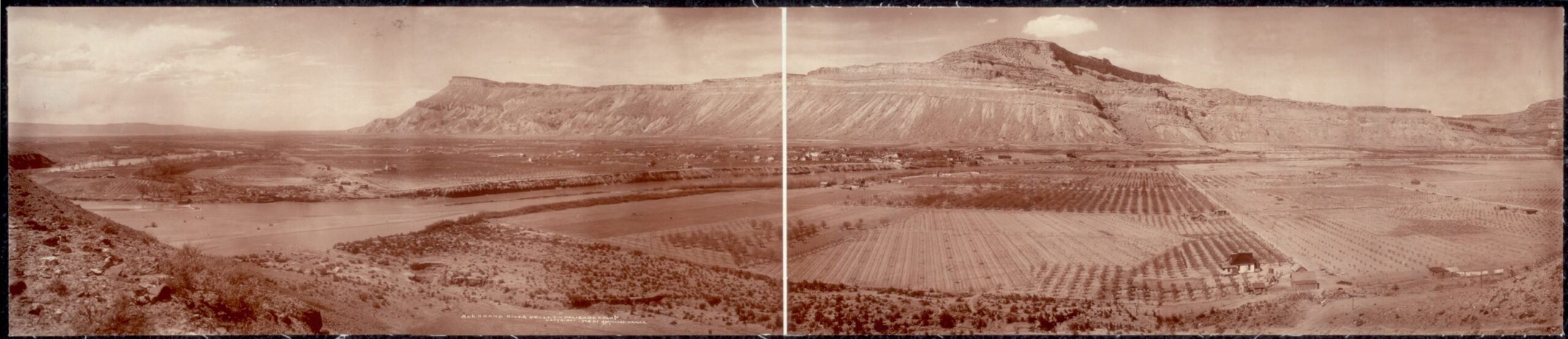
The Grand River valley near Palisade, a few miles up the river from Grand Junction, Colorado, in 1908, the year of the fireworks. Photo by L. C. McClure, Denver. Library of Congress. Click the picture to see it full size.
Still, for one Wednesday night in 1908, a farm town between the orchards and the cliffs saw a New York fireworks show, an acrobatic teddy bear, and its own mayor’s face, drawn in fire and glowing in the dark. The people in the grand stand cheered. And the fellows parked outside the fence saw it too, for free.
Sources
- The Delta Independent (Delta, Colorado): September 4, 1908, page 7 (“Pain’s Fireworks at the Mesa County Fair”). Delta is the next county over: Delta, Colorado.
- The Daily Sentinel (Grand Junction, Colorado): September 22, 1908, page 4 (“The Program for Tomorrow”).
- The Daily Sentinel: September 23, 1908, page 9 (“Great Crowd Saw Fire Exhibit”).
- The Daily Sentinel: September 23, 1908, page 1 (“See it Tonight” notice).
- The Daily Sentinel: September 24, 1908, page 4 (“Another Big Crowd Saw the Fireworks”).
- The Daily Sentinel: September 24, 1908, page 5 (visitors from Fruita).
- The Daily Sentinel: September 25, 1908, page 1 (the rained-out night and the last program).
- The Daily Sentinel: September 26, 1908, page 2 (“Good Sized Crowd Saw Fireworks at Fair”).
- The Daily Sentinel: April 3, 1907, page 1 (“Mayor Elect J. R. Wentworth”).
- “Pain’s Fireworks at the Pan American Exposition, Buffalo, N.Y., 1901,” print copyrighted by Henry J. Pain, 1905, Library of Congress. Published 1905, public domain.
- L. C. McClure, “Grand River Valley near Palisade, Colo.,” 1908 (Library of Congress title “The Grand Valley, Grand Junction, Colo.”), Library of Congress, no known restrictions on publication.
- All newspaper images: Library of Congress, Chronicling America. Published 1907 and 1908.
- Cover: H. H. Carter, “Fireworks at Dellwood Park,” real-photo postcard, copyright 1910, Library of Congress. Published 1910, public domain. It shows a 1910 show in Illinois, not Grand Junction.