In the summer of 1910, Charleston, South Carolina, was getting sewers. Gangs of men with picks and shovels opened long ditches down one street after another, so pipe could be laid in the bottom. It was hot, heavy, everyday work. Nobody expected it to make the newspaper.
Then, on Queen Street, the picks broke into old wood. The Charleston News and Courier told what happened next, and other South Carolina papers passed the story along. In Orangeburg, South Carolina, the Times and Democrat put it on the front page under three words: “DUG UP BONES.”
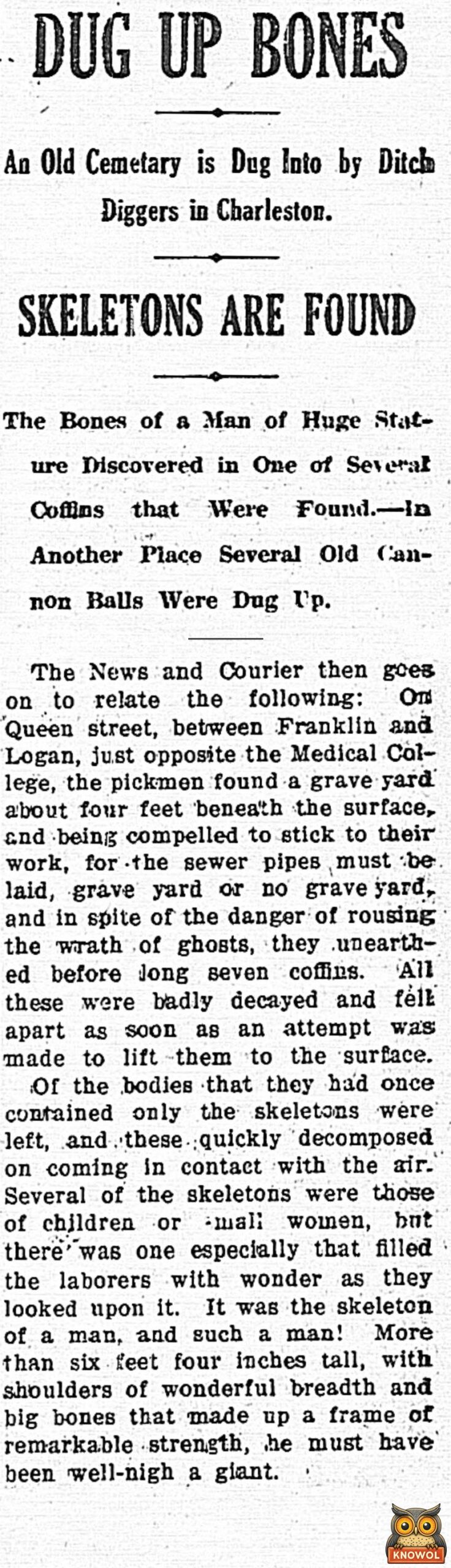
“Dug Up Bones.” The Times and Democrat, Orangeburg, South Carolina, July 21, 1910, page 1. The headline and one paragraph of the story, joined. Library of Congress, Chronicling America. Click the clipping to read it full size.
Four feet under Queen Street
The place was “between Franklin and Logan, just opposite the Medical College.” About four feet down, the diggers had cut into a graveyard. No one seemed to know it was there.
The job did not stop. In the paper’s words, “the sewer pipes must be laid, grave yard or no grave yard.” Before long the men had uncovered “seven coffins.” The wood was so rotten that the boxes “fell apart as soon as an attempt was made to lift them to the surface.”
Only bones were left inside, and they crumbled in the open air. Several were small, from children or small women. One was not small at all.
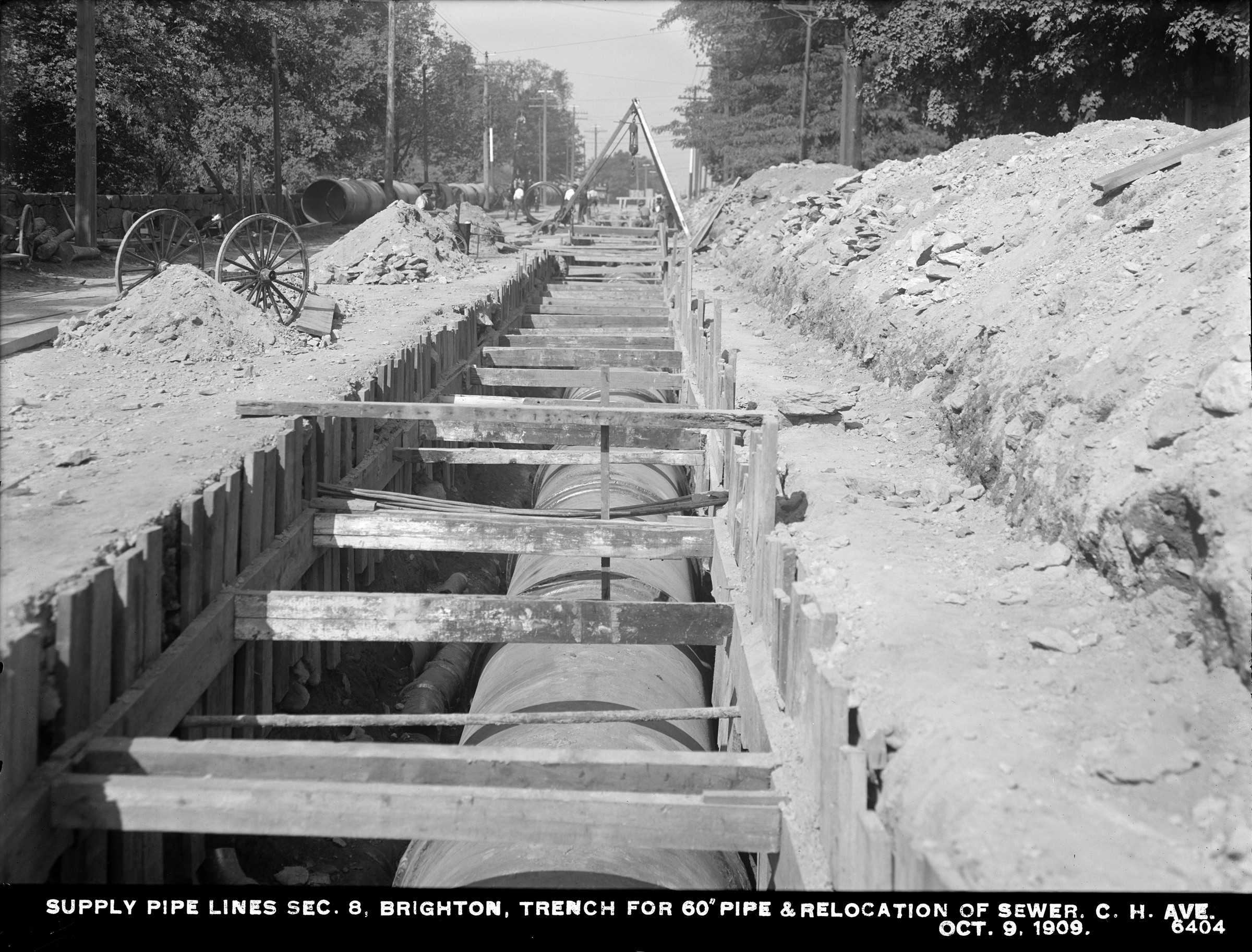
A pipe trench in a street in Brighton, Massachusetts, on October 9, 1909. We found no photo of Charleston’s sewer ditches. This trench held a water pipe five feet wide, far bigger than a sewer pipe, but it shows how a street was opened in those years. Massachusetts Metropolitan Water Works Photograph Collection, Massachusetts Archives, by way of Digital Commonwealth. Click the picture to see it full size.
A man “well-nigh a giant”
“It was the skeleton of a man, and such a man!” the paper said. Then it sized him up: “More than six feet four inches tall, with shoulders of wonderful breadth and big bones that made up a frame of remarkable strength, he must have been well-nigh a giant.”
Well-nigh means nearly, and six feet four would turn heads on a sidewalk even now. The people who saw the bones wanted to know who he was. The paper said they were curious “whether some record of this Hercules who had been laid to rest in this forgotten cemetery long ago, might not be found somewhere and the history of the man brought back to mind.” Hercules was the strongman of the old Greek stories. In plain words, somebody ought to look this fellow up.
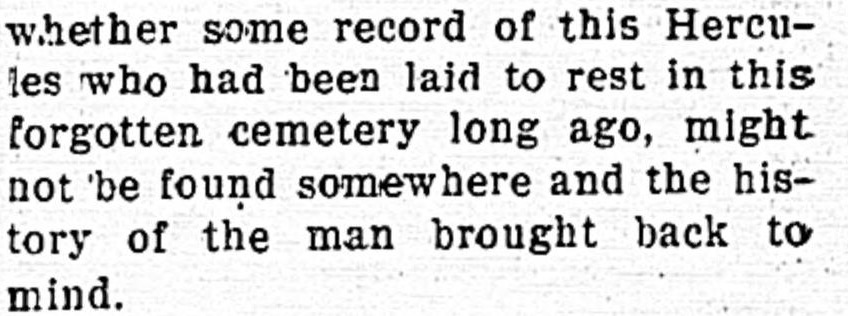
The end of the next paragraph, about the hope of finding the tall man’s name. The Times and Democrat, Orangeburg, South Carolina, July 21, 1910, page 1. Library of Congress, Chronicling America. Click the clipping to read it full size.
As far as we can find, nobody ever did. The paper printed no name for him. It printed no names for the men who dug him up, either.
Cannonballs on Ashe Street
Another gang was digging uptown. “On Ashe street the diggers came across cannon balls that had evidentally been fired during the Revolutionary war,” the paper said, spelling evidently its own way.
Charleston knew its cannonballs. The city had been shelled in the Civil War, less than fifty years before, and these were different. The paper called them “of a kind unknown during the War Between the States,” which was its name for the Civil War, and “much more ancient.”
Each ball weighed “not more than four or five pounds.” An iron ball that heavy is about the size of an orange. Cannons then were named for the ball they threw, so a “four-pounder” fired a four-pound ball. The diggers also found “several smaller grape-shot.” Grapeshot was a bunch of small iron balls fired all at once, so they spread out like the pellets from a giant shotgun.
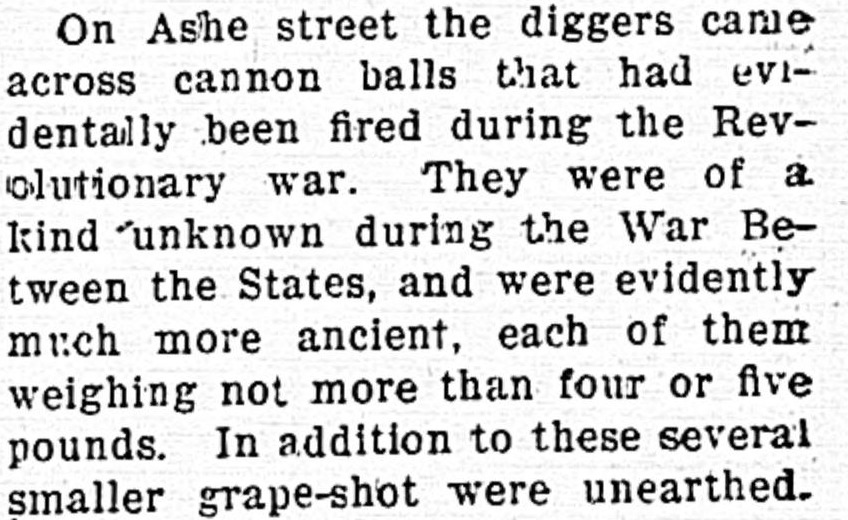
The cannonballs on Ashe Street. The Times and Democrat, Orangeburg, South Carolina, July 21, 1910, page 1. Library of Congress, Chronicling America. Click the clipping to read it full size.
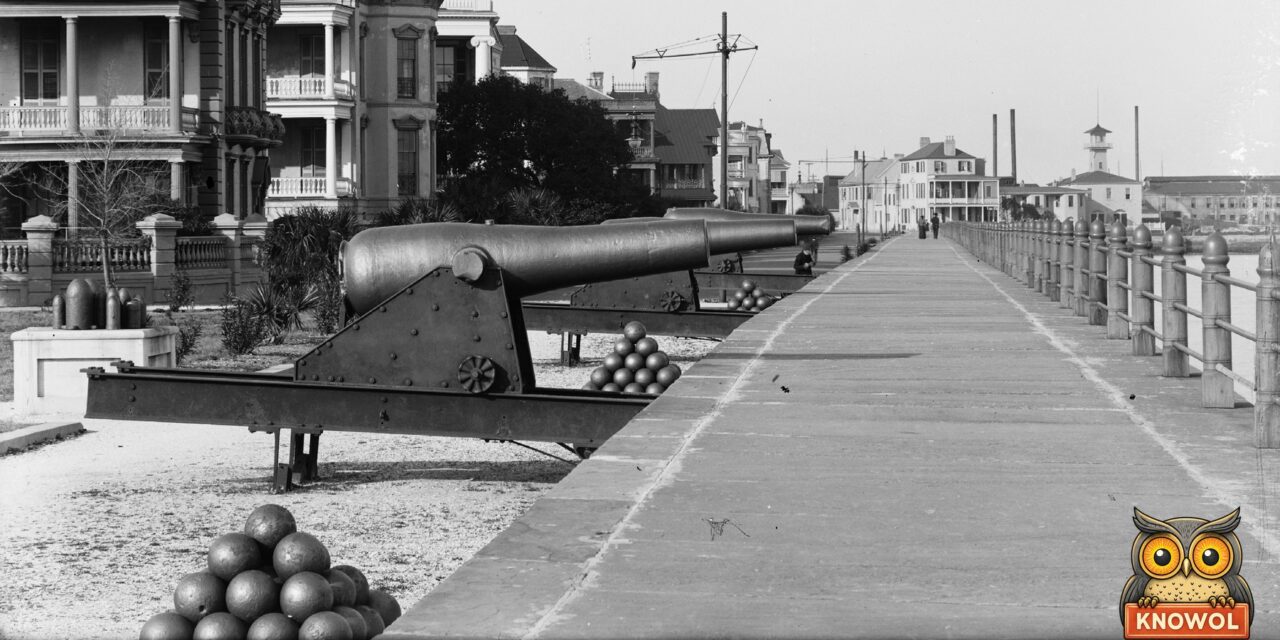
The photo at the top of this page shows a cannon and stacks of cannonballs on Charleston’s waterfront in those years, probably along the East Battery. Those are not the Ashe Street balls. The ones from the ditch were far smaller.
How cannonballs got under a street
The paper did not explain it, but history offers a good guess. In the spring of 1780, a British army closed in on Charleston from the north. On April 1 its soldiers began digging trenches across the neck of land above the town. The Americans waited behind their own line of walls and ditches, which ran from river to river. A piece of its main fort, the Horn Work, still stands in Marion Square.
A British map printed in London that year shows the whole fight. Its key says, “The King’s Army and Works, are Coloured Red. The Ennemys Yellow.” The “Ennemy” was the American side. The map even counts the cannon on the American line: “66 Guns.”
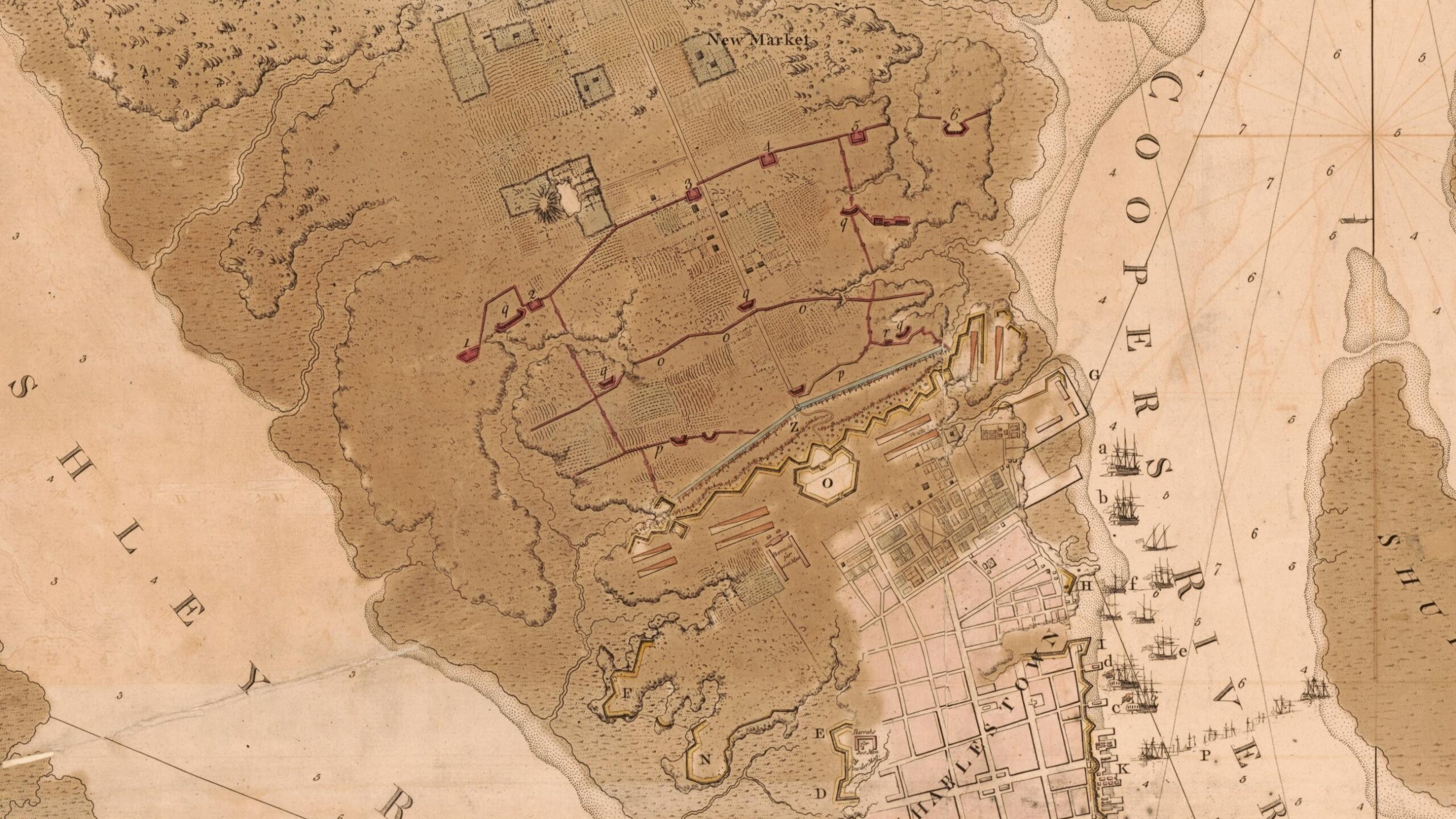
Part of “A Sketch of the Operations before Charlestown, the Capital of South Carolina,” a British map published in London in 1780. The town is the pink grid at the lower right. The yellow zigzag above it is the American line, and the red lines are the British trenches. Library of Congress, Geography and Map Division. Click the picture to see it full size.
Starting April 13, the two sides fired at each other until the town gave up on May 12. Ashe Street is uptown, more than half a mile northwest of Marion Square. In 1780 that ground lay out in front of the American guns, on the British side of the field. A month of flying iron had to land somewhere. Some of it lay in the dirt for 130 years, until a sewer ditch came through.
The graveyard nobody remembered
The graveyard has a likely answer, too. The historian at the Charleston County Public Library has traced the city’s old public burying grounds. They were for the poor, for enslaved people, and for “strangers,” the old word for visitors who died far from home.
The first of those grounds was a square of about four acres. Queen Street was its south edge, with Franklin Street on the west and Logan Street on the east. That is the very block where the sewer gang was digging. The town had used it for more than a hundred years when the city closed it to burials in 1794. Over the years, poorhouses, hospitals and jails were built on the square. The Old Charleston Jail, from 1802, still stands there.
So by 1910 the burying ground had been shut for 116 years, long enough for a whole city to forget. The paper never made the connection, and we can’t prove it. But if the tall man was buried there, that would explain why nobody knew his name. The sewer gang was not the last to be surprised, either. In 1939, the library’s history says, crews building the Robert Mills Manor apartments on old burying ground close by turned up more bones.
On Queen Street the men stuck to their work, and the sewer went through. But the News and Courier had seen something true that week. It wrote that “mystery and romance have a way of turning up where they are least expected.” By romance it meant adventure, the storybook kind. In Charleston it turned up four feet down, at the end of a shovel.
Sources
- The Times and Democrat (Orangeburg, South Carolina): July 21, 1910, page 1 (“Dug Up Bones,” reprinted from the Charleston News and Courier).
- The Manning Times (Manning, South Carolina): July 27, 1910, page 1 (the same story under the same headline).
- Joseph F. W. Des Barres, “A sketch of the operations before Charlestown, the capital of South Carolina,” map, London, 1780, Library of Congress, Geography and Map Division (the trenches begun April 1, the 66 guns, the surrender on May 12).
- National Park Service, “Siege of Charleston 1780” (the first trench on April 1, the bombardment from April 13, the Horn Work in Marion Square).
- Nic Butler, “The Forgotten Dead: Charleston’s Public Cemeteries, 1672-1794”, Charleston Time Machine, Charleston County Public Library, April 30, 2021 (the four-acre public burying ground bounded by Queen, Logan, Magazine and Franklin streets, closed in 1794; the 1802 jail; the 1939 finds).
- “Distribution Department, supply pipe lines, Section 8, trench for 60-inch pipe and relocation of sewer in Chestnut Hill Avenue, Brighton, Mass., Oct. 9, 1909,” Massachusetts Metropolitan Water Works Photograph Collection, Massachusetts Archives, Digital Commonwealth, no known copyright restrictions.
- All newspaper images: Library of Congress, Chronicling America. Published 1910.
- Cover: Detroit Publishing Co., “[Charleston, S.C.],” glass negative made between 1880 and 1920, Library of Congress, no known restrictions on publication. The Library’s note says “Probably East Battery.” It shows a cannon and cannonballs on the waterfront, not the ones dug up on Ashe Street.