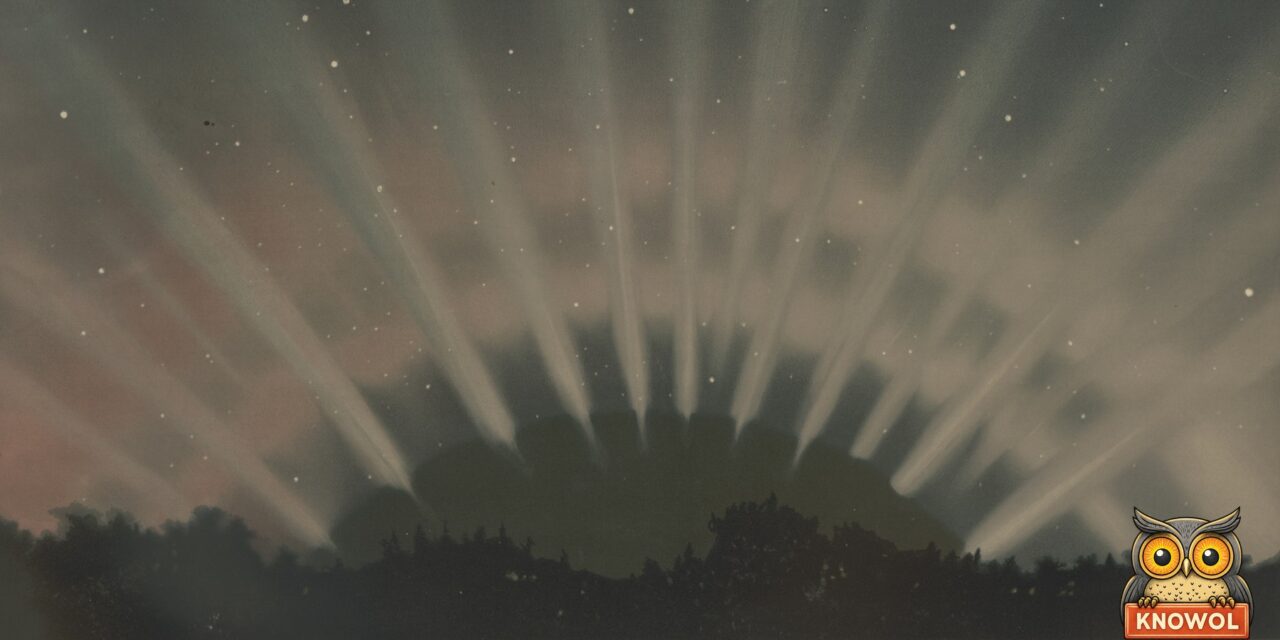
Late on Saturday night, May 14, 1921, people in Barre, Vermont, were heading home with their heads tipped back. Barre was a stone town, known as the Granite City. That night nobody was looking at stone. The whole sky was moving.
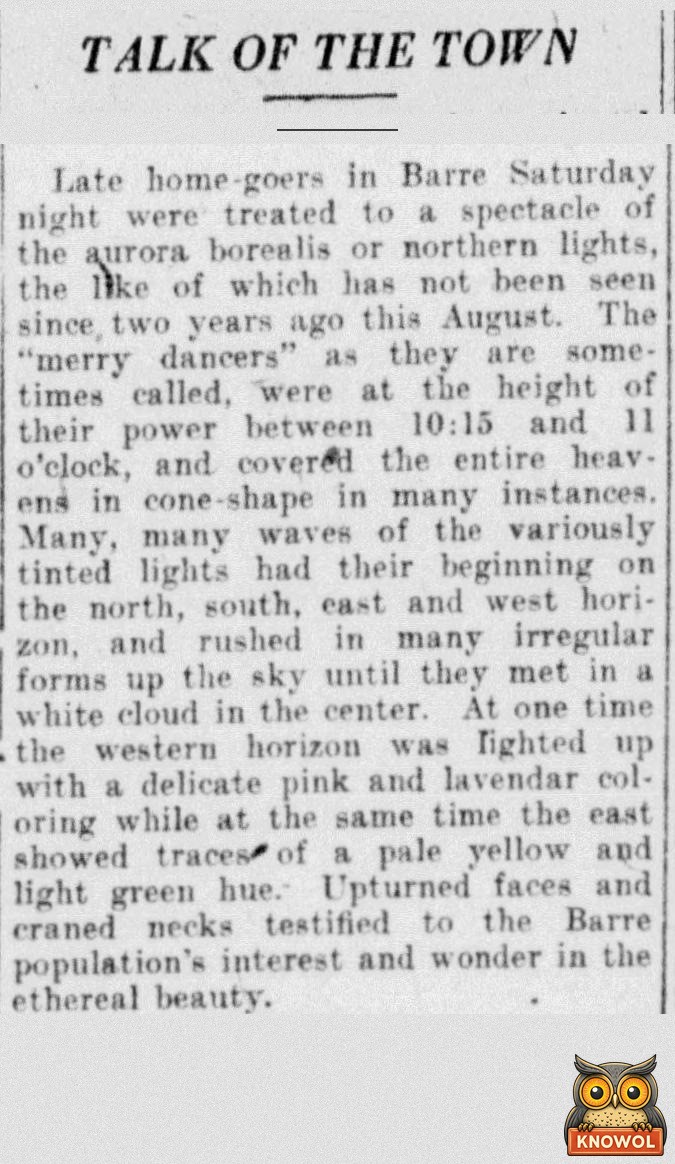
The Barre Daily Times, Barre, Vermont, May 16, 1921, page 8. The heading of the “Talk of the Town” column and its last item, joined. Library of Congress, Chronicling America. Click the clipping to read it full size.
The Barre Daily Times told about it on Monday. “Late home-goers in Barre Saturday night were treated to a spectacle of the aurora borealis or northern lights,” the paper said. The lights were at their best “between 10:15 and 11 o’clock,” and they “covered the entire heavens.”
They came from everywhere at once. “Many, many waves of the variously tinted lights had their beginning on the north, south, east and west horizon,” the Times wrote, “and rushed in many irregular forms up the sky until they met in a white cloud in the center.” The west glowed “a delicate pink and lavendar,” which is how the paper spelled lavender. The east showed “a pale yellow and light green hue.”
The last sentence puts you right on the street. “Upturned faces and craned necks testified to the Barre population’s interest and wonder in the ethereal beauty.” Ethereal means so light and lovely it hardly seems real. In plain words, Barre stood and stared.
We found no photograph of that sky. The color picture at the top of this page shows an aurora seen on March 1, 1872, as E. L. Trouvelot drew it, and it gives a fair idea of the rays.
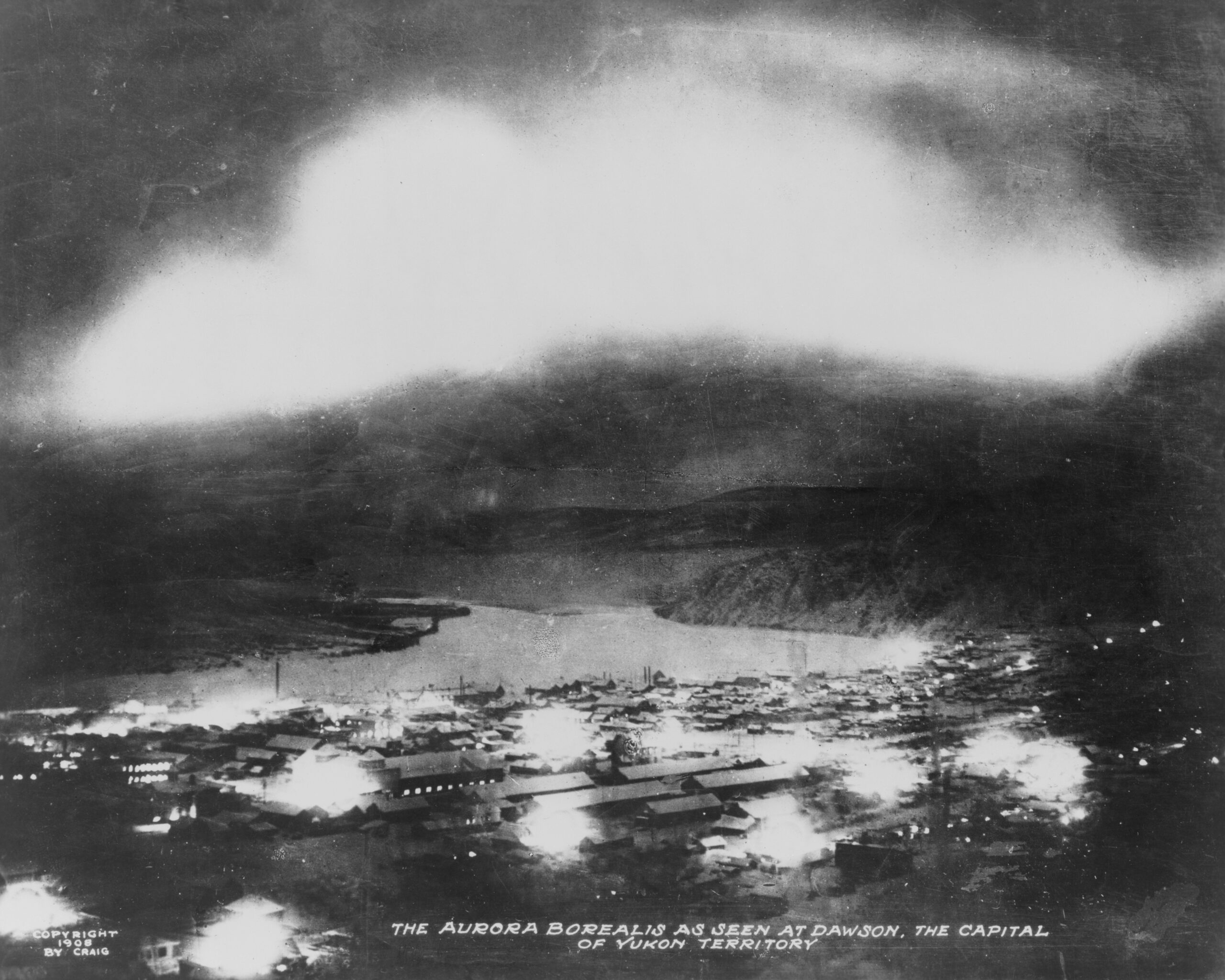
Northern lights over a town at night: “The aurora borealis as seen at Dawson, the capital of Yukon Territory,” a photographic print from 1908. It is Canada, 13 years earlier, not Barre. Library of Congress. Click the picture to see it full size.
One paragraph, after the fishing news
For all that, the Times did not put its sky on the front page. The story ran as the very last item in a column of small-town news called “Talk of the Town.”
The same column opened with Joseph Tondreau, who had spent the weekend fishing at Groton pond and came home “with a fine catch.” It asked for bundles for a rummage sale to help the Barre City hospital, and gave a phone number to call: 91-J. So the best light show Barre had seen in two years got about the same space as a string of fish.
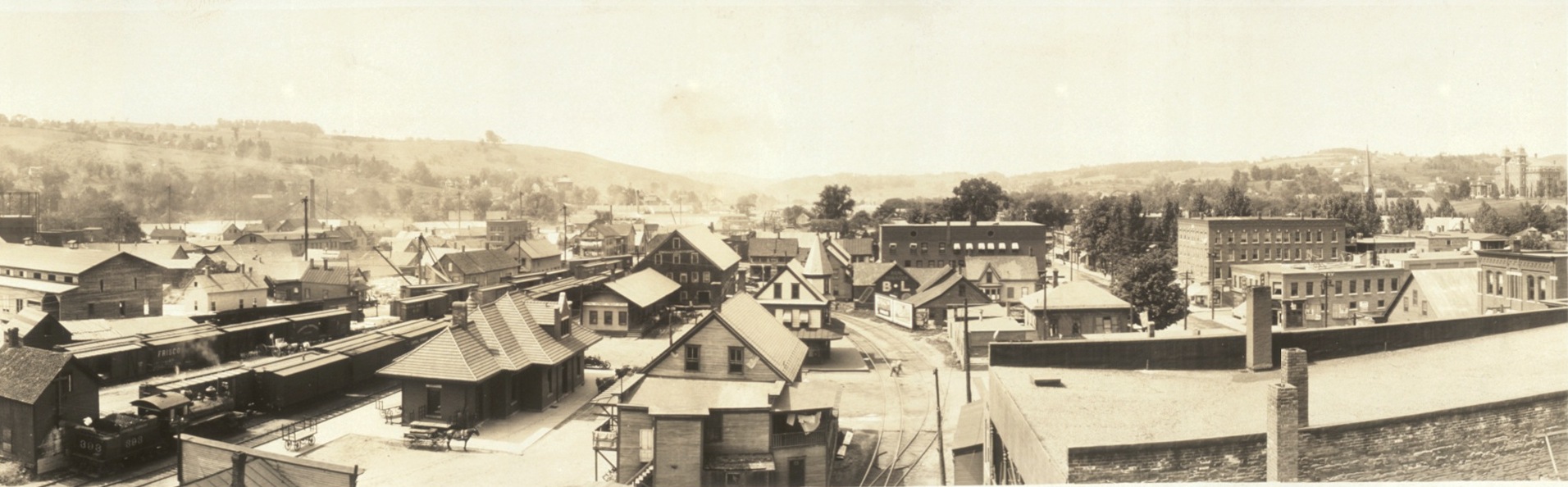
Barre, Vermont, in August 1917, four years before the lights: the railroad yard, a steam locomotive and the brick blocks of downtown. Part of L. L. McAllister’s panoramic photograph “Granite plants on Burnham’s Meadow, Barre, Vt.” Library of Congress. Click the picture to see it full size.
The warning nobody could see
The sky had dropped a hint the day before. On Friday afternoon in St. Johnsbury, Vermont, northeast of Barre, the telegraph stopped working.
A telegraph sent messages as dots and dashes, which were short and long pulses of electricity running down a wire. That Friday there was so much stray electricity in the lines that the messages could not get through. The town’s paper, the Caledonian-Record, said “business was at a standstill.”
The paper blamed the aurora borealis, even though no one had seen a thing. If it had happened after dark, the paper said, it “would have been plainly visible in the north sky.” The next night the lights came after dark, and they did not stay in the north.
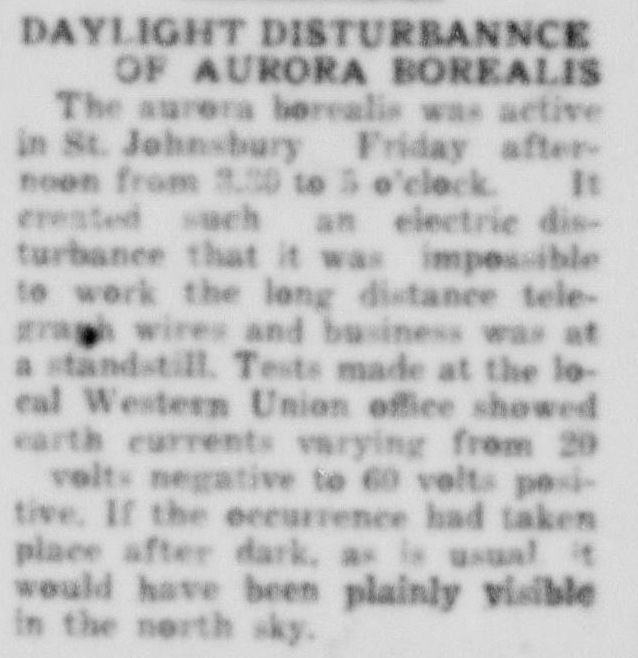
The Caledonian-Record’s item on the daylight disturbance, St. Johnsbury, Vermont, May 14, 1921, page 1. The scan is faint. Library of Congress, Chronicling America. Click the clipping to read it full size.
“Aurora Starts a Commotion”
That was the headline in the Barre Daily Times on Monday, over news from London and New York. The storm that painted the sky had also poured electricity into wires on both sides of the Atlantic Ocean. The Times printed it flatly: “The Western Union Telegraph company reported that, with a few exceptions, its wires all were tied up.”
In Sweden, a telephone exchange in the town of Karlstad burned, and the Times said the storm “is believed to have caused” the fire. In New York City, telegraph men told the New-York Tribune that “never before in the last thirty years had the wires been so badly affected.” Western Union’s people described something that sounds almost spooky: “a high voltage entered the wires at some unknown places and left it at other unknown points.”
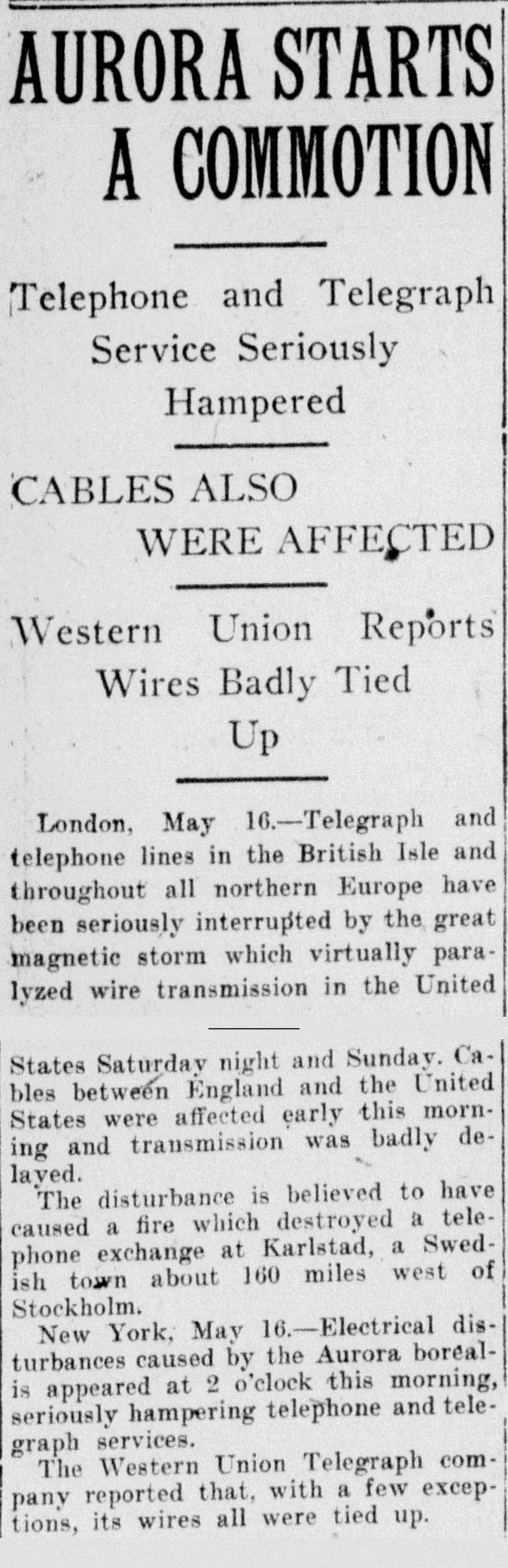
“Aurora Starts a Commotion.” The Barre Daily Times, Barre, Vermont, May 16, 1921, page 3. Two columns of one story, joined. Library of Congress, Chronicling America. Click the clipping to read it full size.
A spot on the sun
Astronomers already had a suspect. At the Naval Observatory in Washington, they had been taking pictures of a dark spot on the face of the sun. The Tribune gave its size: “94,000 miles long and 21,000 wide.” Earth is about 8,000 miles across, so nearly twelve Earths could line up along it.
Here is how a spot that far away can stop a telegram. Sometimes a storm on the sun throws a giant cloud of electrified gas out into space. When the cloud reaches Earth, it shakes the invisible magnetic field around our planet. High overhead, that makes the thin air glow, and the glow is the aurora. Down on the ground, it pushes electric current into anything long and made of metal. In 1921, that meant thousands of miles of telegraph and telephone wire.
The observatory said the spot “could be readily seen through smoked glasses,” meaning dark glass. That was the advice in 1921. Today eye doctors say dark glass and sunglasses are not enough, so never look at the sun without real eclipse glasses.
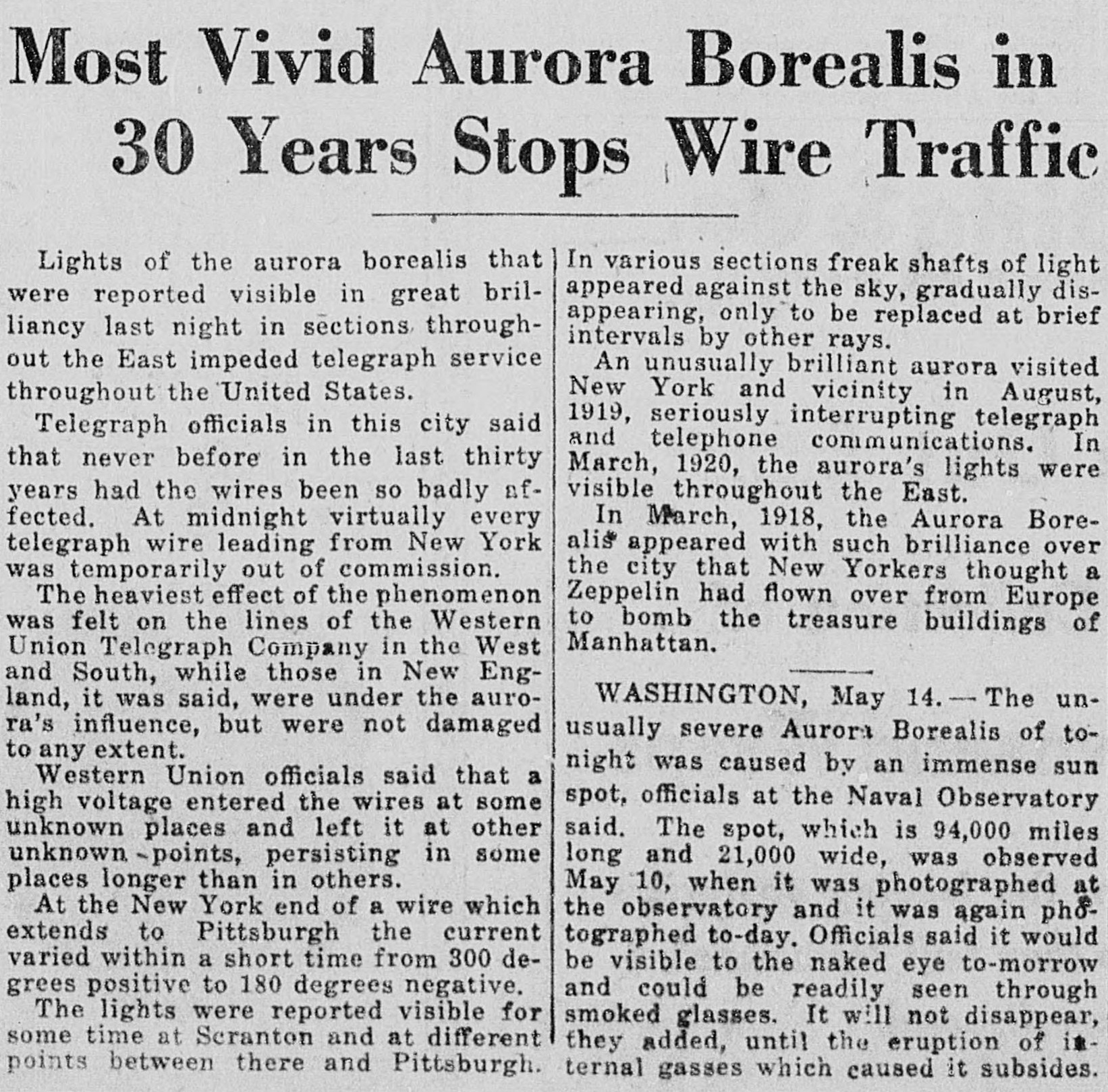
“Most Vivid Aurora Borealis in 30 Years Stops Wire Traffic.” New-York Tribune, New York, May 15, 1921, page 1. Library of Congress, Chronicling America. Click the picture to see it full size.
The merry dancers
The Barre paper called the lights by a pet name, the “merry dancers.” It had used the name before. On August 11, 1919, a headline on its front page read:
“MERRY DANCERS” PUT WIRES OUT OF USE
So the 1921 writer had a good memory. Nothing like it had been seen, the item said, since “two years ago this August.”
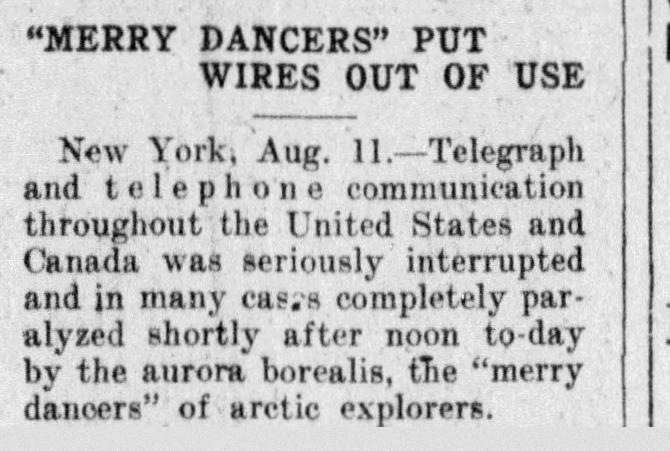
The Barre Daily Times, Barre, Vermont, August 11, 1919, page 1. Library of Congress, Chronicling America. Click the clipping to read it full size.
There were other dancers out that Saturday. The same day’s Times carried a three-line ad: “Dance every Saturday night, Montpelier armory. Carroll’s orchestra. C. V. train at 12:32.” That is Montpelier, Vermont, the next city over. The paper never says where its late home-goers had been. It is nice to think a few of them came home from a dance, under a sky that was dancing too.
Why scientists still talk about it
The wires took a while to settle down. In Manchester, Vermont, in the south of the state, the Manchester Journal said it was “several days before telephone and telegraph workings became normal.”
Scientists have not forgotten that weekend. In 2019, researchers with the U.S. Geological Survey went back to the old magnetic records. They rated the May 1921 storm about as strong as the great solar storm of 1859, the most famous one of all.
In Barre it never got a name. It got one paragraph, down at the bottom of the town talk, after the fishing trip and the rummage sale. But the paper caught the part worth keeping: a town on its way home, looking up.
Sources
- The Barre Daily Times (Barre, Vermont): May 16, 1921, page 8 (“Talk of the Town”: the northern lights, Joseph Tondreau’s fishing trip, the rummage sale); May 16, 1921, page 3 (“Aurora Starts a Commotion”); May 14, 1921, page 8 (the Saturday dance ad); August 11, 1919, page 1 (the “Merry Dancers” headline).
- The Caledonian-Record (St. Johnsbury, Vermont): May 14, 1921, page 1 (the daylight disturbance on the telegraph wires).
- New-York Tribune (New York): May 15, 1921, page 1 (“Most Vivid Aurora Borealis in 30 Years Stops Wire Traffic”).
- The Manchester Journal (Manchester, Vermont): May 19, 1921, page 5 (the “rare exhibition” of the lights, and the wires).
- U.S. Geological Survey: Jeffrey J. Love, Hisashi Hayakawa and Edward W. Cliver, “Intensity and impact of the New York Railroad superstorm of May 1921” (2019).
- “The aurora borealis as seen at Dawson, the capitol of Yukon Territory,” photographic print, copyright 1908 by Craig, Library of Congress, no known restrictions on publication.
- L. L. McAllister, “Granite plants on Burnham’s Meadow, Barre, Vt.,” panoramic photograph, August 1917, Library of Congress, no known restrictions on publication.
- All newspaper images: Library of Congress, Chronicling America. Published 1919 to 1921.
- Cover: E. L. Trouvelot, “Aurora borealis, as observed March 1, 1872, at 9h. 25m. P.M.,” color print published by Charles Scribner’s Sons in 1881, Library of Congress, no known restrictions on publication. It shows an 1872 aurora, not the one over Barre.