By Wednesday, August 13, 1919, the lists were counted, and Mrs. James Letts of Main Street had won. She’d had twenty-eight guests for Old Home Day in South Amboy, New Jersey. The next family had twenty-five. For having the most company in town, Mrs. Letts was awarded the big prize: one ton of coal.
The Perth Amboy Evening News, the daily paper in the city next door, printed her whole guest list. Her company came from Red Bank, Jersey City, Cheesequake, Trenton, Matawan and Philadelphia. It was a funny thing to win a prize for. It was also the whole idea of the day.
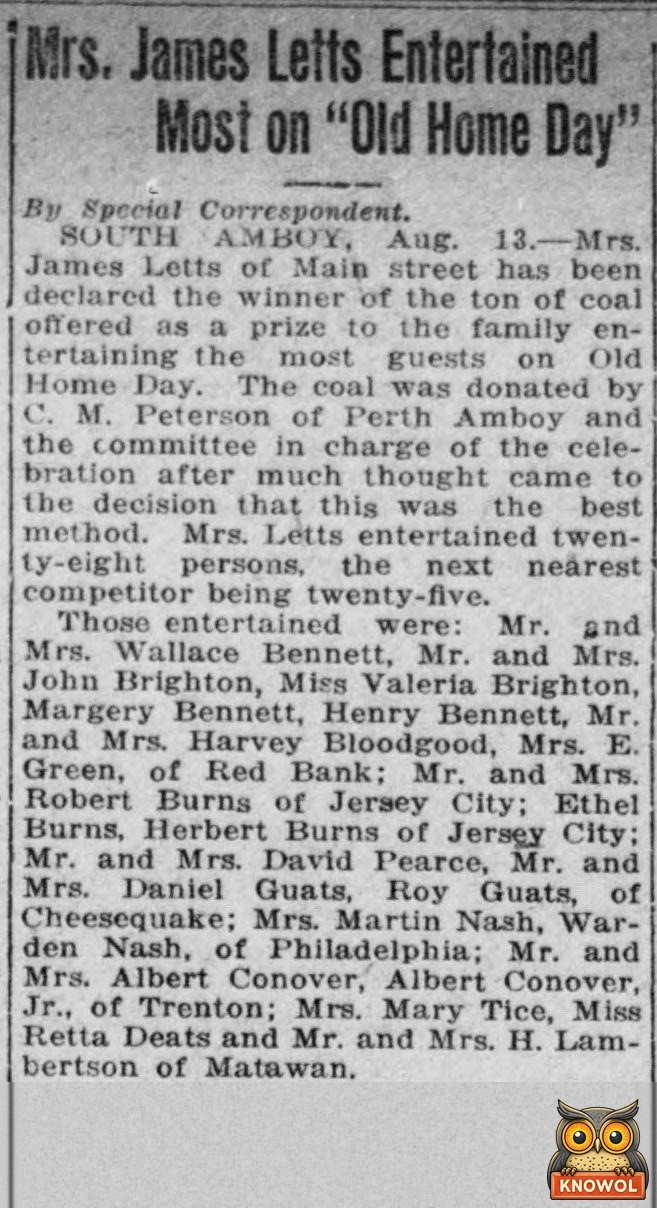
“Mrs. James Letts Entertained Most on ‘Old Home Day.'” Perth Amboy Evening News, Perth Amboy, New Jersey, August 13, 1919, page 5. Library of Congress, Chronicling America. Click the clipping to read it full size.
A prize for a full house
Old Home Day was a homecoming. A town picked a day and asked everybody who had ever lived there to come back for a visit. In 1919 it was the first summer after World War I, and the paper told why the day mattered: “After the families being separated during the war and the boys of the town being overseas, their relatives from out of town are making a special effort to be in this city.”
Peterson’s coal yard in Perth Amboy gave the Old Home Committee a ton of coal for a prize. Coal ran the kitchen stove and kept the house warm, so any family could use it. The committee picked a contest to fit the day. The coal would go to “the family entertaining the most guests from out of town.”
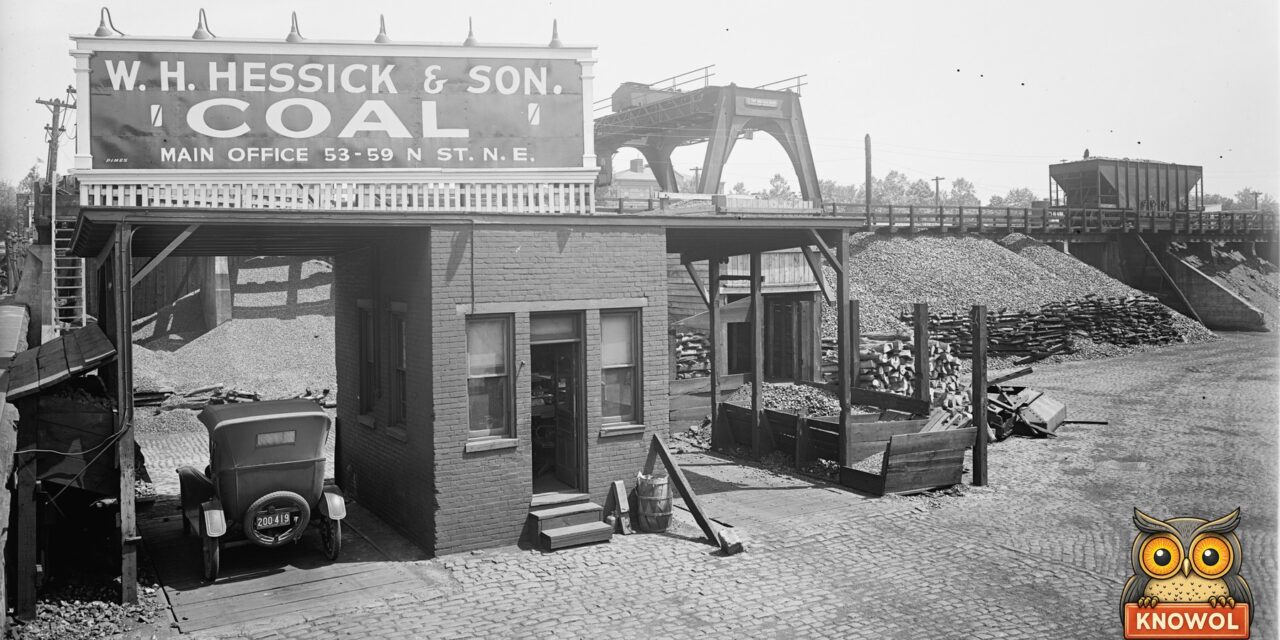
The paper cheered them on. “It is hoped that the thrifty housewives of the city will take special pains to compete for this prize,” it said, “which is well worth winning.” We found no picture of Peterson’s yard. The photo at the top of this page shows another coal yard of those years, W. H. Hessick & Son in Washington, D.C.
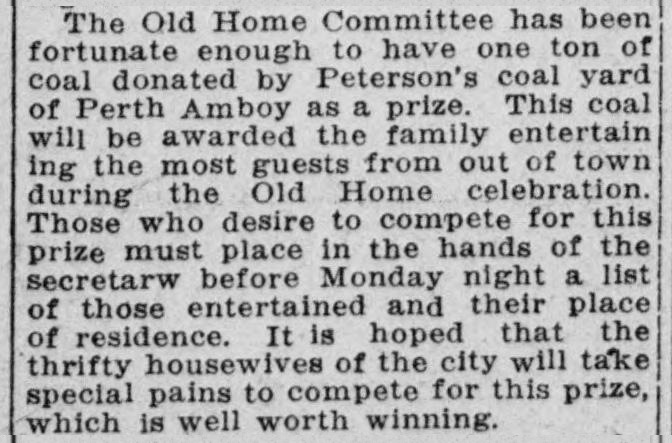
The rules of the contest. Perth Amboy Evening News, Perth Amboy, New Jersey, August 8, 1919, page 17. Library of Congress, Chronicling America. Click the clipping to read it full size.
When farmers drove all night for a swim
South Amboy kept Old Home Day on the second Saturday in August, and there was a reason for that, too. Long before, that Saturday had been Salt Water Day. “Bathing was one of the big attractions,” the paper wrote, “and the shore front was always crowded with the farmers who came to the town to take their ‘annual bath’ in the waters of Raritan Bay.”
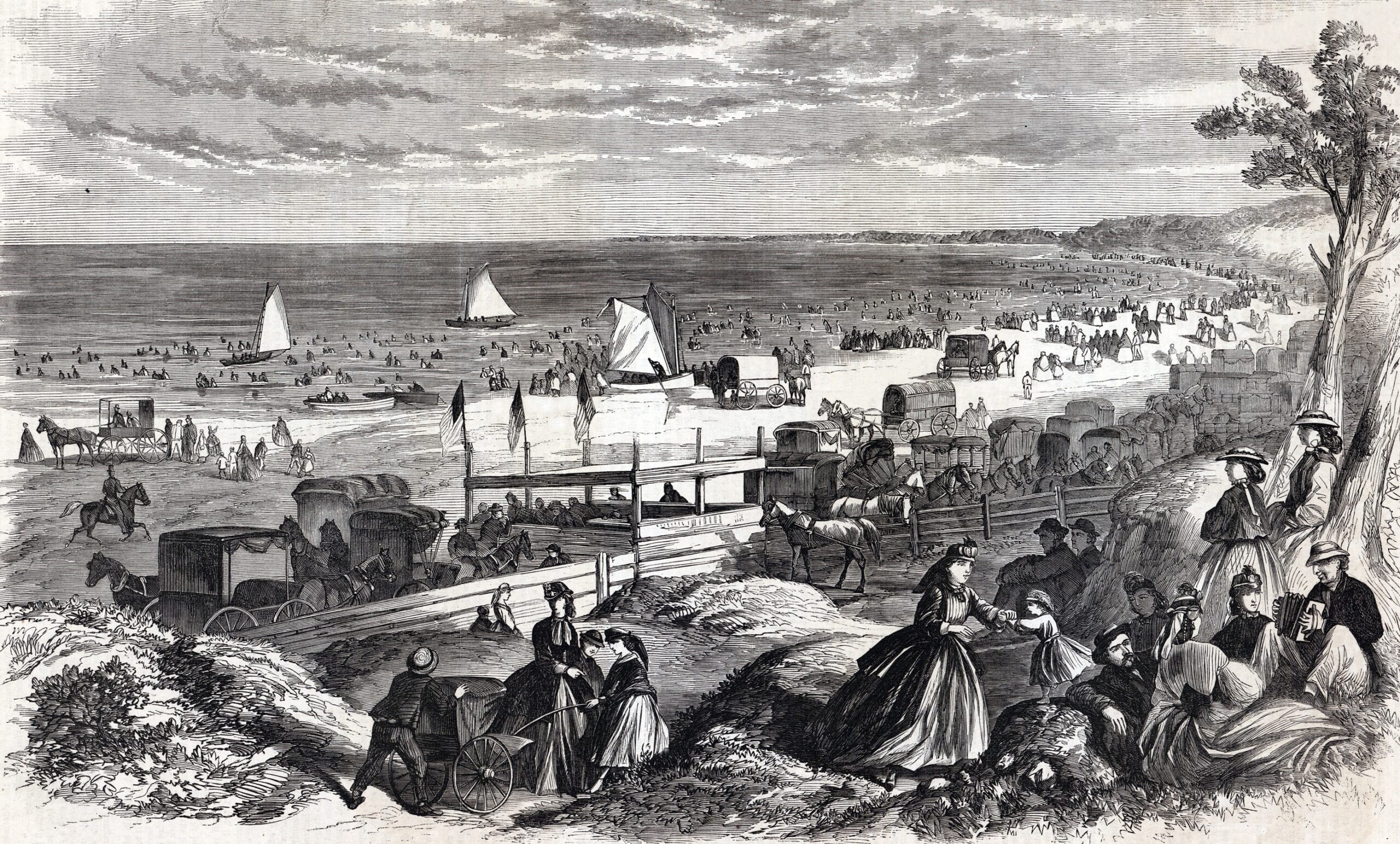
“The Grand Annual Picnic and Excursion of the New Jersey Farmers and Their Families to Raritan Bay, Amboy, N. J., Saturday, August 12.” Drawn from a sketch by F. H. Schell. Frank Leslie’s Illustrated Newspaper, September 2, 1865, page 377. Scan by the House Divided Project, Dickinson College. Public domain. Click the picture to see it full size.
The farm families started the night before. “As early as 12 o’clock the night before the Old Salt Water Day,” the paper said, wagons of every kind “began to rumble into South Amboy with their loads of country folk.” A New York picture paper, Frank Leslie’s Illustrated Newspaper, sent an artist to the beach in 1865. It said some families would “travel 50 miles or more,” and that the trip was called “going to the salt water.”
At the shore, most families changed in what the paper called “improvised shelter.” Some hung shawls or canvas around their wagons “to insure privacy.” Farm wives stood in a ring around a friend while she “made ready to take a plunge.” The men swam in “a pair of overalls.” The women “rigged out” in “old clothes of every description.” A family with a nickel to spare had one more choice. One of the 1865 sketches shows a pen of logs with a canvas roof and a hand-lettered sign. It reads “Bathing House” and gives the price, 5 cents.
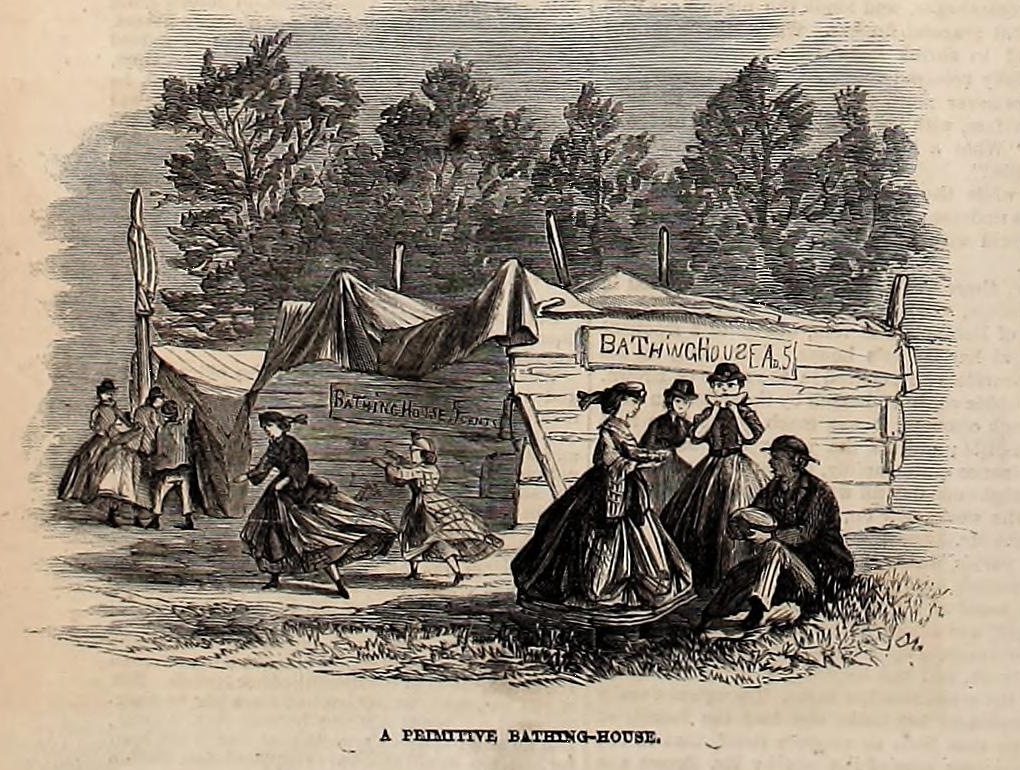
“A Primitive Bathing-House,” one of F. H. Schell’s small sketches of the farmers’ picnic at Amboy. Frank Leslie’s Illustrated Newspaper, September 2, 1865, page 380. Internet Archive. Public domain. Click the picture to see it full size.
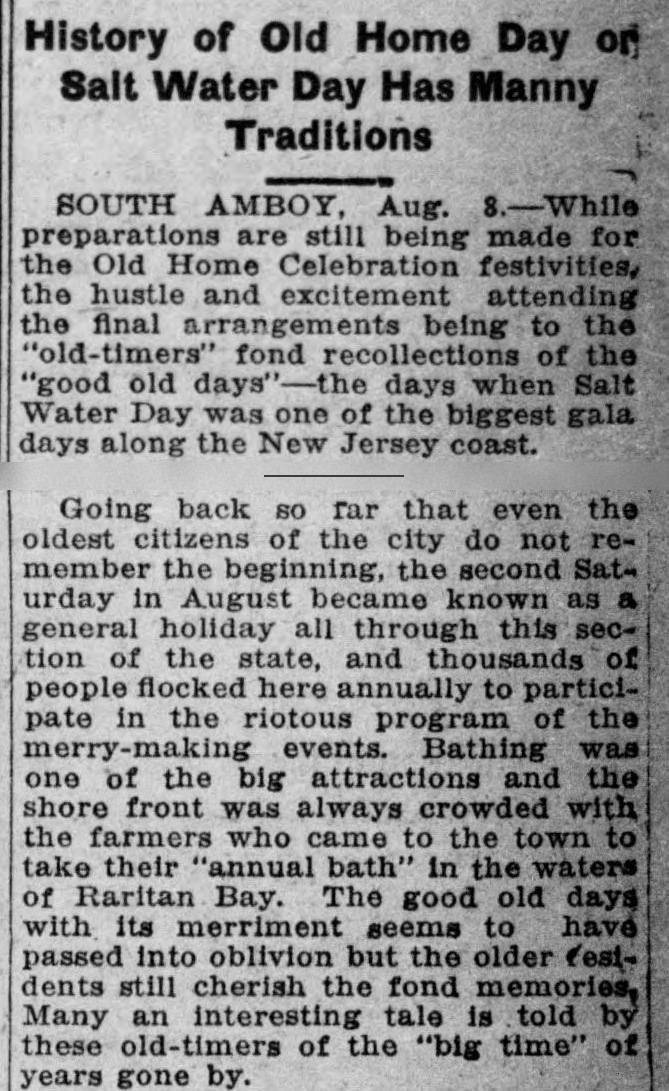
The headline and one paragraph of the paper’s history of Salt Water Day, joined. A portrait that sat between them is left out. Perth Amboy Evening News, Perth Amboy, New Jersey, August 8, 1919, page 17. Library of Congress, Chronicling America. Click the clipping to read it full size.
Then a railroad came through South Amboy in 1874, and people could ride on to the ocean beaches. Salt Water Day faded away, until a few old-timers urged William S. Dey, whom the 1919 paper calls a former mayor, “to start things going again.” The first Old Home Day was held in 1914.
Fifty thousand people and one stolen drum
In 1919 the fun began on Friday night, August 8, at Broadway and Augusta Street. Miss Alice Gunkle was crowned Queen Festiva II, and the mayor handed her the key of the city. Then came block dancing, which means dancing right in the street, “until well after midnight.” Every hotel room was taken. The paper joked that “many who remained sleepless did so by force of circumstances rather than by choice.”
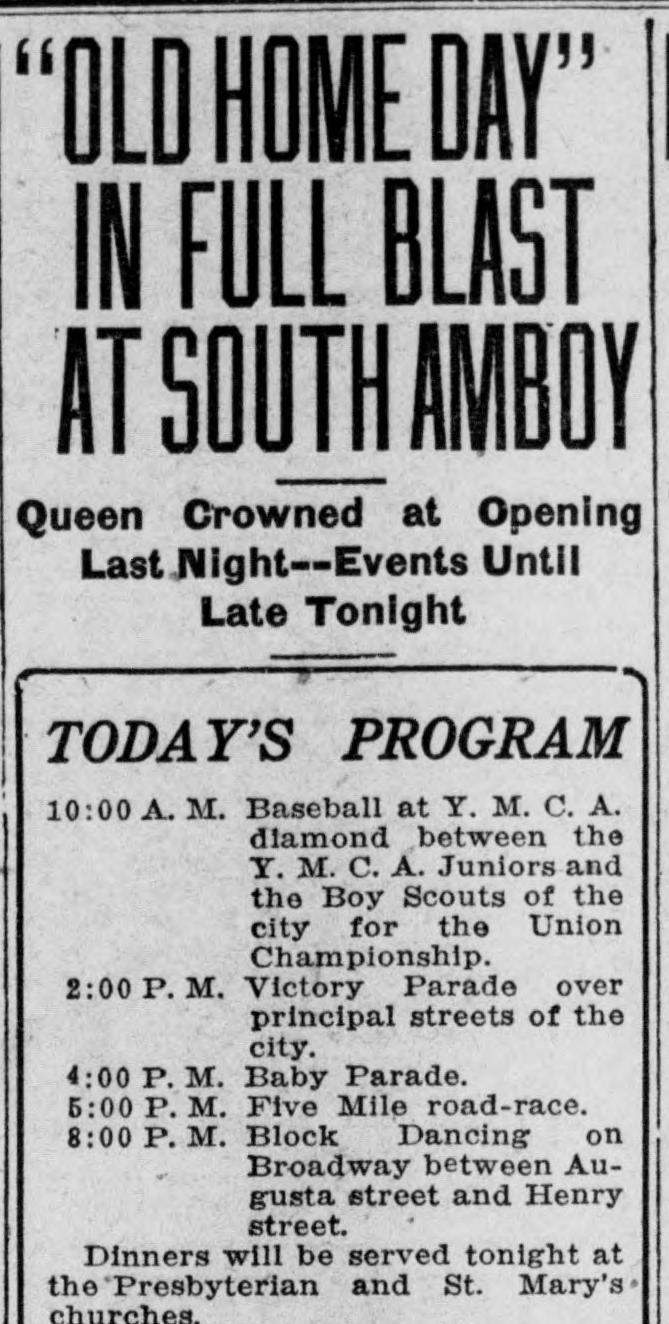
Saturday’s front-page headline and the program for the day. Perth Amboy Evening News, Perth Amboy, New Jersey, August 9, 1919, page 1. Library of Congress, Chronicling America. Click the clipping to read it full size.
Saturday had a ball game, a Victory Parade, a baby parade, a five-mile road race and more dancing. The ladies of the Presbyterian church had planned for “the feeding of several thousand persons.” St. Mary’s Parish ran a carnival all week with a merry-go-round and a Ferris wheel. The committee in charge promised a supper on Saturday night and was “prepared to feed the town if necessary.”
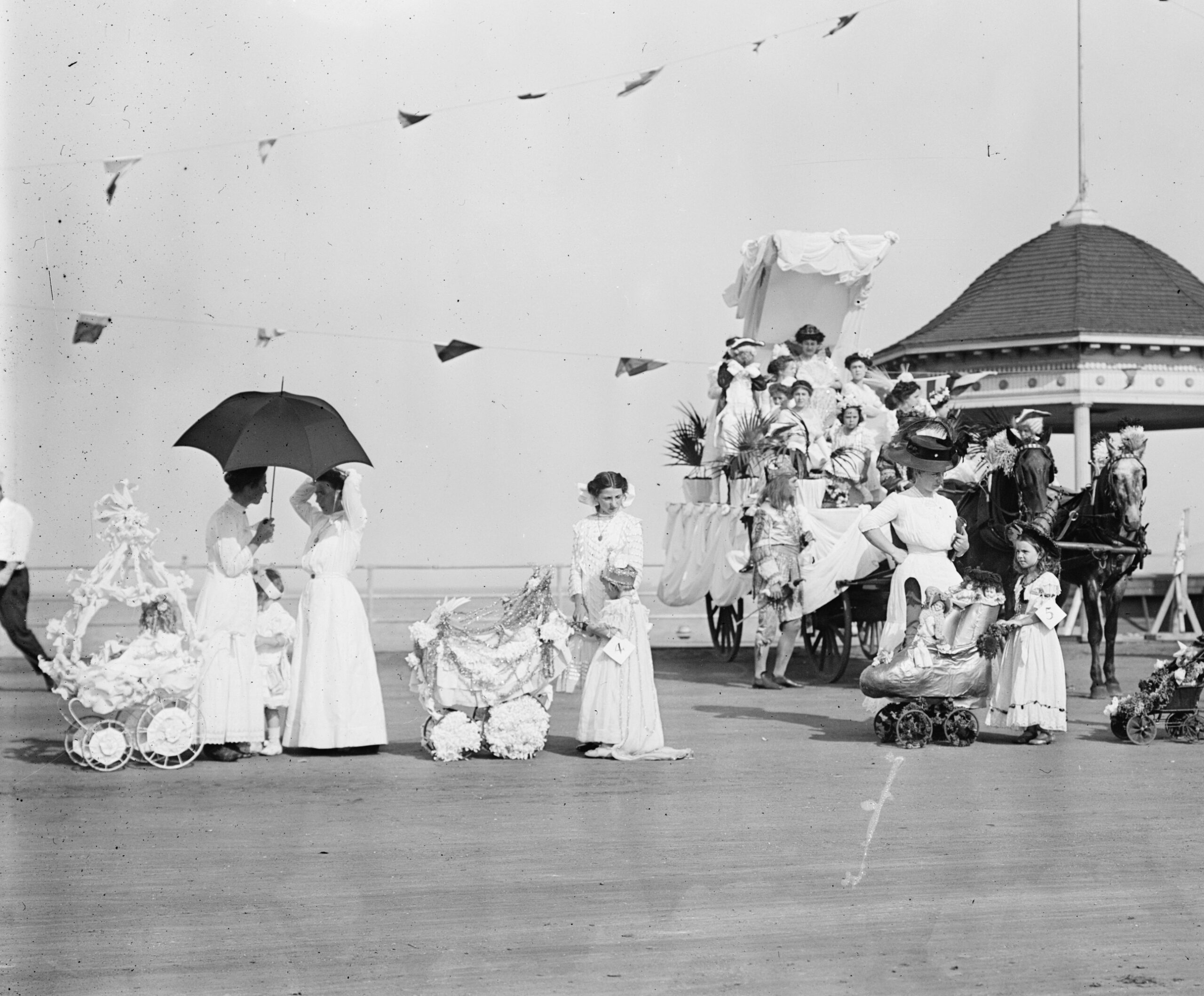
A baby parade of those years at Long Branch, New Jersey, with decorated baby carriages and a float pulled by horses. We found no photo of South Amboy’s parade. Bain News Service, undated glass negative. George Grantham Bain Collection, Library of Congress. Click the picture to see it full size.
It nearly was necessary. On Monday the paper said the crowd was “estimated at fifty thousand people.” Visitors had come “from as far south as Panama, as far west as Chicago and as far north as Portland, Me.” The police made “not one arrest.” The street cleaners hauled away “wagon after wagon load of confetti.”
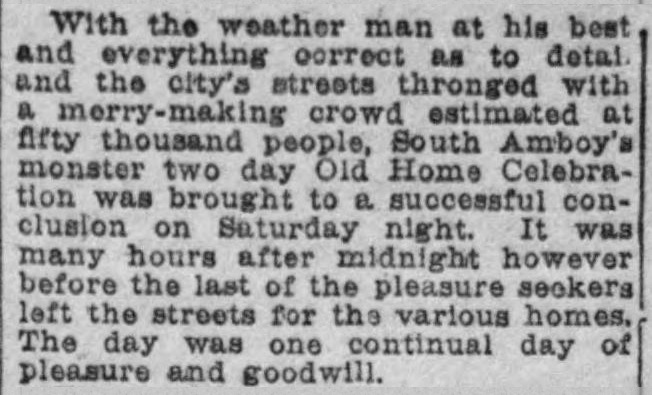
The opening of Monday’s report, “Old Home Day Complete Success at South Amboy.” Perth Amboy Evening News, Perth Amboy, New Jersey, August 11, 1919, page 5. Library of Congress, Chronicling America. Click the clipping to read it full size.
One fellow did walk off with the bass drum from St. Mary’s carnival. Thomas Burden, who lived on Stevens Avenue, stopped him there. The man had “marched hatless and coatless down the avenue all alone and beating the stolen drum.” Asked why, he said “he desired practice, because he was going to start an orchestra.”
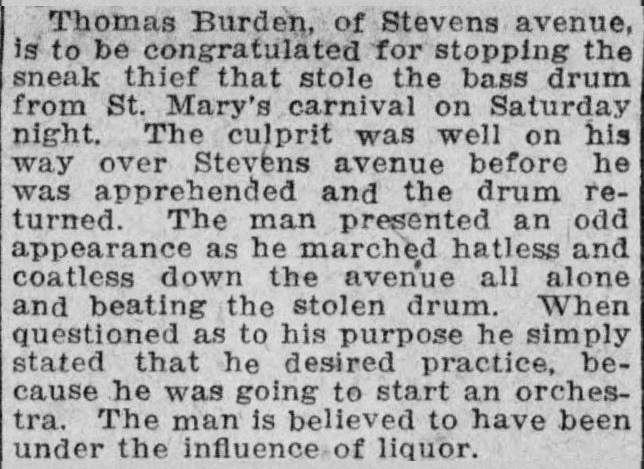
The man with the bass drum. Perth Amboy Evening News, Perth Amboy, New Jersey, August 12, 1919, page 5. Library of Congress, Chronicling America. Click the clipping to read it full size.
Where the coal went
Mrs. Letts was named the winner by August 13, and that should be the end of it. But on August 18 the paper had one more piece of news. The ton of coal, it said, “is now in the coal bin of another resident of this city.” A coal bin was where a house kept its coal.
This other resident had gone “over the head of the committee.” He told Mr. Peterson, the coal dealer, “to send the coal to his home as he was entitled to it.” And that is where the coal went.
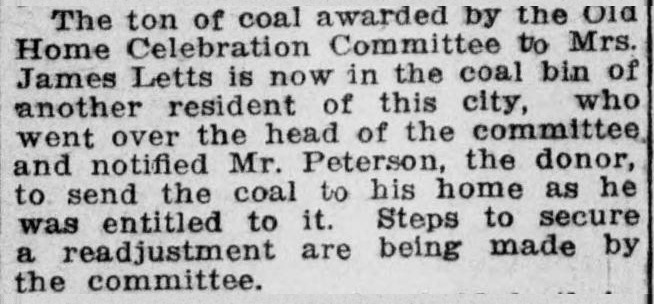
The prize goes astray. Perth Amboy Evening News, Perth Amboy, New Jersey, August 18, 1919, page 5. Library of Congress, Chronicling America. Click the clipping to read it full size.
The paper did not print the man’s name or say why he thought the coal was his. It said only this: “Steps to secure a readjustment are being made by the committee.” That is a polite way of saying the committee wanted its coal back. We read the next two weeks of the paper and found nothing more about it.
So we can’t say who burned that coal. We do know what it was for. South Amboy wanted its people home so much that it offered a ton of coal for a full house, and Mrs. Letts answered with twenty-eight guests. Whoever ended up with the prize, she won the contest.
Sources
- Perth Amboy Evening News (Perth Amboy, New Jersey), Library of Congress, Chronicling America: August 2, 1919, page 5 (St. Mary’s carnival); August 4, page 5 (the church ladies’ plans); August 8, page 17 (the contest rules, the program and the history of Salt Water Day); August 9, page 1 (the queen and the block dancing); August 11, page 5 (the crowd, the confetti and the visitors); August 12, page 5 (the bass drum and Mr. Barnes); August 13, page 5 (Mrs. Letts wins); August 18, page 5 (the coal in another bin).
- Frank Leslie’s Illustrated Newspaper (New York), September 2, 1865: the large engraving on page 377, scanned by the House Divided Project, Dickinson College, and “Grand Annual Picnic of New Jersey Farmers” with the small sketches on page 380, at the Internet Archive. The magazine names the place only as “Amboy,” on Raritan Bay. Its Saturday, its bay and its wagons match what South Amboy’s old-timers told the paper in 1919. Public domain.
- Bain News Service, “Long Branch Baby Parade,” undated glass negative, George Grantham Bain Collection, Library of Congress, no known restrictions on publication.
- All newspaper images: Library of Congress, Chronicling America. Published 1919.
- Cover: National Photo Company, “Hessick Coal Co.,” glass negative made between 1910 and 1925, Library of Congress, no known restrictions on publication. It shows W. H. Hessick & Son’s coal yard in Washington, D.C., not Peterson’s yard in Perth Amboy.