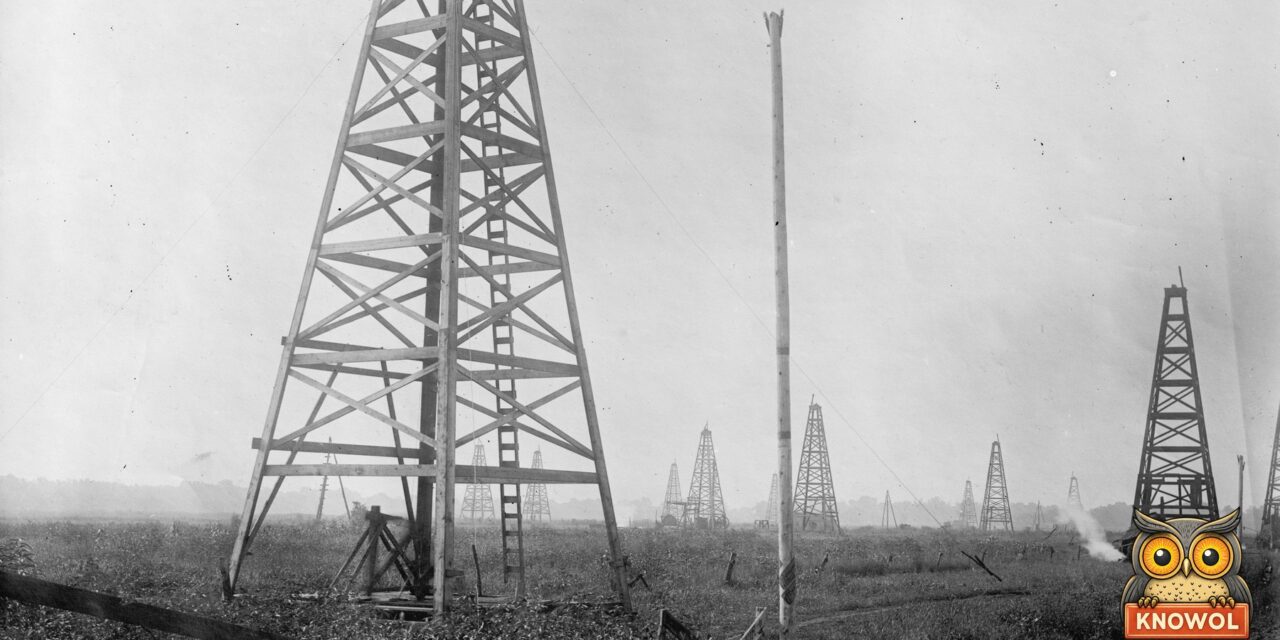
On Thursday, August 17, 1922, nobody was home in Crawfordsville, Arkansas. The banks were closed. The stores were closed. The whole town had gone three miles out into the country to look at a hole in the ground.
It was a special hole. A tower 110 feet tall stood over it. Inside the tower a drill went chugging down, more than 300 feet so far. If that drill found oil, the cotton farmers who owned it would be rich. So they did what people do for a new ship. They threw it a party, and they christened it with a bottle.
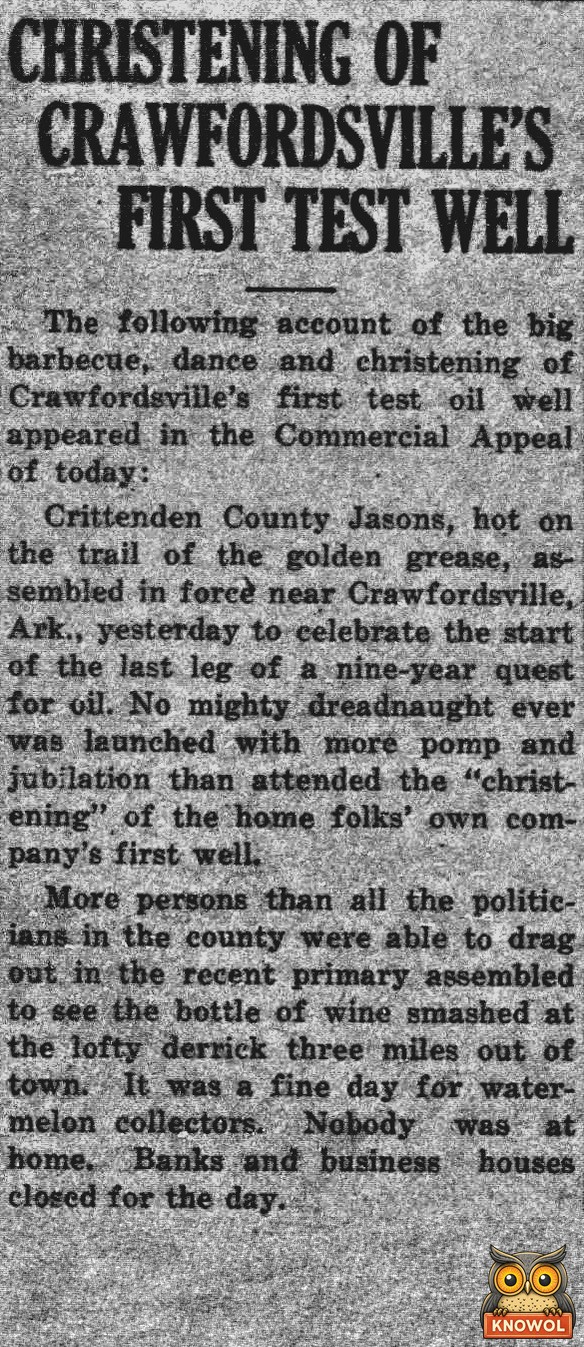
“Christening of Crawfordsville’s First Test Well.” The Forrest City Times-Herald, Forrest City, Arkansas, August 19, 1922, page 1. Library of Congress, Chronicling America. Click the clipping to read it full size.
A well that belonged to the home folks
The Commercial Appeal, a newspaper in Memphis, Tennessee, printed the story of the party. The Times-Herald in Forrest City, Arkansas, about 30 miles west of Crawfordsville, ran it again on its front page. That is where we read it.
The well belonged to the Crittenden County Oil & Gas Company. The reporter called it “the home folks’ own company.” Its owners were planters, which means cotton farmers, and their neighbors. The county, the story said, was on “a nine-year quest for oil.”
They had a reason to hope. In January 1921 a well near El Dorado, in the south of Arkansas, had struck oil. El Dorado had been a farm town of about 4,000 people. Soon it was the busiest oil town in the state. Now Crawfordsville had a derrick of its own. A derrick is the tall tower that holds up the drill.
So everybody came. “Nobody was at home,” the reporter wrote. “Banks and business houses closed for the day.” There was a band and a dance, and a barbecue to feed a county. “Herds of swine and sheep were roasted in the trenches,” the story went on. Swine are pigs. The trenches were long cooking pits dug in the ground.
Forrest City came too. That Thursday its paper noted, “A number of Forrest City people have driven over to Crawfordsville today to take in the big barbecue.”
The first million
One game beat all the others. All day, the reporter wrote, people were “dreaming aloud replies to the question: ‘What are you going to do with your first million?'” The drill had not found any oil yet. Nobody let that slow them down.
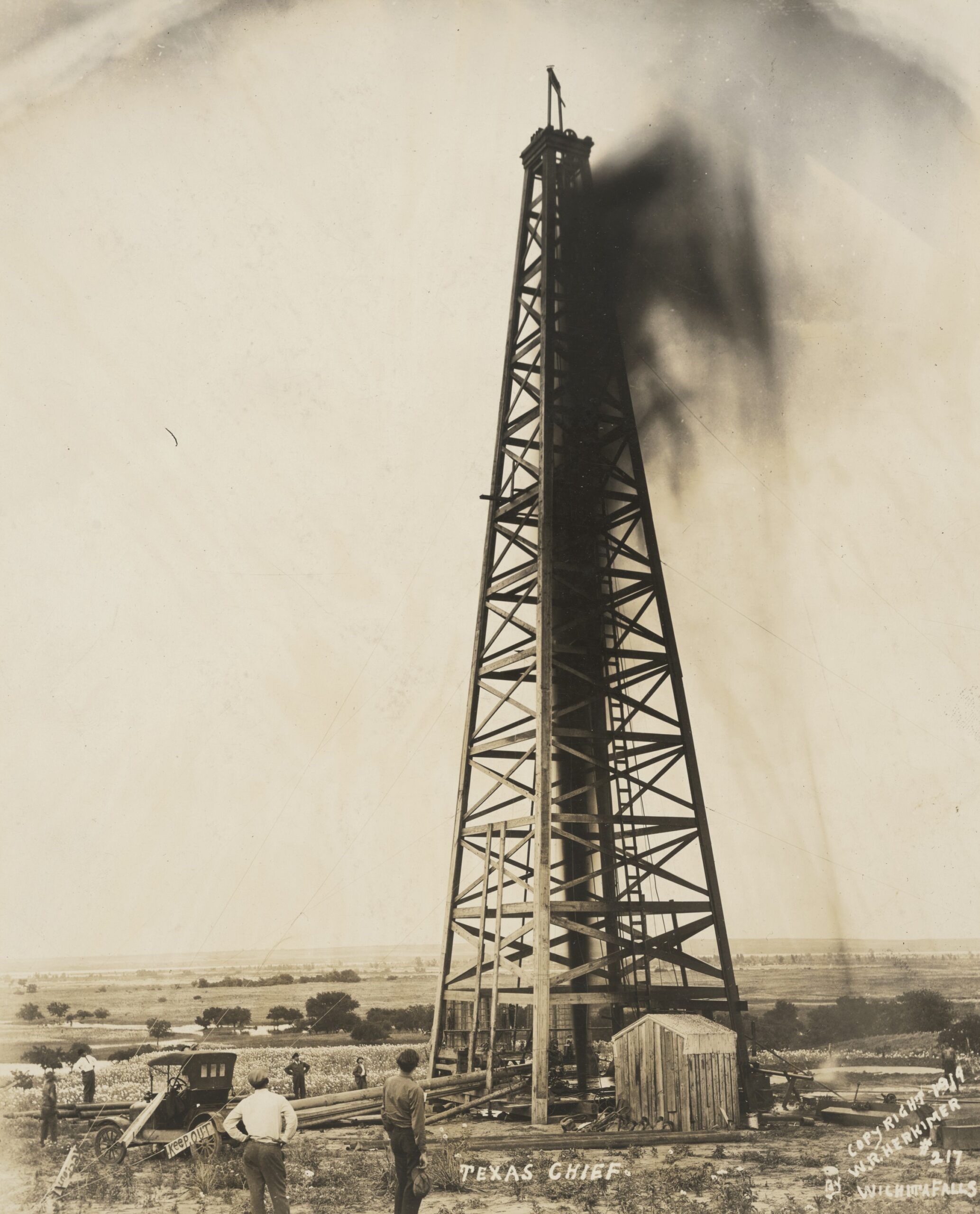
The dream. An oil well called the Texas Chief gushes in Texas in 1919, and men stop to look up. This is not the Crawfordsville well. Photo by W. R. Herkimer of Wichita Falls, Texas. Library of Congress. Click the picture to see it full size.
One planter kept a cool head. The reporter gave no name, only “one planter-stockholder.” A stockholder is a part owner. “If oil is here, we want to know it,” the planter said. “If it isn’t, we want to know that, too.” The well, the planter said, was “a gamble on what seems to be a reasonable chance.”
Then came the fun. “If we win, we’ll hold another barbecue and boil a boll weevil in the first barrel of oil.” There was even a word for John D. Rockefeller, the most famous oil man in America. “John D. hasn’t joined out with us yet, and we haven’t sent for him.”
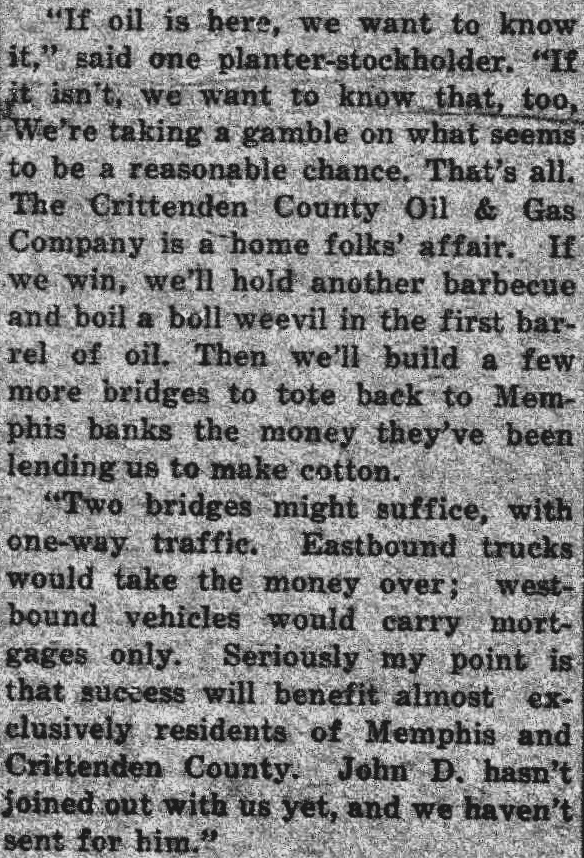
The planter’s speech. It also has a joke about building more bridges to carry money back to the Memphis banks. The Forrest City Times-Herald, Forrest City, Arkansas, August 19, 1922, page 1. Library of Congress, Chronicling America. Click the clipping to read it full size.
Why boil a boll weevil
A boll weevil is a small beetle that eats cotton. That summer it was eating the planters’ money. On the very same front page, the Forrest City paper ran this headline about its own county: “Boll Weevil Damage Will Be Very Large.” Without the bug, the paper said, “we would have had a banner crop.” A banner crop is a great big one. No wonder a cotton planter wanted to drop a weevil in a barrel of oil.
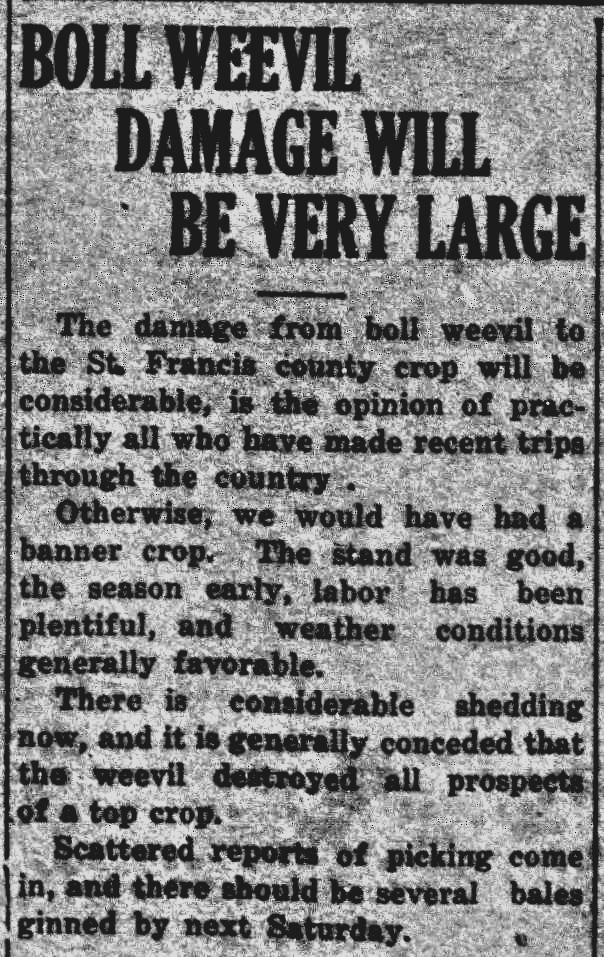
“Boll Weevil Damage Will Be Very Large,” from the same front page as the oil well story. The Forrest City Times-Herald, Forrest City, Arkansas, August 19, 1922, page 1. Library of Congress, Chronicling America. Click the clipping to read it full size.
The queen and the mystery bottle
Three men made speeches. Then the queen came, and the reporter said the speakers “could not hope to vie with the queen of the festival.” To vie is to compete.
She was Miss Bessye Miller Morris of Crawfordsville. She rode in with “her motor car smothered with gold and Harding blue chrysanthemums.” Warren G. Harding was President that year. “High above the heads of the crowd,” the story says, “Queen Bessye appeared suddenly upon a platform, outside the derrick, with her attendants.”
The maids held up a cushion. On it sat “a two-quart bottle.” Now, this was 1922. It was against the law to make or sell beer, wine or whiskey anywhere in America. People who liked that law were called “drys.” People who did not were called “wets.” And here was a big bottle in front of both.
“The cork was covered with tinfoil,” the reporter wrote. “The contents were light yellow and seemed to contain bubbles. A preacher among the spectators gasped.”
Nobody got a closer look. “Before any of the wets or drys had a chance to satisfy their curiosity or call Sheriff Fish from the crowd,” the queen “threw the mysterious bottle with sharpshooter aim” at the middle of the derrick, “where it shattered.”
“I christen thee Stanley No. 1,” she cried. The band played “The Star Spangled Banner.” A flag went up to what the paper called the “110-foot peak.” Then the crowd went back to the picnic, and the drill went back to work.
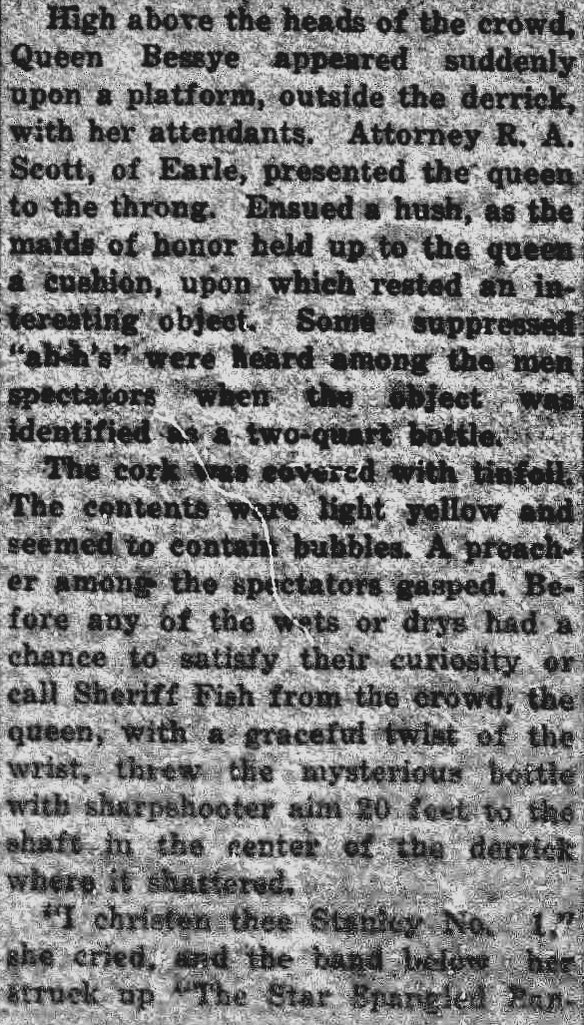
The queen, the cushion and the two-quart bottle. The last lines are dark on the old film. The Forrest City Times-Herald, Forrest City, Arkansas, August 19, 1922, page 1. Library of Congress, Chronicling America. Click the clipping to read it full size.
Near the top of the story the reporter had called it “the bottle of wine.” By the end it was a mystery. The story never does say what was in it.
What the drill found
The planter wanted to know, and so do we. The State of Arkansas keeps a map of the oil tests drilled in Crittenden County. About three miles northwest of Crawfordsville, it shows a small mark with the company’s short name and the name Stanley. Next to the mark is the depth the drill reached: 2,844 feet. That is more than half a mile down.
The mark is the map’s sign for a “dry and abandoned wildcat well.” A wildcat well is one drilled where nobody has found oil before. Dry means this one found none.
Stanley No. 1 had plenty of company. In 1954 a state geologist counted 418 test wells in 27 counties of northeastern Arkansas. Not one of those counties was producing oil or gas. The oil in Arkansas turned out to be in the south, around El Dorado.
We found no picture of the party. The photo at the top of this story shows wooden derricks in another American oil field, taken for the Detroit Publishing Company between 1900 and 1920.
We found no second barbecue, either, and no boiled boll weevil. But the planter got an answer. “If it isn’t, we want to know that, too.” Now they knew. And for one August day, with the banks locked and the pigs roasting, a whole town got to spend its first million out loud.
Sources
- “Christening of Crawfordsville’s First Test Well,” The Forrest City Times-Herald (Forrest City, Arkansas), August 19, 1922, page 1, reprinted from the Memphis Commercial Appeal. The same page has “Boll Weevil Damage Will Be Very Large.” Library of Congress, Chronicling America.
- The Forrest City Times-Herald: “Big Barbecue and Picnic at Crawfordsville,” August 15, 1922, page 1, and the note that Forrest City people had driven over, August 17, 1922, page 8. Library of Congress, Chronicling America.
- Arkansas Geological Survey, Well Location Map of Crittenden County, Arkansas (the Stanley well, total depth 2,844 feet, marked dry and abandoned), from its county well location maps.
- William M. Caplan, Subsurface Geology and Related Oil and Gas Possibilities of Northeastern Arkansas, Arkansas Geological Survey Bulletin 20, 1954 (418 test wells in 27 counties).
- Kenneth Bridges, “Oil Industry,” Encyclopedia of Arkansas (the El Dorado oil strike of January 10, 1921, and where Arkansas oil is found).
- Cover photo: “An Oil field”, Detroit Publishing Co., between 1900 and 1920. The record does not name the place. Library of Congress Prints and Photographs Division, no known restrictions on publication.
- Photo in the story: “Texas oil fields; Texas Chief gusher”, photo by W. R. Herkimer, Wichita Falls, copyright 1919. Library of Congress Prints and Photographs Division, no known restrictions on publication.