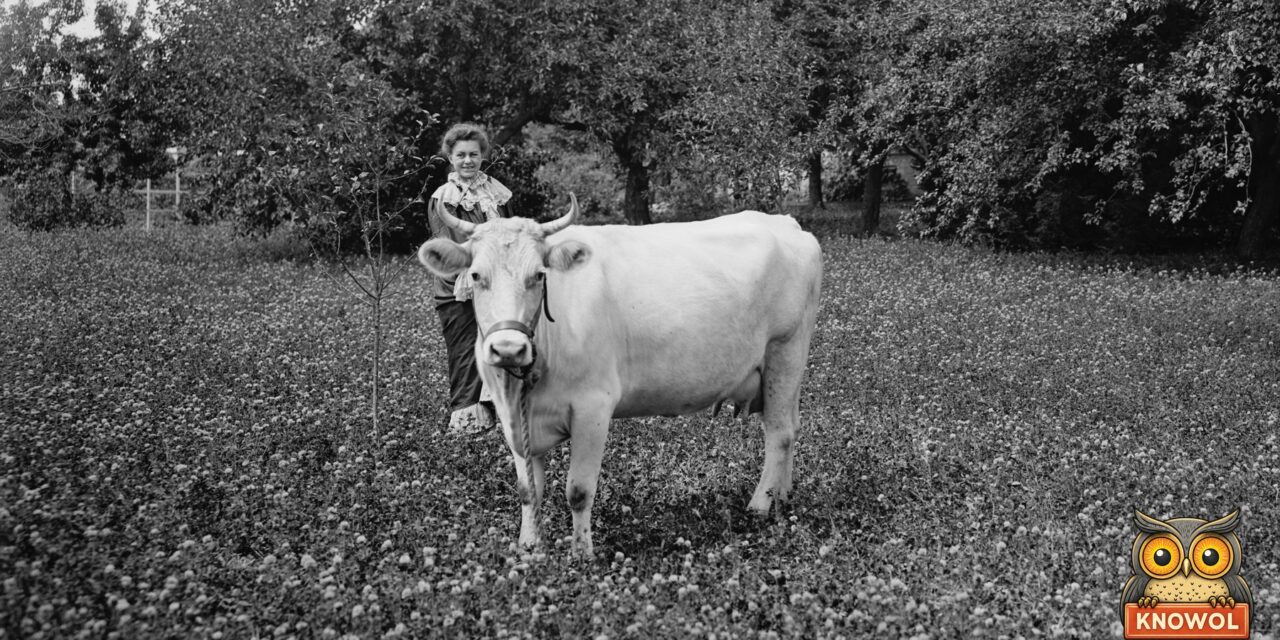
On a Monday in the fall of 1915, Silas A. Lentz needed a place to park his cow. Lentz ran the Great Northern Railway depot in Howard Lake, Minnesota, and his family kept a cow for milk and cream. The newspapers called her Bossy, an old pet name for any cow.
Lentz looked around the railroad yard and saw a box car standing on the siding, a short side track where cars wait until they are needed. The car was big and heavy, and it was sitting still. The Howard Lake Herald said it looked to him like “a perfectly good hitching post,” the kind of post where people tied a horse outside a store. So he tied Bossy to the box car.
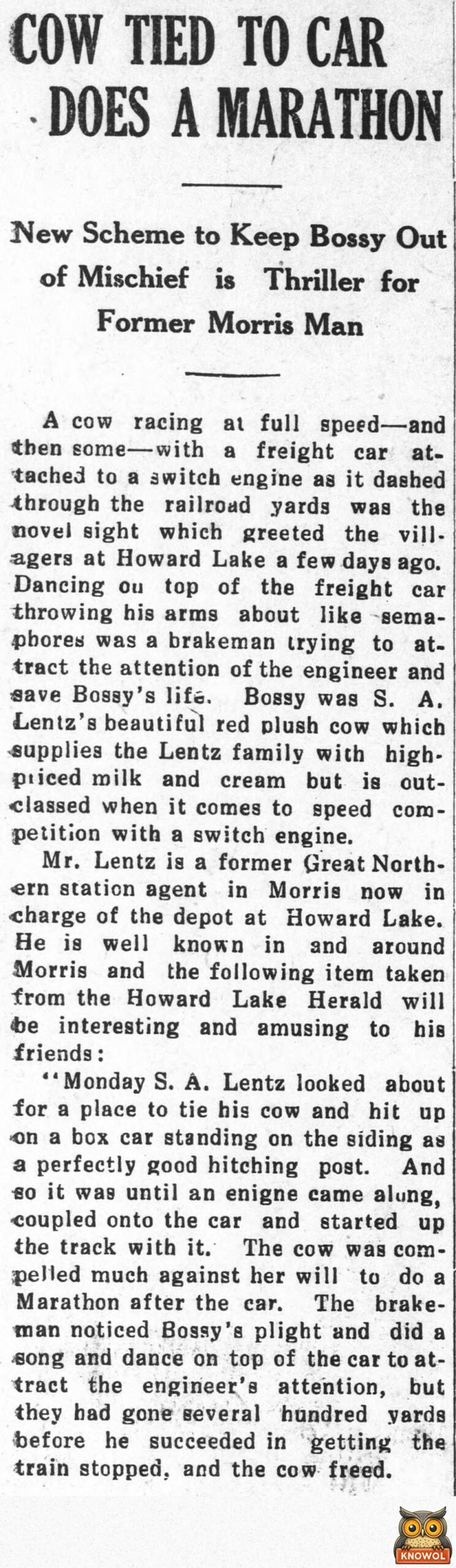
“Cow Tied to Car Does a Marathon.” The Morris Tribune, Morris, Minnesota, October 8, 1915, page 1. The last paragraph is the Howard Lake Herald’s own report. Library of Congress, Chronicling America. Click the clipping to read it full size.
The Box Car in Howard Lake Starts to Roll
A box car in Howard Lake made a fine hitching post until a locomotive came for it. An engine, the Herald said, “came along, coupled onto the car and started up the track with it.”
Coupled means hooked on. It was a switch engine, a small locomotive whose job is to move cars around a rail yard. It seems the engineer had no idea a cow was tied on behind, because it took a dancing brakeman to tell him.
Bossy could not stand still, so she ran. The Herald said she “was compelled much against her will to do a Marathon after the car.”
The Brakeman Who Danced on the Roof
One railroad man in Howard Lake saw the trouble, and he was the brakeman. A brakeman was a member of the train crew who helped with the brakes and with hooking up cars. This one was riding on top of the box car, and from up there he spotted the cow running behind.
He had to get the engineer to look back, so he danced. The Herald said he “did a song and dance on top of the car to attract the engineer’s attention.” The Morris Tribune, the paper in Lentz’s old town of Morris, Minnesota, put the story at the top of its front page. It said the brakeman was “throwing his arms about like semaphores.” A semaphore is a railroad signal, a tall post with an arm that swings up and down to tell a train to stop or go. The brakeman turned himself into one.
The Herald said “they had gone several hundred yards before he succeeded in getting the train stopped, and the cow freed.” A football field is 100 yards long, so Bossy ran the length of a few football fields tied to a train. The Tribune said the brakeman was trying to “save Bossy’s life,” and he did. Neither paper printed his name.
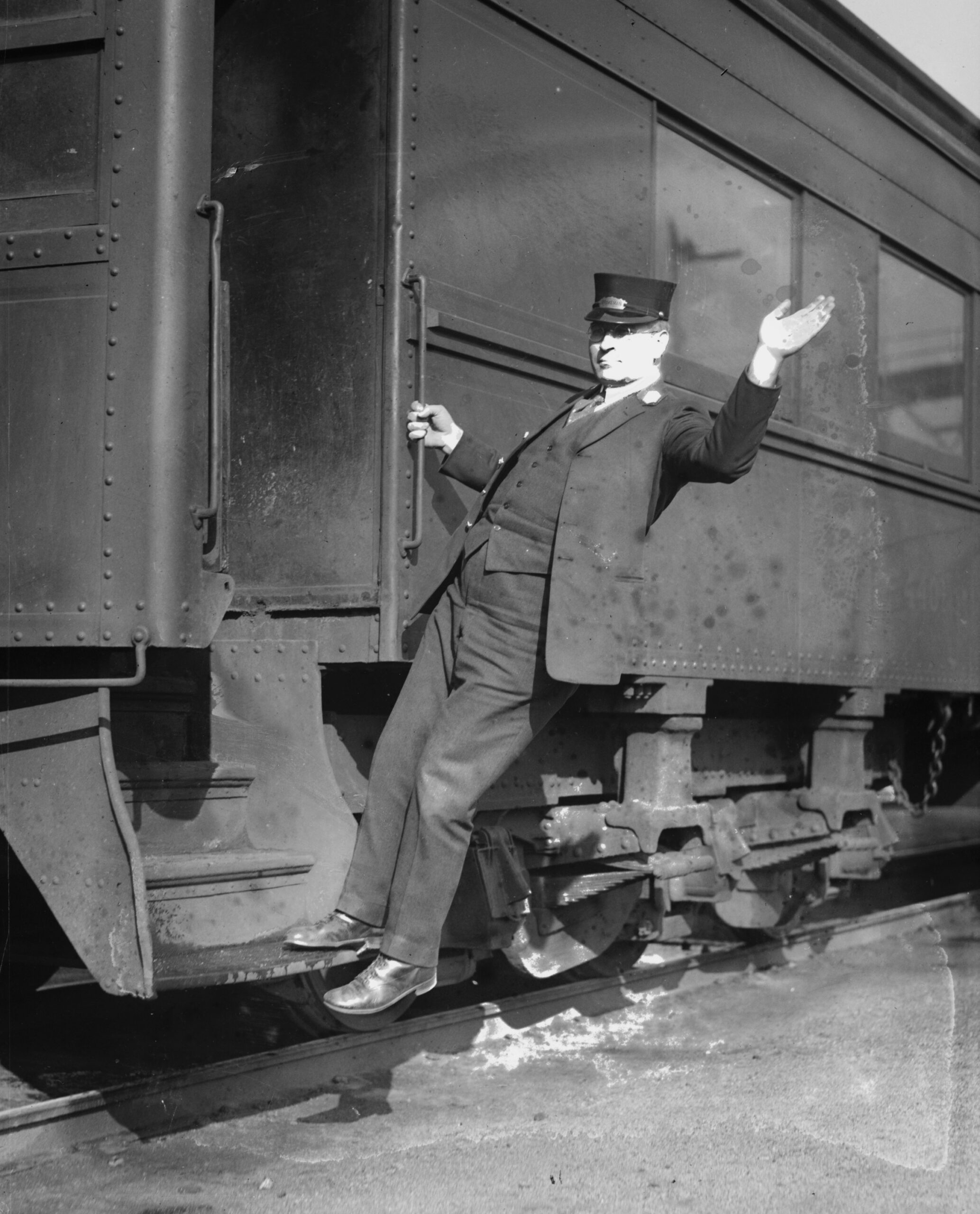
A brakeman leans out from a railroad car with one arm raised. The Library of Congress title is “Brakeman Patrick Lance, Pa.” He is not the Howard Lake brakeman. National Photo Company, between 1918 and 1920. Library of Congress. Click the picture to see it full size.
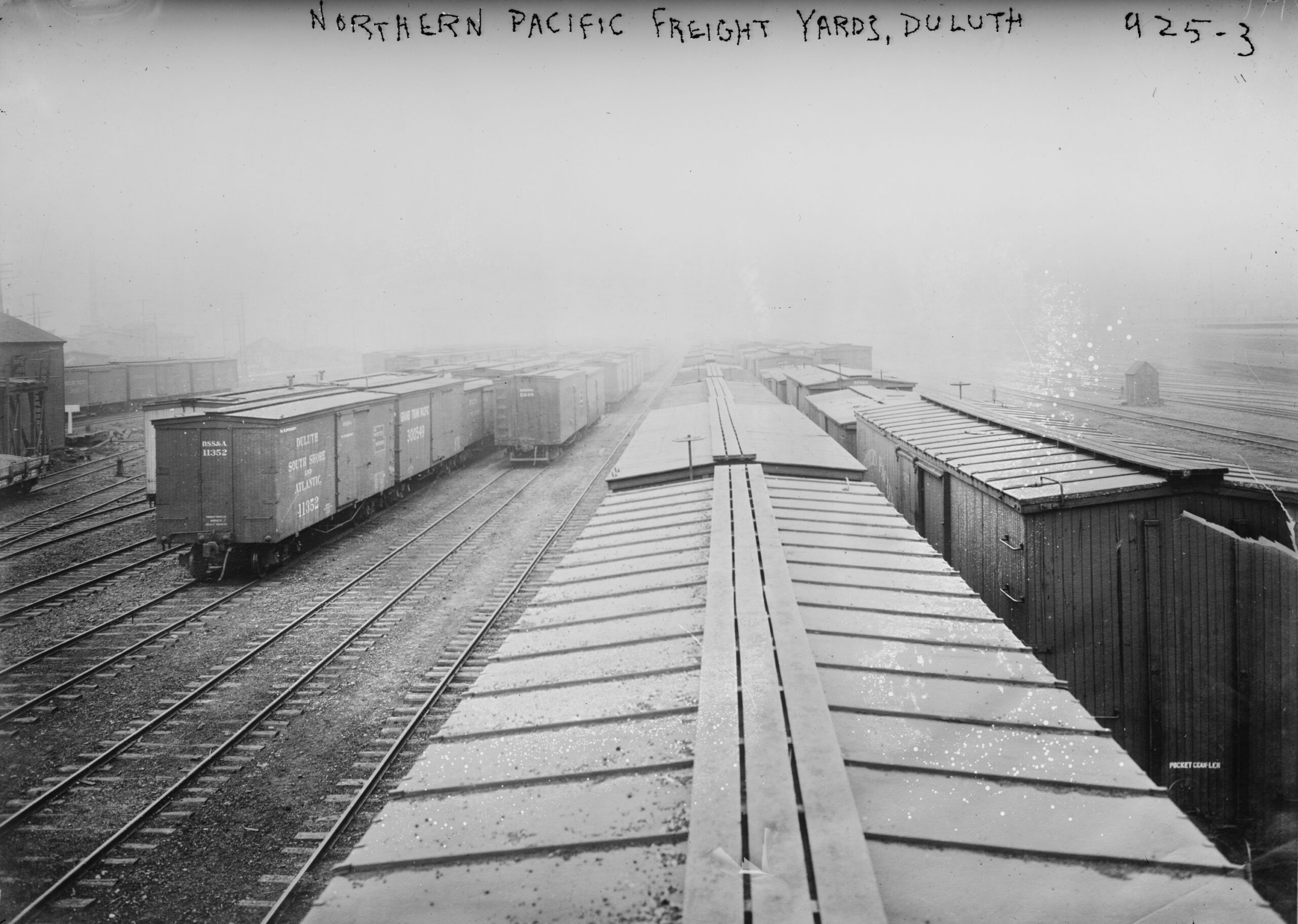
The view from the roof of a box car, with the plank walkway the train crew used. This is the Northern Pacific freight yard in Duluth, Minnesota, not Howard Lake. Bain News Service, undated, probably about 1909. Library of Congress. Click the picture to see it full size.
Silas Lentz of Howard Lake Knew His Trains
Silas Lentz of Howard Lake was no stranger to railroads, and that is the best part of the story. He was a station agent, the person in charge of a town’s depot.
In 1912, when he was the agent at Morris, the Great Northern’s station agents made him president of their association for another term. In his speech he said that only “hard practical experience will make an efficient agent for a railroad company.”
In November 1914 Lentz moved back to Howard Lake, where the Tribune said he had been the agent “for 16 years before coming to Morris.” The men in the Morris office chipped in and bought him a going-away present. It was a meerschaum pipe, a fancy pipe carved from a soft white stone.
So the man who tied his cow to a box car had worked beside box cars for more than 16 years. He knew as well as anyone that they move. That Monday, Silas Lentz got one more piece of hard practical experience.
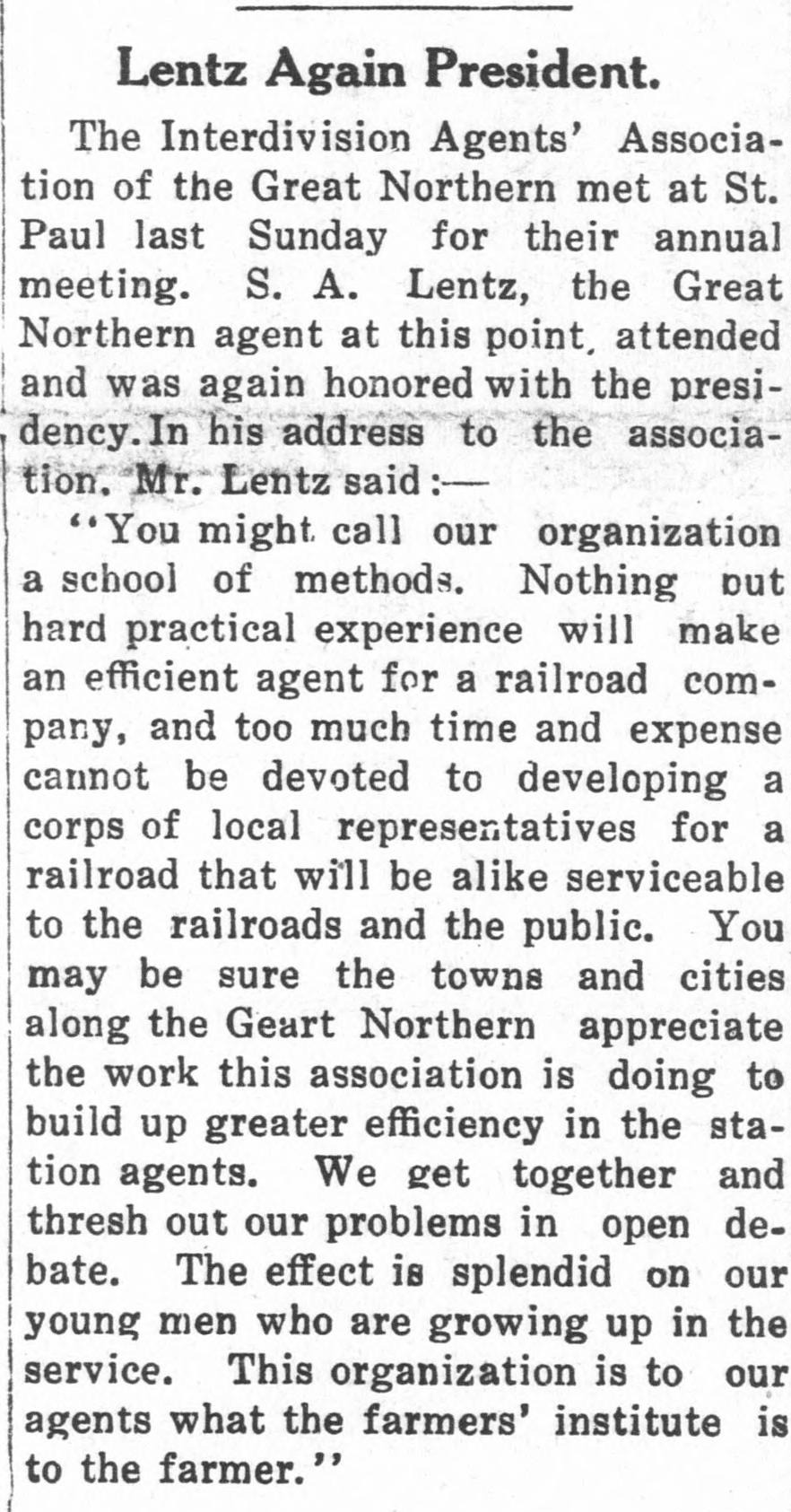
“Lentz Again President.” The Morris Tribune, Morris, Minnesota, May 24, 1912, page 1. Library of Congress, Chronicling America. Click the clipping to read it full size.
What Bossy’s Milk Was Worth in Morris
The Morris Tribune had some fun with the Lentz family cow. It called Bossy a “beautiful red plush cow” that gave the family “high-priced milk and cream.” Plush is a soft, fuzzy cloth, the kind used for teddy bears. But Bossy, the Tribune added, “is outclassed when it comes to speed competition with a switch engine.”
The same front page shows what farm food sold for in Morris that week. The paper’s market list had butter at 25 cents a pound, eggs at 21 cents a dozen and new potatoes at 25 cents a bushel, which is a big basketful. A family with its own cow got its milk, cream and butter at home.
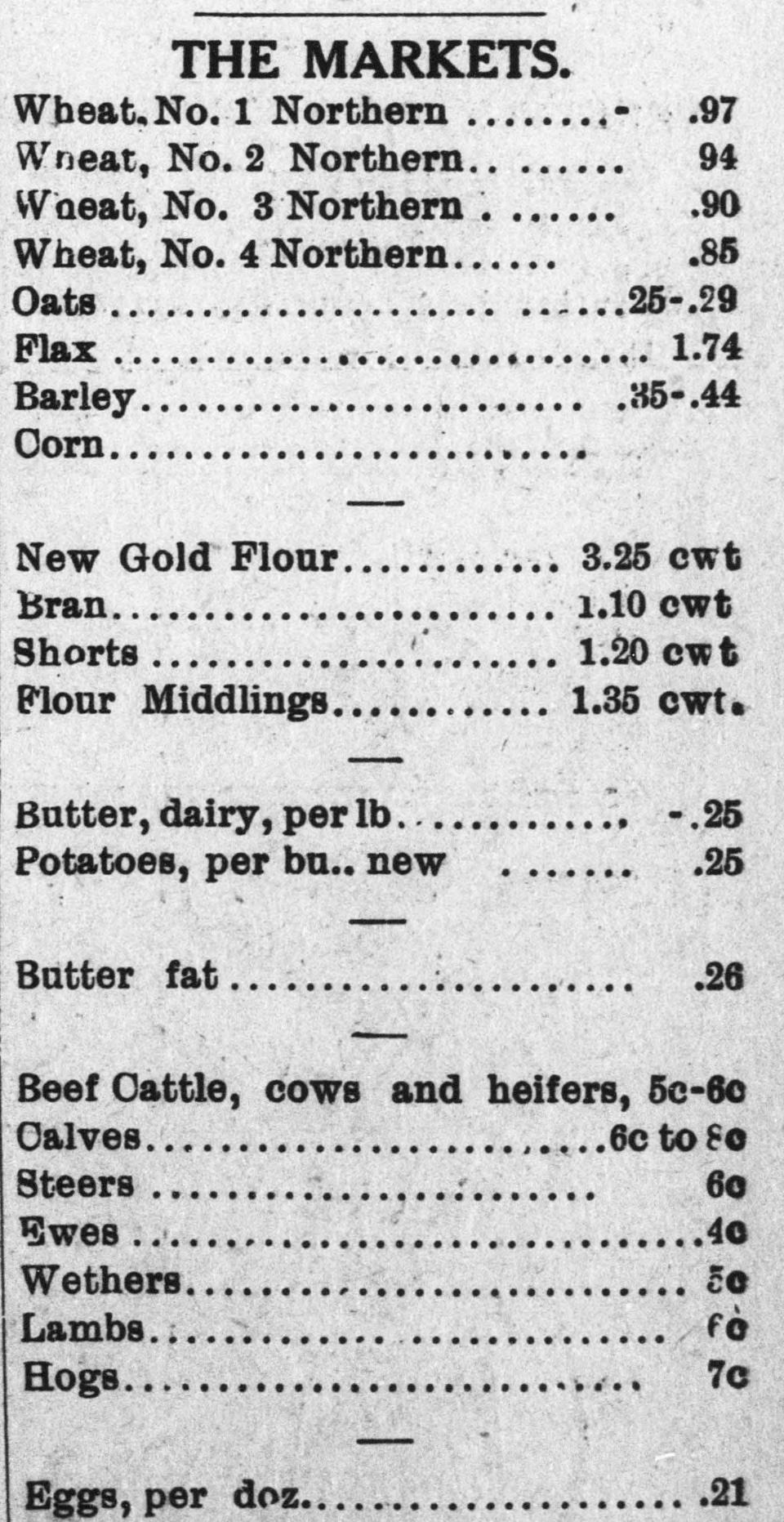
“The Markets,” from the same front page as the cow story. The Morris Tribune, Morris, Minnesota, October 8, 1915, page 1. Library of Congress, Chronicling America. Click the clipping to read it full size.
The Same Front Page in Morris Had a Runaway Horse
The cow from Howard Lake was not the only tied-up animal in the Morris Tribune on October 8, 1915. A few columns over, the paper told about the county fair. A young flier named Monte Rolfe took off there in his biplane, an airplane with two sets of wings. He got about 30 feet up before engine trouble brought him down in a clover field.
“A horse tied to the fence saw the machine as it soared and stricken with fright leaped over the fence,” the Tribune said. “The buggy refused to follow and the animal was caught before much damage was done.”
So one front page had a cow pulled along by a locomotive and a horse scared over a fence by an airplane. In 1915 people still tied their animals to whatever was handy, the way they always had. The machines were new, and nobody had told the animals.
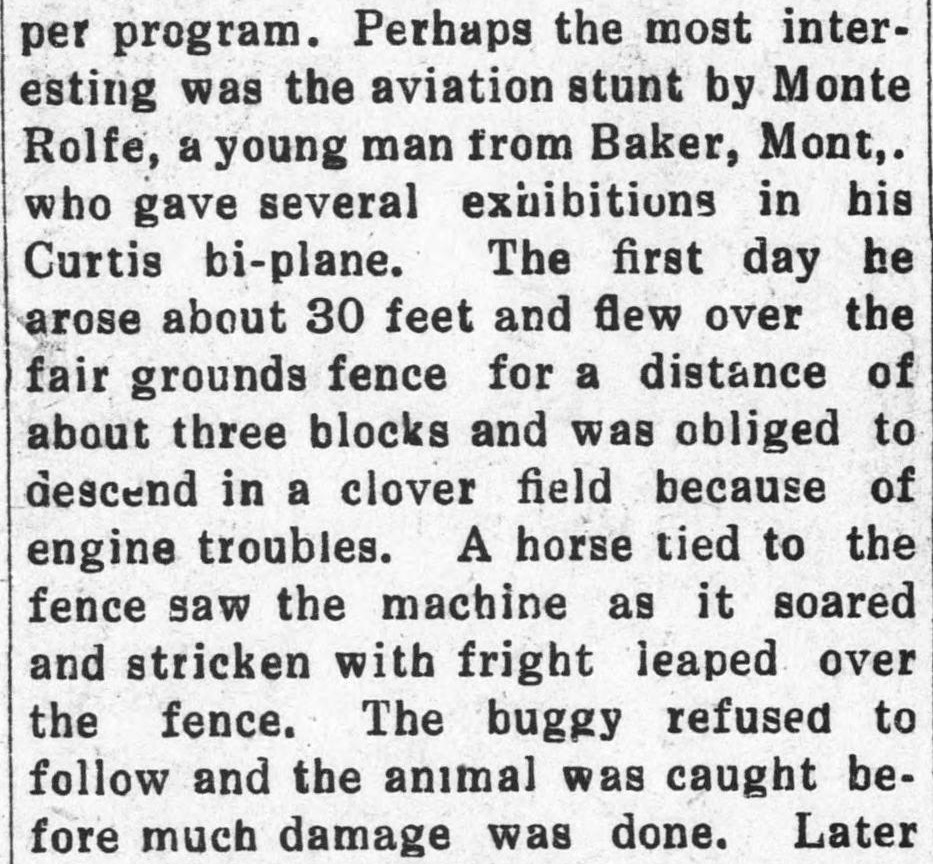
Part of the county fair story, from the same front page. The Morris Tribune, Morris, Minnesota, October 8, 1915, page 1. Library of Congress, Chronicling America. Click the clipping to read it full size.
How It Ended for Lentz and Bossy
In Howard Lake, the runaway box car did Silas Lentz no harm. The Tribune reprinted the Herald’s story for his old neighbors in Morris because, it said, it would be “interesting and amusing to his friends.” In January 1916 it reported that the Knights of Pythias, a men’s lodge in Howard Lake, had made him its top officer and held “a banquet in the lodge hall for members and their wives.”
We have no picture of Bossy. The cow at the top of this page is another family cow on a rope, photographed in New Baltimore, Michigan, by the Detroit Publishing Company between 1901 and 1910. As for the real Bossy, the papers do not say where Lentz tied her after that. A fence post seems like a safe bet.
Sources
- “Cow Tied to Car Does a Marathon,” The Morris Tribune (Morris, Minnesota), October 8, 1915, page 1. It reprints the Howard Lake Herald’s report. The county fair story (“Enormous Crowds Saw County Fair”) and “The Markets” are on the same page. Library of Congress, Chronicling America.
- “Lentz Again President,” The Morris Tribune, May 24, 1912, page 1. Library of Congress, Chronicling America.
- “Tait Succeeds Lentz,” The Morris Tribune, November 13, 1914, page 1 (the move back to Howard Lake and the pipe). Library of Congress, Chronicling America.
- The Morris Tribune, January 28, 1916, page 2 (the Knights of Pythias banquet) and “Lentz-Jongewaard,” November 28, 1913, page 1 (his full name). Library of Congress, Chronicling America.
- Cover photo: “The Firs, family cow, New Baltimore, Mich.”, Detroit Publishing Co., between 1901 and 1910. Library of Congress Prints and Photographs Division, no known restrictions on publication.
- Photos in the story: “Brakeman Patrick Lance, Pa.”, National Photo Company, between 1918 and 1920, and “Northern Pacific freight yards, Duluth, Minn.”, Bain News Service, undated. Library of Congress Prints and Photographs Division, no known restrictions on publication.
- The newspaper pages were printed before 1931 and are in the public domain.