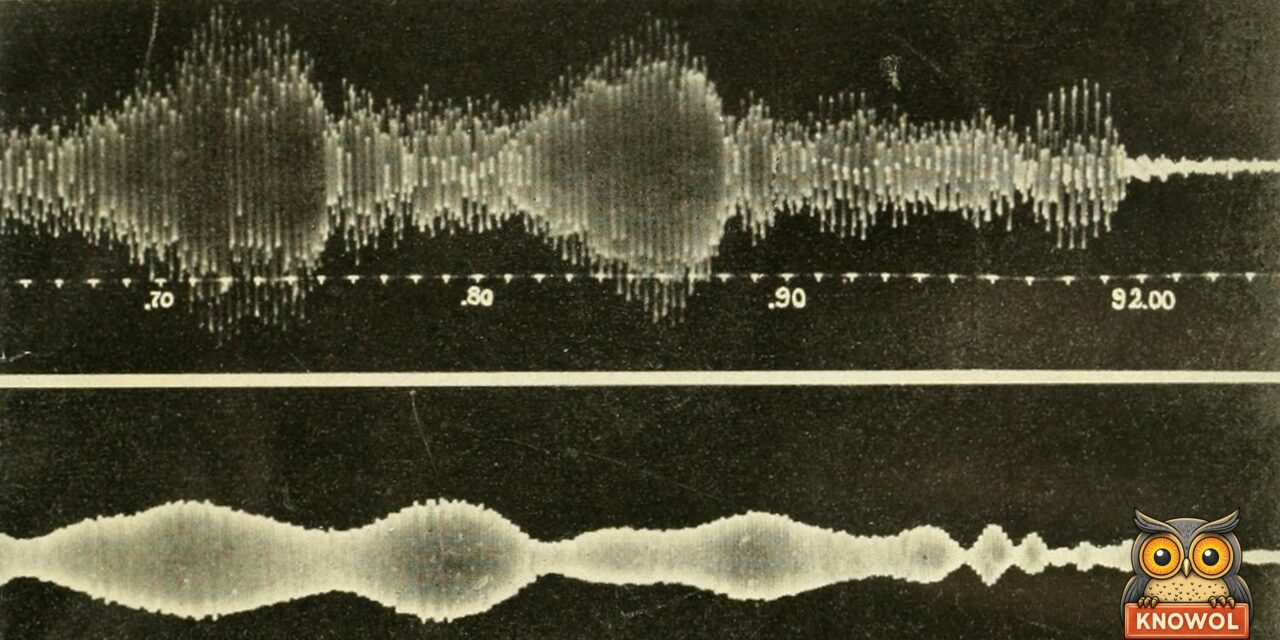
On December 28, 1916, a professor from Cleveland, Ohio, stood beside a strange machine in New York City and spoke one word into a horn: “War.” On a screen across the room, a messy, jagged blot of light flashed up. Then he said “Peace,” and the light turned into a calm, smooth glow.
The professor was Dayton C. Miller of the Case School of Applied Science. His machine was called the phonodeik, and it did something new. It let people see sound. The Evening World, a New York paper, said it best in its headline that day: “This ‘Phonodeik’ Shows You How Your Voice Looks.”
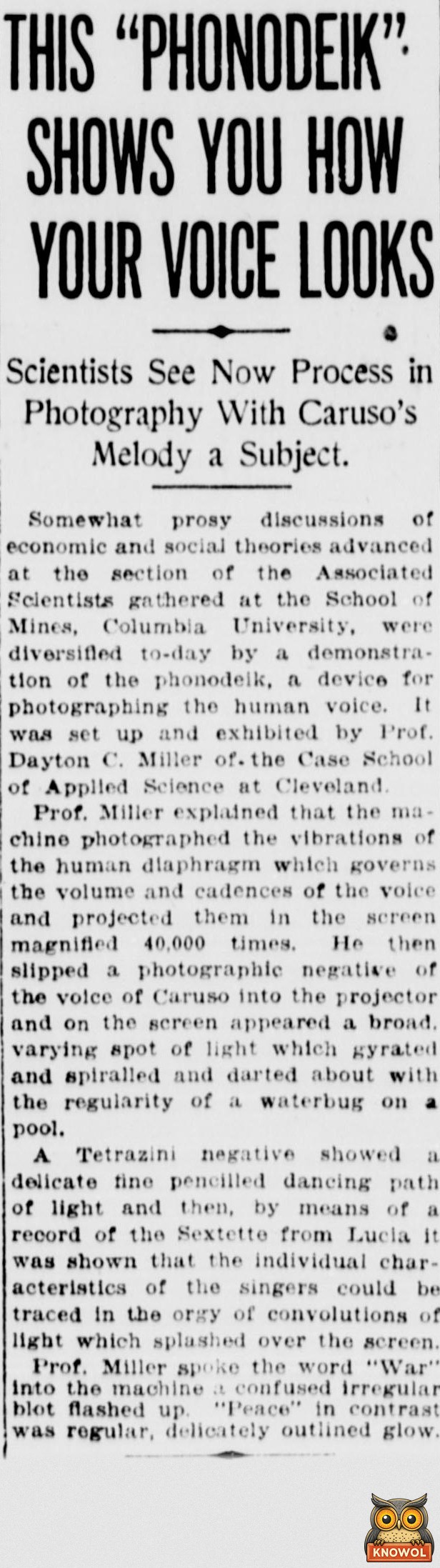
“This ‘Phonodeik’ Shows You How Your Voice Looks.” The Evening World, New York, New York, December 28, 1916, page 3. Library of Congress, Chronicling America. Click the clipping to read it full size.
A Room Full of Scientists in New York
Miller, the Cleveland professor, showed his machine at a big meeting of scientists that week. They gathered at the School of Mines of Columbia University. Many of the talks were about money and how people live. The Evening World called them “somewhat prosy discussions,” which is an old way of saying a little dull. Then Miller set up the phonodeik.
He said his machine made the shaking of a voice “40,000 times” bigger and threw it on a screen. First he slipped a photograph of the voice of Enrico Caruso, the famous opera tenor, into the projector. Caruso’s voice made a broad spot of light that “gyrated and spiralled and darted about with the regularity of a waterbug on a pool.” A waterbug skitters every which way, so that was the reporter’s joke.
The famous soprano Luisa Tetrazzini looked different. Her voice “showed a delicate fine pencilled dancing path of light.” Then Miller played a record of the Sextette from Lucia, an opera song for six singers, and the reporter could pick out each singer in the swirl of light. Last came the word test. “Prof. Miller spoke the word ‘War’ into the machine a confused irregular blot flashed up. ‘Peace’ in contrast was regular, delicately outlined glow.”
World War I had been raging in Europe for more than two years. The United States would join it in April 1917. The picture at the top of this page is a real photograph of sound from Miller’s 1916 book. In the top wave, the wide bulges are Caruso singing the syllable “chi” on a record of that same Sextette. The smooth wave under it is Tetrazzini holding a high note.
How the Cleveland Professor Turned Sound Into Light
Miller explained his machine in his 1916 book, The Science of Musical Sounds. The name phonodeik, he wrote, means “to show or exhibit sound.”
Sound is air shaking back and forth very fast. Miller caught that shaking with a horn. At the narrow end sat a disk of glass only 0.003 inch thick, thinner than a sheet of notebook paper. An ordinary sound moved the glass only about half a thousandth of an inch.
A few silk threads were fixed to the middle of the glass and wrapped around a tiny steel spindle. On the spindle sat a mirror “about 1 millimeter (0.04 inch) square,” about the size of a pinhead. When the glass wiggled, the threads turned the spindle, and the mirror tipped back and forth. A thin beam of light bounced off the mirror onto a strip of film rolling past. The dancing dot of light drew the sound wave on the film.
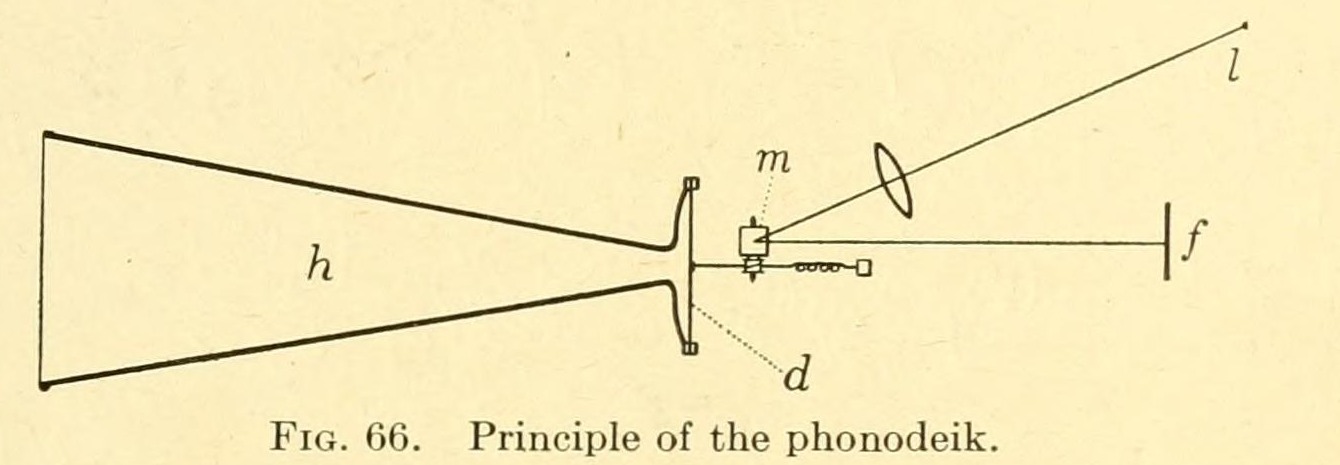
How it worked: sound goes into the horn (h) and shakes the glass disk (d). A thread turns the tiny mirror (m), which bounces light from a pinhole (l) onto moving film (f). Dayton C. Miller, The Science of Musical Sounds, 1916, page 79. Public domain, Internet Archive. Click the clipping to read it full size.
Every part had to be perfect. Miller wrote that “the pivots must fit the jeweled bearings more accurately than those of a watch.” He gave the credit to a skilled helper, Mr. L. N. Cobb, who built the tiny steel part from designs that “seemed almost impracticable,” or nearly impossible.
For crowds, Miller built a bigger version. A spinning mirror spread the light across a screen into a wave that “may be 10 feet wide and 40 feet long.” That is as tall as a basketball hoop and about as long as a school bus.
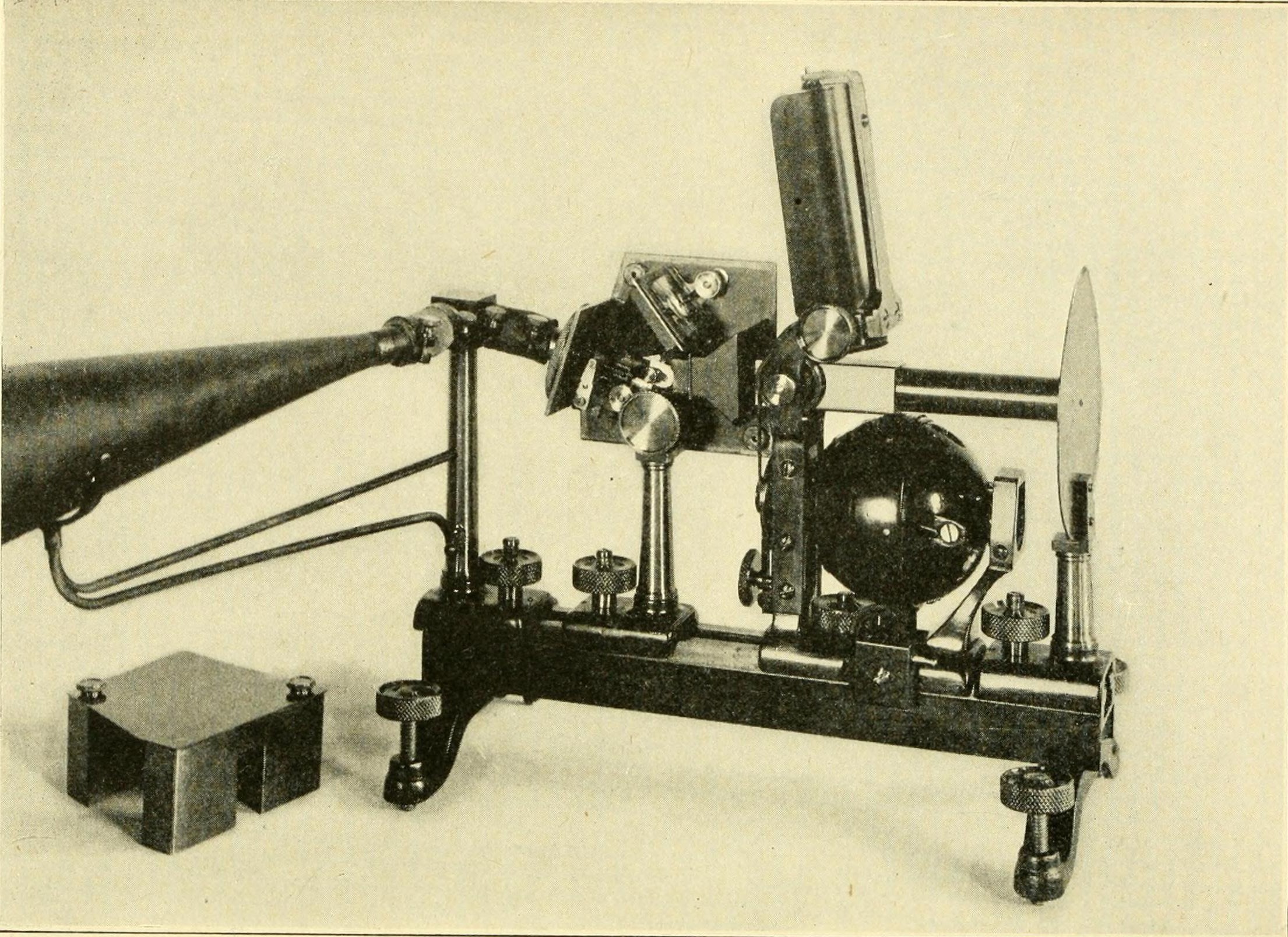
“Projection phonodeik for rendering sound waves visible to a large audience.” The horn is at the left. Dayton C. Miller, The Science of Musical Sounds, 1916, page 86. Public domain, Internet Archive. Click the picture to see it full size.
The 1909 News From Cleveland, Ohio
Miller had been working on it for years. On May 25, 1909, a report from Cleveland said he “has discovered a means of photographing sound.” The 1909 machine made sound waves “two thousand times” bigger and recorded “them on films.” The New-York Tribune printed the news the next day.
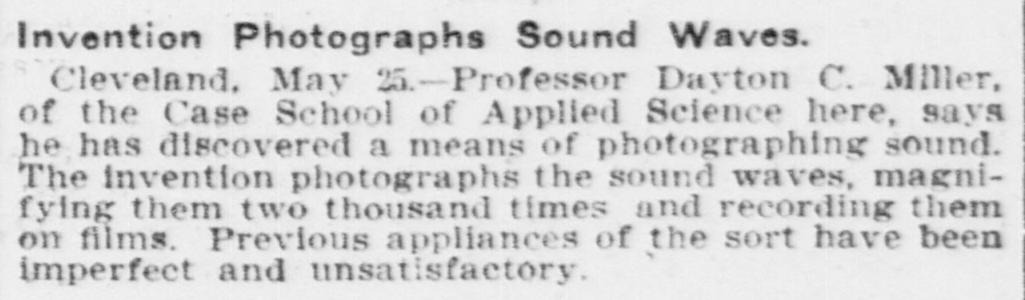
“Invention Photographs Sound Waves.” New-York Tribune, New York, May 26, 1909, page 2. Library of Congress, Chronicling America. Click the clipping to read it full size.
The news traveled south. On June 24, 1909, the Oxford Eagle in Oxford, Mississippi, ran it as a one-line joke: “An Ohio man has invented a contrivance for photographing sound.” A contrivance is a gadget. The editor then poked fun at the tariff, a tax on goods from other countries that Congress was fighting over that summer.
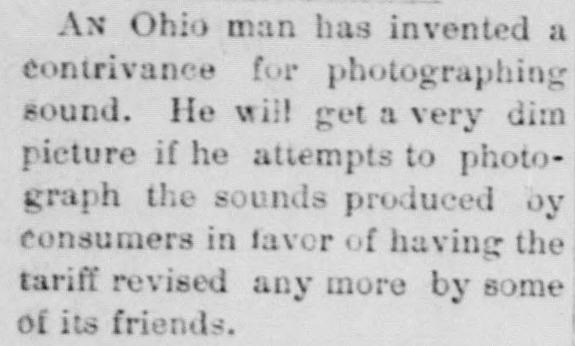
The joke in the Oxford Eagle, Oxford, Mississippi, June 24, 1909, page 2. Library of Congress, Chronicling America. Click the clipping to read it full size.
Miller Brings His Machine to Mississippi
In February 1917, Miller, the Cleveland professor, packed up the phonodeik and headed south. The Columbus Commercial in Columbus, Mississippi, announced “PROMINENT SCIENTIST TO VISIT THE COLLEGE SOON.” He would speak on February 16 in the chapel of the Industrial Institute and College, a college for women, and town people could come “free of charge.”
The paper explained why that mattered. Everyone knew an E sounds higher than a C on a piano “because the string vibrates faster.” But few knew why an E on a violin sounds different from the same E on a piano. Miller, the paper said, “will project on the screen ‘living’ tones of voices and instruments.”
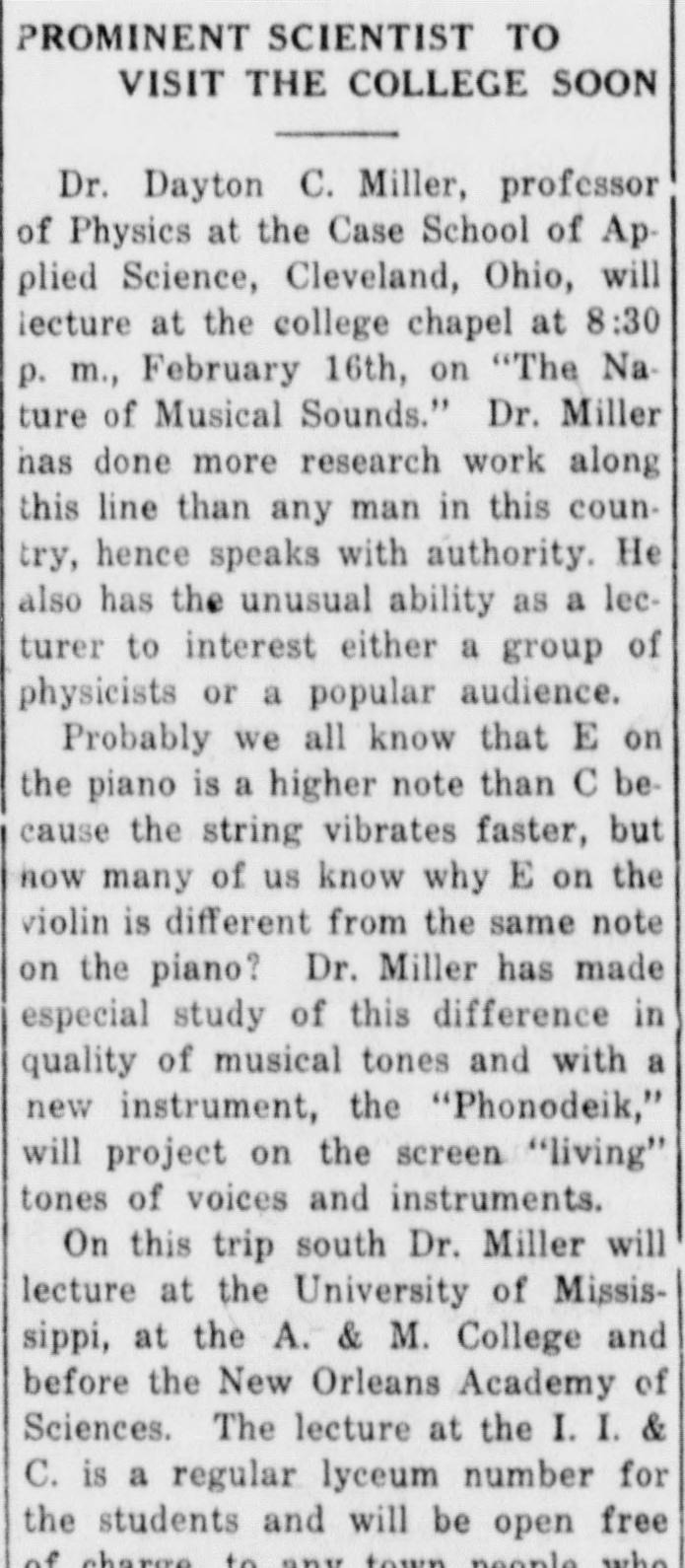
“Prominent Scientist to Visit the College Soon.” The Columbus Commercial, Columbus, Mississippi, February 4, 1917, page 3. Library of Congress, Chronicling America. Click the clipping to read it full size.
The same notice listed his other stops: “On this trip south Dr. Miller will lecture at the University of Mississippi, at the A. & M. College and before the New Orleans Academy of Sciences.” The University of Mississippi is in Oxford, the same town whose paper had joked about his invention eight years before. For his February 17 talk at the A. & M. College in Starkville, the Starkville News said he would bring “slides, musical instruments, and a special piece of apparatus, the Phonodeik.” Two days after the Columbus talk, the Commercial reported that Dr. Miller had given it, on “The Nature of Musical Sounds.”
A Wall of Flutes in Cleveland, Ohio
Back home in Cleveland, Miller kept studying one instrument most of all. He played the flute. His book says “about a thousand photographs of flute tones” were studied, every note at several levels of loudness, on flutes of wood, silver, gold and glass.
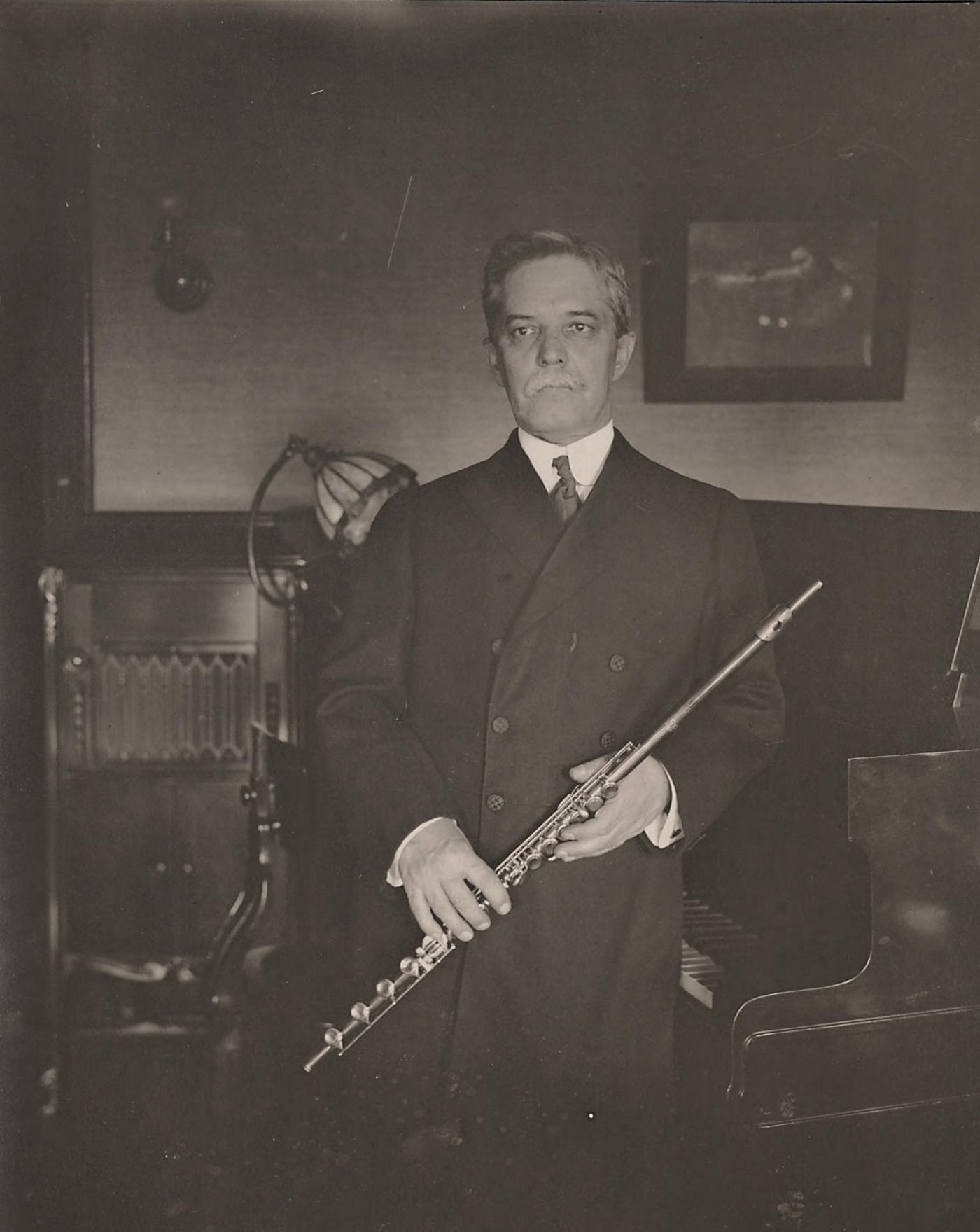
Dayton C. Miller with a flute, about 1922. Library of Congress, Music Division, Dayton C. Miller Collection. Click the picture to see it full size.
He collected flutes, too. By 1928, a whole wall of his Cleveland home was lined with glass cases full of them. When Miller died in 1941, he left his collection to the Library of Congress: more than 1,700 flutes and other wind instruments, plus books, music and photographs. It is still there today.
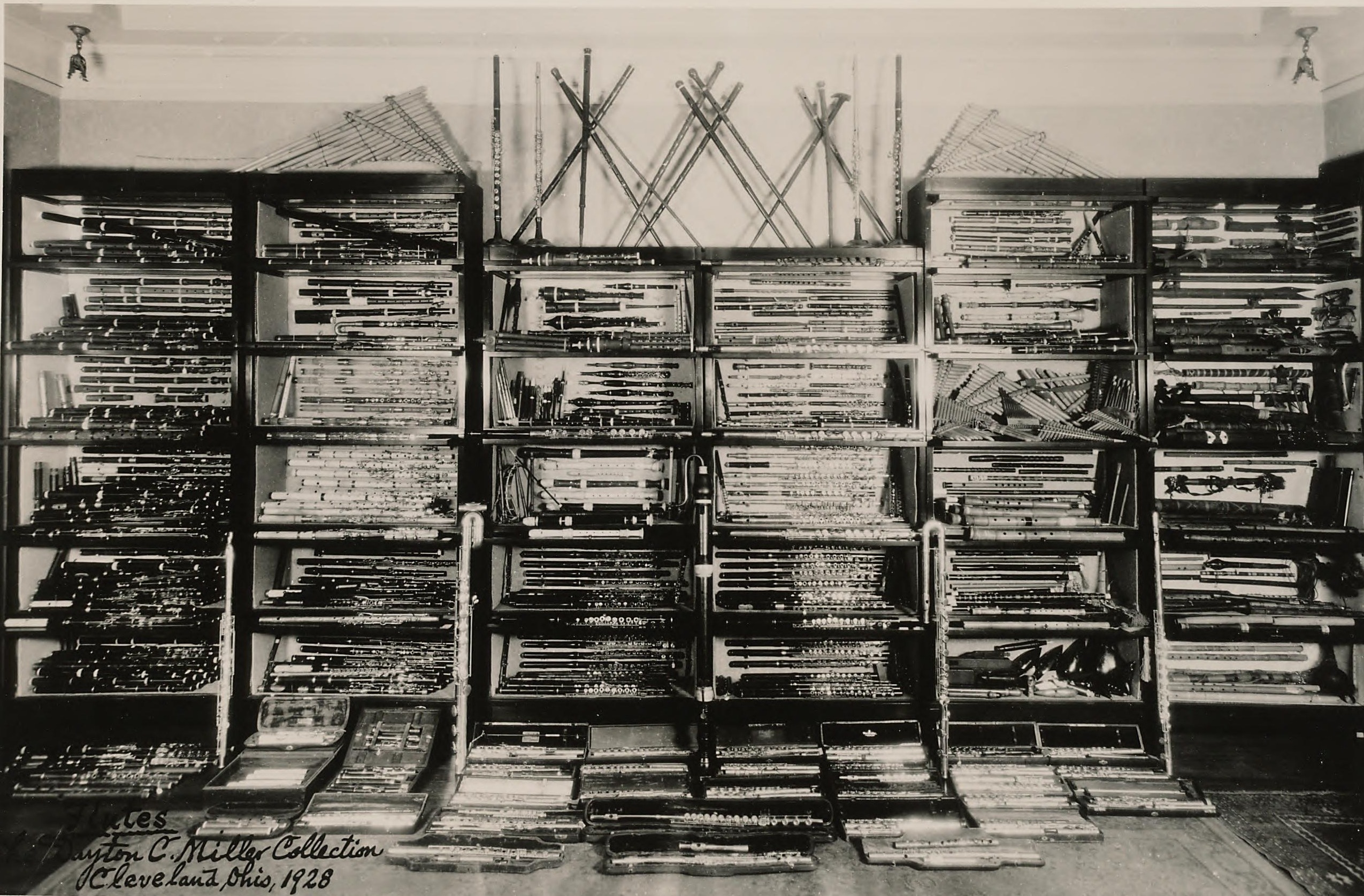
Flutes of the Dayton C. Miller Collection in his home in Cleveland, Ohio, 1928. Library of Congress, Music Division, Dayton C. Miller Collection. Click the picture to see it full size.
Today, a phone can draw the wave of your voice while you talk. In 1916, it took a glass disk, a few silk threads, a mirror the size of a pinhead and a professor from Cleveland willing to say “War” and “Peace” in front of a room full of scientists.
Sources
- “This ‘Phonodeik’ Shows You How Your Voice Looks,” The Evening World (New York, New York), December 28, 1916, page 3. Library of Congress, Chronicling America.
- “Make Machine That Shows How Sound Looks” (Associated Press), Arizona Republican (Phoenix, Arizona), December 29, 1916, page 7. Library of Congress, Chronicling America.
- “Invention Photographs Sound Waves,” New-York Tribune (New York, New York), May 26, 1909, page 2. Library of Congress, Chronicling America.
- The Oxford Eagle (Oxford, Mississippi), June 24, 1909, page 2. Library of Congress, Chronicling America.
- “Prominent Scientist to Visit the College Soon,” The Columbus Commercial (Columbus, Mississippi), February 4, 1917, page 3, and the report of the talk, February 18, 1917, page 1. Library of Congress, Chronicling America.
- “Lecture in College Chapel,” The Starkville News (Starkville, Mississippi), February 16, 1917, page 1. Library of Congress, Chronicling America.
- Dayton C. Miller, The Science of Musical Sounds (New York: Macmillan, 1916). Internet Archive, public domain. The cover picture is part of the book’s fold-out plate “Photographs of Sound Waves,” cropped.
- Dayton C. Miller with flute, about 1922 and Flutes in the Dayton C. Miller Collection, Cleveland, Ohio, 1928. Library of Congress, Music Division. The Library is not aware of any copyright or other restrictions on the Dayton C. Miller Collection.
- The Dayton C. Miller Collection and Dayton C. Miller (1866 to 1941): American Acoustician, Physicist, Flutist, and Collector, Library of Congress.
- The newspapers were printed before 1931 and are in the public domain.