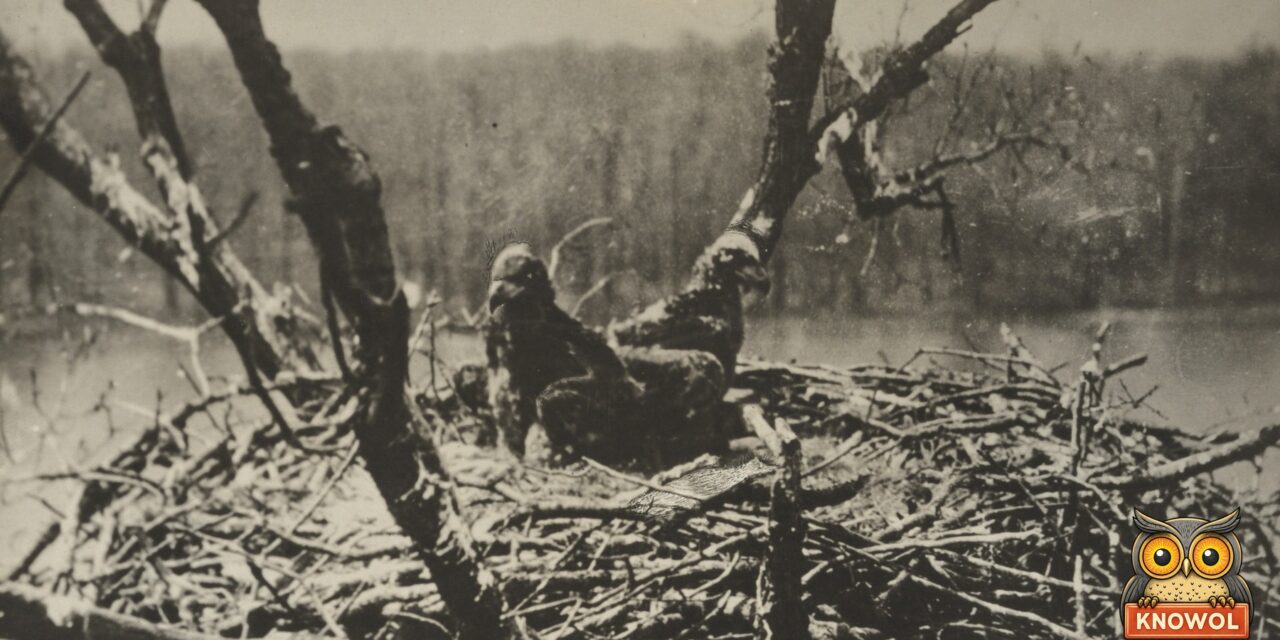
For as long as anyone could remember, an old dead tree stood at a place called Eagle Point. People steered by it, the way you might steer by a church steeple or a big rock. High in its bare branches sat a big eagle’s nest. The eagles had moved out some time before.
Early in 1884, a man who lived nearby decided the old tree had to come down. A visitor from Toledo, Ohio, was there to watch. The trunk came crashing down. Then something fell out of the nest that nobody expected: pieces of iron. They were muskrat traps. There were eight of them.
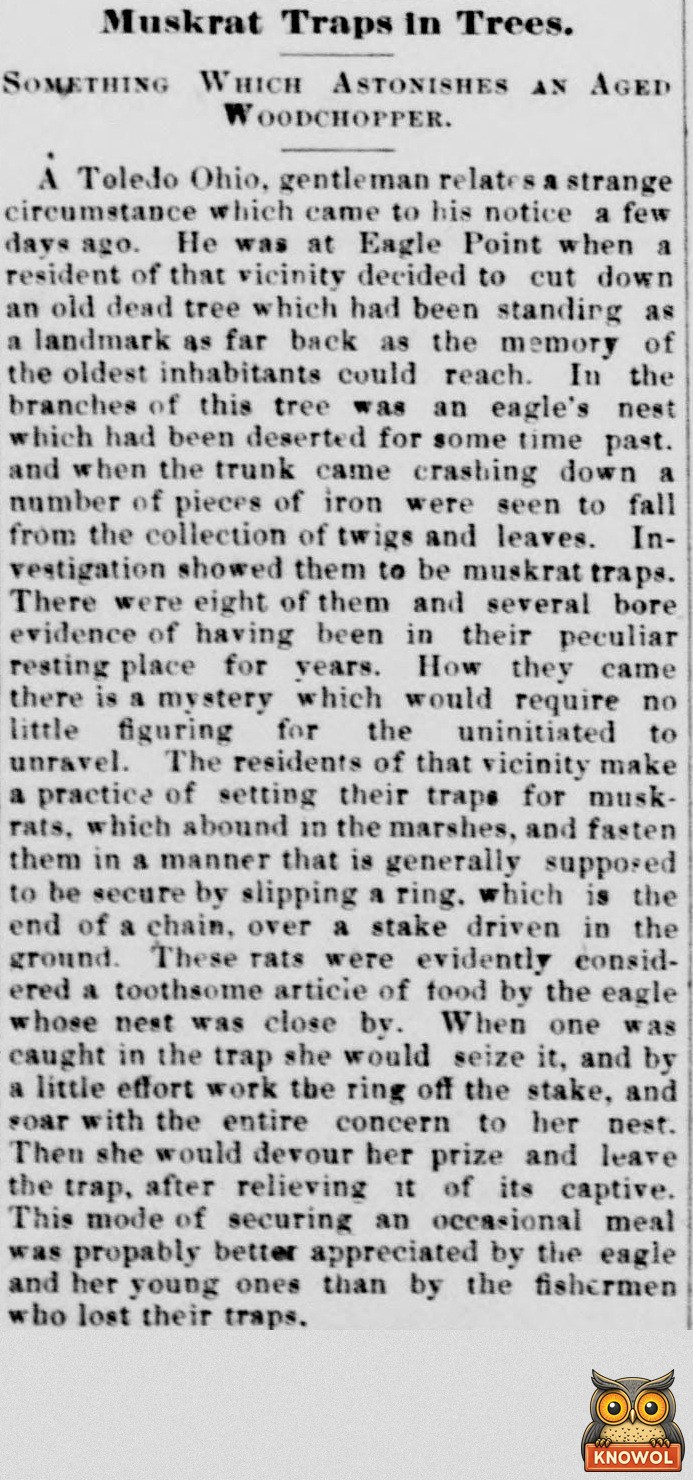
“Muskrat Traps in Trees.” Daily Kennebec Journal, Augusta, Maine, March 13, 1884, page 4. Library of Congress, Chronicling America. Click the clipping to read it full size.
Eight Traps Fell From the Eagle’s Nest at Eagle Point
The man from Toledo told his story, and it traveled. The Daily Kennebec Journal, a newspaper in Augusta, Maine, printed it on March 13, 1884, about 700 miles from Toledo. The headline said “Muskrat Traps in Trees.” Under it, in smaller type: “Something Which Astonishes an Aged Woodchopper.” So the man with the ax was an old-timer.
The tree, the paper said, “had been standing as a landmark as far back as the memory of the oldest inhabitants could reach.” The nest in its branches “had been deserted for some time past.” Then, “when the trunk came crashing down a number of pieces of iron were seen to fall from the collection of twigs and leaves.”
“There were eight of them and several bore evidence of having been in their peculiar resting place for years,” the paper said. In plain words, some of those traps had been up in the nest a long, long time. “How they came there is a mystery which would require no little figuring for the uninitiated to unravel.” The uninitiated were people who didn’t know the ways of the marsh. The people who lived there could figure it out.
How a Muskrat Trap Worked at Eagle Point
Around Eagle Point, the Kennebec Journal said, people set traps for muskrats, “which abound in the marshes.” A muskrat is a furry swimmer with a long, skinny tail. A 1917 U.S. government booklet said a full-grown one “is about four times as large as the ordinary brown rat.” People trapped muskrats for their thick, warm fur.
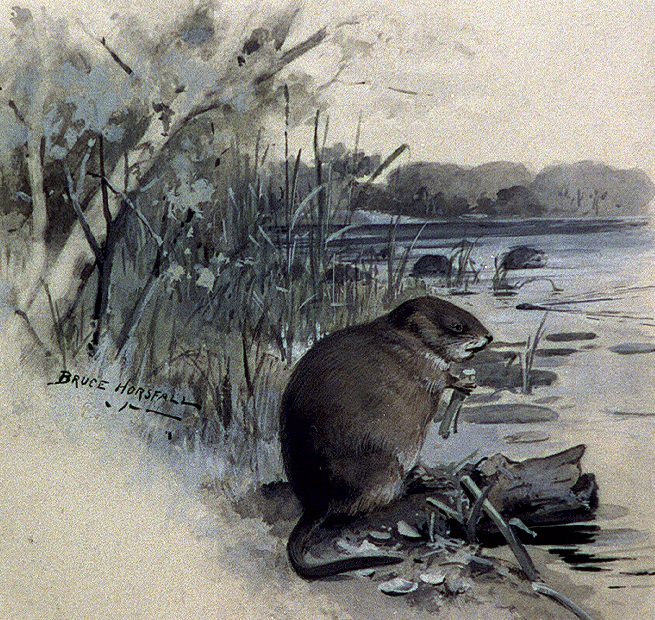
A muskrat at the edge of a pond, painted by Bruce Horsfall for St. Nicholas magazine, June 1900. Library of Congress, Cabinet of American Illustration. Click the picture to see it full size.
A muskrat trap was a small steel trap on a chain. At the far end of the chain hung an iron ring. The Eagle Point trappers, the paper said, fastened each trap “by slipping a ring, which is the end of a chain, over a stake driven in the ground.” Picture a key ring dropped over a tent stake. The trap could tug and jerk, but it couldn’t get away. At least, that was the idea. The paper said it was “generally supposed to be secure.”
How the Eagle at Eagle Point Got the Traps
The neighbors at Eagle Point had a good guess. The muskrats, the paper said, “were evidently considered a toothsome article of food by the eagle whose nest was close by.” Toothsome means tasty.
“When one was caught in the trap she would seize it, and by a little effort work the ring off the stake, and soar with the entire concern to her nest.” The entire concern means the whole thing: muskrat, trap, chain and ring. Up she went, over the marsh, to the top of the old tree. “Then she would devour her prize and leave the trap, after relieving it of its captive.” She ate the muskrat and left the empty trap in her nest. Then, some other day, she did it again.
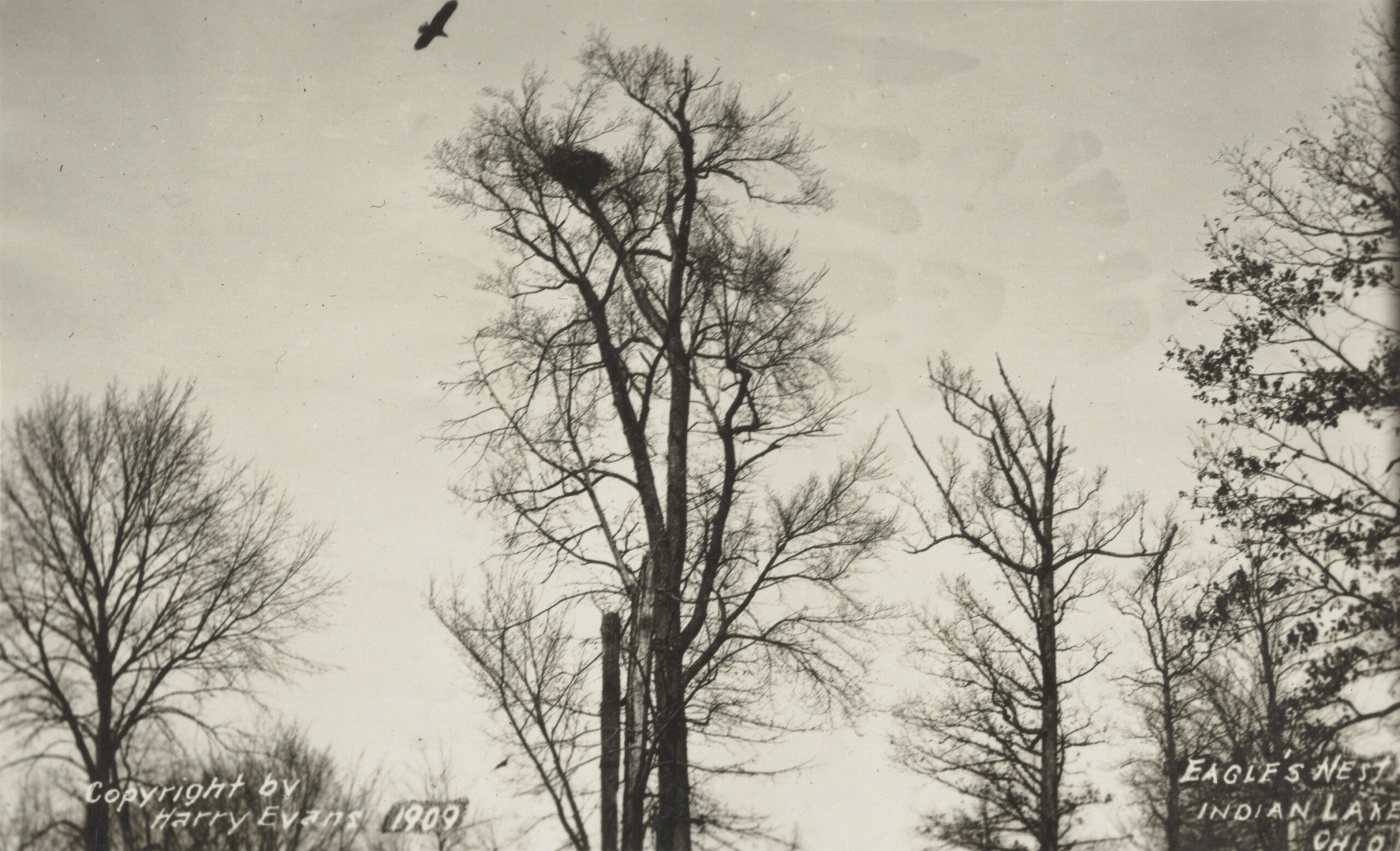
An eagle flies over its nest at the top of a tall bare tree at Indian Lake, Ohio. It is not the Eagle Point tree. Real-photo postcard, copyright 1909 by Harry Evans. Library of Congress. Click the picture to see it full size.
Eagles mostly eat fish. Edward Howe Forbush, a Massachusetts bird expert, wrote in 1927 that “fish form his principal food.” But he added: “This eagle kills mammals from the size of a rat to that of a fox.” A muskrat fits right in between.
Forbush also helps explain how eight traps could pile up. Eagles don’t build a new home every spring. A bald eagle’s nest, he wrote, is “used year after year, repaired and built up until very large, 5 to 8 feet across and often as high or higher.” So the eagles probably laid fresh sticks on top of the old traps, spring after spring. Nobody on the ground could see them. It took the whole tree coming down to shake them loose.
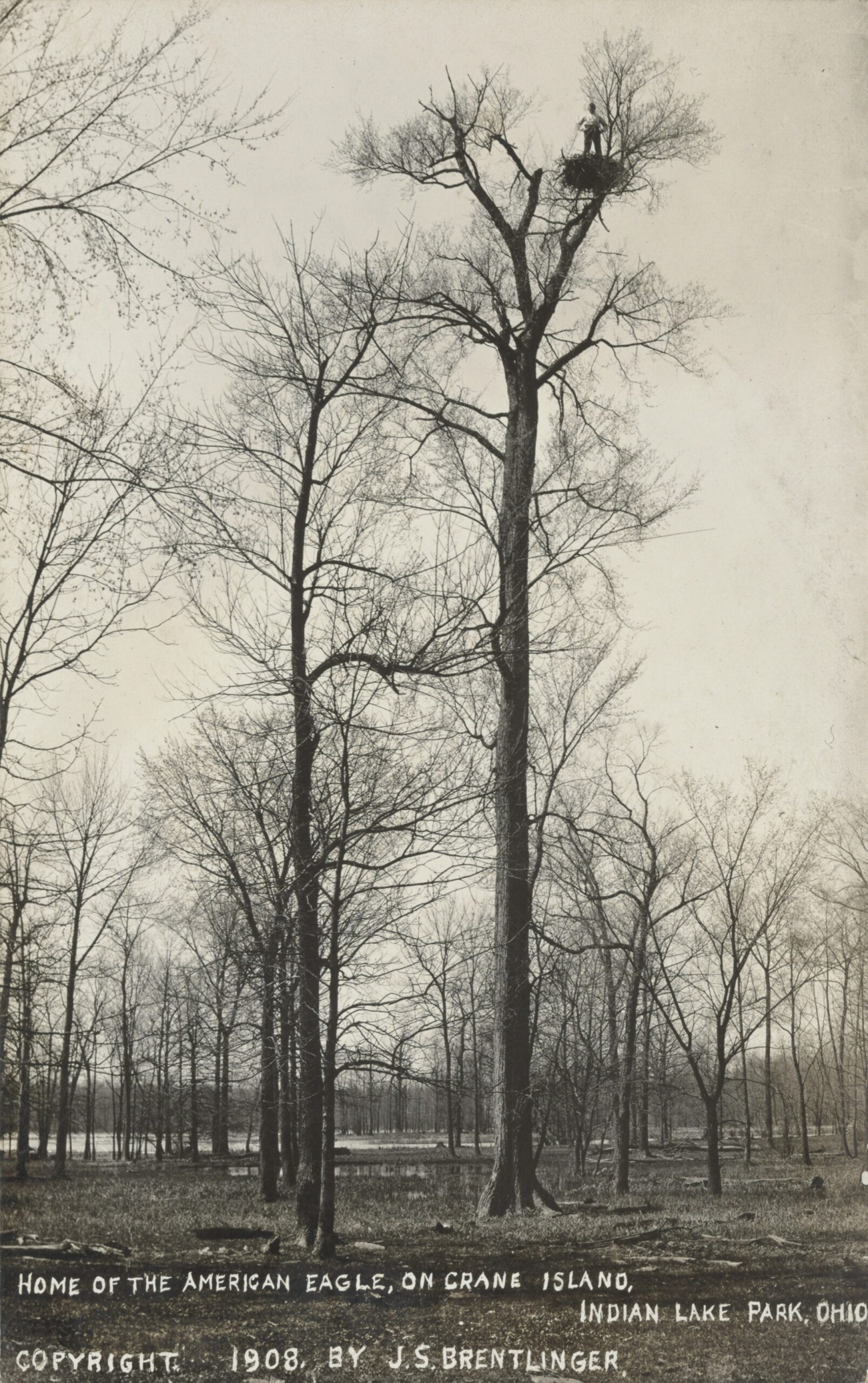
A man stands beside an eagle’s nest at the very top of a tall tree on Crane Island, Indian Lake Park, Ohio. Real-photo postcard titled “Home of the American eagle,” copyright 1908 by J. S. Brentlinger. Library of Congress. Click the clipping to read it full size.
An Eagle Point Across the River From Toledo, Ohio
The Kennebec Journal never said where Eagle Point was. It never named the man from Toledo or the old woodchopper, either. We found the story in only that one paper.
Toledo does have an Eagle Point close by. It sits on the Maumee River, across from the city, in Rossford, Ohio. A history of the neighborhood from the Rossford Historical Society says the name came from two things: a high point of land, 20 to 30 feet above the river, and eagles’ nests in the trees there. We can’t be sure it’s the same Eagle Point. But the name fits.
The marshes fit, too. Near Toledo, the Maumee River runs into Lake Erie through wide, wet marshes, and muskrats loved them. A 1910 government booklet said a Toledo hunting club, the Cedar Point Hunting Club, “controls 5,000 acres of marsh at the mouth of the Maumee River, near Lake Erie.”
What a Muskrat Was Worth Around Toledo, Ohio
Twenty years after the eagle story, the Cedar Point Hunting Club of Toledo had its marsh trapped. The 1910 booklet said: “Five thousand were taken in a single month (January, 1904), and the skins were sold for 25 cents each.” Even the meat sold. “The carcasses also were sold at a dollar a dozen.”
Yes, people ate muskrats. The 1917 booklet said that in the markets of Philadelphia, Baltimore and other cities, muskrats were sold as “marsh rabbits.” In the years of the eagle story, skins were cheap. Looking back, the 1917 booklet said muskrat skins would “probably” never again be “as cheap as they were 30 or 40 years ago.”
So one stolen muskrat wasn’t a fortune. But a trap was a trap, and every one of them belonged to somebody. The Kennebec Journal ended with a joke. The eagle’s way of getting a meal, it said, “was propably better appreciated by the eagle and her young ones than by the fishermen who lost their traps.” That misspelled “propably” is the paper’s own.
The Eagle Story Reached Maine’s Kennebec Valley
The Kennebec Journal’s readers in Maine knew eagles, too. In 1927, Forbush wrote that probably 50 to 100 pairs of bald eagles still nested in Maine. “But in the Kennebec Valley the nests are much less numerous than they were years ago.” The Kennebec Valley is where the Kennebec Journal was printed.
The picture at the top of this page isn’t Eagle Point, either. It shows two young eagles in their nest on Crane Island, at Indian Lake, Ohio, on a 1909 postcard by H. Evans.
The old landmark tree is long gone, and so is its eagle. But for one day in 1884, an old woodchopper’s ax brought down a tree, a heap of sticks and eight iron traps. The answer to a long mystery had been hanging over everybody’s heads the whole time.
Sources
- “Muskrat Traps in Trees,” Daily Kennebec Journal (Augusta, Maine), March 13, 1884, page 4. Library of Congress, Chronicling America.
- Edward Howe Forbush, Birds of Massachusetts and Other New England States, Part II (Massachusetts Department of Agriculture, 1927), Bald Eagle, pages 151 to 156. Internet Archive.
- David E. Lantz, The Muskrat as a Fur Bearer, With Notes on Its Use as Food, Farmers’ Bulletin 869 (U.S. Department of Agriculture, 1917), pages 4, 10 and 12. Internet Archive.
- David E. Lantz, The Muskrat, Farmers’ Bulletin 396 (U.S. Department of Agriculture, 1910), page 32. Internet Archive.
- Virginia Craine, Eagle Point Colony: A History, 1800s to 1982 (Rossford Historical Society), origin of the name. Internet Archive. Facts only, in our own words.
- Eagles nest on Crane Island, India Lake, real-photo postcard, copyright 1909 by H. Evans (the cover). Library of Congress Prints and Photographs Division.
- Eagle’s nest, Indian Lake, Ohio, real-photo postcard, copyright 1909 by Harry Evans. Library of Congress Prints and Photographs Division.
- Home of the American eagle, on Crane Island, Indian Lake Park, Ohio, real-photo postcard, copyright 1908 by J. S. Brentlinger. Library of Congress Prints and Photographs Division.
- The muskrat eating the soft, white part of a rush, watercolor by R. Bruce Horsfall, printed in St. Nicholas, June 1900. Library of Congress, Cabinet of American Illustration. No known restrictions on publication.
- The newspaper, books and postcards above were published before 1931 and are in the public domain, except the Rossford history, which is used for facts only.