On a Friday afternoon in November 1883, a group of actors walked out onto a ball field in Indianapolis, Indiana. That night they had a show to put on at the Grand Opera House. But first, they had a ball game to lose.
They were the traveling company of Helena Modjeska, a famous Polish actress who was playing three days in Indianapolis. Her leading man, Maurice Barrymore, took the pitcher’s spot. His wife, the actress Georgia Drew, sat in the stands and hollered at him to swing hard. The other team was a “picked nine,” a bunch of local men chosen for the day.
The next morning, Saturday, November 3, The Indianapolis Journal told the whole town how it went. The headline was “Actors as Ball-Players.” The score was 22 to 9, and the actors were the 9.
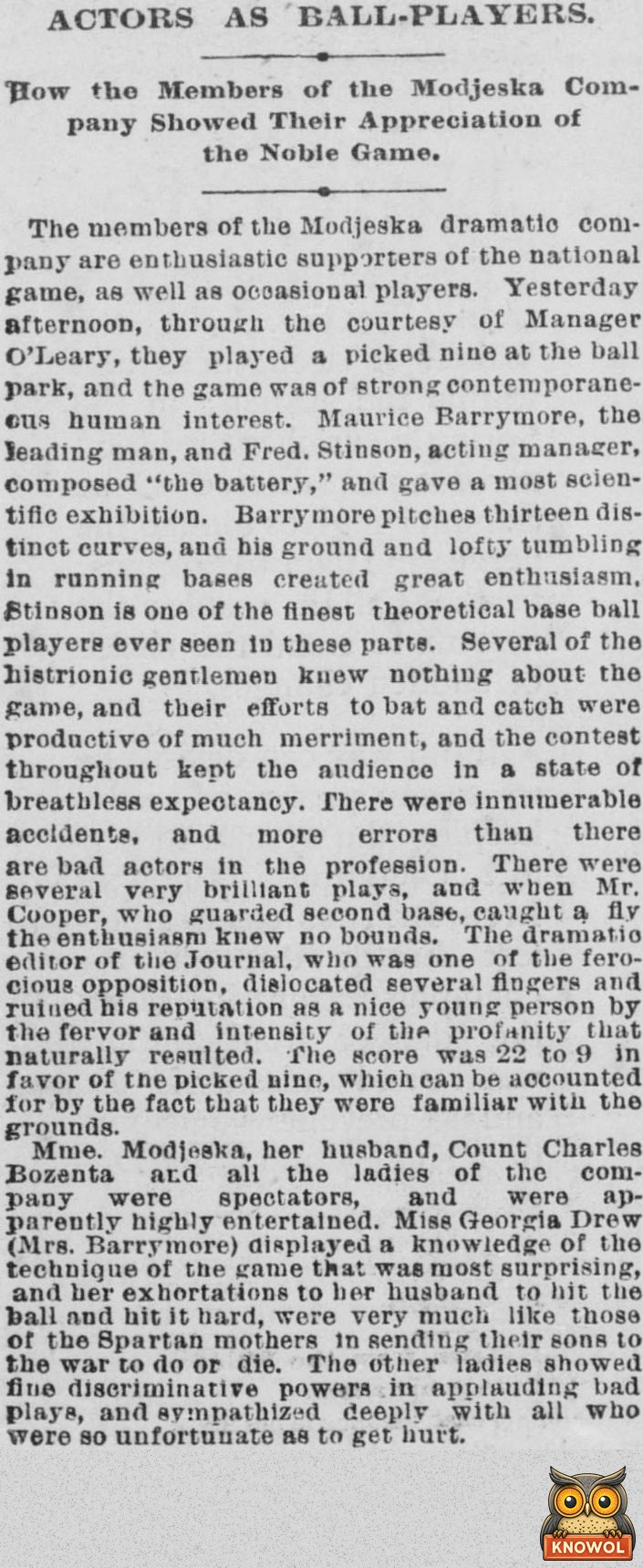
“Actors as Ball-Players.” The Indianapolis Journal, Indianapolis, Indiana, November 3, 1883, page 5. Library of Congress, Chronicling America. Click the clipping to read it full size.
A Borrowed Ball Park in Indianapolis
The Modjeska actors played in Indianapolis “through the courtesy of Manager O’Leary,” the Journal said. That spring the paper had named Daniel O’Leary as “secretary and manager” of the city’s new ball club. The club’s grounds sat at the corner of Tennessee and Seventh streets and measured “440 by 364 feet.” That is about as much ground as three football fields.
The club’s own players wore “gray, with red trimmings and stockings.” Stockings were the long socks ballplayers wore up to the knee. The game story only says “the ball park,” so we can’t be sure which field the actors used, but the club’s grounds are the most likely spot.
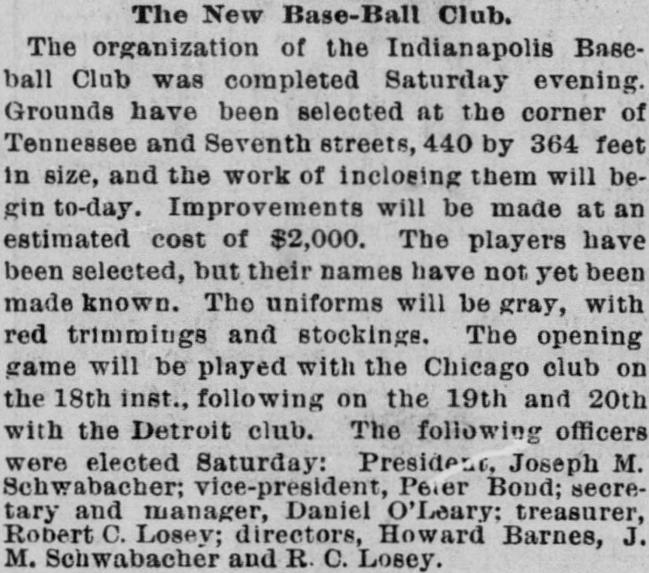
“The New Base-Ball Club.” The Indianapolis Journal, April 9, 1883, page 8. Library of Congress, Chronicling America. Click the clipping to read it full size.
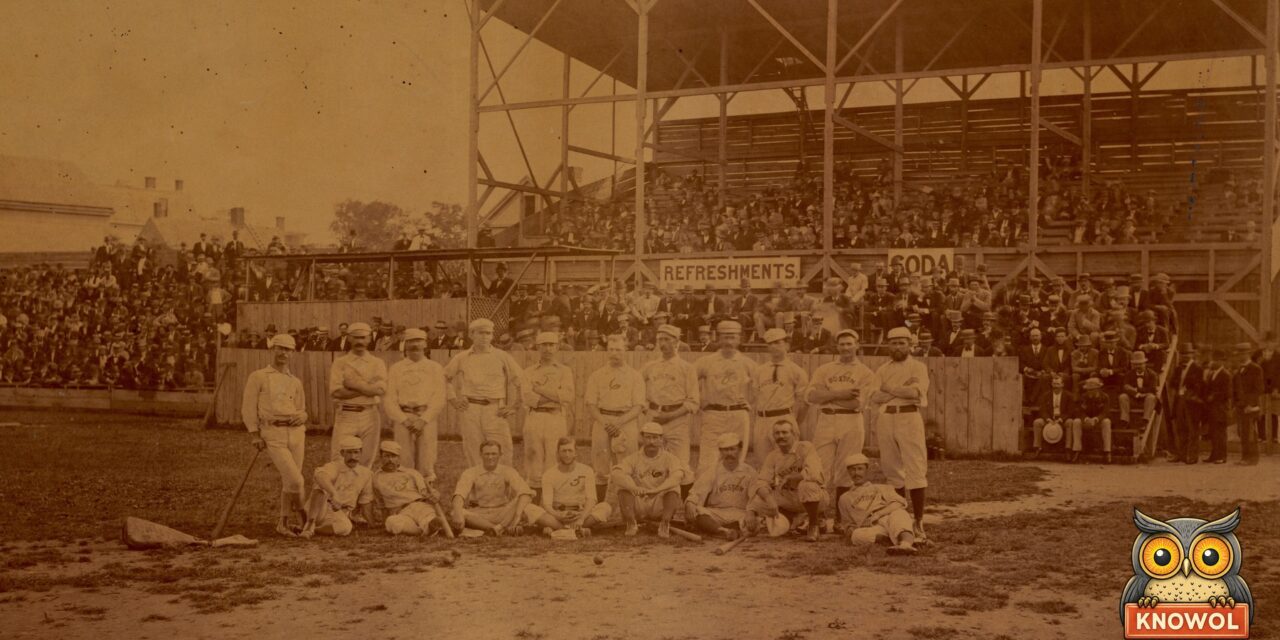
The photo at the top of this story is not Indianapolis. It shows ballplayers and a packed grandstand at the South End Grounds in Boston, Massachusetts, in 1875, with signs for REFRESHMENTS and SODA over the crowd. It shows what a big ball park looked like in those years. The Indianapolis club moved up in the world the next spring and joined the American Association, one of the country’s three big baseball groups. It lasted one season. In December 1884 a Journal headline said, “The Indianapolis Club Dropped from the American Association.”
“Thirteen Distinct Curves”
Maurice Barrymore pitched for the actors in Indianapolis, and the company’s manager, Fred Stinson, caught. A pitcher and a catcher together are called “the battery.” The Journal said the two “gave a most scientific exhibition.”
Then the writer started having fun. “Barrymore pitches thirteen distinct curves,” the paper said. A curve ball spins so it bends on the way to the batter. Nobody really throws thirteen kinds. The writer was joking. He added that Barrymore’s “ground and lofty tumbling in running bases created great enthusiasm.” Ground and lofty tumbling was a circus act full of flips and falls. In plain words, the leading man went down a lot on the base paths, and the crowd loved it.
Stinson got a joke of his own. He was “one of the finest theoretical base ball players ever seen in these parts.” He knew all about the game on paper. On the field, not so much.
Errors, Sore Fingers and One Great Catch
Some of the Modjeska actors in Indianapolis “knew nothing about the game,” the Journal said. Their tries at batting and catching “were productive of much merriment,” which is a fancy way to say people laughed a lot. There were “more errors than there are bad actors in the profession.” That one was a poke at the actors’ own line of work.
Not every play was bad. When a Mr. Cooper at second base caught a fly ball, “the enthusiasm knew no bounds.”
The picked nine had a newspaperman on it: the Journal’s own dramatic editor, the man who wrote about plays for the paper. He “dislocated several fingers,” the story said, “and ruined his reputation as a nice young person by the fervor and intensity of the profanity that naturally resulted.” Put simply, he hurt his hand and said some words the paper would not print. The picked nine won 22 to 9, “which can be accounted for by the fact that they were familiar with the grounds.”
Georgia Drew Yelled From the Stands
Helena Modjeska watched the Indianapolis game from the seats with her husband, Count Charles Bozenta, and “all the ladies of the company.” The paper singled out one fan, Georgia Drew. “Miss Georgia Drew (Mrs. Barrymore) displayed a knowledge of the technique of the game that was most surprising,” the Journal said.
She knew exactly what her husband should do. Her calls “to hit the ball and hit it hard” were “very much like those of the Spartan mothers in sending their sons to the war to do or die.” Sparta was a city in ancient Greece famous for its tough soldiers. The paper meant she cheered him on like a mother sending her son into battle.
The other ladies got a gentle joke. They “showed fine discriminative powers in applauding bad plays,” the paper said, and “sympathized deeply with all who were so unfortunate as to get hurt.”
From the Ball Park to the Stage in Indianapolis
A few hours after the last out, the same actors were on stage at the Grand Opera House in Indianapolis. The play that Friday night was “Adrienne Lecouvreur,” a French drama. Modjeska drew “repeated calls before the curtain.” The Journal’s review ran the same morning as the ball game story, and it had good words for both Barrymores. “Mr. Maurice Barrymore made an excellent Count de Saxe,” it said, and “Miss Georgie Drew” was named among the players “deserving of especial mention.”
So the pitcher who took those tumbles at the ball park played a count that night, and the fan who yelled from the stands was on stage too. The New York Clipper, a weekly paper about the stage and sports, reported that Modjeska was “a great favorite here, and her houses were well filled.”
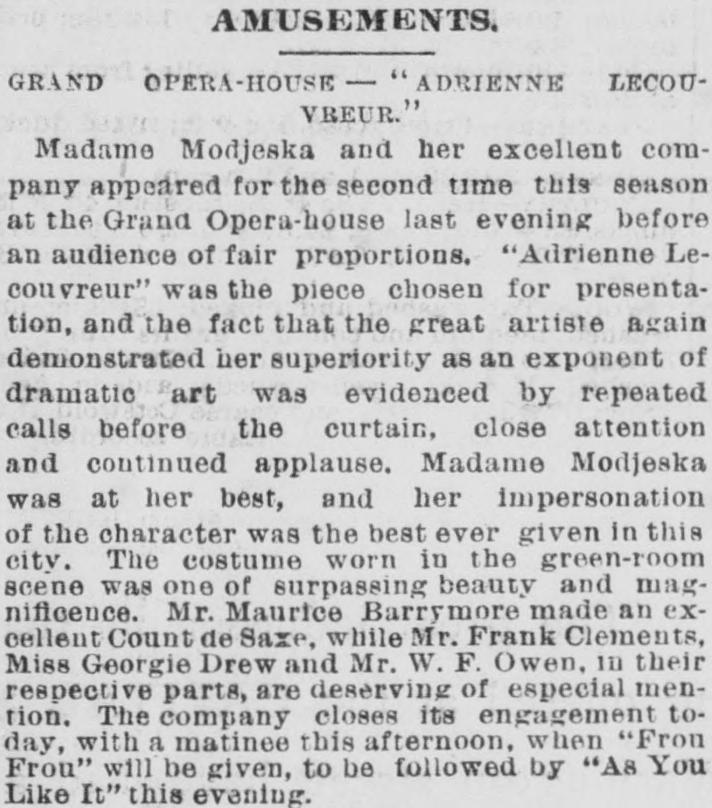
The Journal’s review of “Adrienne Lecouvreur,” played the night of the ball game. The Indianapolis Journal, November 3, 1883, page 7. Library of Congress, Chronicling America. Click the clipping to read it full size.
On Saturday the company gave two more shows: “Frou-Frou” in the afternoon and Shakespeare’s “As You Like It” at night. With Modjeska’s company, Barrymore played Orlando, the young hero of “As You Like It.” The New York photo below shows him dressed for that play.
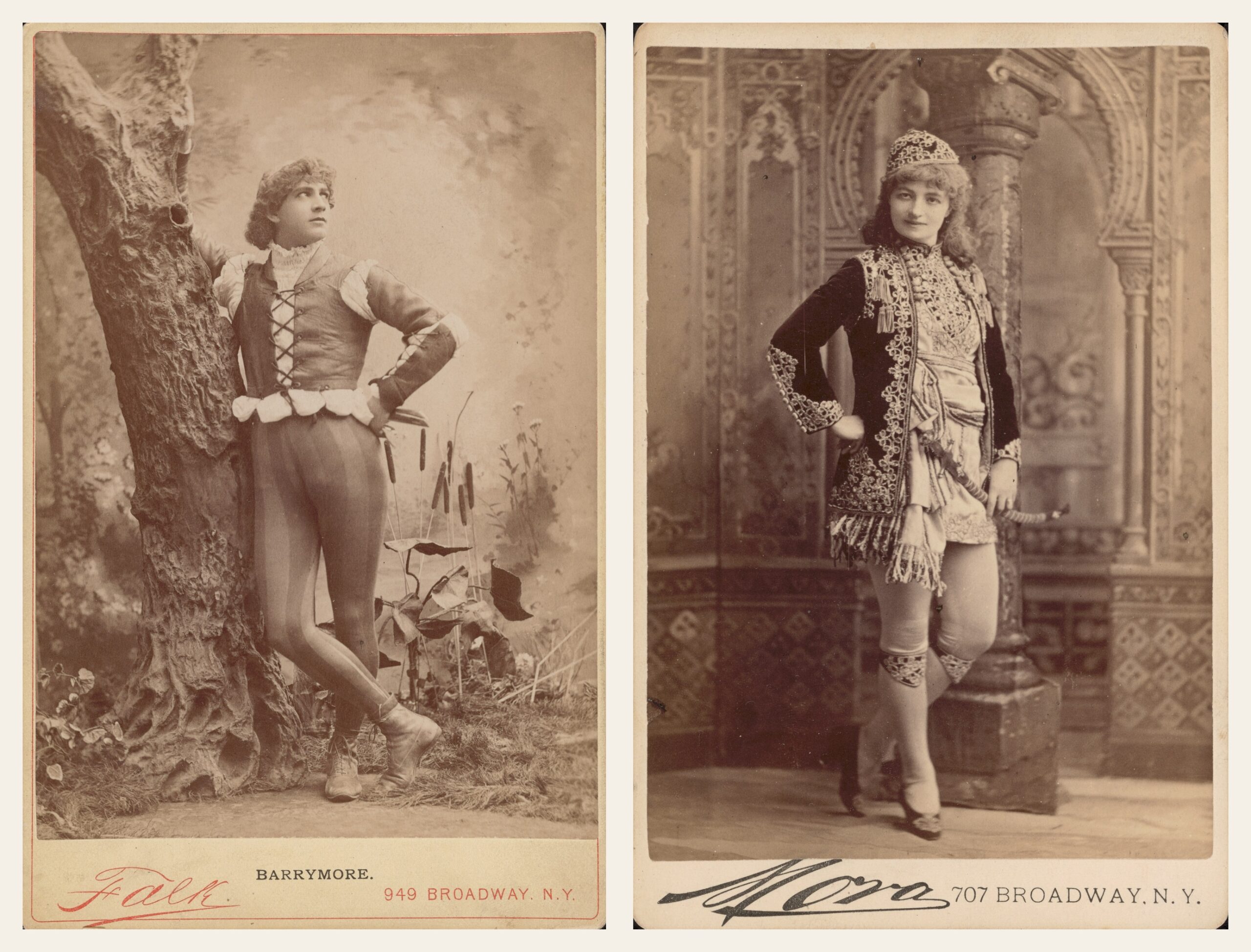
Left: Maurice Barrymore in costume for “As You Like It,” cabinet card by B. J. Falk, New York, dated about 1881 to 1892. Right: Helena Modjeska in a stage costume, on a card labeled “As You Like It,” by Mora, New York, about 1882 to 1884. Boston Public Library, Cabinet Card Collection. No known copyright restrictions. Click the picture to see it full size.
What It Cost to See the Stars in Indianapolis
The Modjeska shows in Indianapolis were not cheap. The Grand Opera House ad in the Journal listed seats at “$1, $1.50, and $2, according to location.” General admission, meaning a ticket without a reserved seat, cost “$1, 75c and 25c.” So the cheapest way in was a quarter.
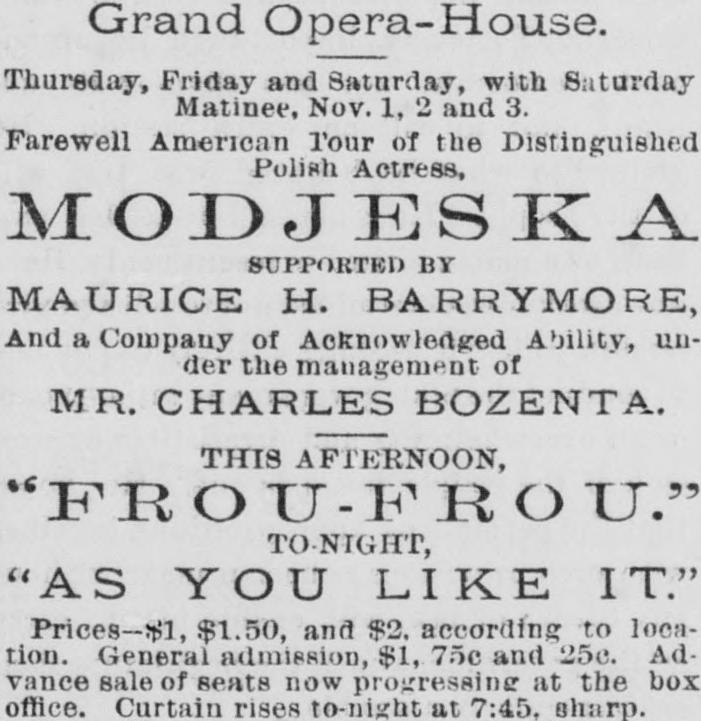
Grand Opera House ad for Modjeska, “supported by Maurice H. Barrymore.” The Indianapolis Journal, November 3, 1883, page 3. Library of Congress, Chronicling America. Click the clipping to read it full size.
Plenty of people thought that was too much. The New York Clipper’s report from Indianapolis said: “Our people grumbled considerably at the advance in prices for the Modjeska engagement. They had to pay more than New York prices.” An advance in prices meant tickets cost more than usual.

The New York Clipper, New York, November 10, 1883, Indiana column. Internet Archive. Public domain. Click the clipping to read it full size.
To see what $2 meant, look at the same page of the Journal. Mack’s shoe store on West Washington Street had men’s calf boots “reduced from $4 to $2.” A $2 seat for Modjeska cost as much as a pair of boots on sale. For 75 cents, Mack’s sold “a Real Felt Shoe,” with a promise of “No cold feet.”

Mack’s shoe ad on the same page as the Modjeska ad. The Indianapolis Journal, November 3, 1883, page 3. Library of Congress, Chronicling America. Click the picture to see it full size.
The Barrymores, a Family of Actors
Maurice Barrymore, the actor who tumbled around the bases in Indianapolis, was no stranger to sports. When he died in 1905, the New-York Tribune said he was born in India about 1850 and went to school at Harrow and Oxford in England. There he “gave special attention to boating and other athletic pursuits,” and “as an amateur boxer, he gained the prize of the Queensberry Cup, awarded to him as champion.” Baseball, it seems, was not his sport.
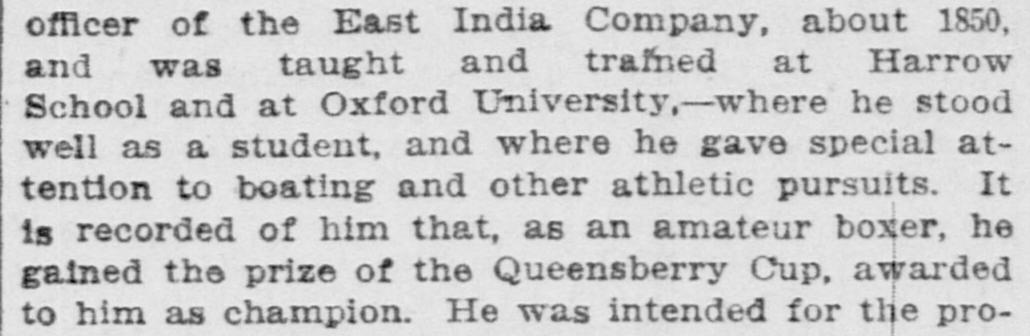
From Maurice Barrymore’s obituary. New-York Tribune, New York, March 26, 1905, page 3. Library of Congress, Chronicling America. Click the clipping to read it full size.
He was also famous for a quick tongue. After he died, a Washington paper told this story. Barrymore “hated to memorize,” and one day Modjeska scolded him, reminding him that she had made him known all over the country. “My dear madame,” Barrymore answered, “you are in error if you think you made me famous. I was known all over the United States when the people thought that Modjeska was the name of a tooth wash.” A tooth wash was a mouthwash.
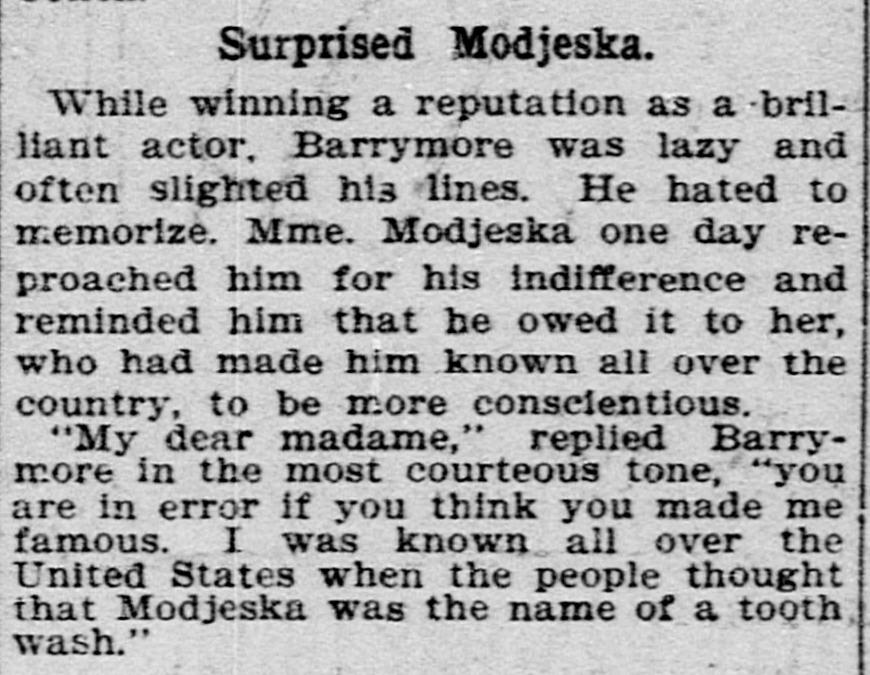
“Surprised Modjeska.” The Washington Times, Washington, D.C., March 27, 1905, page 6. Library of Congress, Chronicling America. Click the clipping to read it full size.
Georgia Drew came from a stage family too. The Tribune called her mother “the renowned actress, Mrs. John Drew.” Maurice and Georgia had three children: Ethel, Lionel and John, who was called Jack. By 1905, the Tribune said, all three were “prominent among the younger players.” John later went into the movies, and in 1920 he played the lead in the film “Dr. Jekyll and Mr. Hyde.” The Barrymore name has stood for acting ever since.
But on that Friday afternoon in Indianapolis, the Barrymores were just a husband and wife at the ball park. He was going down on the base paths while a crowd cheered. She was in the stands, shouting at him to hit the ball and hit it hard.
Sources
- “Actors as Ball-Players,” The Indianapolis Journal (Indianapolis, Indiana), November 3, 1883, page 5. Library of Congress, Chronicling America.
- Grand Opera House ad and Mack’s shoe ad, The Indianapolis Journal, November 3, 1883, page 3. Library of Congress, Chronicling America.
- “Amusements: Grand Opera-House, Adrienne Lecouvreur,” The Indianapolis Journal, November 3, 1883, page 7. Library of Congress, Chronicling America.
- “The New Base-Ball Club,” The Indianapolis Journal, April 9, 1883, page 8. Library of Congress, Chronicling America.
- “Base Ball Agreement,” The Indianapolis Journal, October 29, 1883, page 8. Library of Congress, Chronicling America.
- “Base Ball Matters,” The Indianapolis Journal, December 11, 1884, page 3. Library of Congress, Chronicling America.
- The New York Clipper (New York, New York), November 10, 1883, Indiana column. Internet Archive.
- “Barrymore, Actor, Dead,” New-York Tribune (New York, New York), March 26, 1905, page 3. Library of Congress, Chronicling America.
- “Some Typical Stories of Maurice Barrymore,” The Washington Times (Washington, D.C.), March 27, 1905, page 6. Library of Congress, Chronicling America.
- “Moore’s Garden: Dr. Jekyll and Mr. Hyde,” The Washington Herald (Washington, D.C.), May 10, 1920, page 14. Library of Congress, Chronicling America.
- Philadelphia Athletics and Boston Red Stockings at the South End Grounds, 1875 (the cover). Boston Public Library, Michael T. “Nuf Ced” McGreevy Collection, Digital Commonwealth. No known copyright restrictions.
- Barrymore, cabinet card by B. J. Falk, about 1881 to 1892. Boston Public Library, Cabinet Card Collection, Digital Commonwealth. No known copyright restrictions.
- Modjeska, “As You Like It,” cabinet card by Mora, about 1882 to 1884. Boston Public Library, Cabinet Card Collection, Digital Commonwealth. No known copyright restrictions.
- The newspapers and photographs above were all published or made before 1931 and are in the public domain.