Grace Gebbie was a short, chubby girl with a round face, dimples and thick blond curls. At her convent school, the teachers were nuns, called sisters. Whenever the sisters looked away, Grace drew the funniest face she knew, which was her own, and passed it around the room.
The Dearborn Independent of Dearborn, Michigan, told her story on March 20, 1920. It said that “in a spirit of mischief, when the sisters’ backs were turned,” Grace “would draw pictures of herself and send them around to her schoolmates.” Years later, that same round little face rode in streetcars all over America, holding a can of soup. Grace had drawn the Campbell Kids, and the paper said she was “not just the originator, but also the original.”
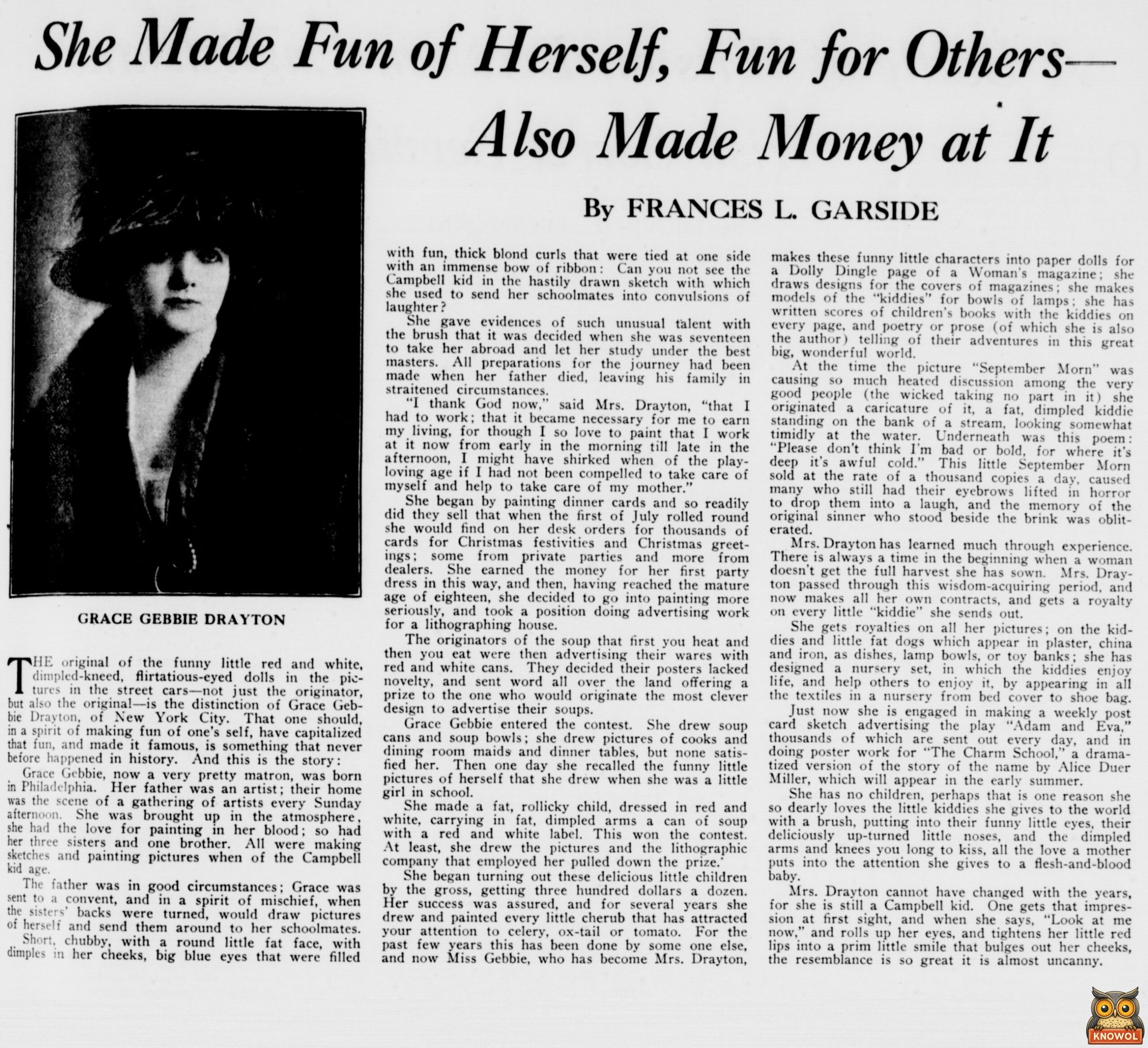
The Dearborn Independent’s story about Grace Gebbie Drayton, by Frances L. Garside, with her photo. The Dearborn Independent, Dearborn, Michigan, March 20, 1920, page 9. Library of Congress, Chronicling America. Click the clipping to read it full size.
Grace Gebbie Drew Herself at School
Grace Gebbie grew up in Philadelphia, Pennsylvania. Her father was a well-known publisher there, and artists filled the family’s home every Sunday afternoon. Grace, her three sisters and her brother all drew and painted.
In 1914, Grace told the Washington Times how her school pictures got started. “I used to caricature everybody, from the teachers I didn’t like to myself. Especially myself,” she said. A caricature is a funny drawing that makes someone’s looks bigger than life, with rounder cheeks or a bigger nose. “The other girls used to squeal over them. I think that’s how the kids were evolved.”
She knew exactly whose face she was drawing. “I used to look very much like them,” she said, “with my round, fat face, big, round eyes, and a pug nose. Oh, my nose is such a pug!” A pug nose is short and turned up at the end, like the nose on a pug dog.
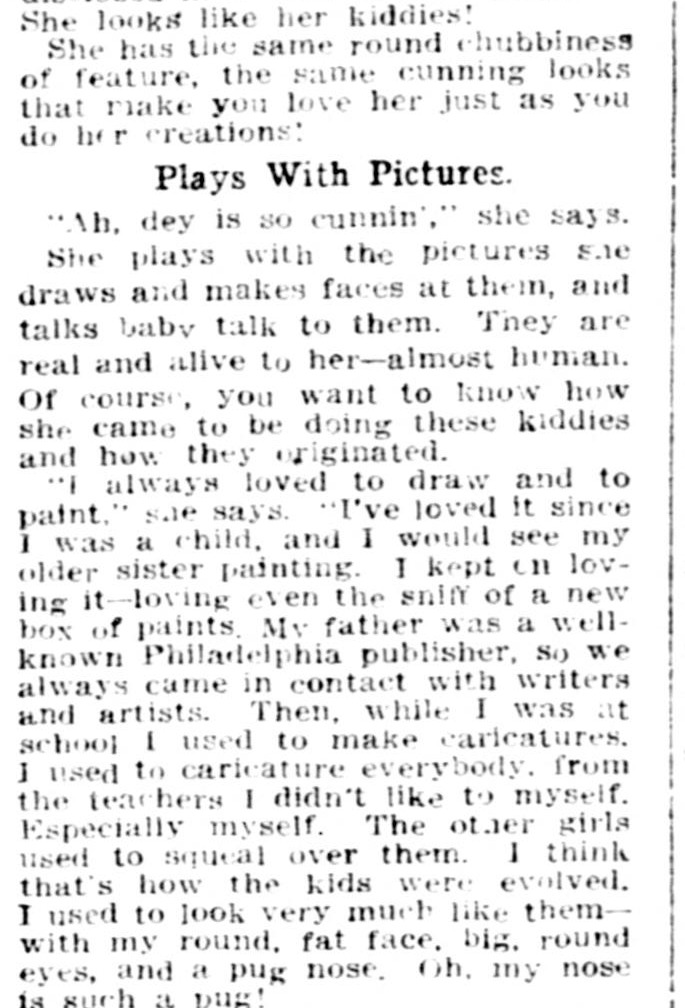
Grace in her own words, from “Creator of Famous Dolls Just Like Her Cherubs,” by Yetta Dorothea Geffen. The Washington Times, Washington, D.C., February 25, 1914, page 8. Library of Congress, Chronicling America. Click the clipping to read it full size.
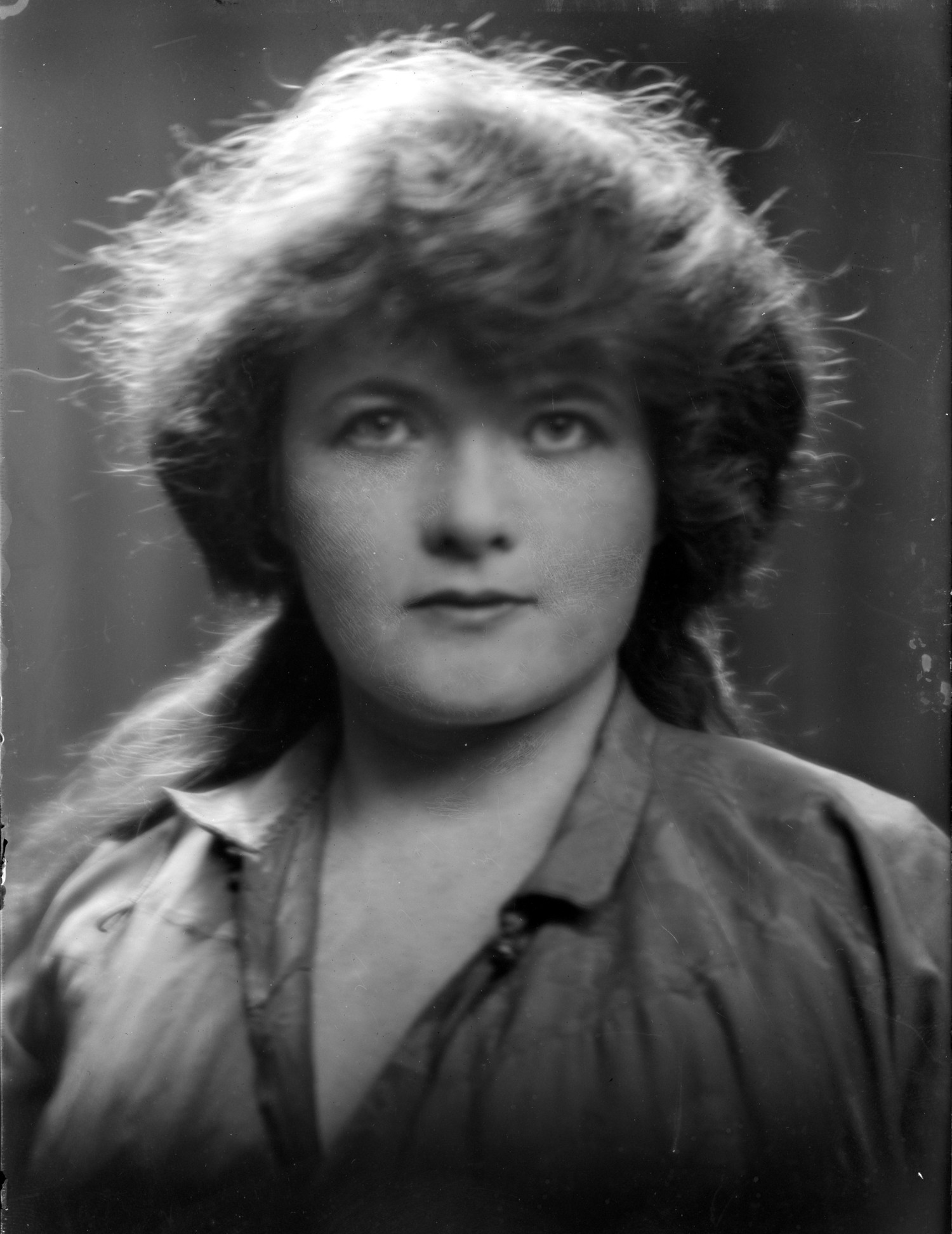
Arnold Genthe’s portrait “Drayton, W.H., Mrs.,” taken in New York on May 8, 1916. That was Grace’s married name then (the Washington Times called her Mrs. W. Heyward Drayton in 1914), and the face matches her photo in the Dearborn Independent. Genthe photograph collection, Library of Congress. Click the picture to see it full size.
Grace Gebbie Went to Work at Eighteen
When Grace Gebbie was seventeen, her Philadelphia family planned to send her overseas to study with the best painters. Then her father died, and money was suddenly short. Years later, Grace was glad. “I thank God now,” she told the Dearborn Independent, “that I had to work.” Without that push, she said, she might have played instead of painting.
She started by painting dinner cards, the small decorated cards set at each plate at a fancy dinner. By the first of July each year, she had orders for thousands of Christmas cards, and that money paid for her first party dress. At eighteen, she took a job drawing ads for a lithographing house, a printing company that turned an artist’s drawing into bright color posters.
A Soup Contest Brought Out the Campbell Kids
Grace Gebbie’s big chance came from the Joseph Campbell Company of Camden, New Jersey, just across the river from Philadelphia. It made condensed soup, which came thick in the can. You added water and heated it, so the Dearborn Independent called the company “the originators of the soup that first you heat and then you eat.” Its ads showed red and white cans. A Campbell’s ad from the 1920s shows one, with its price: 12 cents.
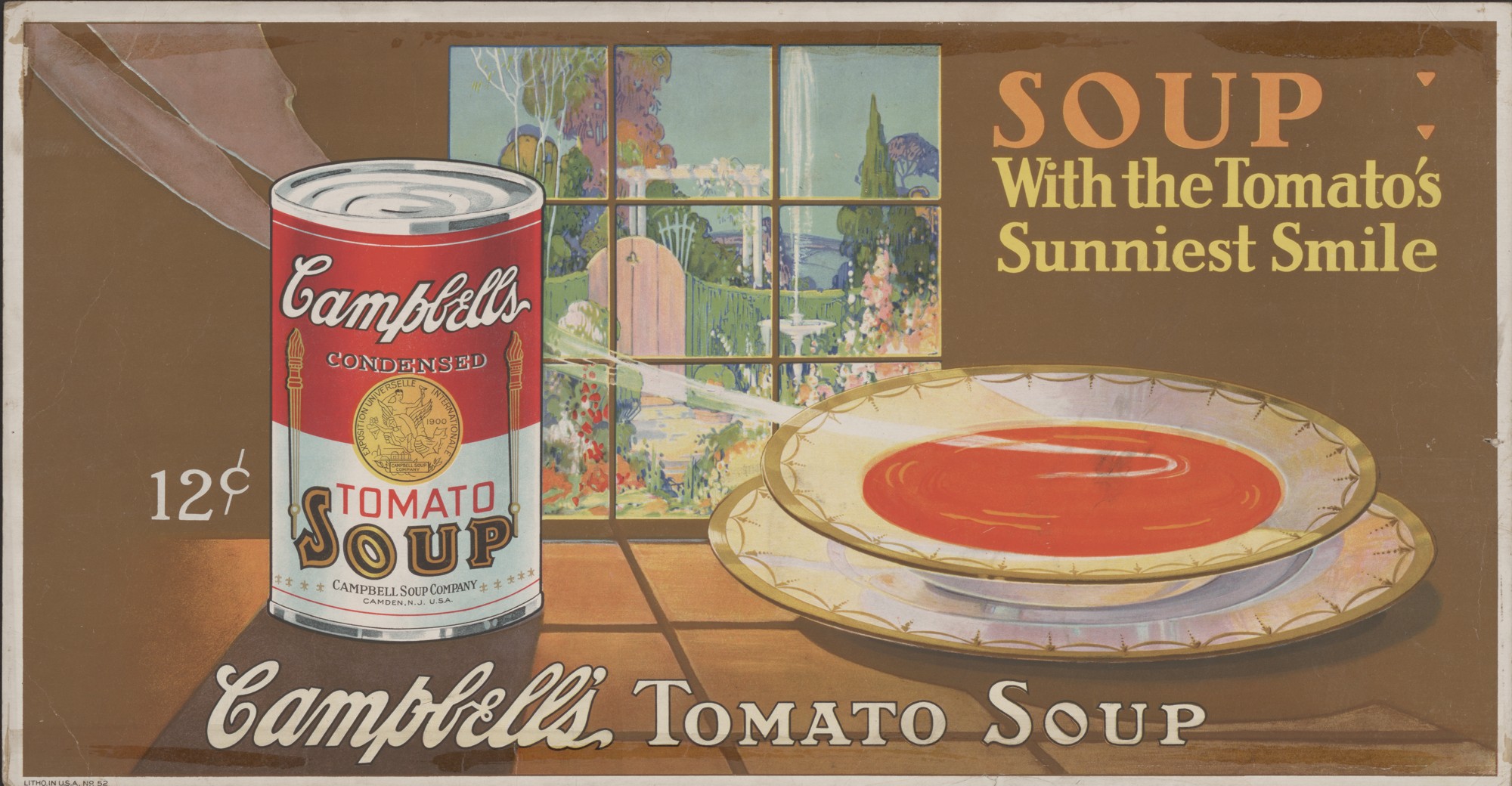
A Campbell’s tomato soup ad from between 1920 and 1930, with the red and white can marked 12 cents. Library of Congress, Prints and Photographs Division. Click the picture to see it full size.
The soup makers decided their posters “lacked novelty,” which means they looked too much like everybody else’s. So they offered a prize for the cleverest new design. Grace entered. She drew soup cans, soup bowls, cooks and dinner tables, and none of them pleased her.
Then Grace remembered the girl she used to draw at school. “She made a fat, rollicky child, dressed in red and white, carrying in fat, dimpled arms a can of soup with a red and white label. This won the contest.”
Here’s the twist. The paper went right on: “At least, she drew the pictures and the lithographic company that employed her pulled down the prize.” In other words, Grace drew the winner, and the printing company she worked for took home the prize. This is the story as the Dearborn Independent told it in 1920, and it is the only paper we found that tells it.
Grace still got paid for the kids that came next. She drew them “by the gross,” and a gross is 144. The paper said she earned “three hundred dollars a dozen,” which comes to $25 a picture. For several years, she drew every little kid in the ads for celery, ox-tail and tomato soup.
The Library of Congress keeps one of Grace’s original Campbell Kid paintings. It says her first Campbell Kids appeared in streetcar ads in 1904.
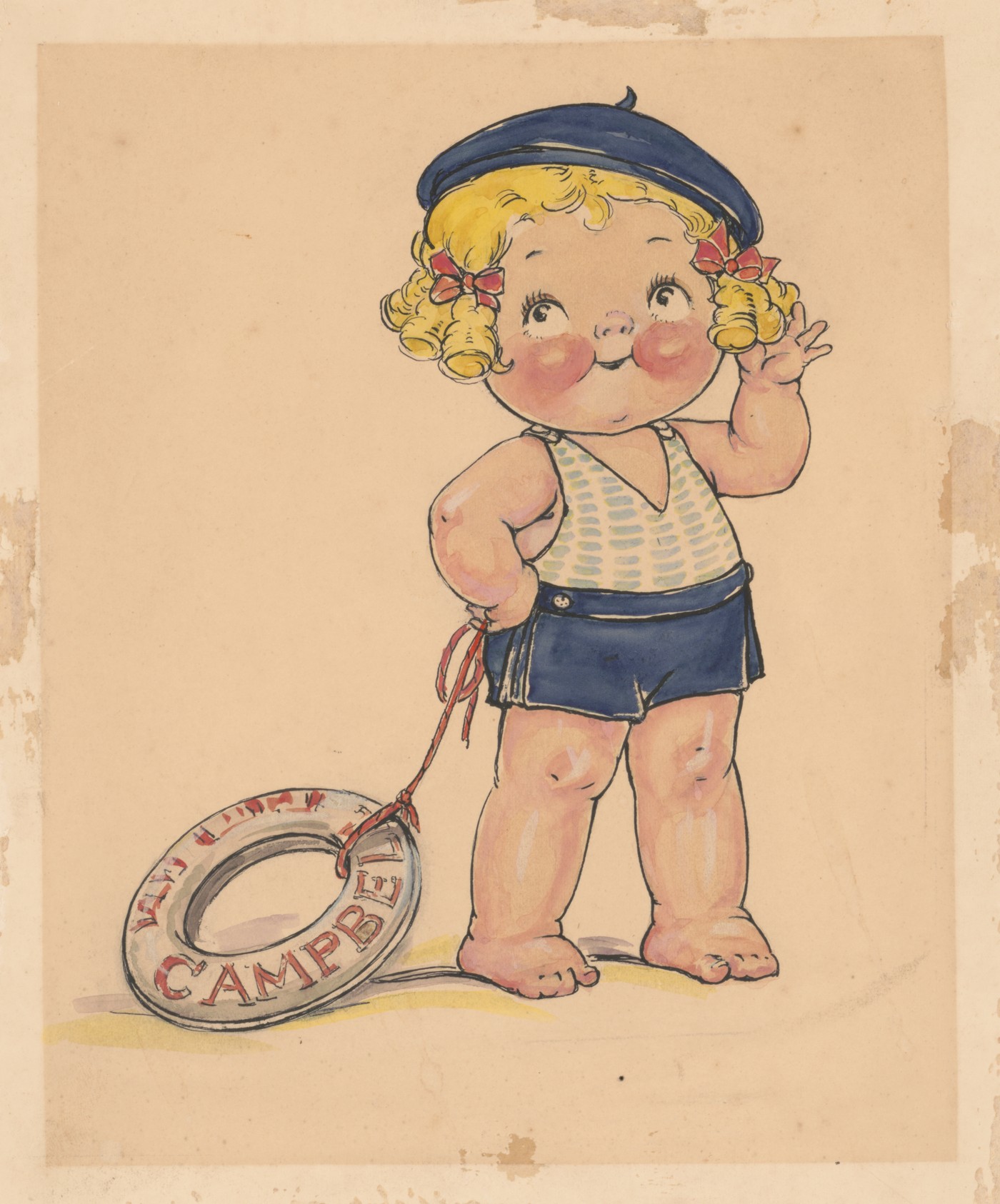
A Campbell Kid with a life preserver marked “Campbell,” an original watercolor and ink drawing by Grace Drayton, about 1910. Library of Congress, Prints and Photographs Division. Click the clipping to read it full size.
Campbell Kids Scampered Out of the Streetcars
By 1914, Grace’s Campbell Kids had spread far beyond the streetcars. The Washington Times said: “They scampered out, and were soon seen on picture post cards in all their rascally chubbiness.” The postcards were “sold not only in the United States, but throughout Europe and even Australia.” There were children’s books, comic pages and dolls of the “unbreakable variety,” which means they wouldn’t shatter like china dolls if a child dropped one.
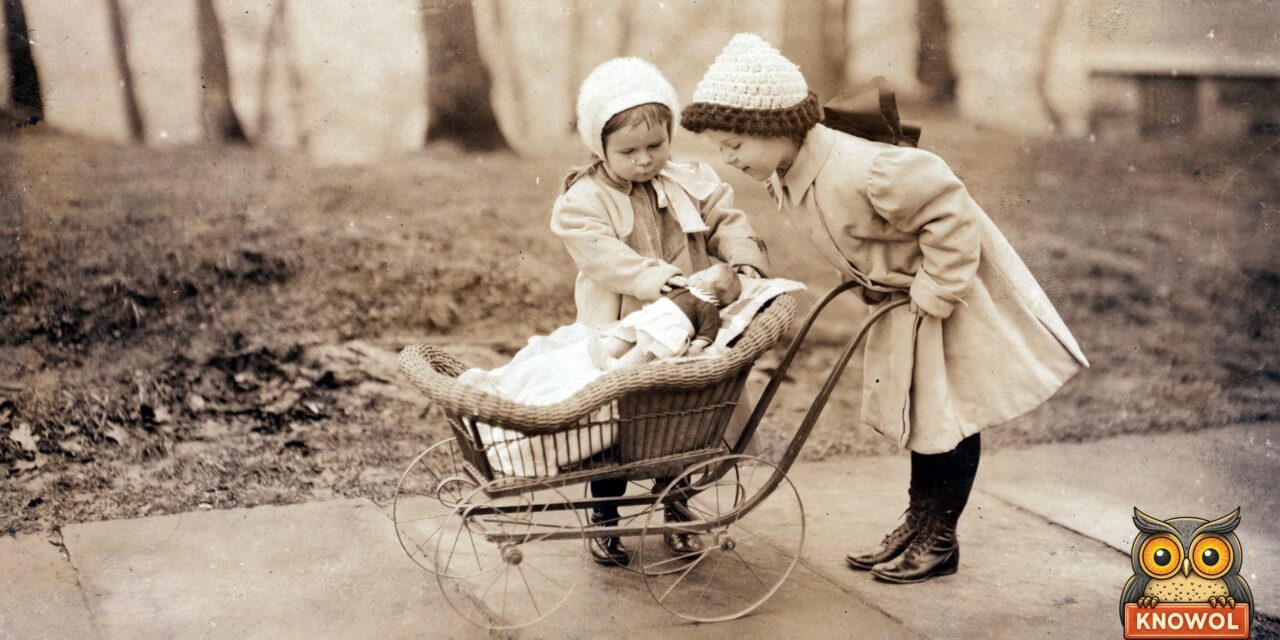
The photo at the top of this page shows two girls in New York with their Campbell Kid dolls in a wicker doll buggy, in March 1912. Lewis Hine took it for the National Child Labor Committee, a group working to end child labor. Hine also photographed New York families who made Campbell Kid doll legs and doll dresses at home, with children as young as five helping after school.
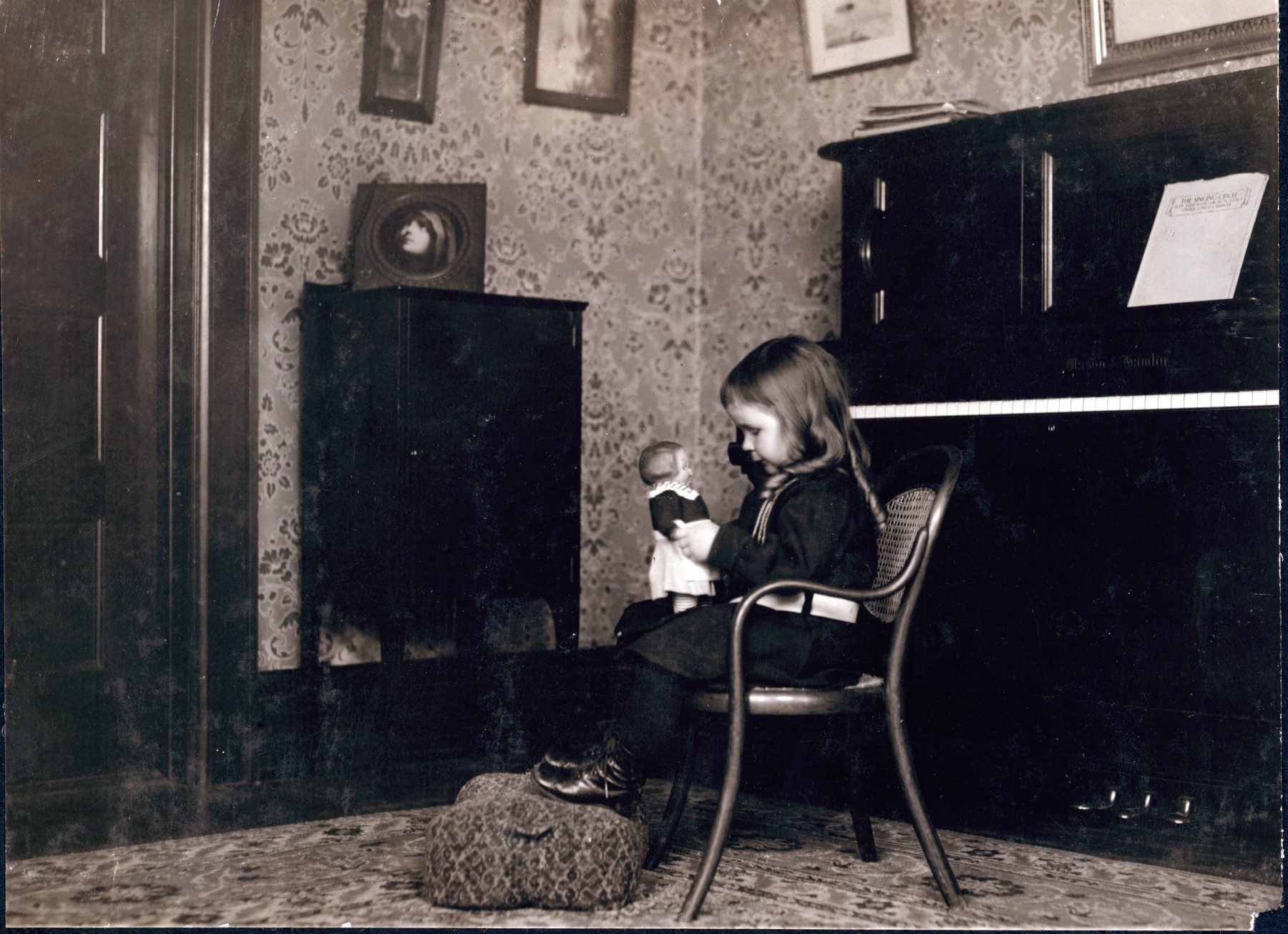
“Little girl conversing with a Campbell Kid,” New York, March 1912. Photo by Lewis Hine. National Child Labor Committee collection, Library of Congress. Click the picture to see it full size.
Grace Drayton Gave Her Kids a New Name
Grace’s early Campbell Kid pictures were signed “Grace G. Wiederseim,” the last name she used then. In 1914, the Washington Times said that “Grace G. Wiederseim became Grace G. Drayton,” the wife of a member of the New York Stock Exchange. “She was tremendously proud of her new name and insisted on changing the name of her kiddies to match her own.”
Her editors begged her to keep the old name. Grace “declared with a flash of her baby-blue eyes” that she would make the “Drayton Kids” “just as popular” as the old ones, “or she would know the reason why!”
Then came what the paper called “An Amusing Mistake.” When the kids showed up signed “Drayton,” about 20 readers (“a score”) wrote in to say they were fakes. One excited lady mailed in an old magazine picture signed “Grace G. Wiederseim” as proof. “Evidently she hoped for a reward, but was tremendously disappointed when she learned that the Wiederseim and Drayton children were one and the same.”
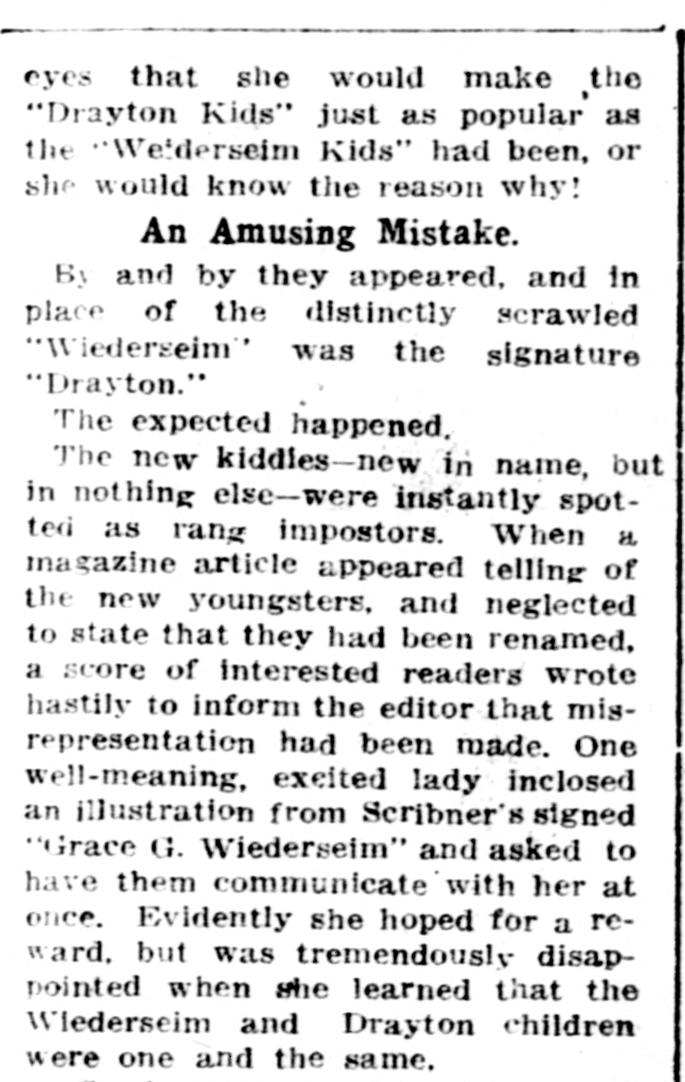
“An Amusing Mistake.” The Washington Times, Washington, D.C., February 25, 1914, page 8. Library of Congress, Chronicling America. Click the clipping to read it full size.
Grace Drayton’s Kid Thought the Water Was Too Cold
In 1913, Grace Drayton poked fun at what the Washington Times called “the greatly discussed picture.” It was “September Morn,” by the French artist Paul Chabas, and it showed a young woman with no clothes on at the water’s edge. Some people called it shocking.
Grace answered with a joke of her own. She drew one of her chubby kiddies on the bank of a stream, peeking at the water, with this poem underneath: “Please don’t think I’m bad or bold, for where it’s deep it’s awful cold.” The Dearborn Independent said it “sold at the rate of a thousand copies a day” and made people who “still had their eyebrows lifted in horror” drop them “into a laugh.”
The joke was such a hit that Grace was asked to make a statue and a doll of her little bather. “Although she had never before done any modeling, she decided to try,” the Washington Times said. The paper ran a photo of the doll, dressed this time.
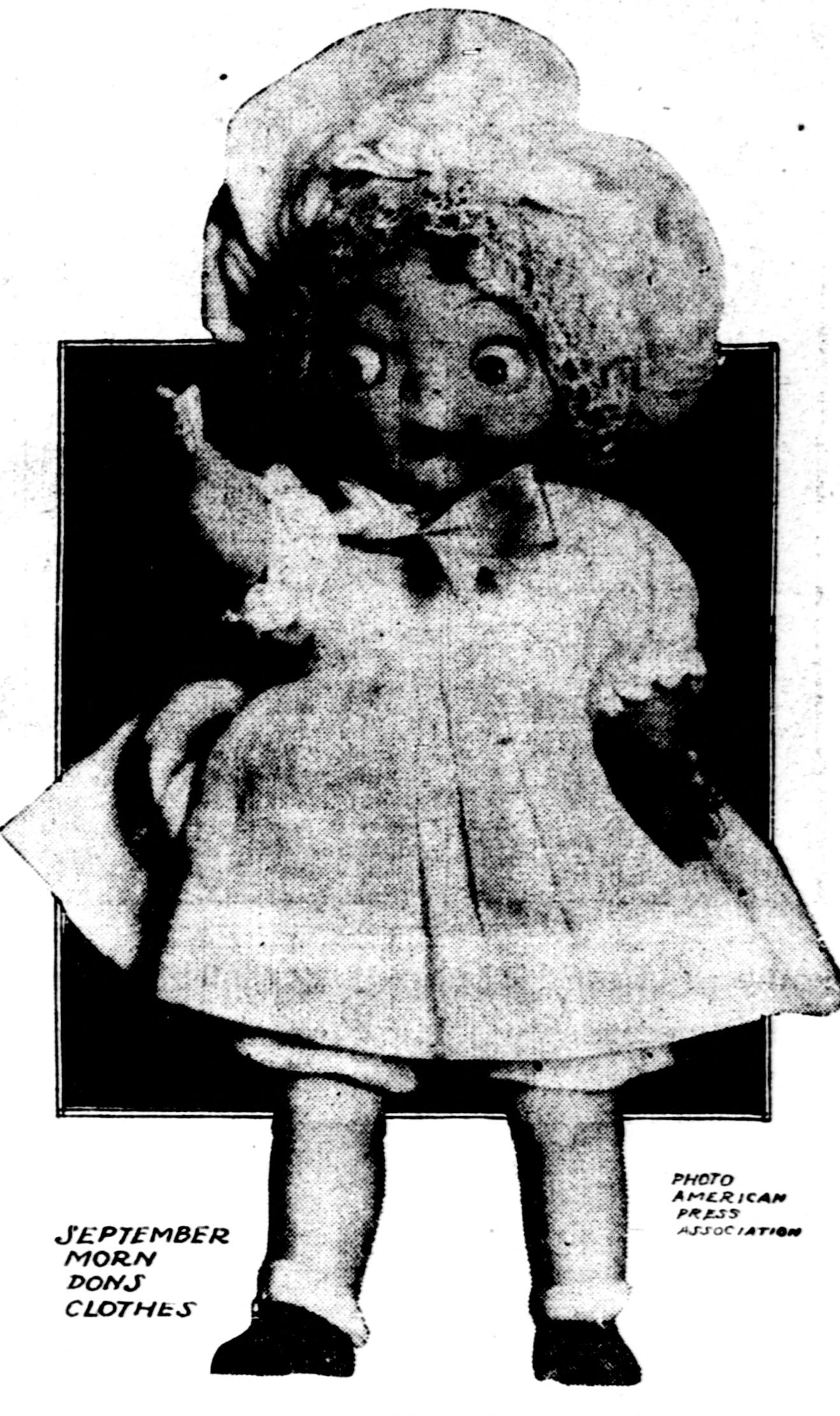
“September Morn Dons Clothes,” a photo of Grace Drayton’s new doll. American Press Association photo in the Washington Times, Washington, D.C., February 25, 1914, page 8. Library of Congress, Chronicling America. Click the clipping to read it full size.
Grace Drayton Learned to Keep Her Share
Grace Drayton never forgot the soup prize her boss’s company took home. By 1920, the Dearborn Independent said, she “now makes all her own contracts, and gets a royalty on every little ‘kiddie’ she sends out.” A royalty is a small payment every time one is sold. Her kids and their “little fat dogs” turned up as dishes, lamp bowls and toy banks, and as paper dolls on a “Dolly Dingle” page in a women’s magazine.
“Look at Me Now,” Grace Drayton Said in New York
In 1920, Grace Drayton lived in New York City and painted “from early in the morning till late in the afternoon.” The Dearborn Independent’s writer, Frances L. Garside, saw it right away: “Mrs. Drayton cannot have changed with the years, for she is still a Campbell kid.”
Then Grace proved it. She said, “Look at me now,” rolled up her eyes, and pressed her lips into a prim little smile that puffed out her cheeks. Garside wrote that “the resemblance is so great it is almost uncanny.” Uncanny means so close that it’s almost spooky.
People kept wondering for years. In 1926, a reader with the initials M. A. G. asked the Evening Star in Washington, D.C., who the model for “the Campbell’s soup kids” was. The answer: “Grace Drayton, the artist, says that she used herself as a model. She had from childhood drawn comical presentments of herself and these finally brought her fame.” Comical presentments means funny pictures. The girl who made her classmates laugh behind the sisters’ backs never really stopped. She just kept drawing that same round face, and the whole country laughed along.
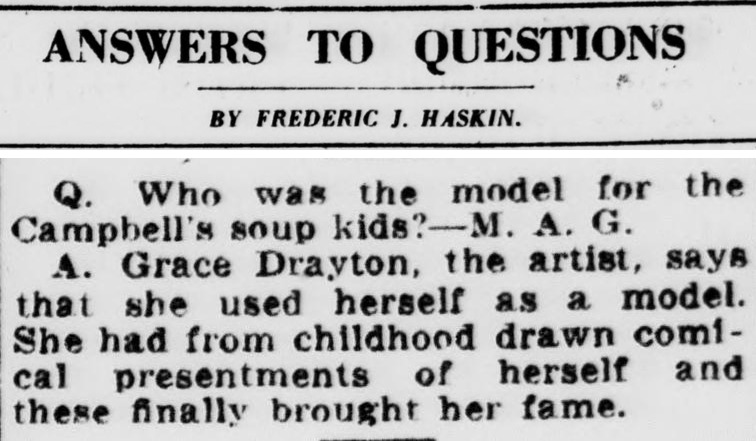
“Answers to Questions,” by Frederic J. Haskin. Evening Star, Washington, D.C., March 25, 1926, page 8. Library of Congress, Chronicling America. Click the clipping to read it full size.
Sources
- “She Made Fun of Herself, Fun for Others, Also Made Money at It,” by Frances L. Garside, The Dearborn Independent (Dearborn, Michigan), March 20, 1920, page 9. Library of Congress, Chronicling America.
- “Creator of Famous Dolls Just Like Her Cherubs,” by Yetta Dorothea Geffen, The Washington Times (Washington, D.C.), February 25, 1914, page 8. Library of Congress, Chronicling America.
- “Answers to Questions,” by Frederic J. Haskin, Evening Star (Washington, D.C.), March 25, 1926, page 8. Library of Congress, Chronicling America.
- Children playing with Campbell kid dolls, New York, March 1912, photo by Lewis Hine (the cover). National Child Labor Committee collection, Library of Congress Prints and Photographs Division. No known restrictions on publication.
- Little girl conversing with a Campbell Kid, New York, March 1912, photo by Lewis Hine. National Child Labor Committee collection, Library of Congress Prints and Photographs Division. No known restrictions on publication.
- Children playing with Campbell Kid dolls, New York, March 1912, photo by Lewis Hine (on the Facebook and Instagram picture). National Child Labor Committee collection, Library of Congress. No known restrictions on publication.
- Drayton, W.H., Mrs., portrait photograph by Arnold Genthe, May 8, 1916. Genthe photograph collection, Library of Congress Prints and Photographs Division. No known restrictions on publication.
- Campbell Kid with life preserver, watercolor and ink by Grace G. Drayton, about 1910, with the Library’s note on her 1904 streetcar ads. Library of Congress Prints and Photographs Division. No known restrictions on publication.
- Trademark registration by Joseph Campbell Company of Camden, New Jersey, for Campbell’s brand Condensed Soups, January 2, 1906. Library of Congress Prints and Photographs Division.
- Campbell’s tomato soup, color lithograph ad, between 1920 and 1930. Library of Congress Prints and Photographs Division. No known restrictions on publication.
- September Morn, by Paul Chabas, about 1912. The Metropolitan Museum of Art (named in the story, not shown).
- The newspapers, photographs and pictures above were all published or made before 1931 and are in the public domain.