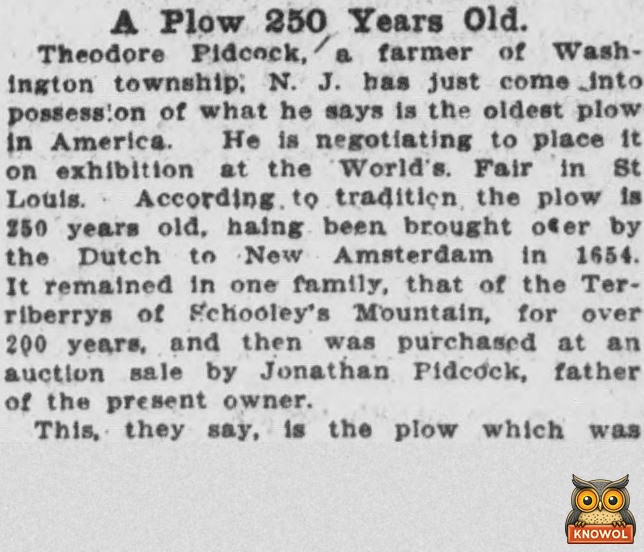
“A Plow 250 Years Old.” The Montgomery Advertiser, Montgomery, Alabama, April 27, 1904, page 5. Library of Congress, Chronicling America. Click the clipping to read it full size.
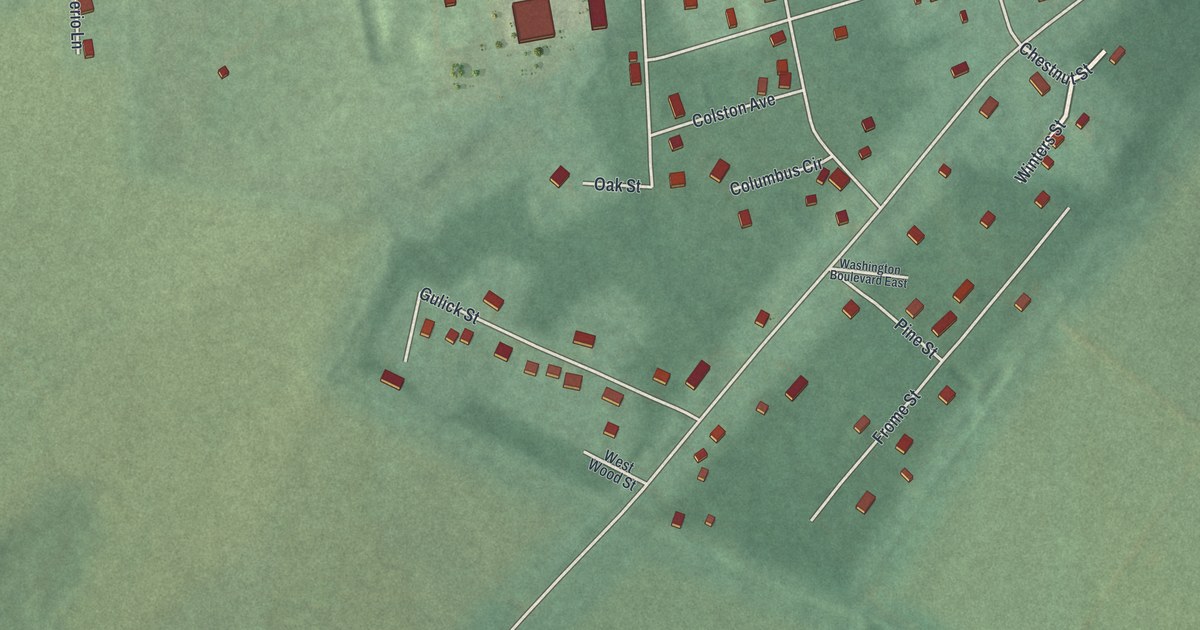
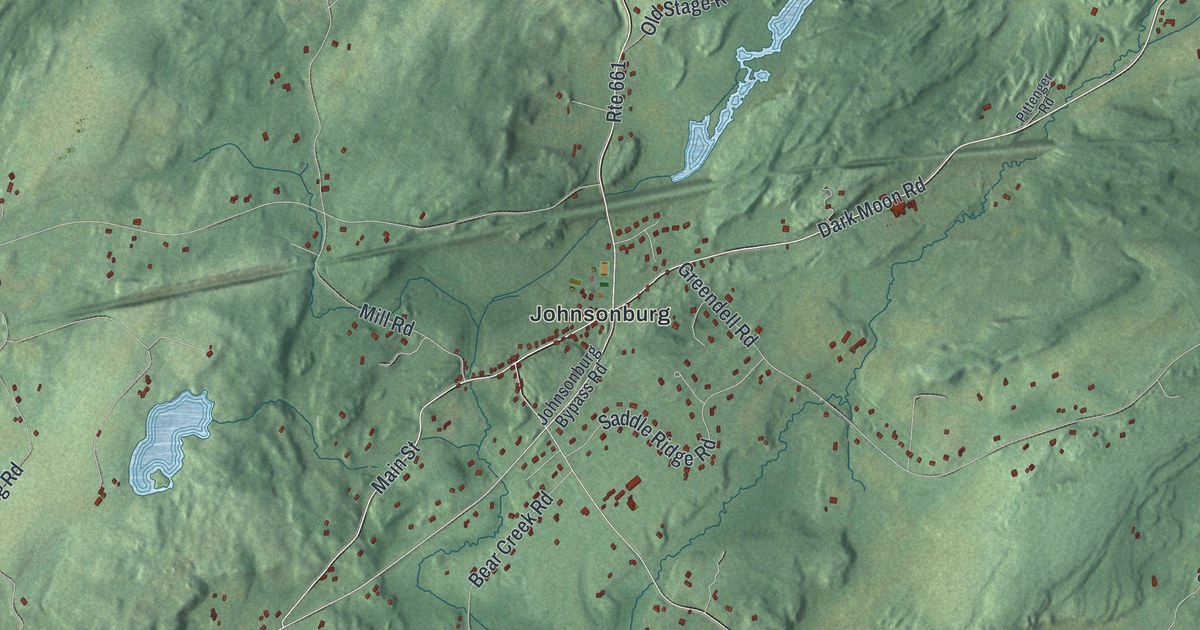
In the spring of 1904, a farmer named Theodore Pidcock had an old wooden plow in Washington Township, in the hills of northwest New Jersey. It had been his father’s, and before that it had belonged to the Terriberry family on Schooley’s Mountain, near Hackettstown, New Jersey. Pidcock was sure of one thing: it was the oldest plow in America.
That spring, the biggest fair in the world was about to open in St. Louis, Missouri. Pidcock wanted his plow to be in it, so a small news item went out, and newspapers all over the country picked it up. Then something funny happened, because the plow’s age didn’t stay the same from paper to paper.
How the Story Started in Richmond, Virginia
The first report we found ran in The Times-Dispatch of Richmond, Virginia, on April 9, 1904. It was just two sentences long. It said Theodore Pidcock, “a Washington, N. J., farmer, claims to have the oldest plough in America.” (Plough is the old spelling of plow.) It added that “he has also many other old farming implements and the lot will be shown at the St. Louis Fair.” Implements are tools, and the note gave no age for the plow at all.
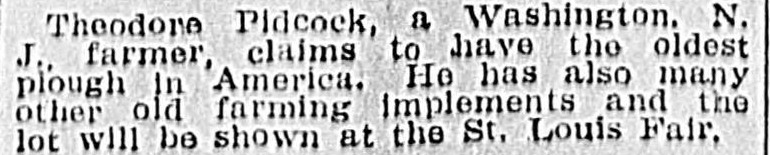
The Times-Dispatch, Richmond, Virginia, April 9, 1904, page 4. Library of Congress, Chronicling America. Click the clipping to read it full size.
The New York Times Gave Pidcock’s Plow 250 Years
Eight days later, on April 17, The New York Times printed a longer story with a big number on top: “A PLOW 250 YEARS OLD.” It said Pidcock was “negotiating,” or working out a deal, to show the plow at the World’s Fair in St. Louis.
The Times told where the plow came from, too. “According to tradition the plow is 250 years old, having been brought over by the Dutch to New Amsterdam in 1654.” A tradition is a story a family passes down, and New Amsterdam was the Dutch town that later became New York City. If the story was right, the plow had crossed the ocean on a sailing ship before New York even had its English name.
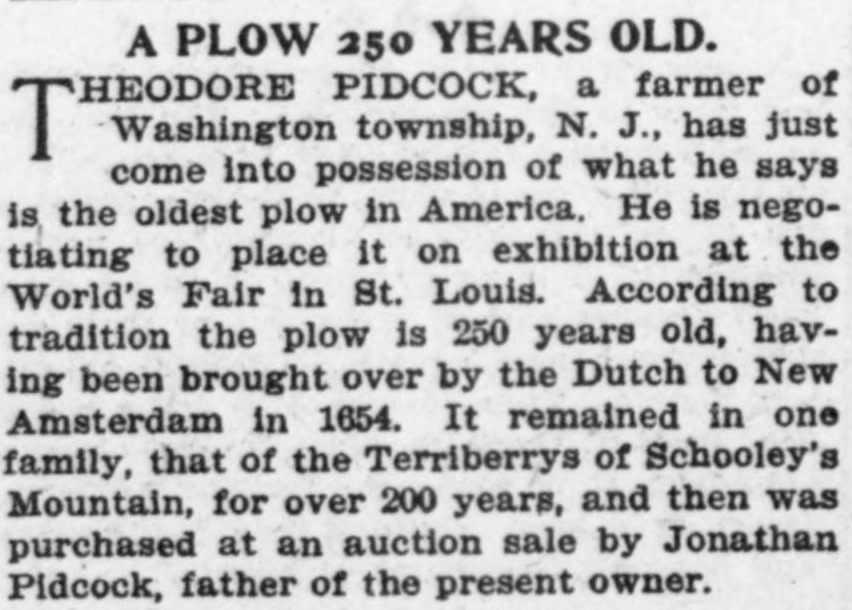
“A Plow 250 Years Old.” The New York Times, New York, April 17, 1904. Internet Archive, public domain. Click the clipping to read it full size.
The Times said the plow stayed with the Terriberrys of Schooley’s Mountain “for over 200 years.” Then Jonathan Pidcock, Theodore’s father, bought it at an auction, and there was more. “This, they say, is the plow which was used in breaking the ground” for a road between Hackettstown and German Valley. The story said American soldiers later pulled their cannon over that road during the Revolutionary War.
The Home Paper in Morristown, New Jersey, Said 150
Two days after the Times story, a paper much closer to the farm told it a different way. The Morris County Chronicle came out in Morristown, New Jersey, in the same county as Schooley’s Mountain. On April 19 it wrote that Pidcock’s plow “is 150 years old, according to Mr. Pidcock’s calculations.”
That is a whole century younger, and in the Chronicle’s story there were no Dutch settlers and no sailing ship. It said only that the plow “was then much older than the owner, having been in the family for several generation” when Jonathan Pidcock bought it.
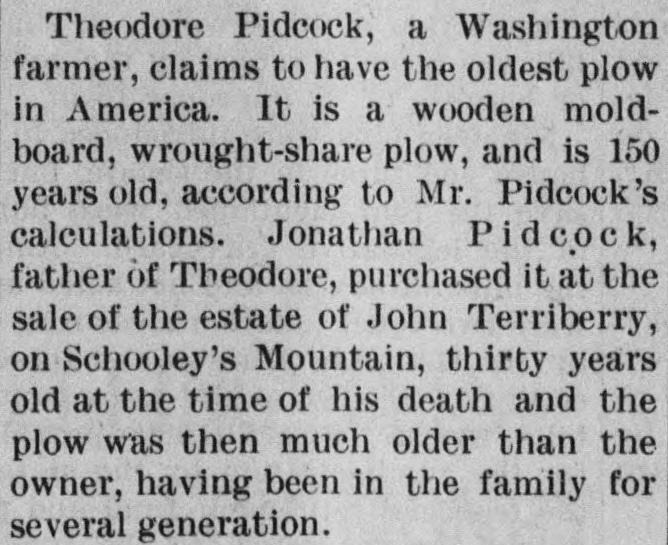
The Morris County Chronicle, Morristown, New Jersey, April 19, 1904, page 5. Library of Congress, Chronicling America. Click the clipping to read it full size.
Nobody can say now which number Theodore Pidcock really believed. Maybe he said 150 to a neighbor and 250 to a city reporter. Maybe one writer simply heard him wrong. All we know for sure is what got printed, and the bigger number is the one that traveled.
How the Old Plow Worked
The longer story did one great thing. It told readers how the plow was built, and the Montgomery Advertiser in Alabama printed that same story on April 27, 1904.
A plow has two main parts, the share and the moldboard. The share is the sharp blade in front that slices into the dirt. The moldboard is the curved board behind it that lifts the cut dirt and flips it over, so old weeds go under and fresh soil comes up on top. Pidcock’s plow worked the same way: “It is built on the same principal as plows of to-day, except it was a wooden mold-board and a wrought iron share.” Wrought iron is iron a blacksmith heats and hammers into shape.
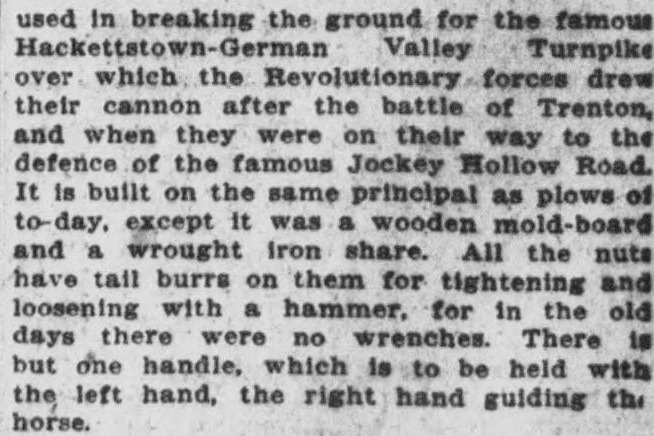
How the plow was built. The Montgomery Advertiser, Montgomery, Alabama, April 27, 1904, page 5. Library of Congress, Chronicling America. Click the clipping to read it full size.
Then came the best line in the whole story. “All the nuts have tail burrs on them for tightening and loosening with a hammer, for in the old days there were no wrenches.” A nut is the little piece that screws onto a bolt and holds parts together. These nuts had a tail sticking out, so a farmer could knock it around with a hammer instead.
The plow also had only one handle. “There is but one handle, which is to be held with the left hand, the right hand guiding the horse.” That means the farmer walked behind it, steering the plow with one hand and holding the horse’s lines with the other.
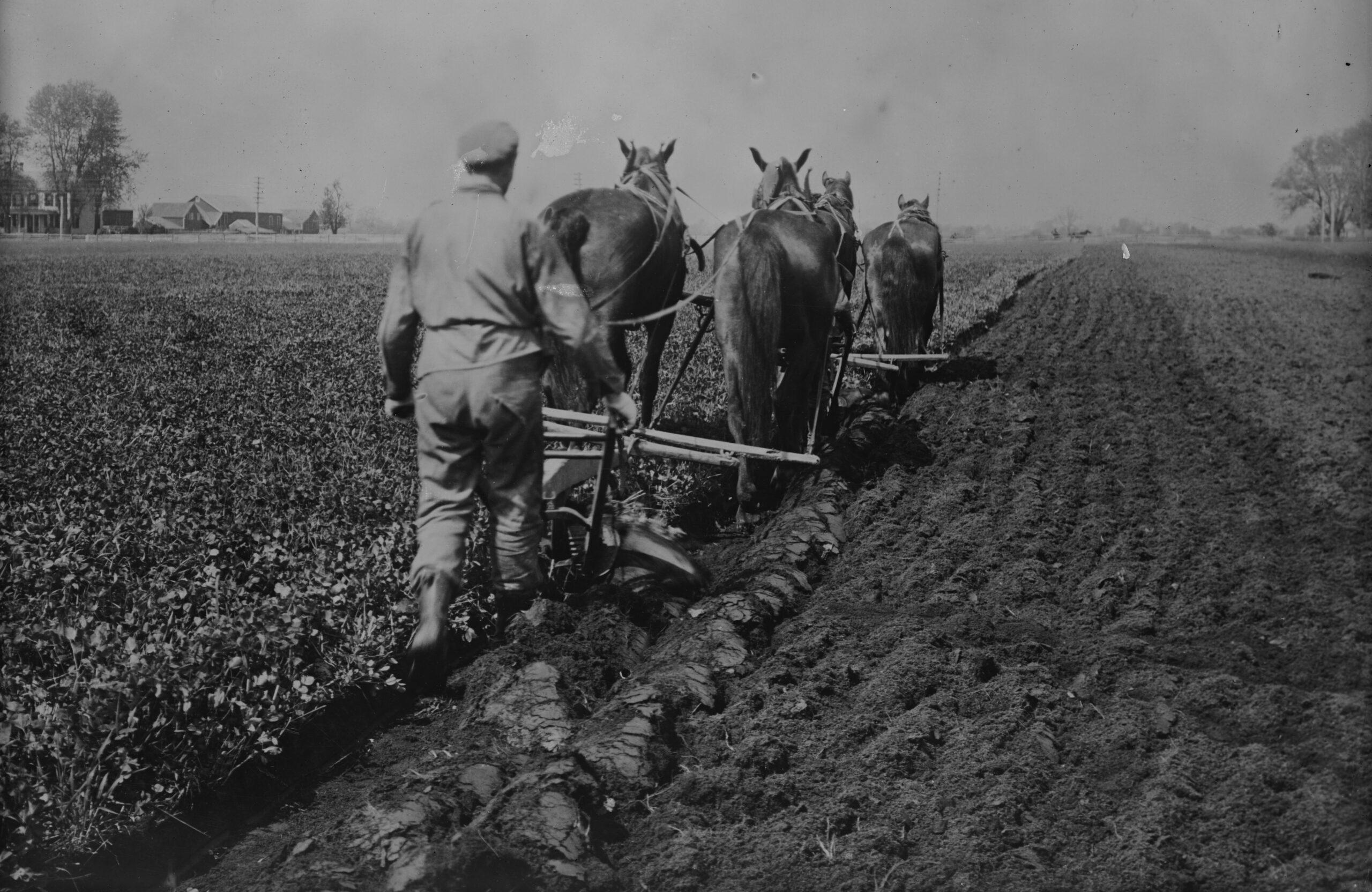
“Plowing under red clover for corn.” A farmer walks behind a newer plow with two handles and a team of four horses, in the 1910s. Not Pidcock’s plow or his farm. Bain News Service, Library of Congress. Click the picture to see it full size.
The Story Kept Growing as It Traveled
Newspapers in 1904 borrowed from each other all the time. A paper in one state would copy a story from a paper in another state, often with a new headline on top. Pidcock’s plow made that trip again and again.
By June 3, the Rock Island Argus in Illinois ran it under a headline that sounded like a done deal: “WILL EXHIBIT THE OLDEST PLOW ON THIS CONTINENT.” The words underneath still said he was only trying to.

Rock Island Argus, Rock Island, Illinois, June 3, 1904, page 6. Library of Congress, Chronicling America. Click the clipping to read it full size.
In October 1904, a trade magazine called Hardware, for people who sold tools, gave it one more twist. Its short item said Pidcock “purchased the implement” himself, from “the Tellibelly family,” who had kept it “for 250 years.” Two more things had changed. The Terriberrys had a new name, and the father who bought the plow was gone from the story.
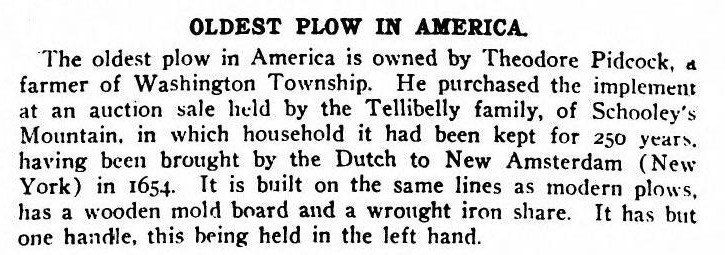
“Oldest Plow in America.” Hardware, volume 30, New York, October 1904. Internet Archive, public domain. Click the clipping to read it full size.
It was like the game where kids whisper a message down a line. Each paper passed it along to the next one, and a few words slipped every time it moved.
The Plow From Washington Township, New Jersey, and the St. Louis Fair
The St. Louis World’s Fair opened on April 30, 1904, and ran into December. Millions of people came to see the newest machines from all over the world. A wooden plow from New Jersey with nuts you tightened with a hammer would have made a fun thing to stand beside them.
But we could not find out if it ever got there. Every story we found said Pidcock was planning or negotiating. None of them said the plow arrived, and the home paper in Morristown never mentioned the fair at all.
So the true ending is a quiet one. Somewhere in the hills of New Jersey, a farmer was proud of a very old plow. The papers made it famous, and they made it older too. The one paper closest to home gave the smaller number, and it added four careful words: “according to Mr. Pidcock’s calculations.”
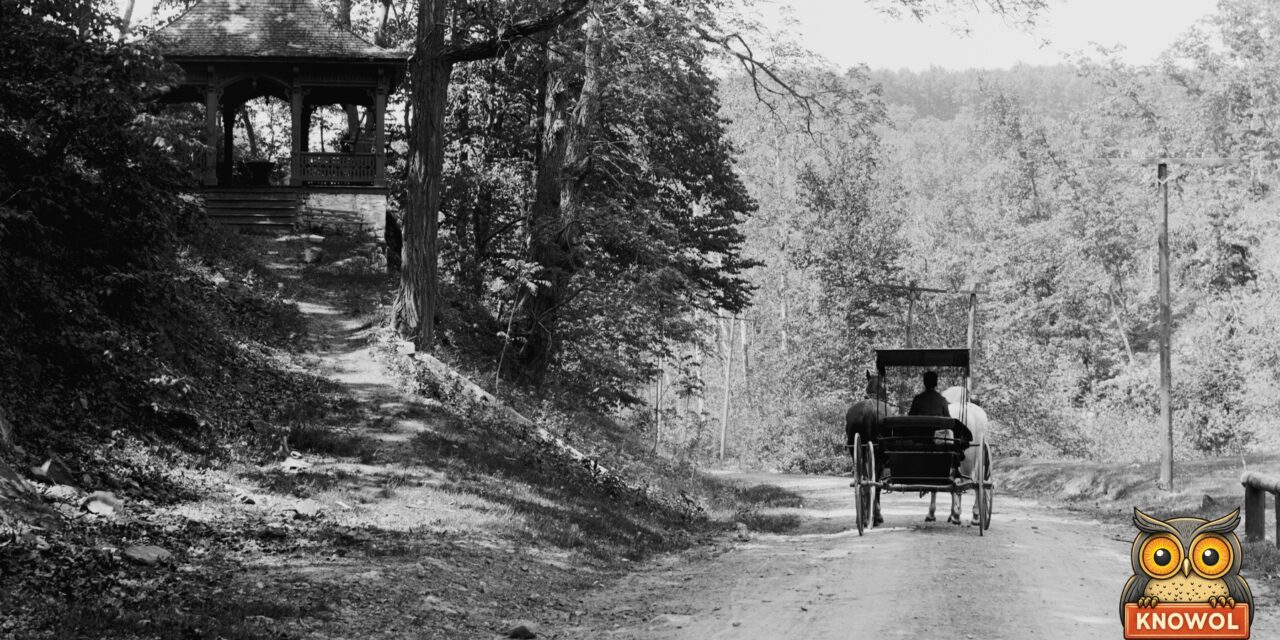
The cover photo shows the road from Hackettstown up Schooley’s Mountain, New Jersey, where the Terriberry family kept the plow, with a horse and buggy on it in the 1890s. It is not the road from the story.
Sources
- “A Plow 250 Years Old,” The Montgomery Advertiser, Montgomery, Alabama, April 27, 1904, page 5. Library of Congress, Chronicling America
- The Times-Dispatch, Richmond, Virginia, April 9, 1904, page 4. Library of Congress, Chronicling America
- “A Plow 250 Years Old,” The New York Times, April 17, 1904. Internet Archive
- The Morris County Chronicle, Morristown, New Jersey, April 19, 1904, page 5. Library of Congress, Chronicling America
- “Will Exhibit the Oldest Plow on This Continent,” Rock Island Argus, Rock Island, Illinois, June 3, 1904, page 6. Library of Congress, Chronicling America
- “Oldest Plow in America,” Hardware, volume 30, October 1904. Internet Archive
- Photo: “Plowing under red clover for corn,” Bain News Service, 1910s. Library of Congress
- Cover photo: “Schooley’s Mtn., road from Hackettstown, N.J.,” Detroit Publishing Co., between 1890 and 1901. Library of Congress
- Newspapers and magazines printed in 1904 are in the public domain. The photos are marked “No known restrictions on publication” by the Library of Congress.