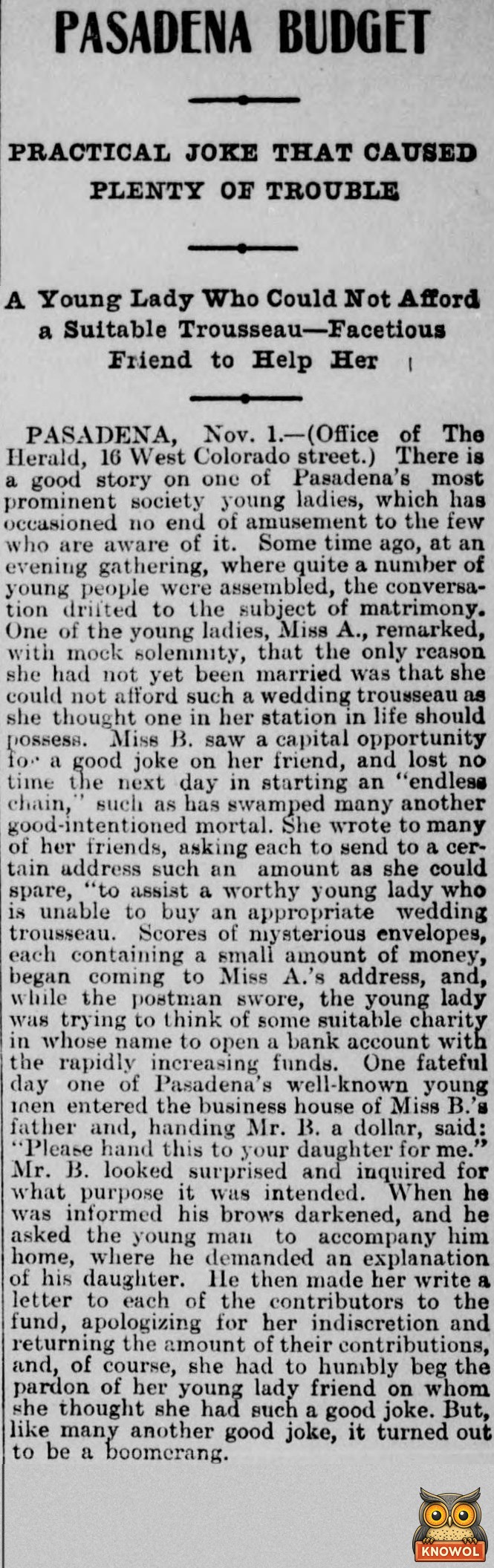
“Practical Joke That Caused Plenty of Trouble.” The Herald, Los Angeles, California, November 2, 1898, page 5. Library of Congress, Chronicling America. Click the clipping to read it full size.
One evening in 1898, a group of young people sat talking at a party in Pasadena, California. The talk turned to getting married. One young woman, whom the paper called only “Miss A.,” said she had a good reason for still being single. She said it “with mock solemnity,” which means with a straight face, as a joke.
Her reason was that she “could not afford such a wedding trousseau as she thought one in her station in life should possess.” A trousseau was everything a bride brought to her new life: dresses, a coat, hats, nightgowns, and sheets and towels for the new house. These were well-off young people in a well-off town, so everyone at the party knew she was kidding.
Her friend, “Miss B.,” heard it and “saw a capital opportunity,” which is old talk for a great chance. The very next day, she started a chain letter.
How a Chain Letter Worked in 1898
That summer, the whole country was crazy about chain letters, which the papers called “endless chains.” The idea was simple. You got a letter asking for a dime for a good cause. You mailed your dime, then you copied the letter four times and sent it to four friends. Each of them sent four more, and on and on.
The most famous one started in Babylon, Long Island, New York. The Evening Star of Washington said it was “started by Miss Natalie Schenck.” In 1898 the United States was at war with Spain, and American soldiers were sweating in the heat of Cuba. Miss Schenck asked for 10 cents from each person to buy ice for them, through the Red Cross. Then the letters came back. A paper in St. Johnsbury, Vermont, said she got about “4000 letters a day,” and “it is carried to her home in clothes baskets.” Then it added: “The postmaster is wild, the chief of police is angry and the entire populace is getting excited over the chain.”
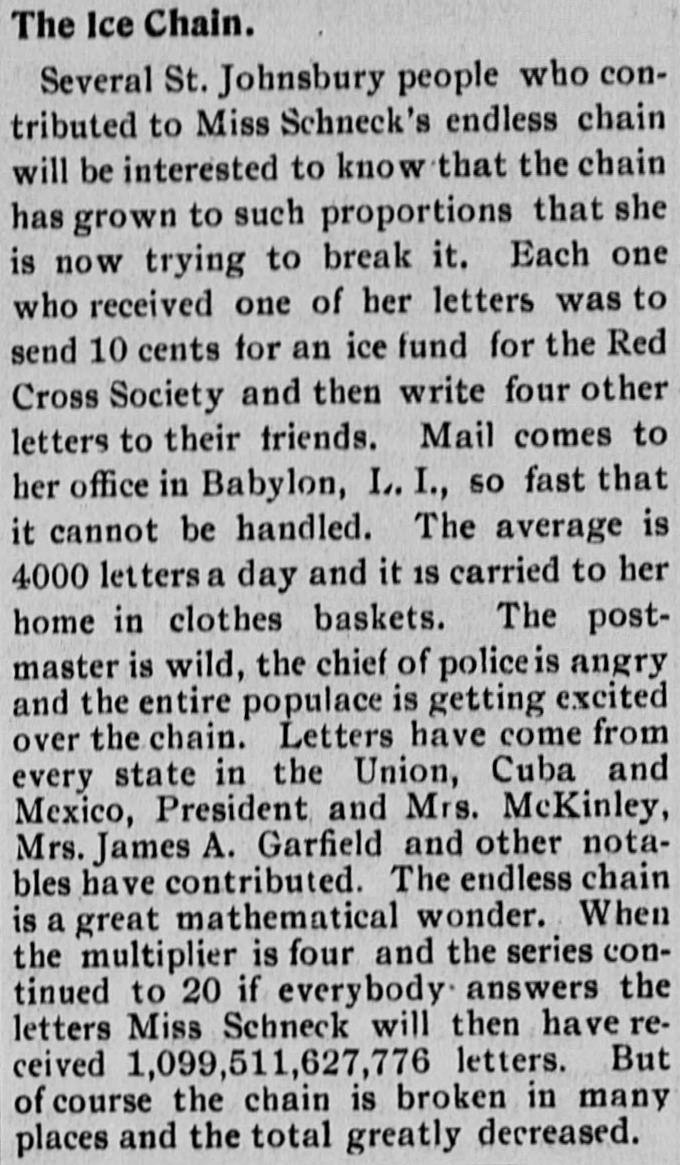
“The Ice Chain.” St. Johnsbury Caledonian, St. Johnsbury, Vermont, July 13, 1898, page 4. Library of Congress, Chronicling America. Click the clipping to read it full size.
The math is what made it wild. One letter becomes 4. Then 16, then 64, then 256. By the tenth round, the chain would need more than a million letters. The Vermont paper did the math out to twenty rounds and got 1,099,511,627,776 letters, more than a trillion. That’s far more people than lived on the whole Earth, so of course every chain broke somewhere. People forgot, or got bored, or just kept their dime.
The Babylon chain still worked. The Star said “Over $20,000 was collected” for the soldiers. And the mail carriers had a time with the name. People wrote “Schenck” every way you can think of: “Sohenka, Sewana, Sonk, Sant and various other misnomers.”
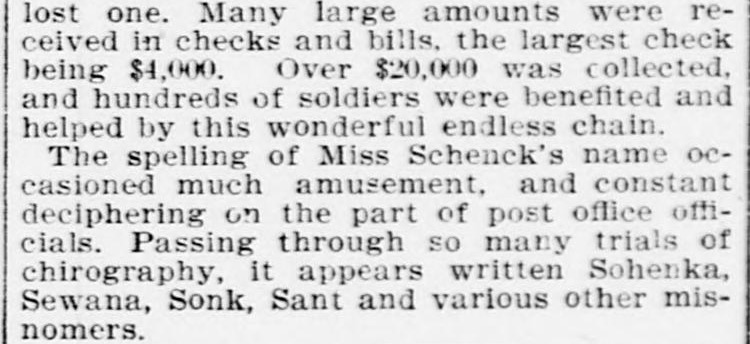
Miss Schenck’s chain. Evening Star, Washington, D.C., September 10, 1898, page 24 (from the Boston Transcript). Library of Congress, Chronicling America. Click the clipping to read it full size.
Chain Letters Come to Los Angeles and Pasadena
Southern California caught the craze too. In August 1898, the Los Angeles Herald itself “suggested that some lady start one in Los Angeles to establish free public baths,” public bathhouses where poor families could wash for free. Mrs. William Cline, the wife of a grocer, took up the idea. Her letter told each person to mail back 10 cents, make four numbered copies, “and above all do not break the chain.”
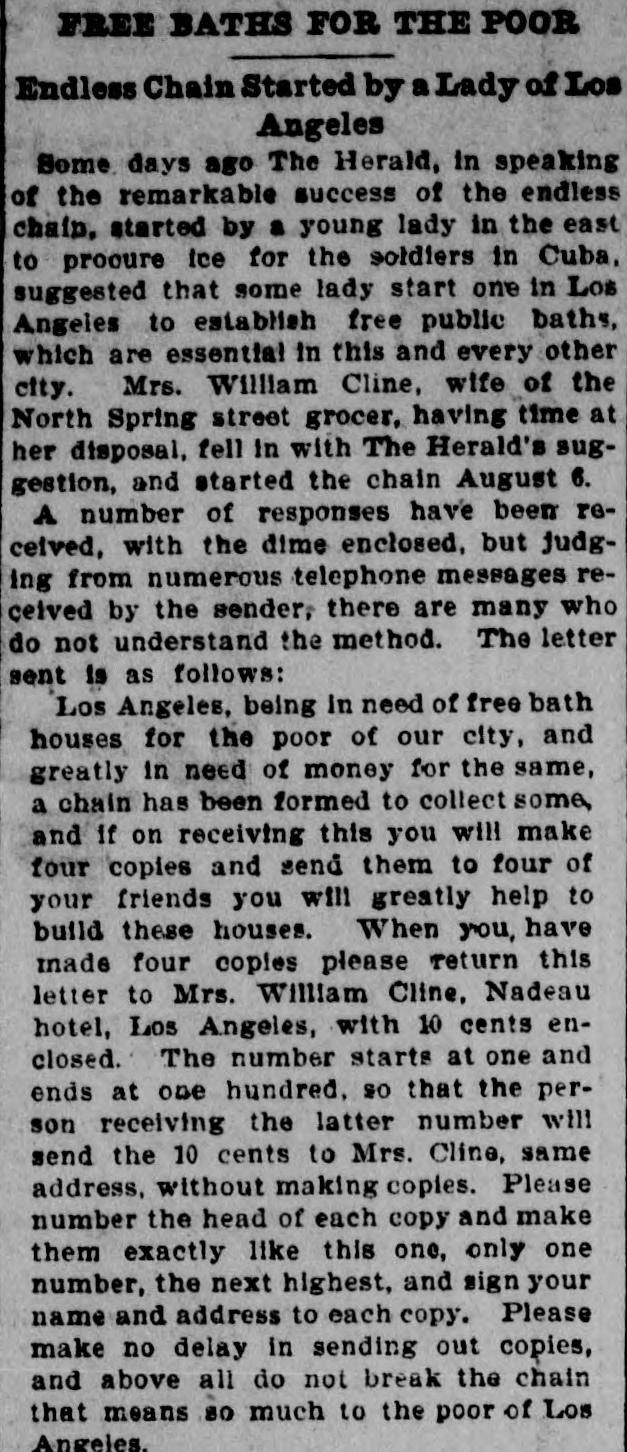
“Free Baths for the Poor.” The Herald, Los Angeles, California, August 16, 1898, page 8. Library of Congress, Chronicling America. Click the clipping to read it full size.
So when Miss B. wanted to play a joke on her friend in Pasadena, she knew just what to do. She wrote to many of her friends. Each was asked to mail whatever she could spare to Miss A.’s address, “to assist a worthy young lady who is unable to buy an appropriate wedding trousseau.”
The Envelopes Pile Up in Pasadena
Then the mail came to Miss A.’s house in Pasadena, and it kept coming. “Scores of mysterious envelopes, each containing a small amount of money, began coming to Miss A.’s address,” the Herald said. Scores means many dozens. Each one held a little money from someone who believed a poor bride really needed help.
The mail carrier who had to haul it all was not amused. The paper put it in three words: “the postman swore.” Miss A. didn’t want to keep the money, and she couldn’t easily send it back to strangers. So she tried to think of a good charity, a group that helps people in need, and planned to open a bank account in its name for “the rapidly increasing funds.”
A Dollar at the Store Counter
Then came the day the joke fell apart. Miss B.’s father ran a business in Pasadena. One day a well-known young man walked into his store and held out a dollar. “Please hand this to your daughter for me,” he said.
Mr. B. was puzzled and asked what it was for. The young man told him. “When he was informed his brows darkened,” the Herald said, which means he frowned hard. He took the young man home with him and “demanded an explanation of his daughter.”
Then Mr. B. handed out the punishment. Miss B. had to write a letter to every single person who had sent money, say she was sorry, and send each one’s money back. That meant one letter for every gift. And she “had to humbly beg the pardon” of Miss A., the friend she had teased.
The Herald ended with a line that still works today: “But, like many another good joke, it turned out to be a boomerang.” A boomerang is a curved throwing stick that flies in a big loop and comes back to the person who threw it. Miss B. threw the joke at her friend, and it flew right back at her.
An Earlier Chain Letter Joke in Pasadena
The November story was not the Herald’s first chain-letter joke from Pasadena. On August 15, 1898, its Pasadena column said “Considerable fun has been created among the society set over a ‘chain letter.'” That one was started by “a young gentleman.” His four letters asked friends to send 10 cents each to a young lady “for the purpose of aiding her to go east to be married.” She was “the daughter of a well-known local banker,” the paper said, and “has no need of the contributions.”
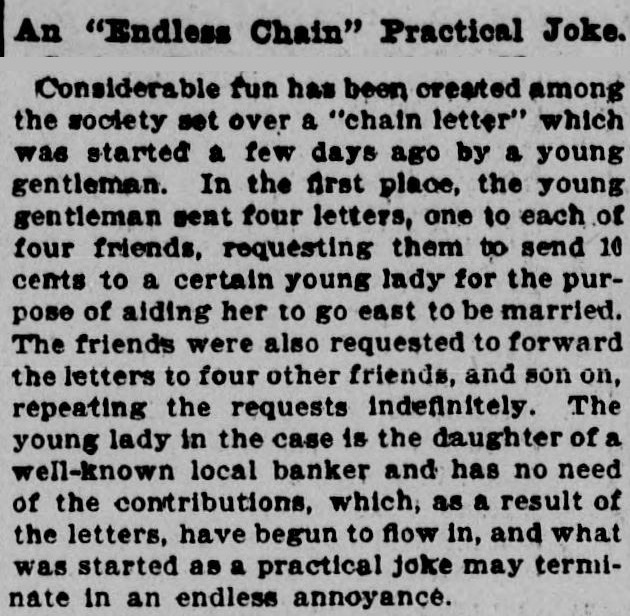
“An ‘Endless Chain’ Practical Joke.” The Herald, Los Angeles, California, August 15, 1898, page 10. Library of Congress, Chronicling America. Click the clipping to read it full size.
The two Pasadena stories are a lot alike: a rich young bride-to-be, a joke chain letter, and money she never asked for. But in August the joker was a young man, and in November it was a young woman. The Herald never said if they were the same joke told two ways, or if two people in Pasadena had the same idea that summer. It never printed anyone’s name, either. That was kind. The papers were happy to laugh at the joke, but they let the jokers keep their privacy.
In August, the Herald had made a guess about how it would all end: “what was started as a practical joke may terminate in an endless annoyance.” It was half right. The joke did end, but it took a father, a stack of letters and a lot of stamps to stop it.
Pasadena in 1898
Pasadena was a small, rich town back then, about ten miles from Los Angeles, full of orange groves, big homes and fancy hotels. The Herald kept a small office there, at 16 West Colorado street, just to cover its parties and news.
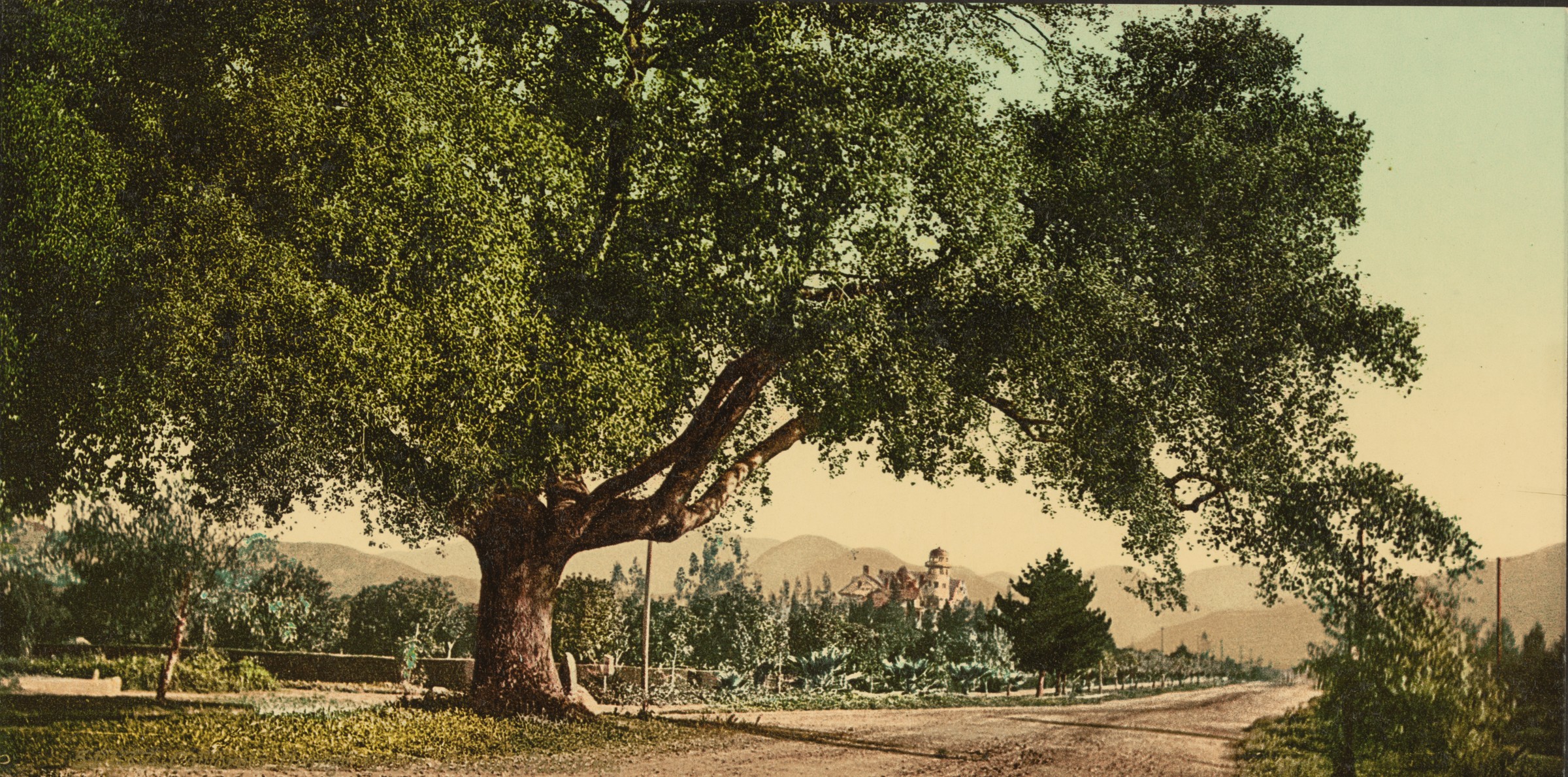
“California. Orange Grove Avenue, Pasadena.” A color photochrom print from the Detroit Publishing Co., about 1898. Library of Congress. Click the picture to see it full size.
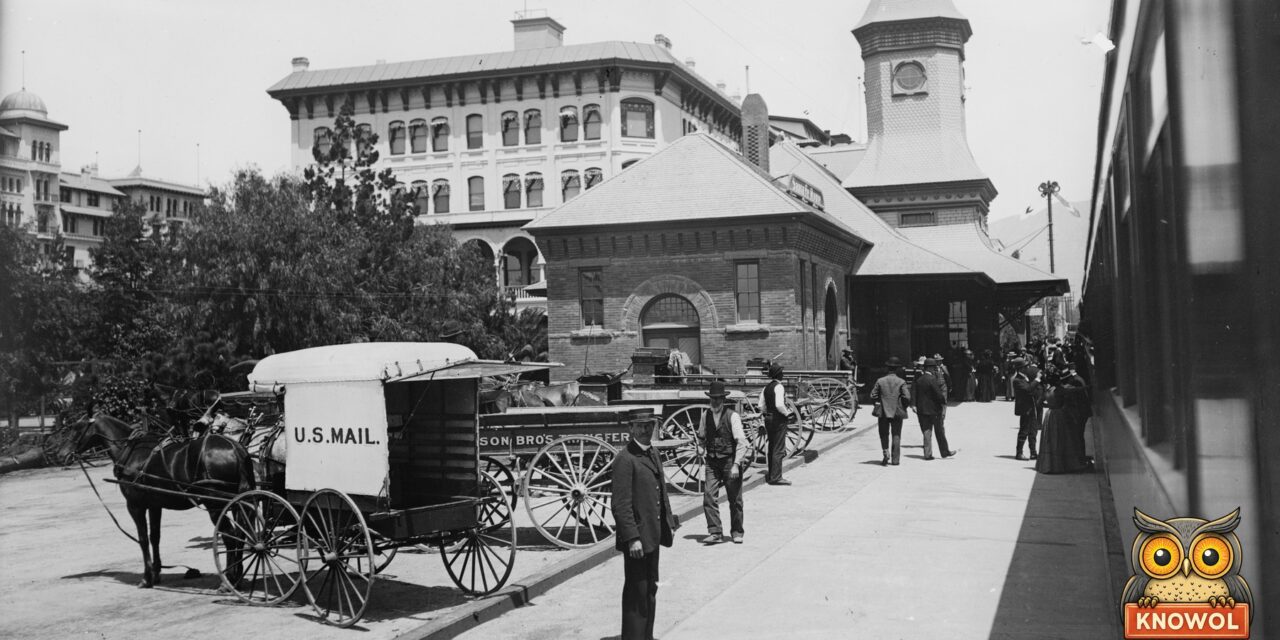
The cover photo shows Pasadena’s railway station about 1900, with a sign for the Santa Fe Route on its roof. Out front, a wagon with “U.S. MAIL” painted on its side waits with its horse by the tracks. In those days, letters from far away came into town by train, and wagons like this one carried the mailbags to the post office. It’s easy to picture one of those mailbags full of envelopes for Miss A.
Sources
- “Pasadena Budget: Practical Joke That Caused Plenty of Trouble,” The Herald, Los Angeles, California, November 2, 1898, page 5. Library of Congress, Chronicling America
- “An ‘Endless Chain’ Practical Joke,” The Herald, Los Angeles, California, August 15, 1898, page 10. Library of Congress, Chronicling America
- “Free Baths for the Poor,” The Herald, Los Angeles, California, August 16, 1898, page 8. Library of Congress, Chronicling America
- “The Ice Chain,” St. Johnsbury Caledonian, St. Johnsbury, Vermont, July 13, 1898, page 4. Library of Congress, Chronicling America
- “Letter No. 98 Rescued and the End Now in Sight,” Evening Star, Washington, D.C., September 10, 1898, page 24. Library of Congress, Chronicling America
- Photo: “California. Orange Grove Avenue, Pasadena,” Detroit Publishing Co. photochrom. Library of Congress
- Cover photo: “[Railway station, Pasadena],” Detroit Publishing Co., about 1900. Library of Congress
- Newspapers printed before 1931 are in the public domain. Both photos: Library of Congress, no known restrictions on publication.