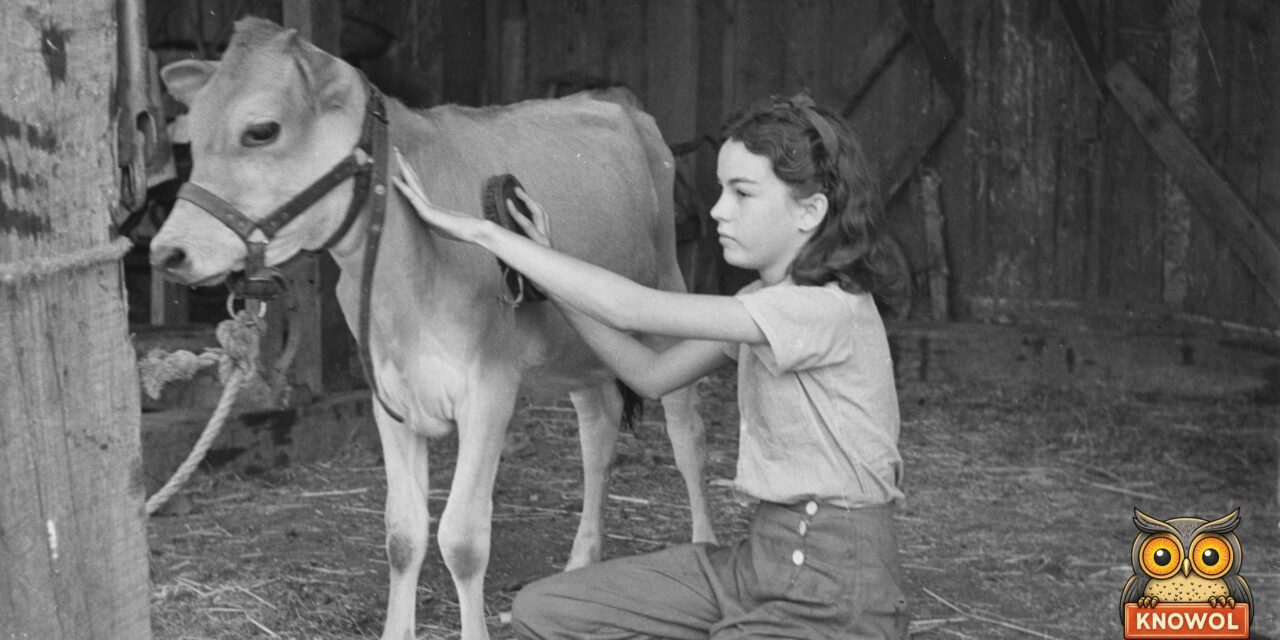
A girl kneels in the straw of an old wooden barn, one hand resting flat on her calf’s shoulder while the other works a stiff brush down its side. The calf wears a leather halter, roped to a big post by the door, and it stands very still. It’s August 1939, in the fruit country near Medford, Oregon, and the woman holding the camera is Dorothea Lange. On her caption card she wrote: “Young girl, daughter of small pear farmer tends her calf. She belongs to the 4-H Club, the largest movement among rural youth in America.”
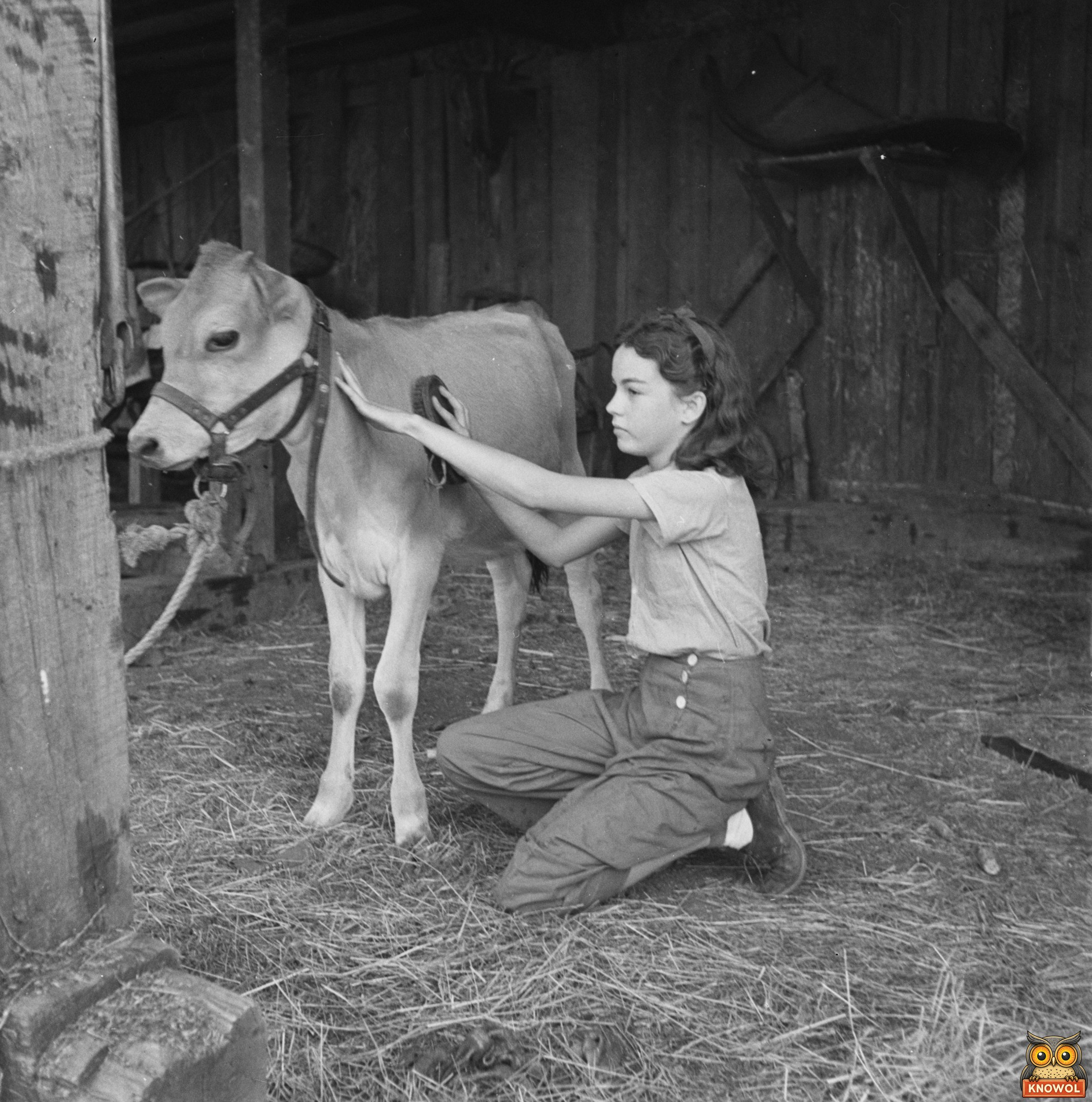
“Young girl, daughter of small pear farmer tends her calf. She belongs to the 4-H Club, the largest movement among rural youth in America. Oregon. Jackson County, near Medford.” Photo by Dorothea Lange, August 1939. Library of Congress, Prints and Photographs Division, FSA/OWI Collection. No known restrictions. Click the picture to see it full size.
A Pear Farmer’s Daughter Near Medford, Oregon
Lange’s card near Medford, Oregon, never gives the girl’s name or her family’s. It says only that her father was a “small pear farmer” in Jackson County, so we won’t guess at it. What the picture does tell us is plenty: a work shirt, rolled-up sleeves, trousers with a row of buttons down the side, and a girl who knows how to handle a calf.
August was a big month on a pear farm near Medford. Old records from the Rogue River Valley give the average day each kind of pear was ready to pick. Bartletts came first, around August 14, followed by the Howell, the Anjou and the Bosc, and the fat, sweet Comice came last, around September 24. So when Lange stopped by, the grown-ups were probably getting ready for the busiest weeks of the year, and the calf was the girl’s job.
How Pears Came to Medford, Oregon
Pears came to the Rogue River Valley around Medford, Oregon, before the town even had a train. Settlers planted the first Bartlett trees in 1855, just for their own families. When the railroad reached Medford in 1884, fruit could finally ride to big cities far away, and the first orchard planted to sell pears went in south of town a year or two later.
The valley’s warm summers grew beautiful fruit. Its Comice pears, first planted there in 1897, were bringing top prices in New York by 1905. By the 1930s, though, the Great Depression had hit farmers hard all over the country. A small grower near Medford had to work for every dollar, and so did his kids.
What 4-H Meant to a Farm Kid in Oregon
The girl near Medford, Oregon, belonged to a club that started with farm kids in the early 1900s. One of the first was a club of boys and girls that an Ohio school principal, A. B. Graham, formed in 1902. Kids in these clubs learned by doing: instead of only reading about better corn or healthier animals, they grew the corn or raised the animal themselves.
The clubs picked a clover for their sign, and by 1907 it had three leaves marked Head, Heart and Hand. A fourth leaf came soon after, for Health, and that’s where the name 4-H comes from. In 1927, at the first National 4-H Club Camp in Washington, D.C., the clubs adopted a pledge. Members promised their head, heart, hands and health to their club, their community and their country.
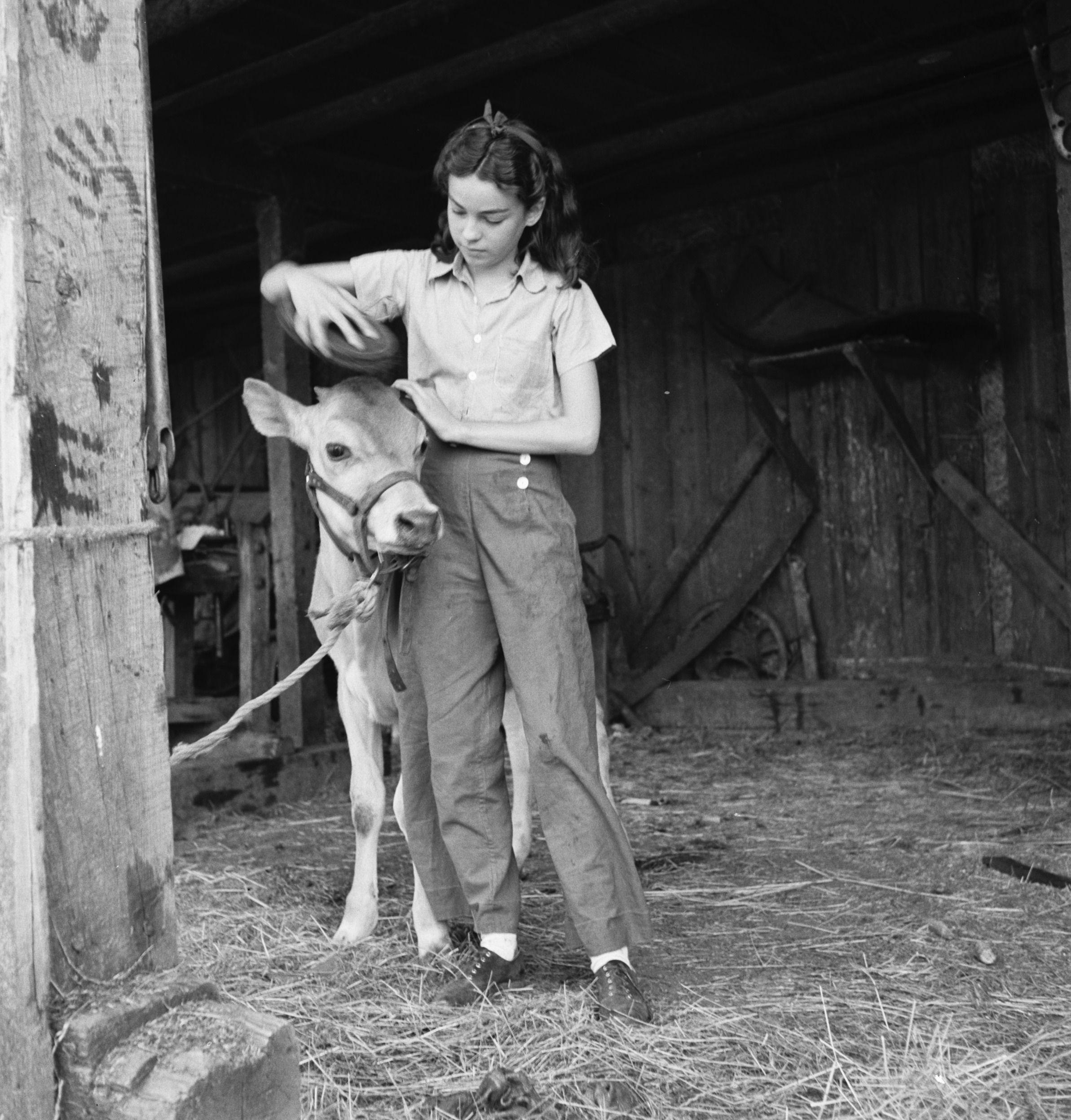
Same barn, same girl and calf, Jackson County, Oregon, August 1939. The Library of Congress record calls this untitled negative “possibly related” to the photo above. Photo by Dorothea Lange. Library of Congress, FSA/OWI Collection. No known restrictions. Click the picture to see it full size.
By 1936, more than a million kids across America belonged to 4-H. In 1939, the same year as this photo, Congress passed a law to protect the 4-H name and the clover sign from people who wanted to use them without permission. So when Lange called 4-H “the largest movement among rural youth in America,” she was writing down something people knew was true.
Brushing a Calf in a Barn Near Medford, Oregon
Lange took several pictures of the girl near Medford, Oregon, and her calf, and the Library of Congress has kept the negatives. In one, the girl stands beside the calf and brushes the top of its head while the calf looks right at the camera. In another, she kneels with one hand on the calf’s chest. Look at the big post by the door in that picture, covered with what look like dark handprints.
Brushing wasn’t just for looks. It cleans a calf’s coat, and a calf that gets handled every day learns to stand quietly for people. A gentle calf that will stand still and walk on a rope is a calf you can lead around a show ring someday. The calf in Lange’s picture looks like it has had plenty of practice.
A Little Brother and an Old Coat Near Medford, Oregon
Lange found someone else in the same farmyard near Medford, Oregon. On another card she wrote: “Young farm boy. Younger brother trying to make a holster from the leather of an old coat.” His negative number sits right between the pictures of the girl and her calf, so he was probably her younger brother.
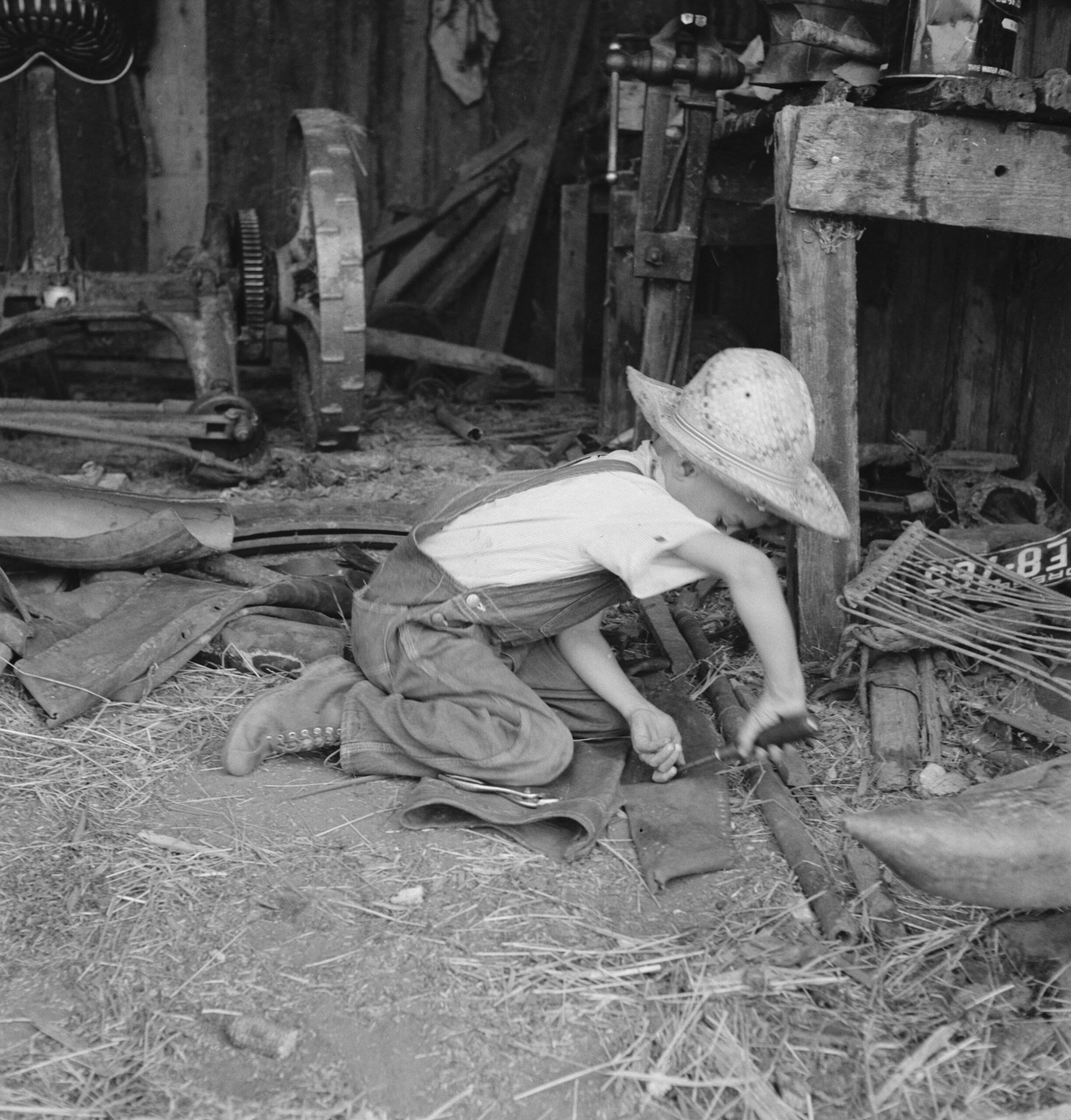
“Young farm boy. Younger brother trying to make a holster from the leather of an old coat. Oregon, Jackson County, near Medford.” Photo by Dorothea Lange, August 1939. Library of Congress, FSA/OWI Collection. No known restrictions. Click the picture to see it full size.
In the picture he wears a straw hat, a T-shirt and denim overalls. He kneels on the dirt floor with a tool in his hand, working on a flat piece of leather. Behind him is a pile of old farm machinery: a big iron wheel with teeth, a rusty seat, scraps of metal, and an old license plate. Nothing was thrown away on a small farm in 1939, and even an old coat could still become a cowboy’s holster.
Who Was Behind the Camera Near Medford, Oregon
Dorothea Lange was already famous when she came to Medford, Oregon. In 1936 she had taken “Migrant Mother,” a picture of a worried mother and her children in a California pea pickers’ camp. It became one of the best-known photographs in American history. Lange worked for the Farm Security Administration, or FSA, a government office that helped struggling farm families. The FSA sent photographers across the country to show how Americans really lived and worked.
In August 1939, Lange arrived in Grants Pass, Oregon, just down the Rogue River from Medford. She took hundreds of pictures in that part of the state. Many showed hard times: hop pickers living in tents and shacks, and workers who earned 42 cents for a whole morning of picking. She also photographed a farm boy on Medford’s main drugstore corner and an empty old farmhouse in the fruit country along the river.
Somewhere in those weeks, she also stepped into this barn. Her pictures of hard times show what was wrong, but this one shows something that was going right. A small farmer’s daughter was learning to care for an animal of her own, the way more than a million other kids in 4-H were doing that same year.
Medford, Oregon, Still Grows Pears
The Rogue River Valley around Medford, Oregon, still grows pears today, Comice pears among them. 4-H is still around too, with clubs where kids raise animals, grow gardens and learn by doing. The girl in the picture never got her name on the card. But on an August day in 1939, with a famous photographer watching, she kept on brushing her calf, steady and careful, the way you take care of something that is yours.
Sources
- Dorothea Lange, “Young girl, daughter of small pear farmer tends her calf. She belongs to the 4-H Club, the largest movement among rural youth in America. Oregon. Jackson County, near Medford,” August 1939. Caption card title, record and full-size scan: Library of Congress, item 2017773089 (LC-USF346-020697-E). FSA/OWI photographs: no known restrictions.
- Same shoot, Dorothea Lange, August 1939: girl and calf, untitled negatives “possibly related,” item 2017773088, item 2017773087, item 2017773085; “Young farm boy. Younger brother trying to make a holster from the leather of an old coat,” item 2017773086; “Half-grown farm boy on main drugstore corner in town,” item 2017773100; “Old-fashioned country home, now uninhabited, in fruit country along the Rogue River,” item 2017773137.
- Southern Oregon Historical Society, Ben Truwe’s history files: history of the fruit industry (first Bartletts 1855, railroad 1884, first commercial pear orchard about 1885, Comice planted 1897) and pears (average ripening dates, Comice prices in New York).
- Jefferson Public Radio, “As It Was: Photographer Records Great Southern Oregon Depression,” January 18, 2018: ijpr.org (Lange in Grants Pass, August 1939; hop pickers; 42 cents a morning).
- University of Illinois Extension, 4-H history timeline (A. B. Graham’s 1902 club, the 1907 clover, the 1939 law protecting the name and emblem) and the national 4-H pledge.
- University of Kentucky, Kentucky 4-H history (national enrollment passed one million in 1936).
- Harry & David, Royal Riviera pear history (Comice pears in the Rogue Valley today).
- Dorothea Lange and “Migrant Mother”: Wikipedia, Dorothea Lange and Migrant Mother. 4-H: Wikipedia.
- About the FSA/OWI photographs and their rights: Library of Congress, FSA/OWI Black-and-White Negatives and rights and restrictions.