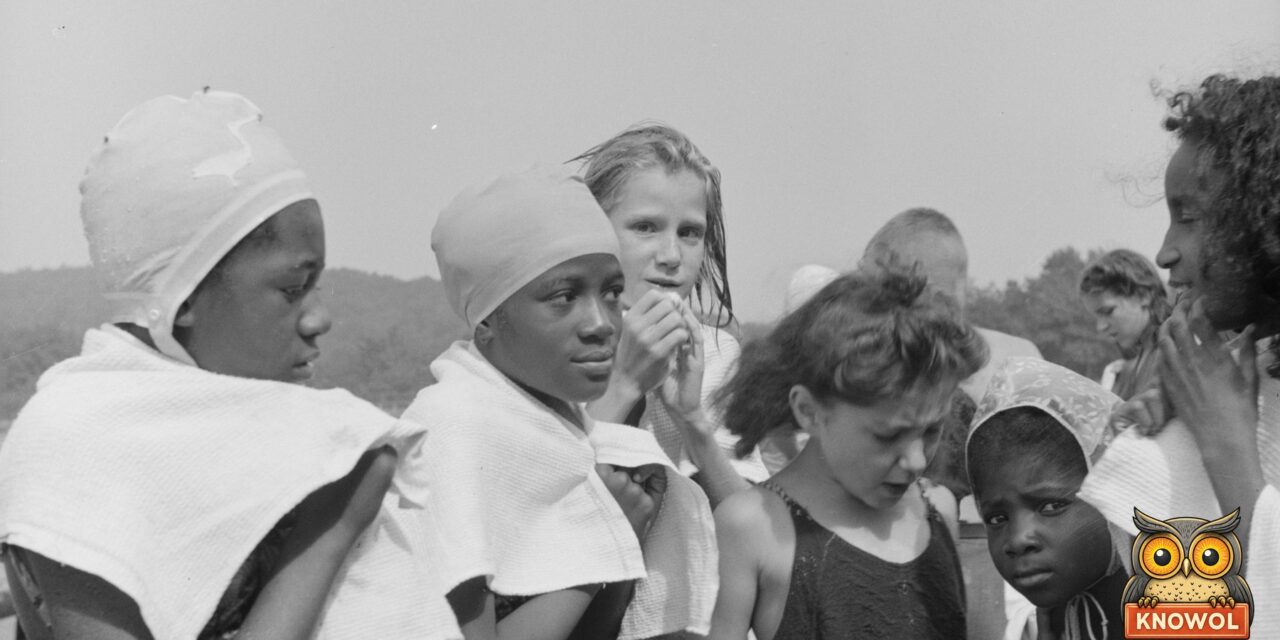
The swim is over. Seven or eight girls crowd together on a wooden dock with towels over their shoulders, still dripping. Two wear rubber bathing caps. One holds her towel shut under her chin with both fists, the way you do when the wind hits wet skin. Some of the girls are Black and some are white, and nobody in the picture seems to think that is worth a second look. It’s August 1943, at a summer camp filed under Haverstraw, New York, and the man with the camera is Gordon Parks.
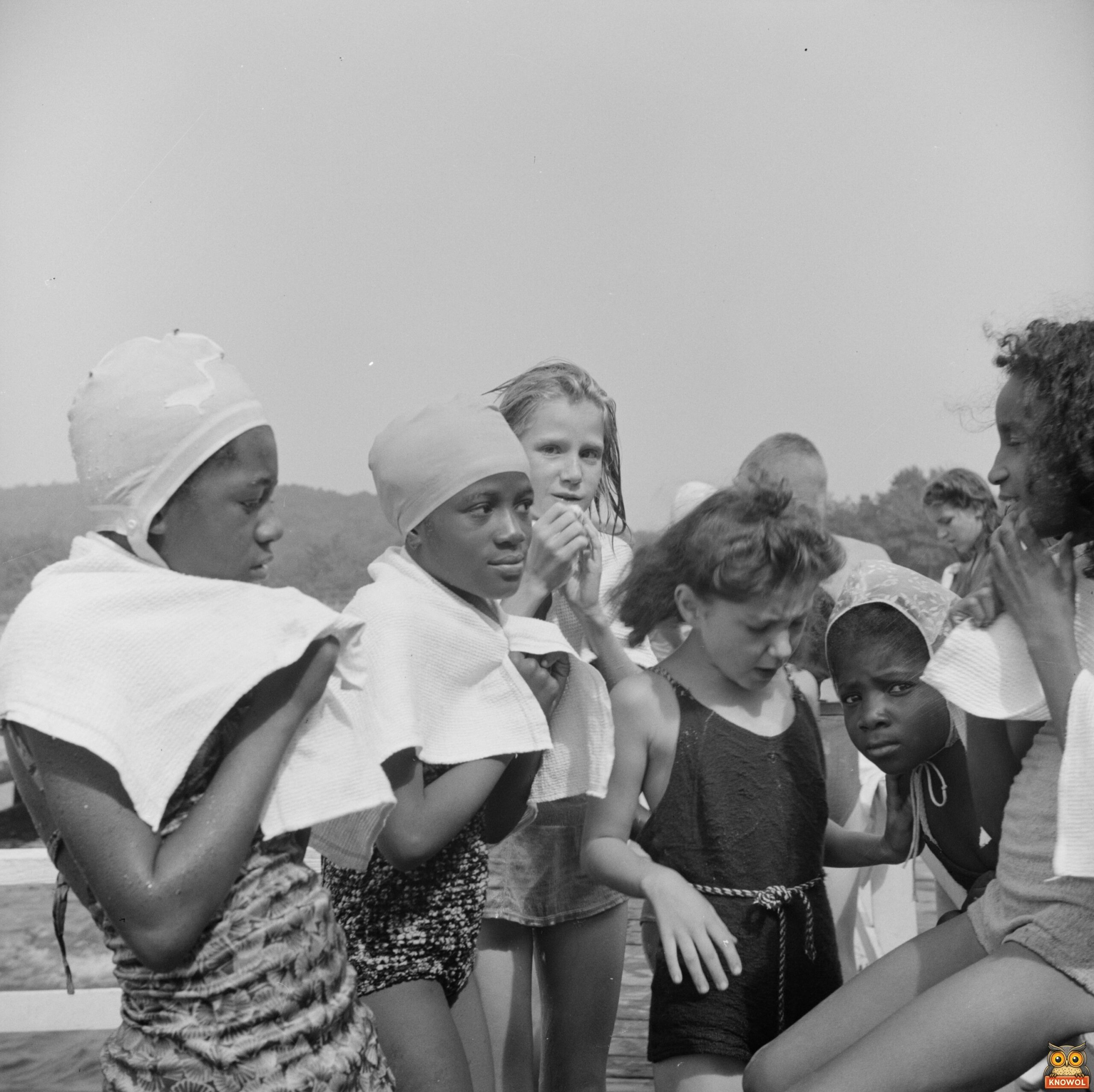
“Haverstraw, New York. Interracial activities at Camp Christmas Seals, where children are aided by the Methodist Camp Service. The end of a swimming period.” Photo by Gordon Parks, August 1943. Library of Congress, Prints and Photographs Division, FSA/OWI Collection. No known restrictions. Click the picture to see it full size.
Parks wrote the words for the picture on a caption card: “Haverstraw, New York. Interracial activities at Camp Christmas Seals, where children are aided by the Methodist Camp Service. The end of a swimming period.” Interracial means people of different races together. In 1943, in much of America, that alone made a summer camp worth a government photographer’s trip.
A Lake Camp Near Haverstraw, New York
Haverstraw is an old brick-making town on the Hudson River, a little over 30 miles north of New York City. Behind it rise the wooded hills of Harriman State Park. Parks’s own cards tell us where the camp really sat. One of them says “Sun bathing on Lake Tiorati,” and Lake Tiorati is in those hills, just over the line in Orange County. The Library of Congress files the pictures under Haverstraw, so we do too.
Lake Tiorati is a man-made lake. Workers dredged a swamp and built a concrete dam, and the water filled in behind it. The name is said to mean “blue like sky.” Starting in 1913, the park built dozens of group camps along lakes like this one, so that children from crowded city blocks could get hot meals, fresh air and a place to swim.
Look past the girls in Parks’s picture and you can see it: a white wooden railing, flat water, and a long green hill on the far side. Another card from the same afternoon says “Recreation includes swimming, fishing, and boating.”
Why a Camp Near Haverstraw Was Named for Christmas Seals
The camp’s name is a clue. Christmas Seals were little stickers people bought and stuck on their holiday letters. The first ones in the United States went on sale in Wilmington, Delaware, in December 1907, for a penny each. Emily Bissell designed them, and the money went to fight tuberculosis, a lung disease that killed many thousands of Americans every year.
Seal money paid for more than doctors. It also paid for summer camps. At Lambert Castle near Paterson, New Jersey, a “Camp Christmas Seal” opened in 1927 for city kids who were underweight and at risk of catching the disease. It took its name from the seals that helped pay its bills. Parks’s cards never say who paid for the camp near Haverstraw. Its name says Christmas Seals probably helped.
The “Mother” of the Camp Near Haverstraw, New York
The camp near Haverstraw, New York, had a director, and Parks put her name on two cards. One says “Mrs. Addie C. Cox, director, giving instruction to the campers before the swim.” In that picture she sits on the dock railing in slacks and leather shoes, with girls in bathing suits all around her.
The other card says “Mrs. Addie C. Cox, director, the ‘mother’ of all the campers.” Parks didn’t call anyone else at this camp that. In the second picture she stands with the girls at the railing, a gray-haired woman in a pressed shirt and slacks.
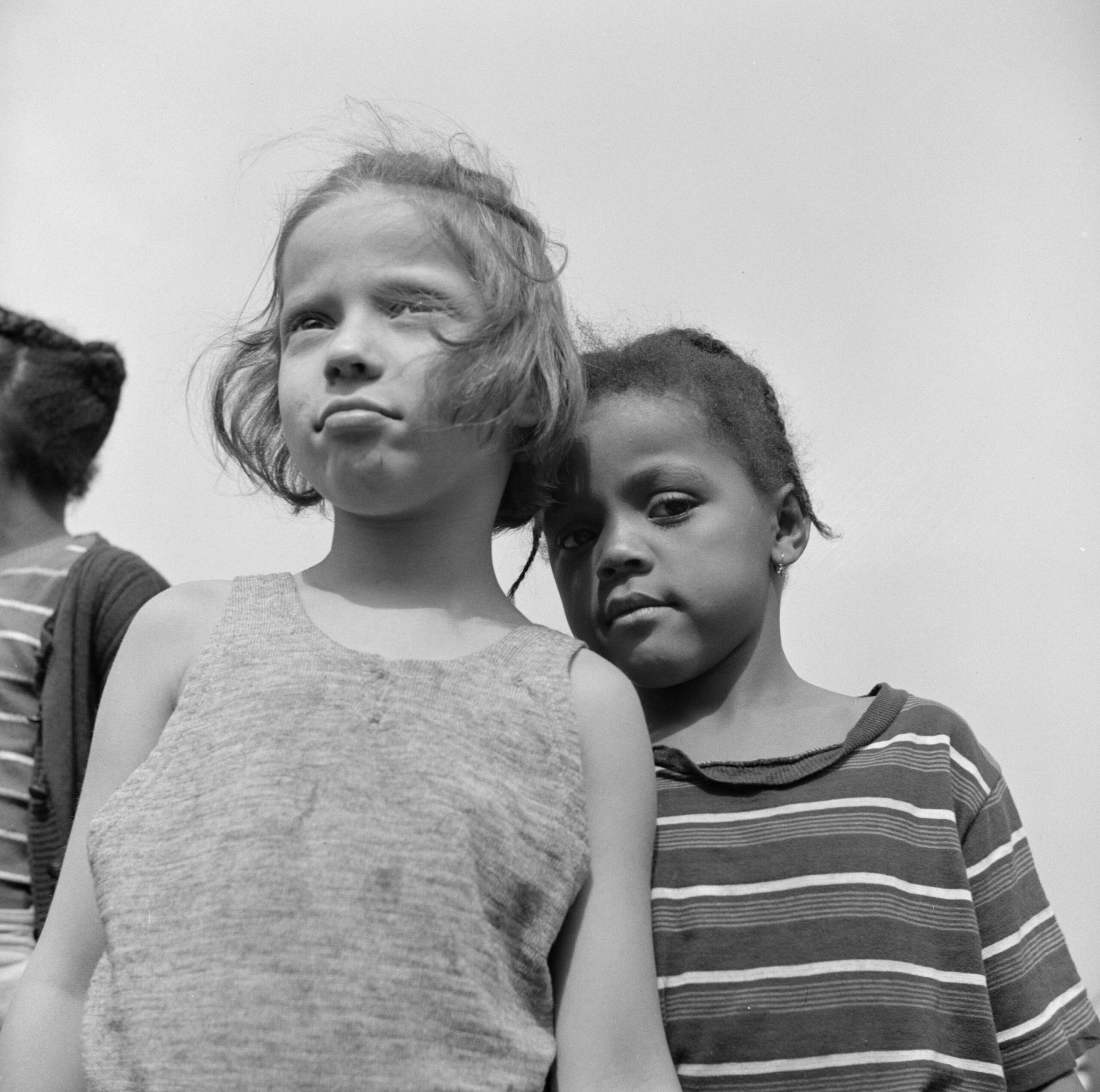
“Haverstraw, New York. Interracial activities at Camp Christmas Seals, where children are aided by the Methodist Camp Service. Camp buddies.” Photo by Gordon Parks, August 1943. Library of Congress, FSA/OWI Collection. No known restrictions. Click the picture to see it full size.
Parks made three pictures of the same two girls and gave every one the same title: “Camp buddies.” In this one, a white girl with windblown hair puffs out her cheeks at the sky. The Black girl beside her, in a striped shirt, leans her head against her friend’s shoulder and looks straight into the camera.
A Joke on the Dock Near Haverstraw, New York
Parks had a sense of humor, and so did the girls at the camp near Haverstraw, New York. In one picture, a girl in a white bathing cap reaches over and clamps her hand across her friend’s mouth. The girl doing the hushing is smiling. Parks titled it “Rumors should not be spread.”
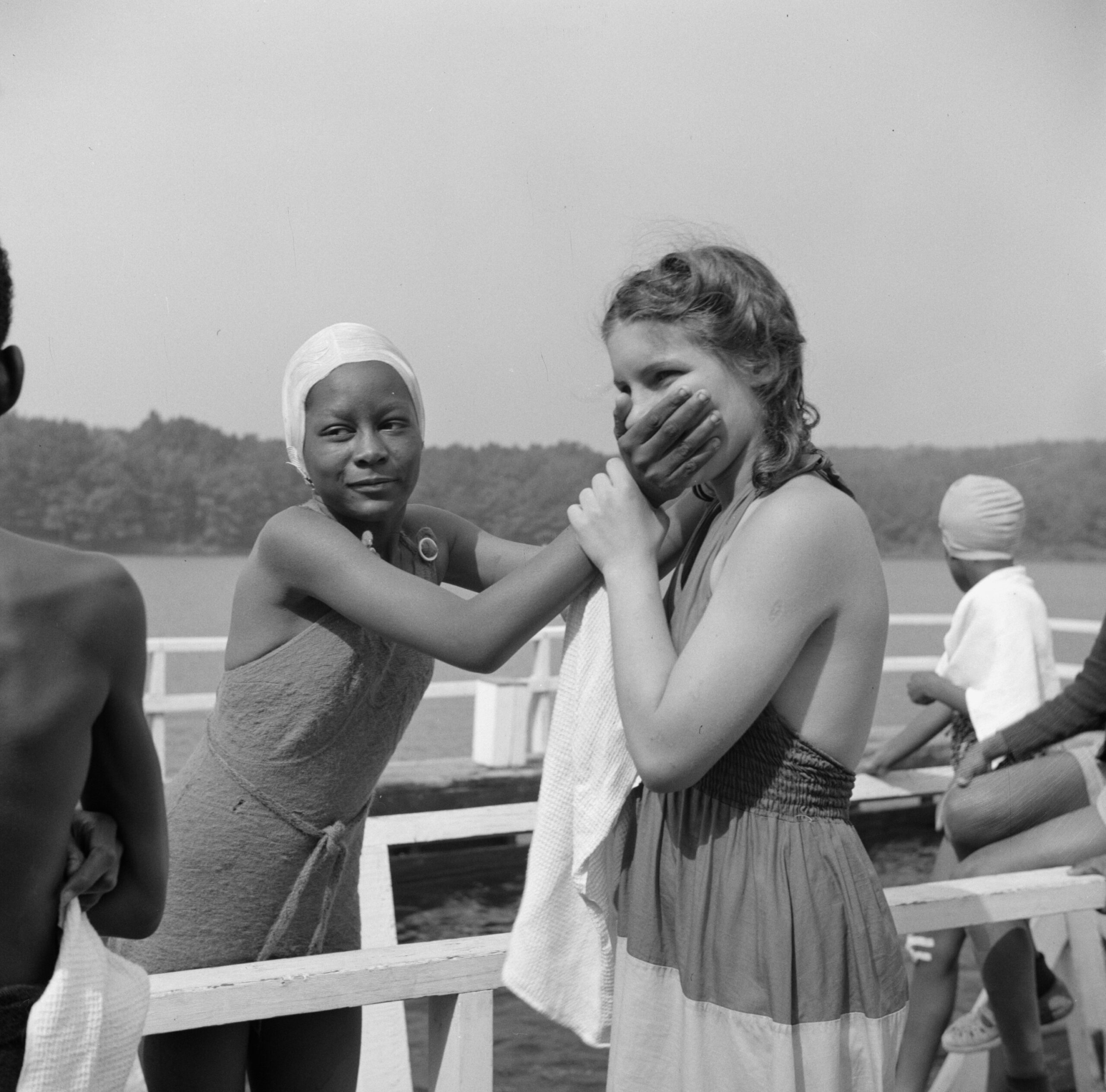
“Haverstraw, New York. Interracial activities at Camp Christmas Seals, where children are aided by the Methodist Camp Service. Rumors should not be spread.” Photo by Gordon Parks, August 1943. Library of Congress, FSA/OWI Collection. No known restrictions. Click the picture to see it full size.
That was a wartime joke. In 1943, posters all over America warned people not to pass along gossip, because loose talk might help the enemy. Parks worked for that same wartime government, and his title turns a serious poster line into a joke about two kids on a dock.
The Summer of 1943, and Why Parks Came to Haverstraw
The pictures from the camp near Haverstraw, New York, were made in a hard summer. The country was at war, and Black and white Americans were often kept apart: in schools, at lunch counters, in the Army, and at the swimming pool. In June 1943, fighting between Black and white residents tore through Detroit for three days. On August 1, a riot broke out in Harlem, in New York City.
That summer, Parks traveled through the hills north of the city to a whole string of camps run with help from the Methodist Camp Service. At Camp Fern Rock near Bear Mountain he photographed kids at archery and on hikes. At Camp Nathan Hale in Southfields, they raised the flag, and his card calls it “Raising Old Glory.” At Camp Gaylord White in Arden, his card says the kids were singing the “Ballad for Americans,” a popular song about how America is made of every kind of people.
The Gordon Parks Foundation, which cares for his work today, says camps that mixed races like this were remarkable for their time. The government probably wanted the world to see them. The record for this picture says the negatives came to the Library of Congress in 1944 from the Office of War Information’s Overseas Picture Division. In the middle of a war against Nazi Germany, these were the pictures that showed what America could look like at its best.
Who Was Behind the Camera at Haverstraw
Gordon Parks was 30 years old when he came to the camp near Haverstraw, New York. He was born in 1912 in Fort Scott, Kansas, the youngest of 15 children. As a young man he saw photos of migrant farm workers in a magazine, and he bought his first camera at a pawnshop in Seattle for $12.50.
In 1942 he won a fellowship that brought him to Washington, D.C., to work for Roy Stryker at the Farm Security Administration, the government office that sent photographers out to show how Americans lived and worked. When that office’s photographers went to work for the Office of War Information, Parks went with them.
Later, Parks became the first Black staff photographer at Life magazine, in 1948. In 1969 he wrote and directed The Learning Tree, a movie based on his own novel about growing up in Kansas, and in 1971 he directed Shaft. He died in 2006, at 93.
The End of a Swim Near Haverstraw, New York
Gordon Parks didn’t line the kids at the camp near Haverstraw, New York, up in a neat row for this picture. He caught them right after the swim, wet and wrapped in towels and busy with each other. That’s the moment he kept. The Library of Congress still has his negatives, and eight decades later the girls are still standing on that dock in the sun, dripping, all of them together.
Sources
- Gordon Parks, “Haverstraw, New York. Interracial activities at Camp Christmas Seals, where children are aided by the Methodist Camp Service. The end of a swimming period,” August 1943. Caption card title, record and full-size scan: Library of Congress, item 2017861187 (LC-USW3-036718-E). FSA/OWI photographs: no known restrictions.
- Same camp, Gordon Parks, August 1943 (all titled “Haverstraw, New York. Interracial activities at Camp Christmas Seals, where children are aided by the Methodist Camp Service”): “Recreation includes swimming, fishing, and boating,” item 2017861189; “Mrs. Addie C. Cox, director, giving instruction to the campers before the swim,” item 2017861190; “Mrs. Addie C. Cox, director, the ‘mother’ of all the campers,” item 2017861191; “Camp buddies,” item 2017861193, item 2017861194, item 2017861195; “Rumors should not be spread,” item 2017861197; “Sun bathing on Lake Tiorati,” item 2017861198.
- Other camps on the same trip, Gordon Parks, 1943: Camp Gaylord White, Arden, “Campers singing the ‘Ballad for Americans,'” item 2017861185; Camp Fern Rock, Bear Mountain, item 2017861199; Camp Nathan Hale, Southfields, “Raising Old Glory,” item 2017861209.
- Gordon Parks Foundation, Interracial Children’s Camps, 1943 and biography.
- Passaic County Historical Society, Camping in a Castle (Camp Christmas Seal at Lambert Castle, 1927).
- New York State Parks, Harriman State Park (group camps since 1913).
- Wikipedia (read for leads, facts in our own words): Gordon Parks, Christmas seal, Lake Tiorati, Haverstraw, 1943 Detroit race riot, Harlem riot of 1943, Ballad for Americans.
- About the FSA/OWI photographs and their rights: Library of Congress, FSA/OWI Black-and-White Negatives and rights and restrictions.