Snow is piled on the barn roofs and on top of the round silo. Cars are parked nose to tail in the barnyard, and one has skis strapped to its roof. A man kneels in the snow to get his skis ready, and another man stands watching by the cars. This is a dairy farm near Woodstock, Vermont, in February 1940. The skiers came because of the farm’s hill. Six years before, America’s first ski tow had started running on it.
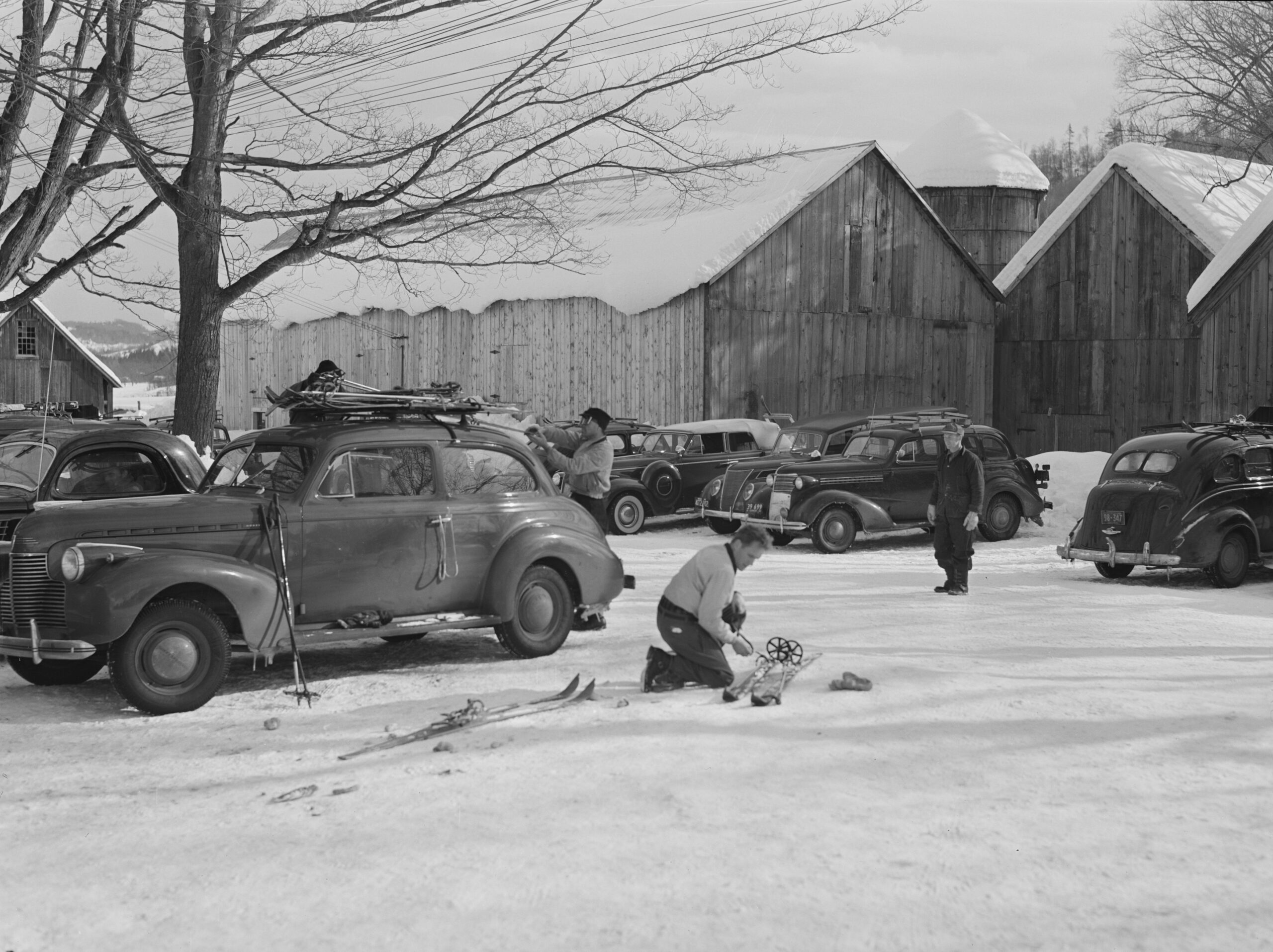
“Every available space for parking is used by skiers on weekends at Clinton Gilbert’s farm.” Woodstock, Vermont. Photo by Marion Post Wolcott, February 1940. Library of Congress, Prints and Photographs Division, FSA/OWI Collection. No known restrictions. Click the picture to see it full size.
The Farmer in Woodstock, Vermont, and His Busy Weekends
The farm belonged to Clinton Gilbert. The photographer, Marion Post Wolcott, wrote down what she learned about him on her caption card. It begins: “Every available space for parking is used by skiers on weekends at Clinton Gilbert’s farm.”
Her card says Gilbert bought the place in 1929. He had “about 150 acres, mainly a dairy farm with twenty three cows.” He also made “about one hundred gallons of maple syrup every year.” So far, that sounds like a lot of Vermont farms. Then comes the surprise: “First skiing town in U.S. built on this farm in 1934 by White Cupboard Inn, but Gilbert now owns and runs tow.”
“Town” is a typing slip. She meant “tow.” Another card from the same visit spells it right: “First Ski tow in United States built on this farm in 1934.”
How a Rope and a Model T Pulled Skiers Up a Woodstock Hill
Before 1934, skiing in Woodstock meant a lot of climbing. If you wanted to ski down a hill, you first had to walk up it on your skis.
The idea for a fix came from the White Cupboard Inn, a small inn in Woodstock run by Robert and Elizabeth Royce. Ski history writers say some of their guests from New York grumbled about all that climbing. The Royces had heard of a rope tow at Shawbridge, Quebec, in Canada, that had started the winter before, and they got a drawing of it.
In January 1934, a crew built one on a hill on Clinton Gilbert’s farm. The Vermont Historical Society says it was a long loop of rope, about 1,800 feet of it, running up a slope about 900 feet long. At the top, the rope went around a pulley tied to a tree. At the bottom, an old Model T Ford engine made it go. The whole thing cost about $500.
Here’s how you rode it. You stood at the bottom on your skis and grabbed the moving rope with your mittens. Then you held on tight and let it pull you up the snow, four or five skiers at a time. The ride to the top took about a minute. Sources don’t agree on the exact opening day (some say January 18, some say January 28), but they agree it was January 1934.
From One Tow to Nine Near Woodstock, Vermont
The tow was a hit. Ski history writers say a Boston ski club, about 70 skiers, came the very next weekend. A ski coach named Wallace “Bunny” Bertram, who had helped with the first tow, took it over for the next winter. He later started his own ski hill nearby, which became the Suicide Six ski area.
Other towns copied the idea fast. By 1937, by one count, there were more than 100 rope tows in the United States. Around Woodstock, Wolcott found so many that she wrote a whole caption about it: “Woodstock, Vermont has nine ski tows and is generally very crowded with skiers on weekends.”
By the time Wolcott visited the Gilbert farm, the tow was in the farmer’s own hands. Her card says it “has increased his income about 25 percent.” That means for every dollar the farm made before, it now made about a dollar and a quarter. That money “enabled him to build small ski lodge and do many repairs to property.”
The Ski Hut on Clinton Gilbert’s Hill in Woodstock, Vermont
Wolcott photographed Clinton Gilbert’s little lodge too, with the hill rising behind it. Her card calls it the “Ski hut and tow built by Clinton Gilbert, farmer in Woodstock, Vermont.” Look up the slope in the big scan and you can see tiny skiers in a straight line, riding the tow up a track in the snow, with poles along the way to hold up the rope.
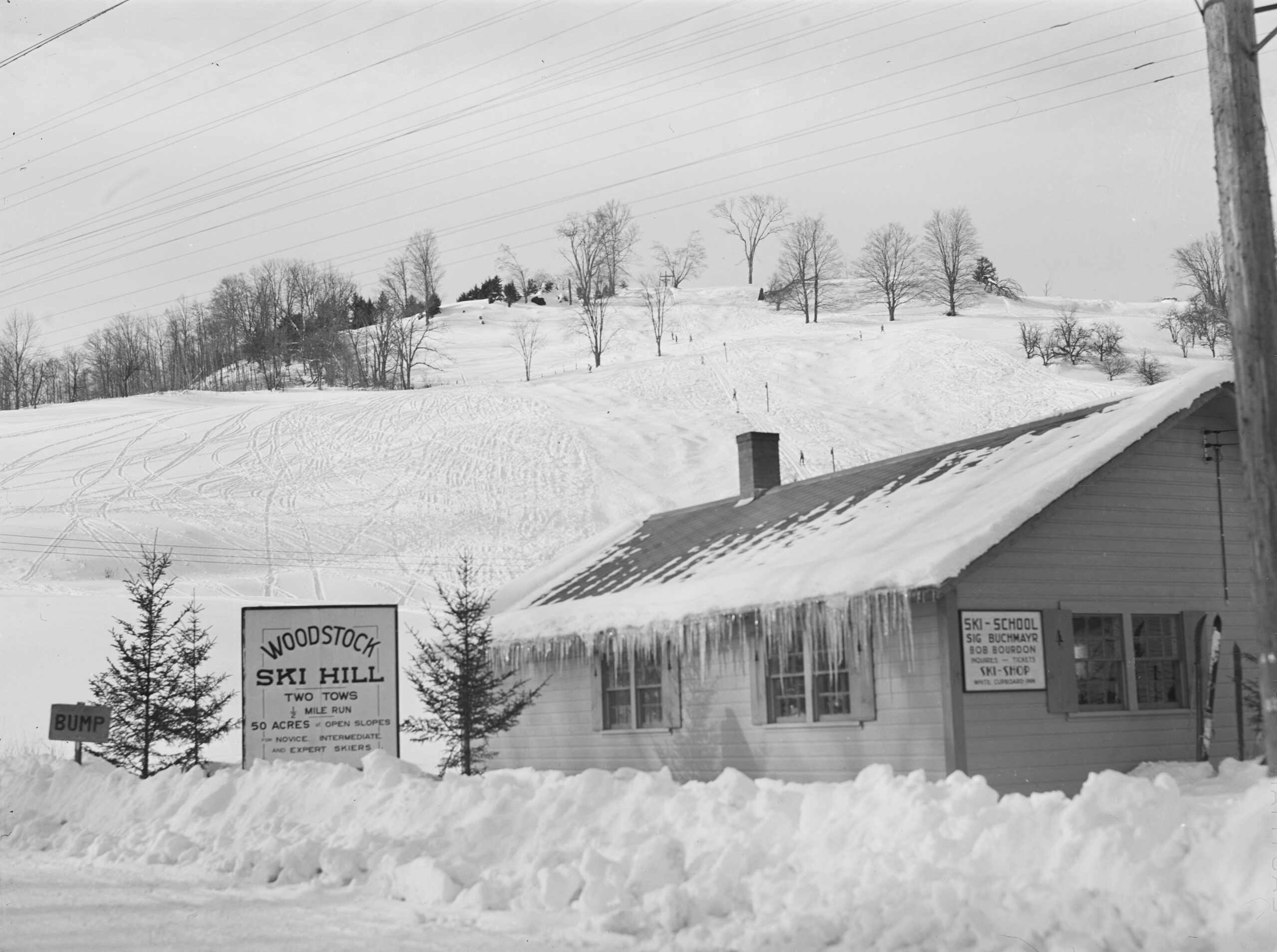
“Ski hut and tow built by Clinton Gilbert, farmer in Woodstock, Vermont.” Photo by Marion Post Wolcott, March 1940. Library of Congress, Prints and Photographs Division, FSA/OWI Collection. No known restrictions. Click the picture to see it full size.
A big sign out front of the Woodstock hut reads “WOODSTOCK SKI HILL,” with “TWO TOWS,” a “1/2 MILE RUN” and “50 ACRES of OPEN SLOPES FOR NOVICE, INTERMEDIATE AND EXPERT SKIERS.” A novice is a beginner. A smaller sign on the hut names a ski school with two teachers, Sig Buchmayr and Bob Bourdon. Ski history writers say a Woodstock ski teacher named Robert Bourdon was the very first person pulled up the hill in 1934. Six years later, a Bob Bourdon was teaching skiing at the bottom of it, very likely the same man.
Another card says, “Weekend skiers, often from New York, can get warm and dry and refreshments in ski hut built by Clinton Gilbert.” City people came all the way from New York to ride a rope up a dairy farm’s hill, then came in to thaw their fingers and get something warm.
Cows on Weekdays, Skiers on Weekends
Skiers came to the Gilbert farm in Woodstock on weekends, but its 23 cows needed care every day. Wolcott’s other pictures from the Gilbert farm that winter show the farm work that never stopped. The winter of 1940 was a hard one. One card says Gilbert and his helper were “hauling water in milk cans on sled, as their sources of water supply were frozen for two months during very severe winter.”
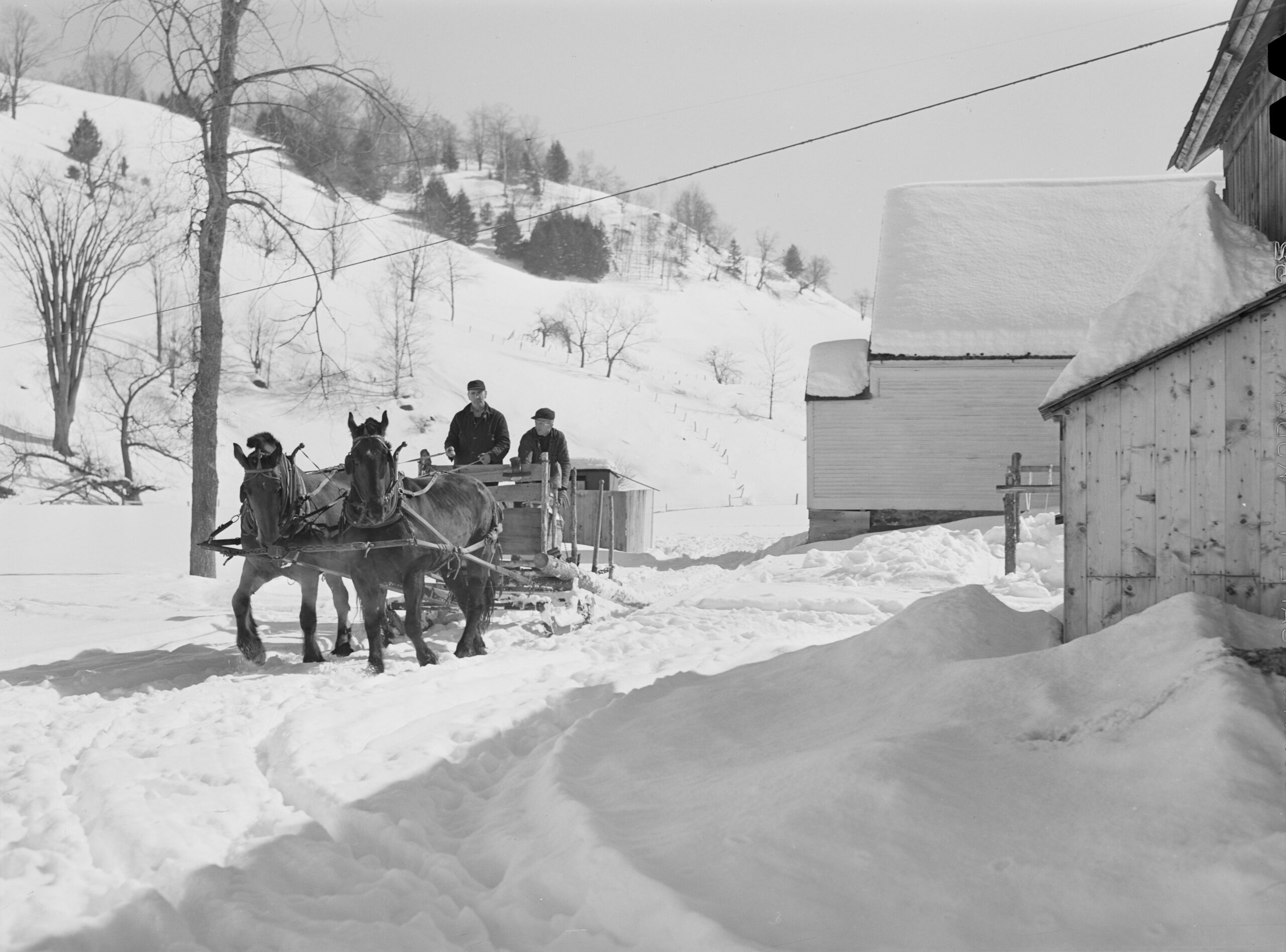
“Clinton Gilbert, farmer, and his helper hauling water in milk cans on sled, as their sources of water supply were frozen for two months during very severe winter. Woodstock, Vermont.” Photo by Marion Post Wolcott, March 1940. Library of Congress, Prints and Photographs Division, FSA/OWI Collection. No known restrictions. Click the picture to see it full size.
Other cards show the farm crew bringing in wood to start the morning fires, an ox team pulling a sled, and the cows walking down to the brook for a drink because their other water was frozen. Put those pictures next to the barnyard full of cars, and you can see what the ski tow meant. The same hard winter that froze the water also brought paying visitors up the road.
Why the Government Photographed a Ski Tow in Vermont
Marion Post Wolcott worked for the Farm Security Administration, a government office that helped struggling farm families during the Great Depression. It sent photographers across the country to show how Americans lived and worked. Wolcott spent part of the winter and spring of 1940 in Vermont. Near Woodstock she also photographed the Shurtleff farm making maple syrup in the deep snow, a story we told in How Deep Was the Snow in Bridgewater, Vermont?
The Gilbert pictures show something hopeful from those hard years. A small dairy farm found a new way to earn money, and it came from the farm’s own snowy hill.
Gilbert’s Hill in Woodstock, Vermont, Today
The farm is still there, about two miles northwest of Woodstock village on Barnard Road (Vermont Route 12). People call it Gilbert’s Hill. In 2019 it was added to the National Register of Historic Places, the country’s official list of places worth saving. A state historical marker stands by the road.
There’s no Model T at the bottom of the hill anymore. But every chairlift and rope tow at a ski area today does the same job that old engine did in 1934: it pulls skiers up, so they can spend their day coming down.
Sources
- Marion Post Wolcott, “Every available space for parking is used by skiers on weekends at Clinton Gilbert’s farm…,” February 1940. Caption card title, record and full-size scan: Library of Congress, item 2017802329 (LC-USF34-053068-D). FSA/OWI photographs: no known restrictions.
- Other Marion Post Wolcott caption cards from the same visit, quoted word for word from the Library of Congress records: the same scene with “First Ski tow in United States,” item 2017802378; ski hut and tow, item 2017802402; weekend skiers in the ski hut, item 2017802396; hauling water in milk cans, item 2017802509; nine ski tows in Woodstock, item 2017755780; wood for the morning fires, item 2017802417; oxen hauling a sled, item 2017802507; cows driven back from the brook, item 2017802508.
- The 1934 tow (rope length, slope, Model T engine, cost, riders): Vermont Historical Society, The Early Days of Skiing, 1934; New England Lost Ski Areas Project, White Cupboard Ski Way (the Royces, their guests, the Shawbridge drawing, the Boston ski club, Bertram); New England Historical Society (the January 28 date).
- Gilbert’s Hill today and the National Register listing: Wikipedia, Gilbert’s Hill. Shawbridge and the count of rope tows by 1937: Wikipedia, Surface lift. Bertram and Suicide Six: Wikipedia, Saskadena Six.
- About the FSA/OWI photographs and their rights: Library of Congress, FSA/OWI Black-and-White Negatives and rights and restrictions.