
A town of five villages west of Concord whose minutemen led the march on the North Bridge in 1775, and whose mill brooks once turned out barrels, pencils and woolen cloth at South Acton's Mill Corner.
Then and now
The same town 140 years apart. Click either map to look closer.
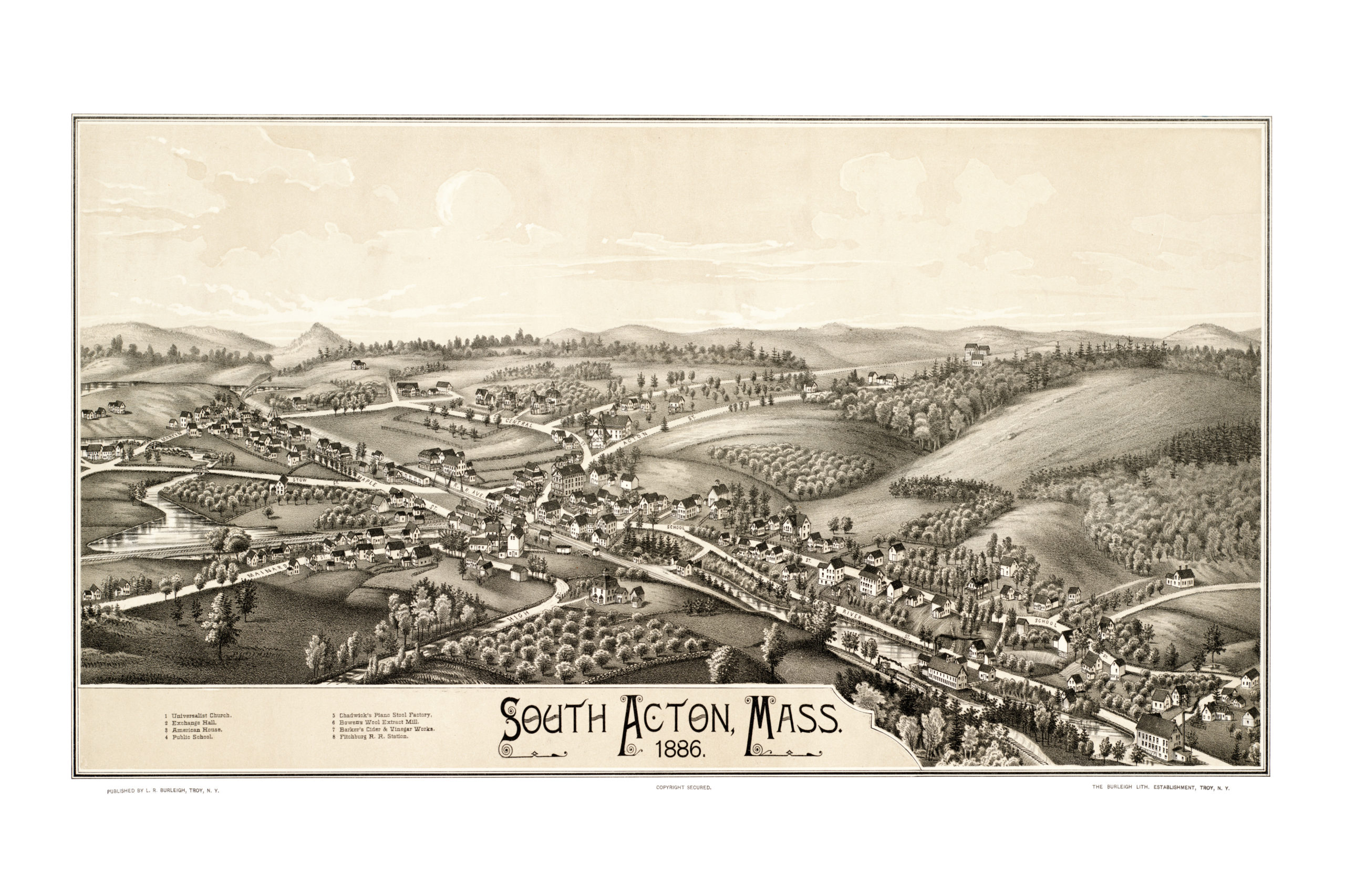
South Acton in 1886
By Lucien R. Burleigh
The mill village of South Acton, the most industrial part of town, drawn as if from the sky, with Chadwick's Piano Stool Factory, Exchange Hall, the American House, Bowen's Wool Extract Mill, Barker's Cider and Vinegar Works and the Fitchburg Railroad station.5
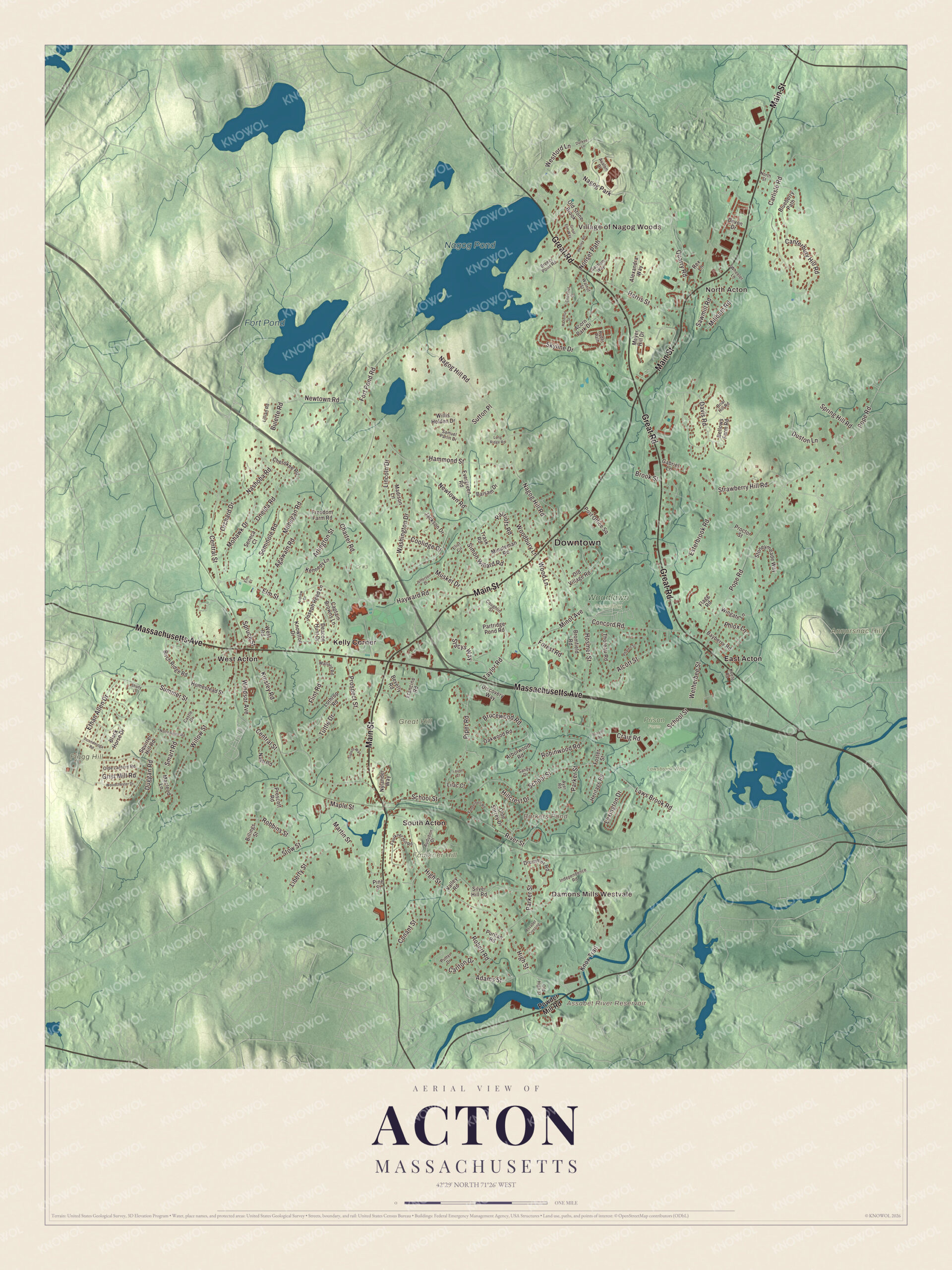
Acton today
By KNOWOL
All five villages on shaded terrain, with Main Street, Massachusetts Avenue and Great Road, Nagog Pond, Fort Pond, Barkers Pond and the Assabet River Reservoir, and Annursnac, Faulkner, Flagg and Canterbury hills.6
The story of Acton
God's own granite
In November 1850 Acton's town meeting voted to raise a monument over Capt. Isaac Davis, Abner Hosmer and James Hayward and move their remains to the Common. The town's minister, James T. Woodbury, carried the case to the State House, and to make his point he brought out the shoe buckles Davis wore and a powder horn carried that day. The Legislature gave $2,000 and the town added $500. Governor George S. Boutwell picked the spot on the Common himself. "Let it be of God's own granite," Woodbury said, and most of the stone came from the hill behind his own house, less than a mile north. The shaft rises seventy-five feet, and it was dedicated on October 29, 1851.789210
The morning of April 19
Before dawn on April 19, 1775, a horseman nobody could name rode up to Capt. Joseph Robbins's house, struck the corner with a heavy club and shouted for him to alarm Acton. Robbins's son rode a mile and a half to Capt. Isaac Davis, whose children were all sick at home. Davis had his company on the road to Concord soon after sunrise, the fifer Luther Blanchard playing, as tradition says, The White Cockade. At the North Bridge his men led the advance, and Davis was heard to say, "I haven't a man who is afraid to go." He and Abner Hosmer were killed there. Years later an Acton man answered a toast in eight words: "Concord furnished the ground, and Acton the men."11112
Mill Corner and the five villages
For most of its first century Acton Center was the only real village, and South Acton was a cluster of mills called Mill Corner. A town story says its first settlers, Nathan Robbins and his wife, moved over from East Acton, and when the family pig balked at the big brook, she carried the baby across first and then went back for the pig. The mill streams kept coopers busy, making fifteen to twenty thousand barrels a year early in the 1800s. The Fitchburg Railroad of 1844 made West Acton, and by 1874 South Acton had about 500 people, a woolen factory, pencil and soapstone works and a hotel called the American House. East Acton's post office then went by Ellsworth.1314315
Through the years
23 moments from 1639 to today.
- 1639The first homestead inside today's town line is built, on land Concord uses for grazing.1
- 1668Capt. Thomas Wheeler leases land on the condition that he keep a herd of 50 cattle for the inhabitants, penned at night against wild animals.16
- 1702Ephraim Jones starts the mills at South Acton that become the nucleus of the town.17
- 1732Jones Tavern is built as a home for Samuel Jones Jr.18
- 1735Acton is incorporated as a town on July 3, set off from Concord.1
- 1736The new town votes to frame and raise its first meetinghouse before winter.19
- 1738Rev. John Swift is ordained as Acton's first minister.20
- 1774In November a company of minutemen is raised under Isaac Davis, young men from sixteen to thirty.21
- 1775On April 19 the Acton minutemen lead the advance at the North Bridge; Isaac Davis and Abner Hosmer are killed.1
- 1776On June 14 the town resolves that an American republic is the only government it wants to see.10
- 1780Part of Acton is taken to help form the new town of Carlisle.20
- 1840Townspeople bring trees from every part of town to plant on the Common, and nearly all of them live.22
- 1844The Fitchburg Railroad reaches Acton on October 1, the making of West Acton.1
- 1848Ebenezer Davis builds the East Acton factory that later makes lead pencils.3
- 1851The 75-foot granite monument over Davis, Hosmer and Hayward is dedicated on Acton Common on October 29.10
- 1861The day after word of Fort Sumter arrives, about forty Davis Guards leave in open wagons, in a drenching rain, bound for Washington.23
- 1862On October 24 a set fire burns most of Acton Center.13
- 1863A new town house goes up at the Center after the fire.13
- 1874South Acton has about 500 people, a woolen factory, pencil and soapstone works and the American House hotel.15
- 1886Lucien R. Burleigh draws his bird's-eye view of South Acton.5
- 1890The Memorial Library is completed, William Allan Wilde's gift in memory of Acton's Civil War soldiers.1
- 1925Acton builds its first purpose-built high school on Massachusetts Avenue.24
- 2018The Acton section of the Bruce Freeman Rail Trail opens on April 3.1
Places to see
Places worth a visit in Acton today.
- Isaac Davis MonumentActon Town Common. Granite shaft over three minutemen.
- Acton Memorial LibraryMain Street, Acton Center. Civil War memorial library of 1890.Visit their website
- Faulkner HouseSouth Acton. Garrison house where the alarm sounded.Visit their website
- Jones Tavern128 Main Street, South Acton. Built 1732, Acton's first store.Visit their website
- Assabet River Rail TrailSouth Acton station. Old rail bed south toward Maynard.
- Nagog PondNorth Acton. On the Littleton line; Concord's water.
- Canterbury HillNorth Acton. Conservation land on the Bay Circuit Trail.
- Village of Nagog WoodsNorth Acton. Big enough for its own ZIP code.
On the National Register
All 9 places in Acton on the National Register of Historic Places that still stand today, oldest first, and why each one matters.4
-
Faulkner Homestead
Acton's oldest colonial building, built for Ephraim Jones, whose mills of 1702 began the settlement, and used as a garrison house in Queen Anne's War. Six generations of Faulkners lived here, and on April 19, 1775, Major Francis Faulkner fired three shots here to call out the militia.17
-
Acton Centre Historic District
The town's civic heart since the 1730s, around the common of 1731 where the minutemen mustered in 1775. It takes in the Congregational Church of 1846, the Italianate Town Hall of 1863 and the Romanesque Revival Memorial Library.25
-
Jones Tavern
Built as Samuel Jones Jr.'s home and a tavern and store by 1750, it's believed to be Acton's first store. Local residents saved it from demolition in 1964.18
-
North Acton Cemetery
Also called the Forest Cemetery, it was in use by 1737 and is one of the town's oldest burial grounds. The oldest marked grave is Mary Heald's, dated 1758, and the yard was enlarged in 1811 partly with money from Carlisle.26
-
Jonathan and Simon Hosmer House
One of Acton's best-preserved colonial houses, an unusual double house built by the bricklayer Jonathan Hosmer Jr., whose work shows in its many fireplaces. The Acton Historical Society bought it in 1974 and runs it as a museum.27
-
Isaac Davis Trail
The six-mile route Captain Isaac Davis and the Acton minutemen marched to the North Bridge on April 19, 1775, still lined with stone walls. The Isaac Davis Trailmarch follows it every Patriots' Day.28
-
John Robbins House
A late Georgian, early Federal farmhouse with stencilwork by Moses Eaton Jr. It is the best preserved of four Acton houses built after four townsmen shared a $10,000 prize in a Harvard College lottery of 1794 and 1795.29
-
Exchange Hall
James Tuttle, a dry goods merchant, built this Italianate hall with an open third floor for civic, social and religious gatherings. It later held the South Acton branch of the public library.30
-
Acton High School
Acton's first purpose-built high school, a Renaissance Revival building by John H. Bickford. It was a high school for thirty years and an elementary school for 45, and it now holds homes.24
In their words
“Concord furnished the ground, and Acton the men.”
A toast at Concord's 1850 anniversary dinner, as Governor George S. Boutwell recalled it in 190212
“Let it be of God's own granite, said Mr. Woodbury, and let it be from the Acton quarry nearest to the site.”
Rev. James T. Woodbury on the Davis monument, from James Hayward, 19119
“At the centre of the town there is a village of unsurpassed beauty. It has a broad common, bordered with neat residences and adorned with well-kept rows of wide-spreading trees”
History of Middlesex County, 188031
Nearby towns
Sources
- Acton, Massachusetts, Wikipedia
- James Hayward, born April 4, 1750, killed in the battle of Lexington April 19, 1775 (1911), on the monument's design, Internet Archive
- History of Middlesex County, Massachusetts (1890), on Acton's industries, Internet Archive
- National Register of Historic Places listings in Middlesex County, Massachusetts, Wikipedia
- Exploring South Acton, Massachusetts in 1886, restored by KNOWOL
- Map of Acton, Massachusetts in 2026, KNOWOL (USGS elevation, Census Bureau roads)
- James Hayward, born April 4, 1750, killed in the battle of Lexington April 19, 1775 (1911), on the 1850 vote, Internet Archive
- Reminiscences of sixty years in public affairs (1902), on the Acton monument, Internet Archive
- James Hayward, born April 4, 1750, killed in the battle of Lexington April 19, 1775 (1911), on the monument's granite, Internet Archive
- Beneath old roof trees (1896), on the resolution of June 14, 1776, Internet Archive
- History of Middlesex County, Massachusetts (1880), on the alarm of April 19, 1775, Internet Archive
- Reminiscences of sixty years in public affairs (1902), on the Concord toast, Internet Archive
- Middlesex County and its people; a history (1927), Internet Archive
- History of Middlesex County, Massachusetts (1890), on the first settlers of South Acton, Internet Archive
- Gazetteer of the state of Massachusetts (1874), on Acton's villages, Internet Archive
- Gazetteer of the state of Massachusetts (1874), on Thomas Wheeler's lease, Internet Archive
- Faulkner House (Acton, Massachusetts), Wikipedia
- Jones Tavern, Wikipedia
- History of Middlesex County, Massachusetts (1890), on the first meetinghouse, Internet Archive
- A gazetteer of the state of Massachusetts (1890), Internet Archive
- Reminiscences of sixty years in public affairs (1902), on the minute company of 1774, Internet Archive
- Historic homes and places and genealogical and personal memoirs relating to the families of Middlesex County, Massachusetts (1908), Internet Archive
- The Massachusetts register (1862), on the Davis Guards, Internet Archive
- Acton High School (Massachusetts), Wikipedia
- Acton Centre Historic District, Wikipedia
- North Acton Cemetery, Wikipedia
- Jonathan and Simon Hosmer House, Wikipedia
- Isaac Davis Trail, Wikipedia
- John Robbins House (Acton, Massachusetts), Wikipedia
- Exchange Hall, Wikipedia
- History of Middlesex County, Massachusetts (1880), on Acton's villages, Internet Archive