
A railroad junction cut from the south end of Groton in 1871, where a dozen farms became a busy depot town, the brick blocks of Main Street rose after the fire of 1872, and Camp Devens trained New England soldiers for the First World War.
Then and now
The same town 140 years apart. Click either map to look closer.
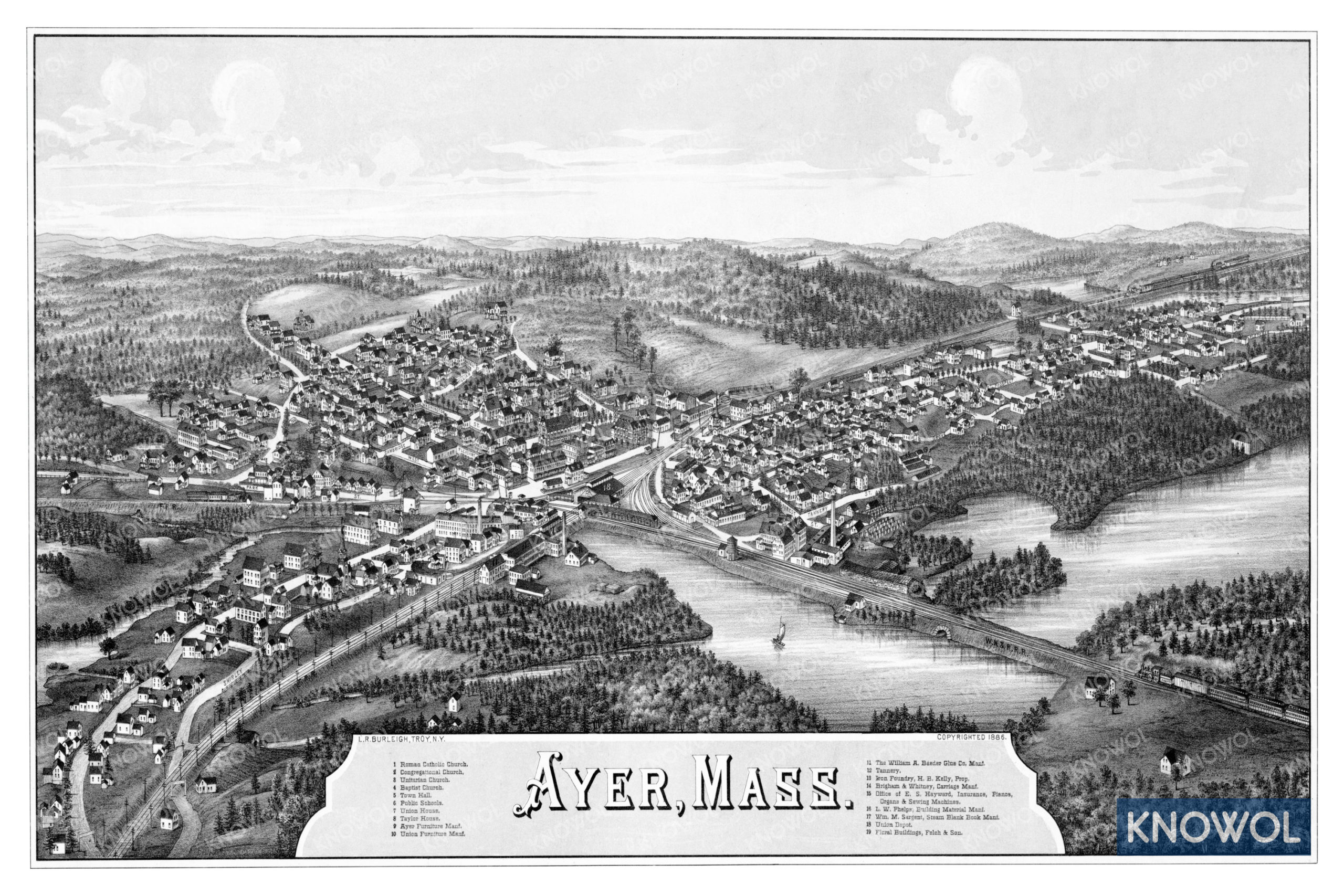
The bird's-eye view
By Lucien Burleigh
Ayer drawn as if from the sky in 1886, with street names and old landmarks including Union Depot, Ayer Furniture Manufacturers, the William A. Baedar Glue Company, Kelly's Iron Foundry, Brigham and Whitney Carriage Manufactury and Phelps Building Materials.5
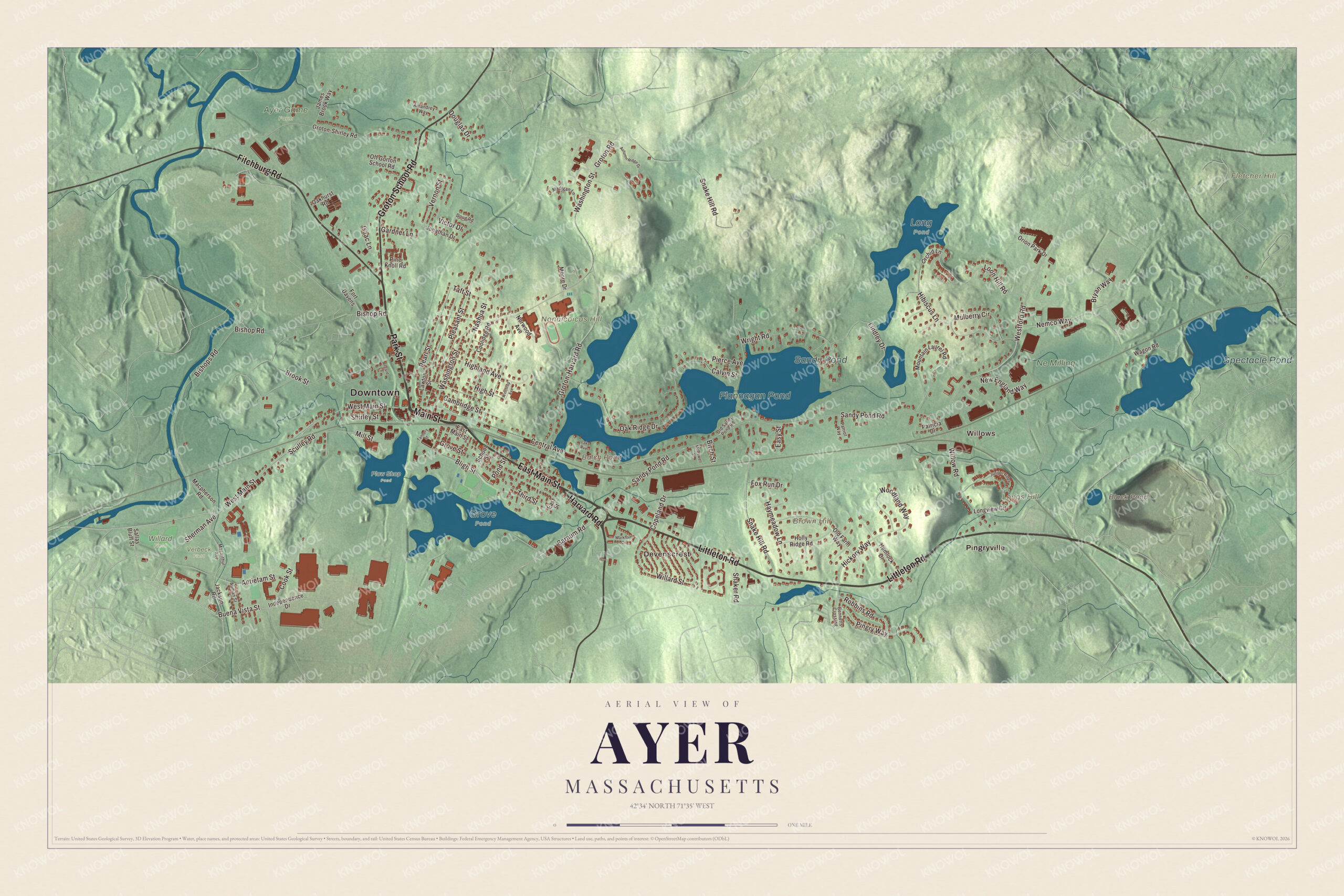
Ayer today
By KNOWOL
Shaded terrain with Main Street, East Main Street, Park Street, Harvard Road, Littleton Road and Fitchburg Road, the Willows, Spectacle Pond, Balch Pond, Black Pond, Flannagan Pond, Brown Hill, Fletcher Hill and Longs Hill.6
The story of Ayer
How Groton Junction became Ayer
In 1843 the south end of Groton was about a dozen farms. Then the Fitchburg Railroad came through, by 1848 several lines met at a Union Station, and the village of South Groton became Groton Junction, a railroad town. Talk of a separate town started in a debating society in 1855. In 1871, 270 citizens petitioned the legislature. A letter in the Public Spirit suggested the name Ayer: easy to spell and speak, like no other town in the state, and a reminder of the poems of Robert Burns. It also honored Dr. James C. Ayer of Lowell. Shirley agreed to give up its land east of the Nashua for $500 toward its town debt, and the two towns split the cost of a new bridge. Ayer was incorporated on February 14, 1871.27891
The fire that took the library
Ayer's first library was the Literary Club's collection, handed to the new town in 1871 and kept in Levi Sherwin's store. In April 1872 a great fire swept the village center. It destroyed the whole library except about seventy-five books that happened to be out on loan, and it took the White Church, the Unitarian chapel on the town house lot. Ayer rebuilt in brick and stone, and those blocks along Main Street, built mostly between 1872 and 1898, are now a National Register district. The library started over and grew. In the spring of 1890 Frederick Fanning Ayer, son of the town's namesake, remembered that Ayer wasn't very well supplied with books and offered up to $5,000 for more. He later gave the town the Ayer Memorial Library.101112313
The earthen pot by the brook
Long before the junction, this ground was Nonacoicus, home to a Nashaway settlement on the brook that still carries the name. Judge Samuel Sewall was told in 1698 that the word meant an earthen pot, and an Ayer lawyer, George J. Burns, later pointed to a run of small hills and hollows near the brook's mouth as the likely reason. About 1671 Major Willard built a house at Nonacoicus. It burned in King Philip's War and is said to have been the first house destroyed when Groton was attacked. Willard's farm left a mark you can still find: the angular line of Ayer's southern border, along its western half, follows the old farm. For generations neighbors shortened the brook's name to Coicus.11415
Through the years
22 moments from 1667 to today.
- 1667The first settlement in today's Ayer grows up around a mill on Nonacoicus Brook, then part of Groton.1
- 1671About this year Major Willard builds a house at Nonacoicus, on land now in Ayer.15
- 1676Willard's house burns in King Philip's War, said to be the first house destroyed when Groton was attacked.15
- 1698Judge Samuel Sewall is told that Nonacoicus means an earthen pot.1
- 1758About this year a grammar school opens in the Ayer section of Groton. It burns two years later and is rebuilt.16
- 1843South Groton is still only about a dozen farms.2
- 1844The Fitchburg Railroad arrives.1
- 1848Several railroads meet at a Union Station, and Groton Junction is born.2
- 1855A local debating society votes in favor of a separate town.7
- 1862The state sets up Camp Stevens, a Civil War mustering camp, in what is then Groton.17
- 1871On January 20 a letter in the Public Spirit suggests the name Ayer.8
- 1871Ayer is incorporated on February 14 and holds its first town meeting on March 6.7
- 1871The Literary Club's books become the town library, kept in Levi Sherwin's store.10
- 1872The great fire of April destroys the library, all but about seventy-five books, and the White Church.10
- 1875The new Unitarian church is dedicated on September 1.11
- 1886Lucien Burleigh publishes his bird's-eye view of Ayer.5
- 1890Frederick Fanning Ayer gives up to $5,000 for library books.3
- 1893The Pleasant Street School opens.18
- 1917Camp Devens is set up to train New England soldiers for the First World War.1
- 1935A wooden ski jump goes up at Pingry Hill near the Willows. It's used for one winter.1
- 1996Fort Devens closes and reopens the next day as a smaller reserve training area.1
- 2026KNOWOL maps the town for its 2026 Massachusetts series.6
Places to see
Places worth a visit in Ayer today.
- Ayer stationJust south of Main Street. Fitchburg Line trains to Boston.
- Ayer Main Street Historic DistrictMain Street. Brick blocks built after the 1872 fire.
- Town HallEast end of Main Street. Victorian Gothic, paid for by Dr. Ayer.
- Pleasant Street SchoolPleasant Street. Schoolhouse of 1893.
- Nashua River Rail TrailStarts near the station. Old rail line north to Nashua.Visit their website
- The WillowsNear Pingry Hill. Where the 1935 ski jump stood.
- Nonacoicus BrookWestern Ayer. Site of the first mill.
- DevensSouth of downtown. The old Camp Devens grounds.
On the National Register
All 5 places in Ayer on the National Register of Historic Places that still stand today, oldest first, and why each one matters.4
-
Ayer Main Street Historic District
Four blocks of Ayer's downtown, built mostly between 1872 and 1898 on the north side of Main Street facing the rail yards, after a fire in 1872 destroyed many earlier buildings. It includes the old railroad depot and the high Victorian Gothic Town Hall; its oldest building, of 1868, was moved here from south of the tracks in 1878.12
-
Sandy Pond School
Built in 1868 as Groton's district 11 school, it's the only district schoolhouse left in Ayer. It closed in 1906 when streetcars reached Sandy Pond Road, and a local nonprofit has kept it ever since as a meeting place and museum.19
-
Pleasant Street School
A Colonial Revival school designed by Boston architect Charles E. Parks and built in 1893, one of the oldest school buildings in town. It was doubled in size in 1906 and taught children until 1984.18
-
Community Memorial Hospital
A brick and stone Colonial Revival building of 1929 by the Fitchburg firm of Haynes and Mason, the first hospital building dedicated to serving Ayer. It served as a hospital until 1971 and now houses assisted living.20
-
Fort Devens Historic District
The heart of the old Fort Devens: Georgian Revival barracks, offices and warehouses built in a U around the parade ground, now Rogers Field, when the Army replaced its First World War buildings. It also marks a Civilian Conservation Corps camp of 1933 to 1937 and Congresswoman Edith Nourse Rogers, who helped keep the base open.21
In their words
“Ayer, as easy to spell and speak ; not likely to be confounded with that of any other town in the state, associated in the mind of every one with the sweet strains of Robert Burns”
A letter in the Public Spirit, January 1871, proposing the name, in History of Middlesex County, 18808
“So that Ayer is twenty-nine per cent healthier than the state as to consumption, and seven hundred per cent healthier than the state as to typhoid fever.”
History of Middlesex County, 188022
“The development of steam railroads is what made the village of South Groton, later the town of Ayer, a 'railroad town.'”
Historic homes and places of Middlesex County, 19082
Nearby towns
Sources
- Ayer, Massachusetts, Wikipedia
- Historic homes and places … of Middlesex County, Massachusetts (1908), on the railroad town, Internet Archive
- History of Middlesex County, Massachusetts (1890), on Frederick F. Ayer's gift of books, Internet Archive
- National Register of Historic Places listings in Middlesex County, Massachusetts, Wikipedia
- Map of Ayer, Massachusetts from 1886, restored by KNOWOL
- Map of Ayer, Massachusetts in 2026, KNOWOL (USGS elevation, Census Bureau roads)
- Historic homes and places … of Middlesex County, Massachusetts (1908), on the incorporation of Ayer, Internet Archive
- History of Middlesex County, Massachusetts (1880), on naming the town, Internet Archive
- History of the town of Shirley, Massachusetts (1883), on the Nashua River bridge, Internet Archive
- History of Middlesex County, Massachusetts (1890), on the Ayer library and the fire of 1872, Internet Archive
- Middlesex County and its people; a history (1927), on Ayer's churches, Internet Archive
- Ayer Main Street Historic District, Wikipedia
- Biographical history of Massachusetts (1913), on Frederick Fanning Ayer, Internet Archive
- Facts relating to the history of Groton, Massachusetts (1912), on the name Nonacoicus, Internet Archive
- Groton historical series (1887), on Major Willard's farm at Nonacoicus, Internet Archive
- Middlesex County and its people; a history (1927), on Ayer's schools, Internet Archive
- Middlesex County and its people; a history (1927), on Groton in the Civil War, Internet Archive
- Pleasant Street School, Wikipedia
- Sandy Pond School, Wikipedia
- Community Memorial Hospital, Wikipedia
- Fort Devens Historic District, Wikipedia
- History of Middlesex County, Massachusetts (1880), on Ayer's health figures, Internet Archive