
A city of old mill villages on the Chicopee River, where Chapin farms lined Chicopee Street from the 1600s and the falls later turned cotton mills, the Ames sword and bronze works and a tiny early match shop.
Then and now
The same town 148 years apart. Click either map to look closer.
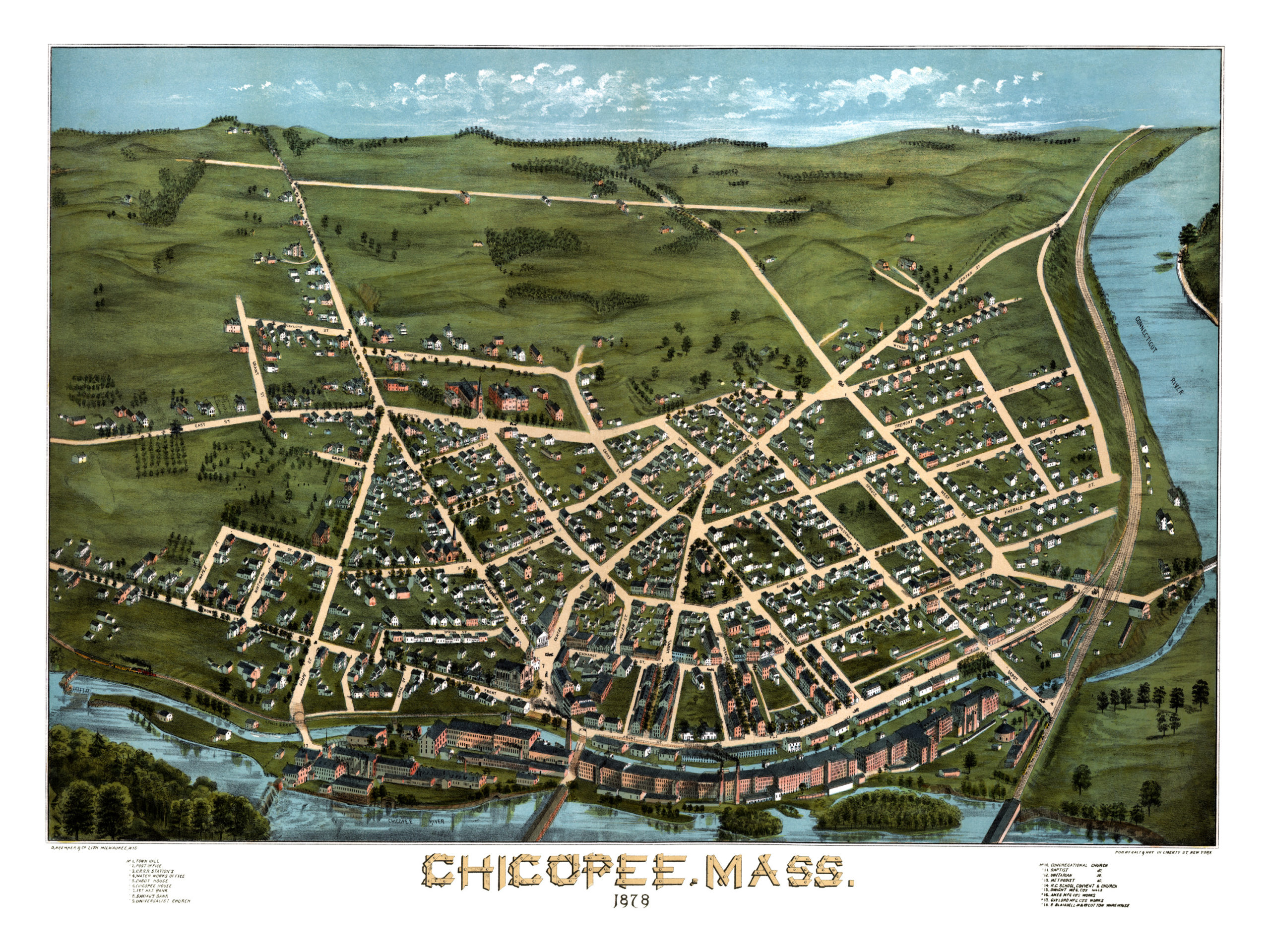
The 1878 bird's-eye view
By D. Bremner, with Galt & Hoy, lithographers
Chicopee drawn as if from the sky in 1878, with the Town Hall, the Post Office, the Cabot House and the Chicopee House, the Dwight Manufacturing Company mills, the Ames company, Gaylord Manufacturing, the Water Works Office and the Blaisdell cotton warehouse.6
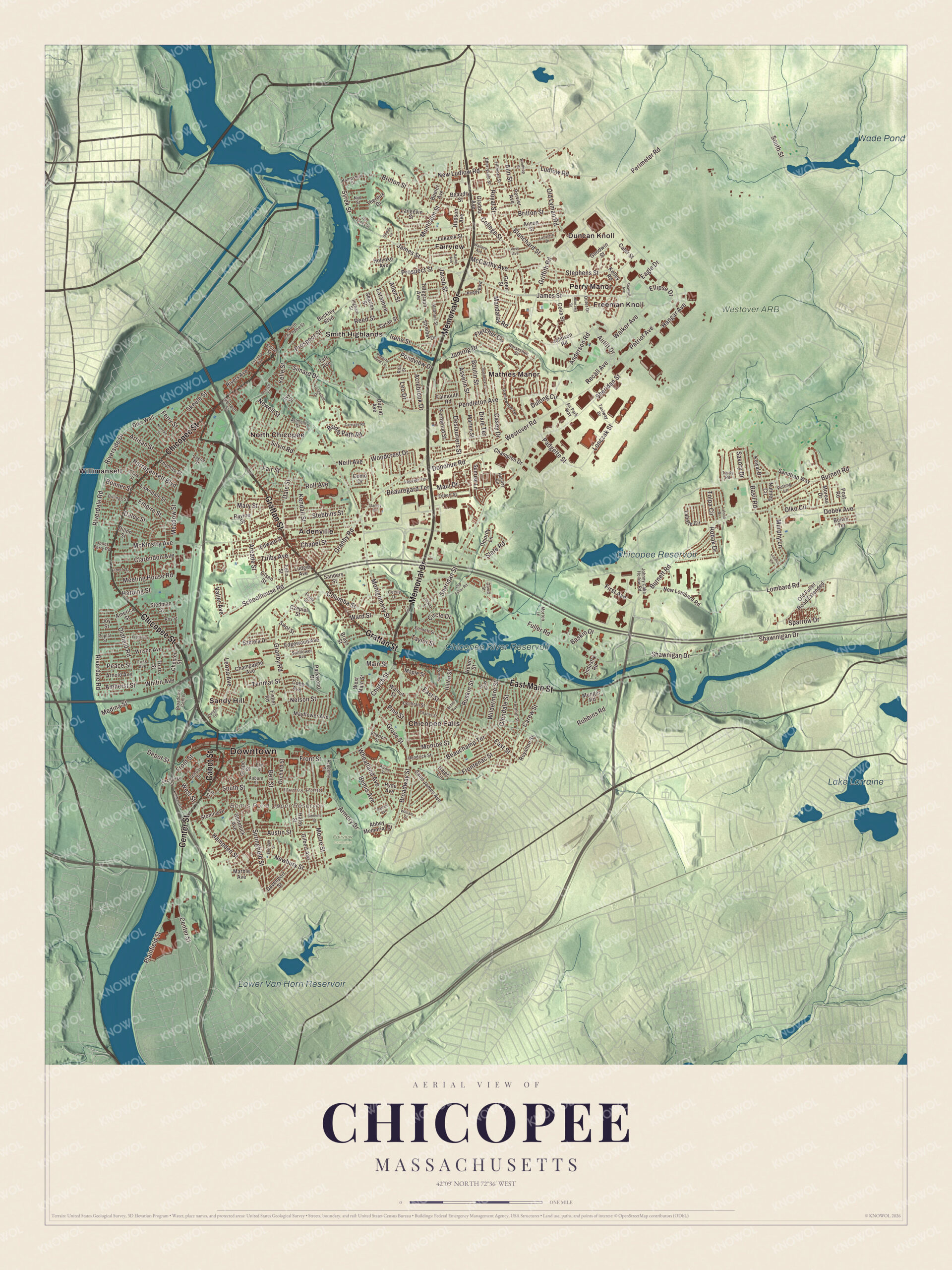
Chicopee today
By KNOWOL
Shaded relief from the Connecticut River east past Chicopee Falls, with Chicopee Street, Grattan Street, Cabot Street, Memorial Drive, Center Street and East Main Street, Bemis Pond, the Chicopee River Reservoir and Lake Lorraine.1
The story of Chicopee
Shad, salmon and wolves
Before the mills, the Chicopee River fed the families along its banks. Henry Chapin bought 200 acres on its north side in 1659 for 20 pounds, paid in wheat, and family tradition said he'd served seven years on a British man-of-war before he settled here. Shad were caught in large numbers at the river's mouth and above the Chicopee Street crossing, and salmon were plentiful too. Late in the 1700s Azariah Van Horn caught a large number in a weir near the later Gaylord's Dam. One evening a Mr. Horton of Skipmuck rode home at dusk with a fine string of shad, and the wolves gave chase. He dropped fish to slow them down, and by the time he got home there were hardly any left. About 1778 the first bridge crossed the river, paid for partly by a lottery.78910
Matches, swords and a dance at the mill
Chicopee's industry started small. On Chicopee Street, Monroe Chapin and a Mr. Phillips made friction matches in a brick building less than ten feet each way, splitting the wood by hand and selling the matches for fifty cents a box. A 1902 county history calls their works of 1835 the first of its kind in the country. At the falls the Dwights' company began its dam and canal in 1823, and when John Chase finished a new mill there in 1832 he opened it with a dance on Washington's Birthday, he and his wife leading the first round. Nathan P. Ames began making cutlery at the falls in 1829 with nine workmen, and his company went on to swords, bronze cannon and statues. By 1879 the Dwight mills made a front a third of a mile long.1141213141516
The year Chicopee left Springfield
By 1845 nearly 8,000 of Springfield's 18,000 people lived at the Chicopee end of town, in Cabotville, Chicopee Falls, Chicopee Street and Willimansett. They wanted a town of their own, while the south end wanted a city charter with its borders unbroken. At the town meeting of 1848 the split lost by about three votes to two. Then Silas Mosman, Jr., Cabotville's man in the legislature, drew up a chart of the whole town to show where each village lay. The legislature voted for the division on April 25, and the governor signed the act on April 29. At the first town meeting in Cabot Hall on May 17, Timothy W. Carter told the new town, "From this time forward our destiny, under God, is in our own hands."17218
Through the years
24 moments from 1659 to today.
- 1659John Pynchon sells Henry Chapin 200 acres north of the Chicopee River for 20 pounds, paid in wheat.7
- 1660A settlement begins at Skipmuck, above the falls, mostly on the south side of the river.19
- 1678Colonists put up a sawmill at the falls, the first industry on the river.1
- 1720Landlord Abel Chapin of Chicopee Street builds the first house at Willimansett.20
- 1753The new parish finishes its meetinghouse, and the council agrees to seat men and women together.21
- 1778About this year the first bridge crosses the Chicopee, paid for partly by a lottery.10
- 1786Ten local men lease two acres and the water at the falls on condition that iron works go up there.22
- 1801Benjamin Belcher and the Witherell brothers take over the furnace, melting ore dug nearby.22
- 1823The Dwights' company begins its dam and canal at the falls.12
- 1829Nathan P. Ames starts making cutlery at Chicopee Falls with nine workmen.14
- 1832John Chase opens a new mill at the falls with a dance on Washington's Birthday.13
- 1834On June 12 the Cabot mill in Cabotville spins its first bobbin of yarn.23
- 1835Chapin & Phillips start making friction matches on Chicopee Street.4
- 1839The Ames company brings in electroplating, by the 1879 county history's account.15
- 1845Nearly 8,000 of Springfield's 18,000 people now live at the Chicopee end of town.17
- 1848Springfield's town meeting votes against a split, but the governor signs the act creating Chicopee on April 29.2
- 1848At the first town meeting in Cabot Hall on May 17, Timothy W. Carter is chosen moderator.18
- 1853The Cabot Institute gives its library to the town.24
- 1871City Hall, with its tower modeled on Florence's Palazzo Vecchio, is dedicated on December 21.25
- 1878D. Bremner draws the bird's-eye view of Chicopee.6
- 1888Edward Bellamy of Chicopee Falls publishes Looking Backward and wakes up famous.26
- 1891George S. Taylor, elected without opposition, takes office as the new city's first mayor.27
- 1898The Church of the Nativity at Willimansett and a chapel at Aldenville are dedicated on October 30.28
- 1914The Polish National Home goes up on Cabot Street.29
Places to see
Places worth a visit in Chicopee today.
- City HallMarket Square. Palazzo Vecchio tower, standing since 1871.
- Edward Bellamy HouseChurch Street, Chicopee Falls. Where Looking Backward was written.Visit their website
- Chicopee StreetNorth of the Chicopee River. The Chapin family's first farm street.
- Chicopee FallsThe bend of the river. The old Factory Village at the falls.
- WillimansettOn the Connecticut River. Old village across from Holyoke.
- AldenvilleEast of Willimansett. Edward Alden's little city on the hill.
- FairviewNorth end of the city. Once known for its tobacco farms.
- Westover Air Reserve BaseNorthern Chicopee. Largest Air Force Reserve base in the country.
- Frank J. Szot Memorial ParkBemis Pond. Ball fields, picnicking and war memorials.
On the National Register
All 11 places in Chicopee on the National Register of Historic Places that still stand today, oldest first, and why each one matters.5
-
Ames Manufacturing Company
The surviving factory of the company that made swords, cannon and tools and cast bronze statues and the bronze doors of the Capitol's East Wing. Its connected brick buildings date from 1847 on, and the largest are now homes.30
-
Edward Bellamy House
National Historic Landmark
Edward Bellamy grew up in this house in Chicopee Falls, came back to it after his studies, and wrote Looking Backward here in the years that made him famous. It is a National Historic Landmark, and the Edward Bellamy Memorial Association, which restored it in the 1970s, runs part of it as a house museum.31
-
City Hall
Designed by Charles E. Parker of Boston and dedicated on December 21, 1871, it has a rose window and a 147-foot tower modeled on the Palazzo Vecchio in Florence, topped by a golden eagle. A tower clock was added in 1888, and the building still holds city offices.25
-
Valentine School
Built in 1898 to a design by George P. B. Alderman of Holyoke, it is a prominent local example of Renaissance Revival architecture. It served as a public school until the 1980s and has since been turned into apartments.32
-
Chapin School
Built in 1899 to plans by Holyoke architect George P. B. Alderman and named for Japhet and Henry Chapin, the area's first English settlers, it was planned for growth after the Holyoke-Willimansett Bridge opened. It now houses homeless veterans.33
-
Carreau Block
It was built in 1912 by Louis Carreau, a locally notable builder of French Canadian extraction, and is his only known surviving building of this type. It was listed on the National Register of Historic Places in 1998.34
-
Polish National Home
It was built in 1914 for $55,000. It functioned as a community center for the large Polish immigrant community, providing a variety of community services (including English language lessons and citizenship classes), and served as transient housing for Polish migrants.29
-
Dwight Manufacturing Company Housing District
The Dwight Manufacturing Company Housing District is a residential historic district in Chicopee, Massachusetts. Roughly bounded by Front, Depot, Dwight, Exchange, and Chestnut Streets, it encompasses a variety of housing built for mill workers at Chicopee's mills during the 19th century.35
-
Springfield Street Historic District
The Springfield Street Historic District is a predominantly residential historic district south of the downtown area of Chicopee, Massachusetts. It encompasses a significant number of Queen Anne style houses built in the second half of the 19th century by wealthy residents of Chicopee, as well as housing for skilled workers at the nearby textile mills.36
-
Cabotville Common Historic District
The Cabotville Common Historic District is a predominantly residential historic district in Chicopee, Massachusetts. It is centered on the park now called Lucy Wisniowski Park, which was previously known as "The Common", and includes all of the buildings that face the park, as well as a few on immediately adjacent city streets.37
-
Al's Diner
When it was listed in 2000 it was one of only two diners in Massachusetts built by Master Diner of Pequannock, New Jersey. It came to Willimansett in 1958, opened the next year as The White Diner, and took the name Al's after Al Rubin bought it in 1962.38
In their words
“From this time forward our destiny, under God, is in our own hands”
Timothy W. Carter at Chicopee's first town meeting, May 17, 1848, in History of the Connecticut Valley in Massachusetts, 187918
“to speak of Chicopee; to speak of her quietude, her good-fellowship, and her good [citizenship].”
Governor George D. Robinson of Chicopee, at Springfield's 250th anniversary in 1886, in Springfield, 1636-1886 (1888)39
“on the whole, there are few more pleasant villages than Chicopee.”
Inland Massachusetts illustrated, 189040
Nearby towns
Sources
- Map of Chicopee, Massachusetts in 2026, KNOWOL
- History of western Massachusetts (1855), on the division of Springfield, Internet Archive
- History of the Connecticut Valley in Massachusetts (1879), on the Chicopee River, Internet Archive
- "Our county and its people": A history of Hampden County, Massachusetts (1902), on friction matches, Internet Archive
- National Register of Historic Places list, Wikipedia
- Beautifully detailed map of Chicopee, Massachusetts in 1878, restored by KNOWOL
- History of the Connecticut Valley in Massachusetts (1879), on Henry Chapin's purchase, Internet Archive
- History of the Connecticut Valley in Massachusetts (1879), on Henry Chapin, Internet Archive
- History of the Connecticut Valley in Massachusetts (1879), on shad, salmon and wolves, Internet Archive
- History of the Connecticut Valley in Massachusetts (1879), on the first bridge, Internet Archive
- History of the Connecticut Valley in Massachusetts (1879), on the first matches, Internet Archive
- History of the Connecticut Valley in Massachusetts (1879), on the mills at the falls, Internet Archive
- History of the Connecticut Valley in Massachusetts (1879), on John Chase's mill dance, Internet Archive
- History of western Massachusetts (1855), on Nathan P. Ames, Internet Archive
- History of the Connecticut Valley in Massachusetts (1879), on the Ames Manufacturing Company, Internet Archive
- History of the Connecticut Valley in Massachusetts (1879), on the Dwight mills, Internet Archive
- "Our county and its people": A history of Hampden County, Massachusetts (1902), on the split from Springfield, Internet Archive
- History of the Connecticut Valley in Massachusetts (1879), on the first town meeting, Internet Archive
- History of western Massachusetts (1855), on early Chicopee, Internet Archive
- "Our county and its people": A history of Hampden County, Massachusetts (1902), on Willimansett, Internet Archive
- Western Massachusetts: a history, 1636-1925 (1926), on the first church, Internet Archive
- History of western Massachusetts (1855), on the iron works at the falls, Internet Archive
- History of the Connecticut Valley in Massachusetts (1879), on the Cabot mill, Internet Archive
- History of the Connecticut Valley in Massachusetts (1879), on the town library, Internet Archive
- City Hall, Wikipedia
- Massachusetts of today (1892), on Edward Bellamy, Internet Archive
- Massachusetts of today (1892), on George S. Taylor, Internet Archive
- "Our county and its people": A history of Hampden County, Massachusetts (1902), on the Church of the Nativity, Internet Archive
- Polish National Home, Wikipedia
- Ames Manufacturing Company, Wikipedia
- Edward Bellamy House, Wikipedia
- Valentine School, Wikipedia
- Chapin School, Wikipedia
- Carreau Block, Wikipedia
- Dwight Manufacturing Company Housing District, Wikipedia
- Springfield Street Historic District, Wikipedia
- Cabotville Common Historic District, Wikipedia
- Al's Diner, Wikipedia
- Springfield, 1636-1886: history of town and city (1888), Governor Robinson's remarks, Internet Archive
- Inland Massachusetts illustrated (1890), on Chicopee, Internet Archive