
The Land of the Sleeping Giant, a string of mill villages along the Mill River where Eli Whitney made muskets at Whitneyville, Candee made rubber shoes at Centerville and Mount Carmel turned out axles.
Hamden on the map
Click the map to look closer.
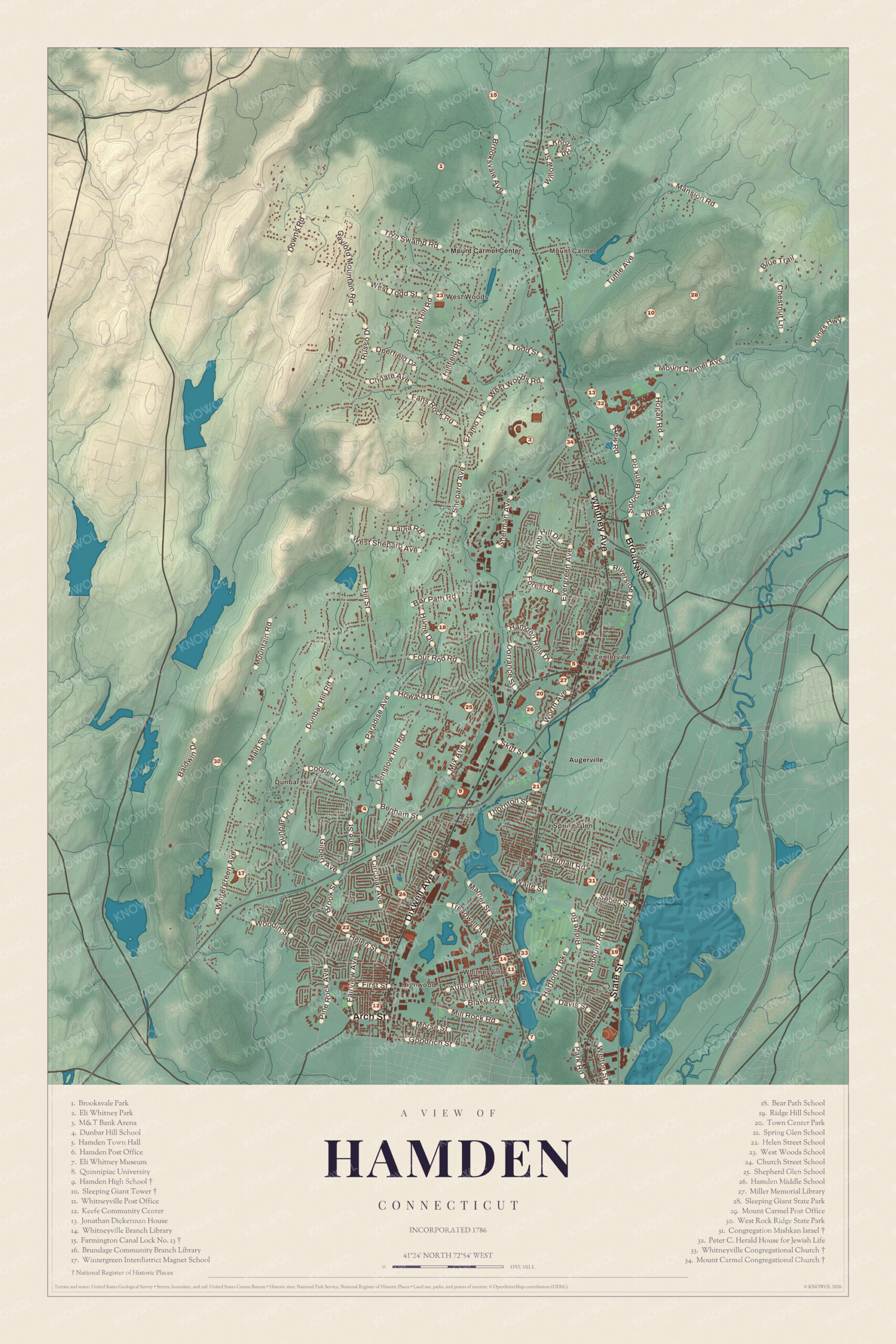
Hamden today
By KNOWOL
Shaded hills from West Rock Ridge to the Sleeping Giant, every street, Whitneyville, Spring Glen, Highwood, Mount Carmel and Lake Whitney, and a guide of 34 numbered landmarks with the National Register sites marked.5
The story of Hamden
Rubber, axles and augers
In the 1800s the Mill River ran Hamden like a string of beads. An 1895 magazine counted the dams from Mount Carmel south: the axle works, Hermon Clarke's silk factory, the Woodruff brass and iron foundry, the Beers grist mill, the New Haven Web Company at Centerville, and one more at Augerville for augers and bits. The workers' homes, it said, made one long village through nearly the whole town. Henry Ives started the Mount Carmel Axle Works in 1842. In the fall of 1843 Leverett Candee, licensed by Charles Goodyear, began making rubber shoes at Centerville, and an 1898 writer called his company one of the first in the country to make rubber goods. By 1850 part of the business had moved to New Haven, and the Web Company later took over the old Centerville site.678
Squire Whitney's village
In 1798 Eli Whitney bought a mill site on the Mill River at the foot of East Rock and set out to make 10,000 muskets for the government, with no factory, no workers and no experience. The village that grew up around his armory took his name. In Hamden he was a neighbor, too. He often presided at town meetings, audited the town's accounts and served as justice of the peace, so people here called him Squire Whitney. Cotton gins were made at the armory for a while as well. In 1836 John Warner Barber wrote that the spot was admired for the romantic beauty of its scenery. Ithiel Town's covered bridge of about 1823 crossed the river there, and when the dam was raised it was moved upstream for $250.391011
No fire on Hamden Plain
Soon after the Revolution, families in the south of Hamden wanted a place of worship closer than the New Haven churches. For a time they met at Captain Mix's house on the East Plain, and about 1793 they built a meeting house of their own. An 1892 county history remembers it as cheap and plain, and for many years it never had a fire. People sat through the coldest weather without one, and an old account added that if the wind blows anywhere, it blows on Hamden Plain. The church was organized on August 18, 1795. In 1834, on land given by the Whitney family, it moved into a new Greek Revival church in Whitneyville, and Rev. Austin Putnam, installed in 1838, stayed as its pastor for 48 years.121314
Through the years
25 moments from 1638 to today.
- 1638In November the New Haven settlers buy a 130-square-mile tract from the Mattabesset chief Montowese, taking in what's now Hamden.1
- 1735Jonathan Ives settles on the bank of the Mill River near what becomes Ivesville.15
- 1757The Mount Carmel congregation is organized, while the area is still part of New Haven.16
- 1779Captain John Gilbert and five other men of the Hamden company are killed when the British enter New Haven on July 5.17
- 1786Hamden becomes a town, set off from New Haven and named for the English statesman John Hampden.1
- 1795The East Plain church, today's Whitneyville congregation, is organized on August 18.12
- 1798Eli Whitney buys a mill site on the Mill River and starts building his armory.3
- 1823Ithiel Town builds a covered truss bridge over the Mill River at Whitneyville.11
- 1825Work on the Farmington Canal through Hamden begins.18
- 1834The Whitneyville Congregational Church is finished on land given by the Whitney family.13
- 1838Rev. Austin Putnam is installed at the Whitneyville church and stays 48 years.14
- 1840The Greek Revival Mount Carmel Congregational Church is finished.16
- 1842Henry Ives starts the Mount Carmel Axle Works.7
- 1843Leverett Candee begins making rubber shoes at Centerville under a license from Charles Goodyear.8
- 1845Eli Whitney's son builds a boarding house for workers at his pistol factory.19
- 1848The Farmington Canal closes, replaced by the railroad.1
- 1850Part of the Candee rubber business moves from Centerville to New Haven.8
- 1861A new dam floods the Mill River valley above Whitneyville, making a lake more than a mile long for New Haven's water.20
- 1874The Whitneyville Horse Railroad starts running to the center of New Haven.21
- 1888The town builds a brick and stone town hall at Centerville, designed by Prof. William P. Blake.22
- 1888Winchester buys the Whitney armory and closes it, after 90 years of making firearms.3
- 1890Mount Carmel Center gets its own post office.23
- 1924Hamden Memorial Town Hall is finished where Dixwell and Whitney Avenues meet.24
- 1935Hamden High School is built on Dixwell Avenue.25
- 1961Dr. Martin Luther King Jr. preaches at Congregation Mishkan Israel, helping dedicate its new building on Ridge Road.26
Places to see
The numbers match the landmark guide printed on the 2026 map.
- 1Brooksvale ParkNorthwest corner. Old Brooks farm, now over 500 acres.
- 5Hamden Town HallDixwell and Whitney Avenues. Memorial town hall finished in 1924.
- 7Eli Whitney MuseumWhitneyville. On the site of Whitney's gun factory.Visit their website
- 10Sleeping Giant TowerSleeping Giant State Park. Stone WPA tower on the left hip.Visit their website
- 13Jonathan Dickerman HouseMount Carmel Avenue. House of about 1795, now a museum.
- 15Farmington Canal Lock No. 13North Hamden. Best preserved wood-lined lock on the canal.
- 28Sleeping Giant State ParkMount Carmel. More than 30 miles of trails.Visit their website
- 31Congregation Mishkan IsraelRidge Road. Connecticut's oldest Jewish congregation, here since 1960.Visit their website
- 33Whitneyville Congregational ChurchWhitney Avenue. Greek Revival church finished in 1834.
- 34Mount Carmel Congregational ChurchWhitney Avenue. Hamden's finest Greek Revival church, 1840.
On the National Register
All 17 places in Hamden on the National Register of Historic Places that still stand today, oldest first, and why each one matters.4
-
Atwater-Linton House
A Cape built by Jared Atwater, a descendant of early settler David Atwater, and thought to be the oldest standing Atwater house in the area. The British wood-engraver William James Linton leased it in 1870, named it Appledore after the orchard above, and lived and worked here for thirty years.27
-
Elam Ives House
One of Hamden's oldest houses, built by Elam Ives Sr. His sons helped industrialize the area, and Ivesville takes its name from the family. The water authority has owned it since 1912.28
-
Jonathan Dickerman II House
An unusual late Georgian house built by the grandson of one of Hamden's first settlers. The Hamden Historical Society runs it as a museum; it was badly damaged by a tornado in 2018 and restored by 2021.29
-
Eli Whitney Gun Factory
The site where Eli Whitney made muskets for the United States with water-powered machinery and some of the first standardized, interchangeable parts. The barn, stone coal shed and boarding house survive, and the Eli Whitney Museum works in an 1890 factory building on the grounds.3
-
Orrin Todd House
One of the best Federal houses left in town, built by Orrin Todd, probably with his father, the housewright Simeon Todd. It was moved across the road when the Farmington Canal came through in the 1820s, and local protest saved it from demolition in 2016.30
-
George Atwater House
A vernacular Federal farmhouse with its gable end to the street, a fine carved parlor fireplace and an unusual early kitchen ell. It stayed in the Atwater family until 1933.31
-
Farmington Canal Lock No. 13
The best preserved wood-lined lock on the Farmington Canal, New England's longest canal, which carried boats north from New Haven through Hamden. Its timbers and lock keeper's house are gone, but the lock survives beside the canal trail.32
-
Whitneyville Congregational Church
A Greek Revival church built when the congregation, founded in 1795 on Hamden Plains, moved to Whitneyville on land given by the Whitney family. Rufus G. Russell restyled the interior in 1866.13
-
Mount Carmel Congregational Church and Parish House
Considered Hamden's finest Greek Revival building, with an Ionic temple front, plus a 1911 Colonial Revival parish house. Hamden's first town meeting was held in the congregation's first meeting house in 1786.16
-
Pistol Factory Dwelling
A Greek Revival boarding house Eli Whitney's son built for skilled workers at his pistol factory. It's the only building left from that factory, whose site was flooded in 1861; the house was moved a short way for road work in 1940.19
-
Alphonso Johnson House
One of Hamden's few 19th-century brick houses, a Greek Revival and Italianate mix, probably built of bricks from the Johnson family brickyard on Wilmot Brook.33
-
East Rock Park
A 427-acre park around the East Rock ridge, laid out by Donald Grant Mitchell and the Olmsted Brothers, with stone gates of about 1890, the Pardee Rose Garden and the 1887 Soldiers' and Sailors' Monument on the summit. It is run by New Haven and lies partly in Hamden.34
-
Hamden Memorial Town Hall
A Colonial Revival town hall by the Hamden architect Richard Williams, with a curved Ionic colonnade, a clock tower and an oval lobby that serves as the town's war memorial. It cost $164,000, a large sum for the time.24
-
Hamden Bank & Trust Building
A Classical Revival bank of multicolored cast stone on a triangular corner lot, designed by C. Frederick Townsend. The bank failed in 1931, and the building was the Union Trust branch from 1937 to 1983.35
-
Hamden High School
The original building has a golden cupola on its clock tower, and its lobby is ringed by murals of Hamden history by the Hamden artist Salvatore DeMaio, finished in 1936.25
-
Sleeping Giant Tower
A stone observation tower built by the Works Progress Administration on the Giant's left hip, the mountain's highest point at 739 feet, with views over the Mill and Quinnipiac River valleys.2
-
Congregation Mishkan Israel
The Modernist synagogue of the oldest Jewish congregation in Connecticut and New England, designed by Fritz Nathan with stained glass by Jean-Jacques Duval. Dr. Martin Luther King Jr. preached here in 1961, helping to dedicate it.26
In their words
“If the wind blows anywhere it is sure to blow on Hamden Plain.”
An old account quoted in the History of New Haven County, 189212
“This spot, which is two miles from New Haven, is admirably adapted for manufacturing purposes, and justly admired for the romantic beauty of its scenery.”
John Warner Barber on Whitneyville, Connecticut Historical Collections, 183610
“And if his statue be placed here we will watch round it with love as well as with pride.”
The Connecticut Magazine, 1905, on a monument to Eli Whitney at Whitneyville36
Nearby towns
Sources
- Hamden, Connecticut, Wikipedia
- Sleeping Giant (Connecticut), Wikipedia
- Eli Whitney Museum (Eli Whitney Gun Factory), Wikipedia
- National Register of Historic Places listings in New Haven County, Connecticut, Wikipedia
- Map of Hamden, Connecticut in 2026, KNOWOL (USGS elevation, Census Bureau roads)
- The Connecticut quarterly (1895), on the Mill River dams, Internet Archive
- The Connecticut quarterly (1898), on the Mount Carmel Axle Works and the Candee Rubber Company, Internet Archive
- History of New Haven County, Connecticut (1892), on the Candee rubber works, Internet Archive
- Papers of the New Haven Colony Historical Society (1894), on Eli Whitney in Hamden, Internet Archive
- Connecticut Historical Collections, John Warner Barber (1836), on Whitneyville, Internet Archive
- History of New Haven County, Connecticut (1892), on the Whitneyville covered bridge, Internet Archive
- History of New Haven County, Connecticut (1892), on the Hamden Plain meeting house, Internet Archive
- Whitneyville Congregational Church (Hamden, Connecticut), Wikipedia
- Commemorative biographical record of New Haven County, Connecticut (1902), on Rev. Austin Putnam, Internet Archive
- History of New Haven County, Connecticut (1892), on Jonathan Ives, Internet Archive
- Mount Carmel Congregational Church and Parish House, Wikipedia
- Connecticut Historical Collections, John Warner Barber (1836), on the Hamden company in 1779, Internet Archive
- History of New Haven County, Connecticut (1892), on the Farmington Canal in Hamden, Internet Archive
- Pistol Factory Dwelling, Wikipedia
- History and antiquities of New Haven, Conn. (1870), on the Whitneyville dam, Internet Archive
- 1874 New Haven CT Directory (1874), on the Whitneyville Horse Railroad, Internet Archive
- The Connecticut quarterly (1898), on the Centerville town hall, Internet Archive
- History of New Haven County, Connecticut (1892), on Augerville and Mount Carmel Center, Internet Archive
- Hamden Memorial Town Hall, Wikipedia
- Hamden High School, Wikipedia
- Congregation Mishkan Israel, Wikipedia
- Atwater-Linton House, Wikipedia
- Elam Ives House, Wikipedia
- Jonathan Dickerman II House, Wikipedia
- Orrin Todd House, Wikipedia
- George Atwater House, Wikipedia
- New Haven and Northampton Canal (Farmington Canal Lock No. 13), Wikipedia
- Alphonso Johnson House, Wikipedia
- East Rock Park, Wikipedia
- Hamden Bank & Trust Building, Wikipedia
- The Connecticut magazine (1905), on a Whitney monument at Whitneyville, Internet Archive