
A Merrimack River city that began as Pentucket in 1640, built ships and bridges against the spring ice, grew into one of the great shoe towns of America and took in old Bradford across the river in 1897.
Then and now
The same town 150 years apart. Click either map to look closer.
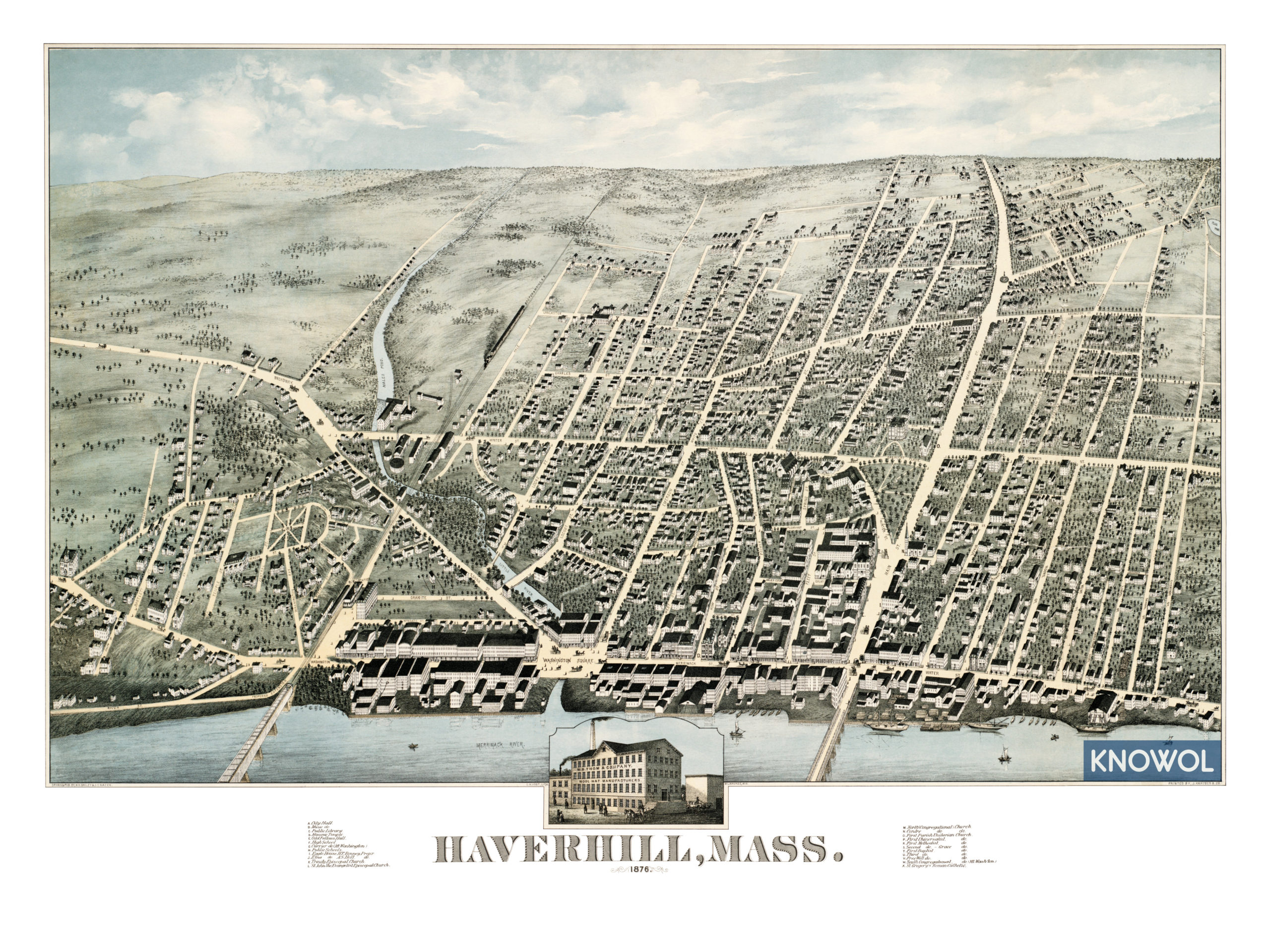
Haverhill in 1876
By H.H. Bailey and J.C. Hazen
A bird's-eye view of the city with its street names and landmarks, among them City Hall, Haverhill Music Hall, the Masonic Temple, Odd Fellows Hall, the Eagle House, Thom & Company Wool Hats and 13 churches.5
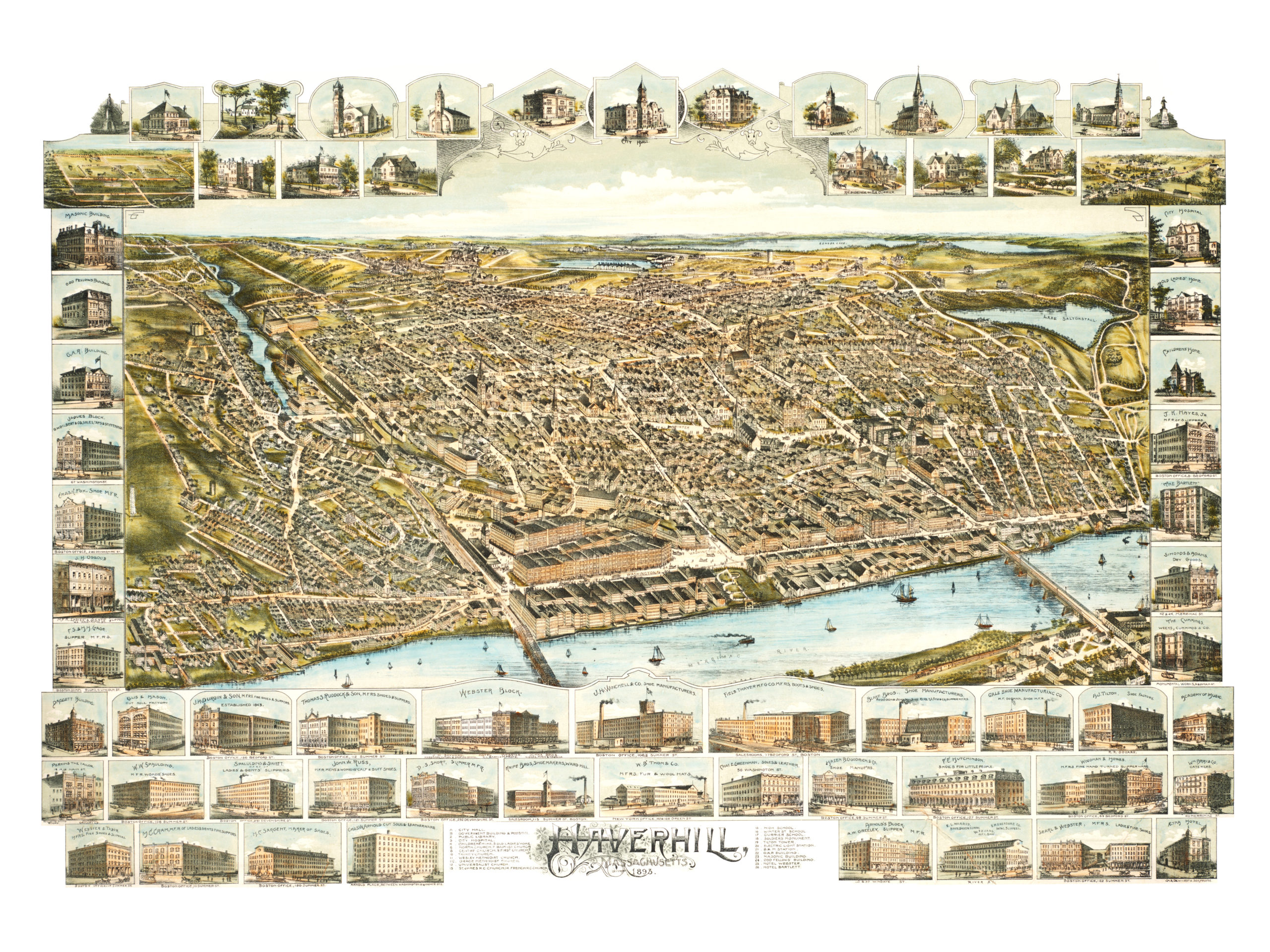
Haverhill in 1893
By O.H. Bailey & Co.
A colorful bird's-eye view of the waterfront and business district when 30,000 people lived here, with the Masonic Building, W.W. Spaulding Shoe Manufacturers, City Hall, City Hospital, Trinity Church and Haverhill High School.6
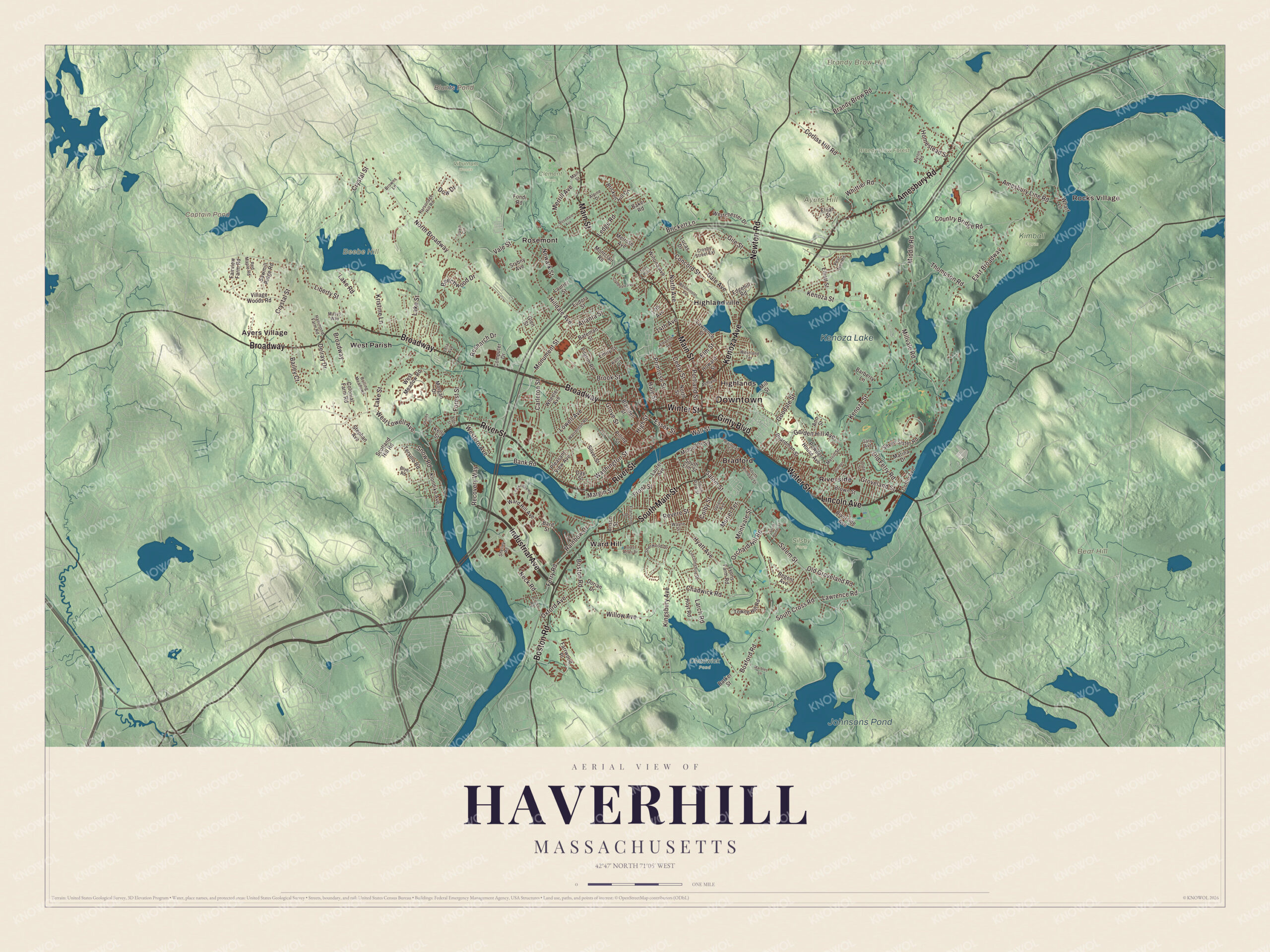
Haverhill today
By KNOWOL
Shaded relief from USGS elevation data with River Street, Water Street, Winter Street, Lincoln Avenue, Broadway and Amesbury Road, plus Kenoza Lake, Johnsons Pond, Brandy Brow Forest and Ayers Hill.7
The story of Haverhill
The pleasantest village
George Washington came to Haverhill on November 4, 1789, and the town's 1861 history gathered what people remembered of it. He walked up Merrimack Street as far as the square and street that were named Washington in honor of his visit. Looking over the Merrimack from near the Little River bridge, he said, "Beautiful, beautiful!" His remark that Haverhill was the pleasantest village he had passed through was handed down from father to son. That evening a small boy came into the tavern and cried until he was taken up to see him. Washington patted his head and told him, "I am George Washington, my little lad, but I am only a man." The next morning about a hundred militiamen paraded for him on Water Street, and he left by the old ferry near the foot of Kent Street.81
The shoemaker they turned away
Haverhill's shoe trade began with a man the town didn't want. In 1677 the town meeting turned away Peter Pattee, a journeyman shoemaker who asked for land to settle on. He stayed anyway, was chosen constable in 1694 and ran Pattee's Ferry by 1710, and a 1908 history calls him the town's first regular shoemaker. In 1832 the town's first history said that if the trade kept growing that fast, no town in the state would make more shoes. By 1861 the village had about a hundred shoe factories. The Great Fire of February 17, 1882, burned out eighty of them and left two thousand workers without jobs. The owners rebuilt the burned blocks between the river and Wingate Street, today's Washington Street Shoe District. By the end of 1913, one tenth of the nation's shoes came from Haverhill.91023111
Bridges, ships and spring ice
Before there was a bridge, people crossed the Merrimack at Haverhill by ferry. In 1794 the Proprietors of Haverhill Bridge finished a bridge to Bradford, though many people thought no bridge could stand up to the spring ice. A town sketch of 1816 said it rested on three stone piers carrying three arches, each two hundred feet long, and that it had held, though it sometimes trembled. Haverhill built ships too. In 1810 its yards turned out nine vessels of 1,800 tons in all, with fifty or sixty men at work, and ships of 400 tons were launched at high tide. Downriver at Rocks Village, a bridge to West Newbury went up in 1795, the longest on the river. Ice in the great freshet of 1818 carried off what was left of it, and it was rebuilt in 1828.121314
Through the years
24 moments from 1640 to today.
- 1640Settlers from Newbury begin the town at Pentucket, which the city page translates as place of the winding river.1
- 1642On November 15 the settlers buy the land from the Pentucket people for three pounds, ten shillings.1
- 1647About this time Thomas Whittier comes from Newbury with a swarm of bees, probably the first in town.15
- 1672Across the river, Bradford takes its name on January 7, by tradition after Bradford in Yorkshire.16
- 1677The town turns away Peter Pattee, a journeyman shoemaker, but he stays and later serves as constable.9
- 1705John Swan and Jonathan Emerson are allowed to set up a grist mill on Little River.17
- 1726Haverhill people begin settling Penacook, today's Concord, New Hampshire.18
- 1789George Washington visits on November 4 and calls Haverhill the pleasantest village he has passed through.8
- 1794The village is just Merrimack, Water and Main Streets, and its only brick building is part of Sheriff Bartlett's house.19
- 1794The Haverhill Bridge to Bradford is finished in the autumn.12
- 1795A bridge goes up at Rocks Village to West Newbury, the longest on the river.12
- 1803Bradford Academy is founded across the river.1
- 1810Haverhill's shipyards build nine vessels of 1,800 tons in all.14
- 1818Ice in a great freshet carries off what is left of the Rocks Village bridge. It's rebuilt in 1828.12
- 1832The town's first history finds shoemaking growing so fast that no town in the state may soon outdo it.10
- 1835Ezekiel Hale Jr. and his son put up a brick woolen flannel factory on Winter Street.1
- 1859Great Pond is renamed Kenoza Lake, a name chosen by the poet Whittier.20
- 1861The village counts about 1,200 houses, 100 shoe factories and 11 churches.2
- 1870Haverhill becomes a city.1
- 1882The Great Fire of February 17 burns out eighty shoe factories.3
- 1893Hervey E. Guptill starts a shoe business with $192, making a special shoe for older women.21
- 1897Bradford joins the city of Haverhill on January 1.1
- 1898Haverhill elects John C. Chase, a former shoe factory worker, its first socialist mayor.1
- 1913By year's end one tenth of the shoes made in the United States come from Haverhill.1
Places to see
Places worth a visit in Haverhill today.
- Washington Street Shoe DistrictDowntown. More than 60 shoe factories of the 1800s.
- Main Street Historic DistrictMain Street. The city's civic core.
- Haverhill City HallMain Street. The 1909 high school behind Archie Comics.
- Lafayette SquareDowntown. Lafayette statue put up in 1932.
- Museum of PrintingThornton Avenue. Printing history in a former supply building.Visit their website
- Kenoza LakeKenoza Avenue. Great Pond until Whittier renamed it.
- Winnekenni CastleWinnekenni Park. James R. Nichols's stone summer home.Visit their website
- John Greenleaf Whittier HomesteadWhittier Road. The poet's birthplace, setting of Snow-Bound.
- Bradford Common Historic DistrictBradford. Bradford's old town center.
- Rocks VillageEast end of the city. Old ferry and bridge crossing to West Newbury.
On the National Register
All 22 places in Haverhill on the National Register of Historic Places that still stand today, oldest first, and why each one matters.4
-
Bradford Burial Ground
The 1.5-acre (0.61 ha) cemetery was established in 1665, on land given by John Heseltine to the town of Bradford. The oldest readable marker in the cemetery has a date of 1689, but there are likely to be older burials.22
-
Dustin House
One of very few brick houses of its period left in Massachusetts. It's believed farmer and brickmaker Thomas Duston was building it at the time of the 1697 attack on Haverhill, when his wife Hannah was taken captive from their older house nearby.23
-
Ephraim Davis House
Ephraim Davis built the first part of this house in 1705, the year he married, and his descendants kept it into the late 1800s. Empty since 1929, it now serves a farm as a garage and storage building, still with its oak frame and central chimney.24
-
Hastings-Morse House
Its central chimney and right-side rooms were probably built about 1706 by a man named Hastings. The left-side rooms and a partial leanto on the back were added during the 1700s.25
-
Hazen-Spiller House
Built about 1724 by Richard Hazen, it is a rare brick house of its time, laid in English bond with end chimneys. Wallace Nutting bought it in 1915 and showed it in his Chain of Picture Houses guidebook.26
-
Emerson House
Begun about 1730, the house shows building methods changing from the First Period to the Second. Nehemiah Emerson, who bought it in 1787, probably added its left side, and it was moved here from Winter and Pecker Streets in the 1850s.27
-
East Parish Meeting House
A Greek Revival meeting house of 1838 on the rural east side, built where the parish's first meeting house of 1744 stood. Regular services ended in 1906, and the restored building is now a neighborhood gathering place for weddings, dinners and meetings.28
-
School Street School
A brick school of 1856 designed by Joseph R. Richards, mixing Romanesque arches, an Italianate cornice and Greek Revival pilasters. Set on a hill, it looks like two stories from some sides.29
-
Winter Street School
Built in 1856 to bring two smaller schools together, it is one of the city's oldest school buildings, with a mansard roof added about 1873. It has been converted into apartments.30
-
Primrose Street Schoolhouse
The two story brick building was designed by Haverhill architect Josiah M. Littlefield and built in 1868 to meet increased demand for schooling occasioned by an influx of French Canadian families, and served as a public school until the 1890s.31
-
Intervale Factory
Built in 1889, it is one of Haverhill's better-preserved shoe factory buildings. Now converted to apartments, it was listed on the National Register of Historic Places in 1988.32
-
Charles H. Hayes Building
A former box factory built in 1894 and enlarged in 1911 for Charles H. Hayes, a leading shoe manufacturer, to make packing boxes for Haverhill's shoe factories. The first part was designed by the Haverhill architect Josiah M. Littlefield.33
-
Peabody School
Bradford's last school building, built in 1895 to designs by Damon Brothers, two years before the town joined Haverhill. It was planned with the newest ideas in school design, roomy classrooms with good heat, air and daylight, and now holds eight condominiums.34
-
Haverhill Board of Trade Building
A seven-story brick building put up in stages from 1906 to 1908 by the Haverhill Board of Trade, a group of local businessmen, to give small companies, mostly in the shoe trade, affordable factory space.35
-
Merrimack Associates Building
An eight-story brick factory of 1913, one of the few industrial buildings to survive redevelopment north of the main business district. Damon Brothers, who also designed the nearby Board of Trade Building, were its architects.36
-
Rocks Village Historic District
A village of 25 buildings at the old ferry crossing to West Newbury, 15 of them from the 1700s, beside the Rocks Village Bridge. The 1750 Ingalls House has wall murals by the traveling artist Rufus Porter, and the poet John Greenleaf Whittier was born nearby.37
-
Washington Street Shoe District
Two blocks of Washington and Wingate Streets between Railroad Square and Essex Street, where more than 60 shoe factories were set up in the late 1800s. Most are brick Italianate buildings of three or four stories, smaller than the later mill-sized shoe factories.11
-
Bradford Common Historic District
Bradford's town center from about 1750 until it joined Haverhill in 1897, around the common at South Main and Salem Streets. It keeps a former Kimball tavern of about 1690, the White Church of 1848 and the old Bradford College campus.38
-
Main Street Historic District
The city's civic core, with the 1909 high school that is now City Hall, the old town common now called G.A.R. Park, and churches of 1848, 1859 and 1883. It also holds some of the finest houses built by Haverhill's business leaders.39
-
Haverhill Historical Society Historic District
The Haverhill Historical Society's grounds at 240 Water Street, centered on Buttonwoods, a brick Federal house given to the society in 1903. In the 1660s this was the home of Elizabeth Ward and Nathaniel Saltonstall, and the remains of a late 1600s house site lie on the property.40
-
L.H. Hamel Leather Company Historic District
The largest group of intact old factory buildings in downtown Haverhill, built up between 1886 and 1929. Its eight-story concrete buildings of 1911 to 1916 added 30 acres of floor space for shoe companies, and Louis Hamel's leather company grew there in the 1920s.41
-
Haverhill Powder House
A powder house, the small building where the town kept its gunpowder. The town's 1861 history says Haverhill built its first powder house in 1767 and put up a new one on Golden Hill about 1845.42
In their words
“Haverhill is the pleasantest village I have passed through.”
George Washington in 1789, as the town's 1861 history remembers it8
“[Haverhill] may justly boast of its bridge.”
A historical sketch of Haverhill, 181613
“If this business increases as rapidly for a few years to come as it has the three last years, no town in the State will exceed this in the number of shoes manufactured.”
The history of Haverhill, 1832, on the shoe trade10
Nearby towns
Sources
- Haverhill, Massachusetts, Wikipedia
- The history of Haverhill, Massachusetts, from its first settlement, in 1640, to the year 1860 (1861), on the view from Silver's Hill, Internet Archive
- Industries of Massachusetts: historical and descriptive review of Lynn, Lowell, Lawrence, Haverhill and others (1886), on the Great Fire, Internet Archive
- National Register of Historic Places list, Wikipedia
- Beautifully restored map of Haverhill, MA from 1876, restored by KNOWOL
- Bird's eye view of Haverhill, Massachusetts in 1893, restored by KNOWOL
- Map of Haverhill, Massachusetts in 2026, KNOWOL
- The history of Haverhill, Massachusetts, from its first settlement, in 1640, to the year 1860 (1861), on Washington's visit, Internet Archive
- Historic homes and places and genealogical and personal memoirs relating to the families of Middlesex County, Massachusetts (1908), on Peter Pattee, Internet Archive
- The history of Haverhill, Massachusetts (1832), on the shoe trade, Internet Archive
- Washington Street Shoe District, Wikipedia
- Standard history of Essex county, Massachusetts (1878), on the Merrimack bridges, Internet Archive
- A historical sketch of Haverhill, in the county of Essex, and commonwealth of Massachusetts (1816), on Haverhill Bridge, Internet Archive
- A historical sketch of Haverhill, in the county of Essex, and commonwealth of Massachusetts (1816), on shipbuilding, Internet Archive
- The history of Haverhill, Massachusetts, from its first settlement, in 1640, to the year 1860 (1861), on Thomas Whittier's bees, Internet Archive
- History of Essex County, Massachusetts (1888), on the naming of Bradford, Internet Archive
- The history of Haverhill, Massachusetts, from its first settlement, in 1640, to the year 1860 (1861), on the mills of 1705, Internet Archive
- The history of Haverhill, Massachusetts, from its first settlement in 1640 to the year 1860 (1861), on the settling of Penacook, Internet Archive
- The History of Haverhill Massachusetts from its first settlement in 1640 to the year 1860 (1861), on Haverhill in 1794, Internet Archive
- Municipal history of Essex County in Massachusetts (1922), on Haverhill's lakes and water works, Internet Archive
- Genealogical and Personal Memoirs relating to the families of Boston and eastern Massachusetts, Volume II (1908), on Hervey E. Guptill, Internet Archive
- Bradford Burial Ground, Wikipedia
- Dustin House, Wikipedia
- Ephraim Davis House, Wikipedia
- Hastings-Morse House, Wikipedia
- Hazen-Spiller House, Wikipedia
- Emerson House, Wikipedia
- East Parish Meeting House, Wikipedia
- School Street School, Wikipedia
- Winter Street School, Wikipedia
- Primrose Street Schoolhouse, Wikipedia
- Intervale Factory, Wikipedia
- Charles H. Hayes Building, Wikipedia
- Peabody School, Wikipedia
- Haverhill Board of Trade Building, Wikipedia
- Merrimack Associates Building, Wikipedia
- Rocks Village Historic District, Wikipedia
- Bradford Common Historic District, Wikipedia
- Main Street Historic District, Wikipedia
- Haverhill Historical Society Historic District, Wikipedia
- L.H. Hamel Leather Company Historic District, Wikipedia
- The history of Haverhill, Massachusetts, from its first settlement, in 1640, to the year 1860 (1861), on the powder houses, Internet Archive