
A hill town of farms and mill villages around an old crossroads green, where the diamond brand of 1710 still shapes the town seal and Gilead, Amston and Hope Valley each keep a story of their own.
Hebron on the map
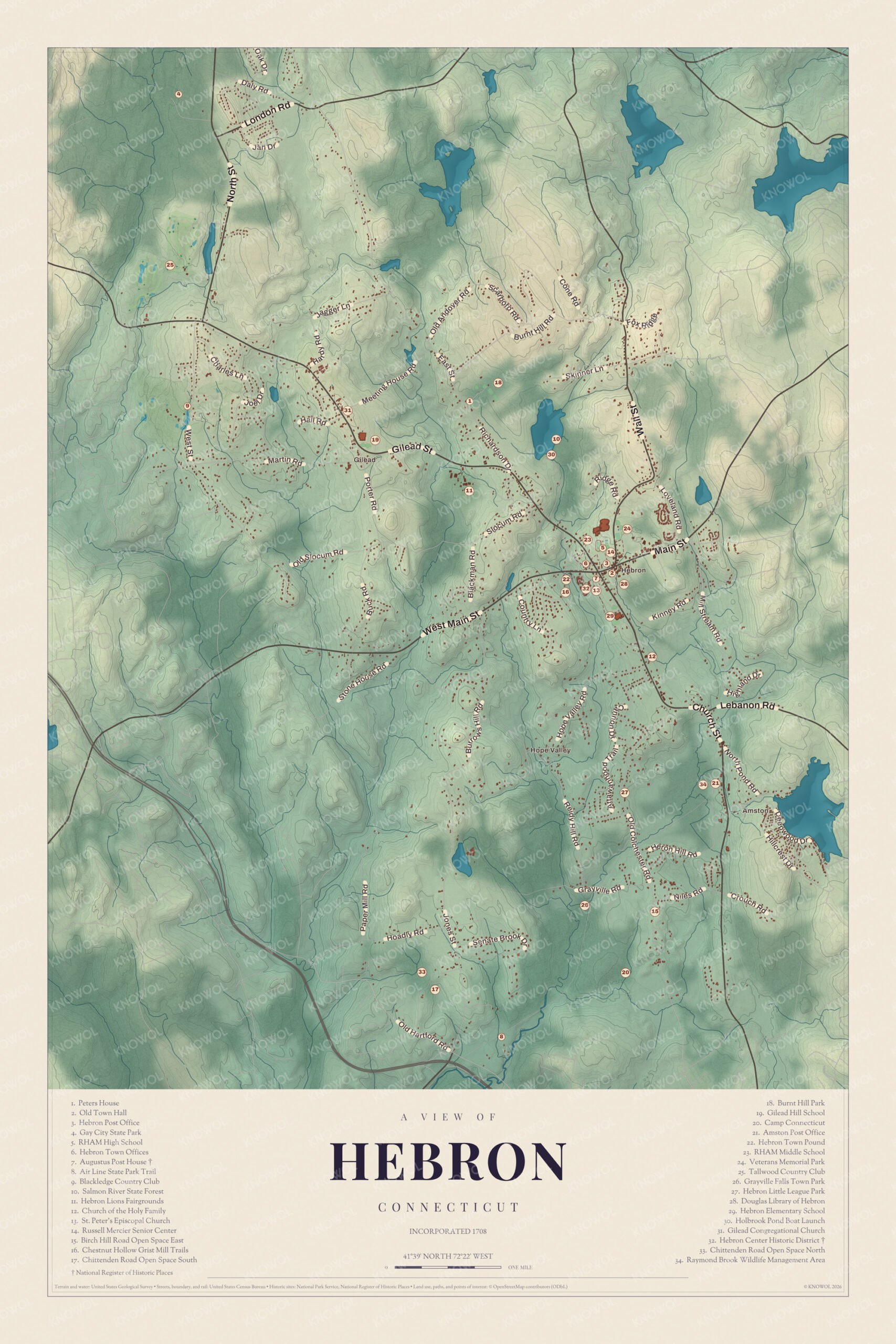
Click the map to look closer.
Hebron today
By KNOWOL
Shaded hills from Gilead and the woods of Gay City down through Hebron Center to Amston and the Salmon River country, every street by name, and a guide of 34 numbered landmarks with the National Register sites marked.5
The story of Hebron
How Hebron became Pump Town
When word reached Hebron in 1758 that the French fortress at Louisburg had fallen, the town wanted to fire a salute, and it had no cannon. So people hauled a huge oak log out of the forest and turned it into a gun. A blacksmith bound it with iron hoops, wooden hoops went on over those, and the powder horns of the town were emptied into it. They dragged it to the top of the highest hill, lit the train and stood well back. The log blew itself to pieces, and that's how Hebron got the name Pump Town. By 1775 the mood had turned, and the town raised a liberty pole. A passing traveler nailed a rhyme to it: I am thy God cut from the stump, you sing my praise and fire your pump.67
Life on Hebron Green
The green has been the center of Hebron since the first meeting house went up on it. That house burned in 1747, and the colony ordered the new one built on the same spot. In 1763 tavern keeper David Barber planted an elm there with his six-year-old daughter Patience, and it stood until 1904. On the Sunday after Lexington, a rider galloped up during the afternoon service with the news, and about 60 men marched the next morning. At a town meeting in 1845 the floor of the hall gave way and dropped everyone into the room below, so they finished on the church steps. A fire in 1882 took the church and the schoolhouse, and one August night in 1888 the village boys tore down the old fence around the green.8910111213
From the iron furnace to Amston
In the south of town, a blast furnace stood by 1835, smelting bog iron carted in from an ore bed in Colchester. It never paid much. In 1853 Phineas W. Turner bought the property and built a silk village around it, with three mills, a store and more than thirty houses. It took his name, Turnerville, and got its own post office in 1864. Turner put his fortune behind the Air Line railroad, and one of its first locomotives carried his name. He also fought the town all the way to the state Supreme Court over the fishing in North Pond, and won. After his death in 1903 the silk business failed. Charles Ams bought the village lands in 1912, and the next year Turnerville became Amston.1431315
Through the years
25 moments from 1704 to today.
- 1704Settlement of the town begins.1
- 1706Settlers' wives, lost on the walk in, spend the night on a high rock in Gilead, remembered as Prophet's Rock.16
- 1708Hebron is incorporated on May 26, with nine families living here.1
- 1709The town votes the diamond as its cattle brand and names a white oak its sign-post.17
- 1717Rev. John Bliss is ordained as the town's first minister, with the meeting house rising on the green.17
- 1735Bliss's followers begin building St. Peter's, Hebron's Episcopal church.18
- 1744A map of the town shows 151 houses.2
- 1747The meeting house on the green is set on fire and burns down.8
- 1748The new parish of Gilead holds its first meeting, after the legislature turns down the name Rehoboth.19
- 1758Hebron celebrates the fall of Louisburg with a cannon made from an oak log, and earns the name Pump Town.6
- 1763Tavern keeper David Barber plants the great elm on the green.9
- 1774Rev. Samuel Peters, the loyalist rector of St. Peter's, flees to England.6
- 1775News of Lexington reaches the Sunday service on the green, and about 60 men march the next morning.10
- 1786Hebron, the wealthiest town in Tolland County, tries and fails to leave the new county.20
- 1798The Missionary Society of Connecticut is organized at Rev. Amos Bassett's house in Hebron.21
- 1803Part of Hebron goes to form the new town of Marlborough.1
- 1831John S. Peters of Hebron becomes Governor of Connecticut.22
- 1835A blast furnace smelting bog iron stands where Turnerville will grow.14
- 1845The town hall floor gives way during a town meeting, and the meeting finishes on the church steps.11
- 1853Phineas W. Turner buys the furnace property and starts making silk.14
- 1876The cotton mill at Hope Valley burns and is never rebuilt.23
- 1882Fire sweeps the green, taking the Congregational church, the schoolhouse and seven other buildings.12
- 1888The village boys tear down the old fence around the green.13
- 1913Turnerville and its post office are renamed Amston.15
- 1943The state buys the land of the old mill village of Gay City for a park.5
Places to see
The numbers match the landmark guide printed on the 2026 map.
- 1Peters HouseEast Street. On the Connecticut Freedom Trail.
- 4Gay City State ParkFar north. Site of a vanished mill village.Visit their website
- 7Augustus Post HouseMain and Church Streets. Brick Federal house of about 1820.
- 8Air Line State Park TrailAcross the town. Rail trail on the old Air Line.Visit their website
- 13St. Peter's Episcopal ChurchHebron Center. Parish founded in the 1730s.
- 18Burnt Hill ParkEast Street. Hebron's largest town park.
- 22Hebron Town PoundHebron Center. Site of the old stone pound.
- 24Veterans Memorial ParkHebron Center. What remains of the green.
- 28Douglas Library of HebronHebron Center. The town's public library.Visit their website
- 31Gilead Congregational ChurchGilead. Church of the Gilead parish.
On the National Register
All 2 places in Hebron on the National Register of Historic Places that still stand today, oldest first, and why each one matters.4
-
Hebron Center Historic District
The village center has been Hebron's civic heart since 1708. Fires in the 1800s took nearly all its 18th century buildings, and road widening split the green, but the district keeps 60 historic buildings, the old green, the town pound site, St. Peter's cemetery and the Douglas Library.24
-
Augustus Post House
A fine brick Federal house facing a surviving piece of the green, with a fanlight over its door. Later owners included Governor John S. Peters and the Hewitt family, who kept a general store nearby.22
In their words
“That prospect of calm and peaceful country life which has ever been the charm of Hebron and which draws us back again and again, however far we may wander.”
Hebron, Connecticut, bicentennial, 1910, from the address on the green in 190825
“In population, wealth and influence it stood in the front rank among the towns of the state”
Dr. Cyrus H. Pendleton on Hebron in 1800, Hebron bicentennial, 191021
“Hebron has furnished quite a number of distinguished men.”
John Warner Barber, Connecticut Historical Collections, 183626
Nearby towns
Sources
- Hebron, Connecticut, Wikipedia
- Hebron, Connecticut, bicentennial, August 23d to 25th, 1908 (1910), on the first settlers, Internet Archive
- Genealogical and family history of the state of Connecticut (1911), on Phineas W. Turner, Internet Archive
- National Register of Historic Places listings in Tolland County, Connecticut, Wikipedia
- Map of Hebron, Connecticut in 2026, KNOWOL (USGS elevation, Census Bureau roads)
- Hebron, Connecticut, bicentennial, August 23d to 25th, 1908 (1910), on the firing of the pump, Internet Archive
- Hebron, Connecticut, bicentennial, August 23d to 25th, 1908 (1910), on the liberty pole, Internet Archive
- The public records of the colony of Connecticut (1850), on the burning of the meeting house, Internet Archive
- Hebron, Connecticut, bicentennial, August 23d to 25th, 1908 (1910), on the elm on the green, Internet Archive
- Hebron, Connecticut, bicentennial, August 23d to 25th, 1908 (1910), on the news of Lexington, Internet Archive
- Hebron, Connecticut, bicentennial, August 23d to 25th, 1908 (1910), on the town meeting of 1845, Internet Archive
- Hebron, Connecticut, bicentennial, August 23d to 25th, 1908 (1910), on the fire of 1882, Internet Archive
- Hebron, Connecticut, bicentennial, August 23d to 25th, 1908 (1910), on the green fence and North Pond, Internet Archive
- Hebron, Connecticut, bicentennial, August 23d to 25th, 1908 (1910), on the furnace and the Turner silk mills, Internet Archive
- House on the Hill: The Story of the Ams Mansion, Hebron Historical Society
- Hebron, Connecticut, bicentennial, August 23d to 25th, 1908 (1910), on Prophet's Rock, Internet Archive
- Hebron, Connecticut, bicentennial, August 23d to 25th, 1908 (1910), on the first town meetings, Internet Archive
- Hebron, Connecticut, bicentennial, August 23d to 25th, 1908 (1910), on St. Peter's Church, Internet Archive
- Hebron, Connecticut, bicentennial, August 23d to 25th, 1908 (1910), on the parish of Gilead, Internet Archive
- Hebron, Connecticut, bicentennial, August 23d to 25th, 1908 (1910), on Tolland County, Internet Archive
- Hebron, Connecticut, bicentennial, August 23d to 25th, 1908 (1910), on the Missionary Society and Hebron in 1800, Internet Archive
- Augustus Post House, Wikipedia
- A modern history of New London County, Connecticut (1922), on Daniel I. Norton, Internet Archive
- Hebron Center Historic District, Wikipedia
- Hebron, Connecticut, bicentennial, August 23d to 25th, 1908 (1910), opening address, Internet Archive
- Connecticut historical collections, John Warner Barber (1836), Internet Archive