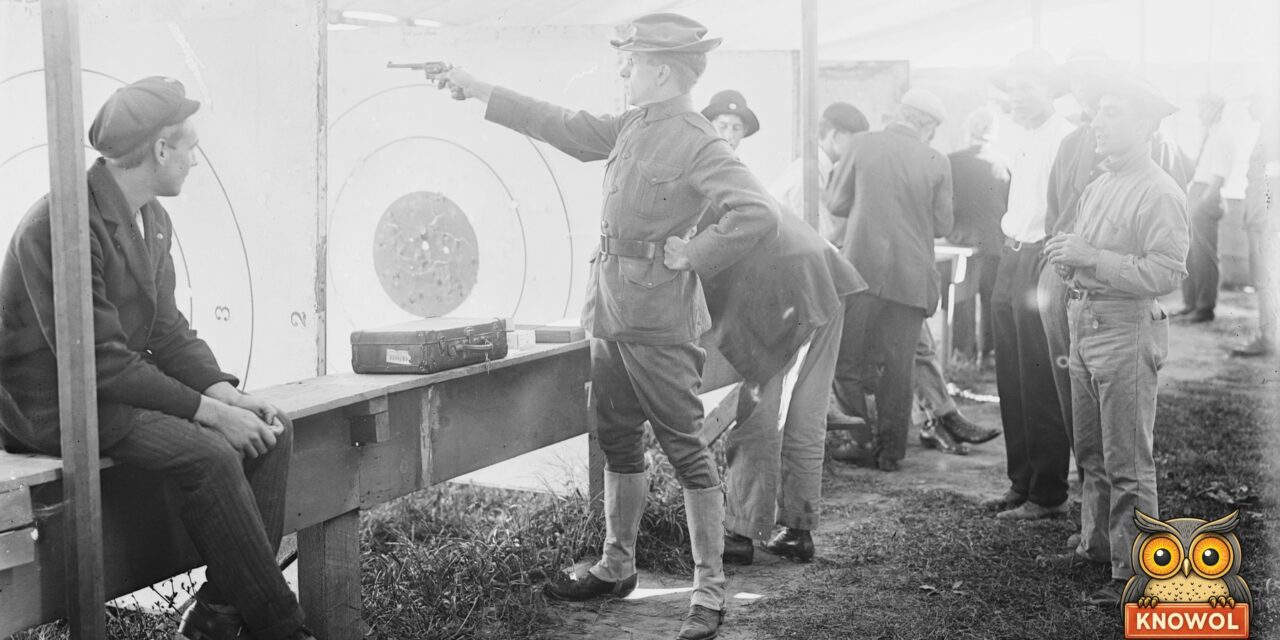
On a Wednesday night, April 20, 1910, a few married men in Los Angeles, California, found a good reason to leave the house. They belonged to the Los Angeles Rifle and Revolver Club, and the club had a new indoor target range in the Y.M.C.A. building. The Los Angeles Herald’s rifle-club column said the indoor shoots had turned out to be “as good as lodge meetings as an excuse for the Benedicts to get away from home at night.” Lodge meetings were nights out at clubs like the Elks. “Benedicts” was an old word for married men. It came from a Shakespeare character who swore he would never marry, and then did.
That night a club member named E. L. Stevenson came over from Pasadena, California. He brought a gun with him, and it was not an ordinary gun.
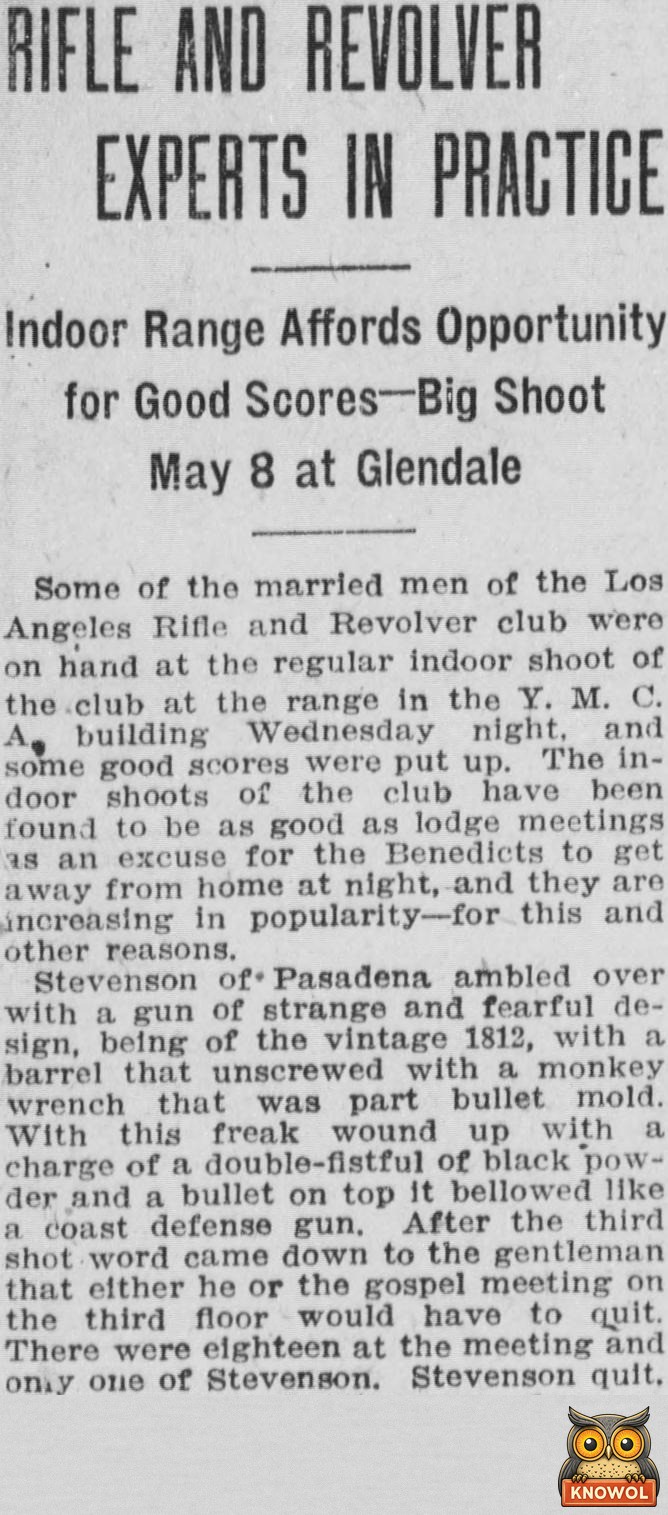
“Rifle and Revolver Experts in Practice,” the start of the rifle-club column in the Los Angeles Herald, Saturday, April 23, 1910, page 11. Library of Congress, Chronicling America. Click the clipping to read it full size.
A Gun “of Strange and Fearful Design” Comes to Los Angeles
Stevenson’s gun was, in the Herald’s words, “a gun of strange and fearful design, being of the vintage 1812.” That may have been a joke, since the War of 1812 was almost a hundred years in the past. The next part was plain enough. The gun had “a barrel that unscrewed with a monkey wrench that was part bullet mold.”
A monkey wrench is a wrench you can open wider or narrower. A bullet mold is a small iron tool with jaws like a pair of pliers. Inside the jaws is a hollow the shape of a bullet. You pour in melted lead, let it cool, open the jaws, and out drops a bullet. Stevenson’s one tool did both jobs. It made his bullets, and it took his gun apart.
Then he loaded it. The Herald said the gun was “wound up with a charge of a double-fistful of black powder and a bullet on top.” Black powder is the old kind of gunpowder. It goes off with a big boom and a cloud of smoke. Inside the walls of the Y.M.C.A., Stevenson’s gun “bellowed like a coast defense gun,” the paper said. Coast defense guns were the giant cannons in forts that guarded America’s harbors.
A Range Built for Little Rifles
The indoor range at the Los Angeles Y.M.C.A. was not built for a cannon. The club’s indoor team belonged to a new indoor league of the National Rifle Association. In January the Herald printed the league’s rules: “twenty shots for each man at 75 feet, with 22-caliber rifles.” A 22-caliber bullet is less than a quarter of an inch wide. The bull’s-eye in the middle of the target was “one-half inch in diameter.” That is smaller than a dime.
Nobody had to travel for these matches. Each club shot at home, and then, the Herald said, “Scores are wired and targets sent by mail.” That winter the Los Angeles club was matched against the Fort Pitt Rifle Club of Pittsburgh and the Italian Rifle Club of New York City. Its first match had to be shot at the Harvard School range, because “the range in the Y. M. C. A. building has not been finished.” By April, it was.
Eighteen Upstairs, One Downstairs
The Los Angeles Y.M.C.A. held more than a rifle range. On its third floor that Wednesday night, a gospel meeting was going on. That is a church service with preaching and hymns. Somewhere below the meeting, Stevenson fired his old gun once, then twice, then a third time.
“After the third shot,” the Herald said, “word came down to the gentleman that either he or the gospel meeting on the third floor would have to quit.”
The math was easy. “There were eighteen at the meeting,” the paper said, and only one Stevenson. Then came the shortest sentence in the whole column: “Stevenson quit.”
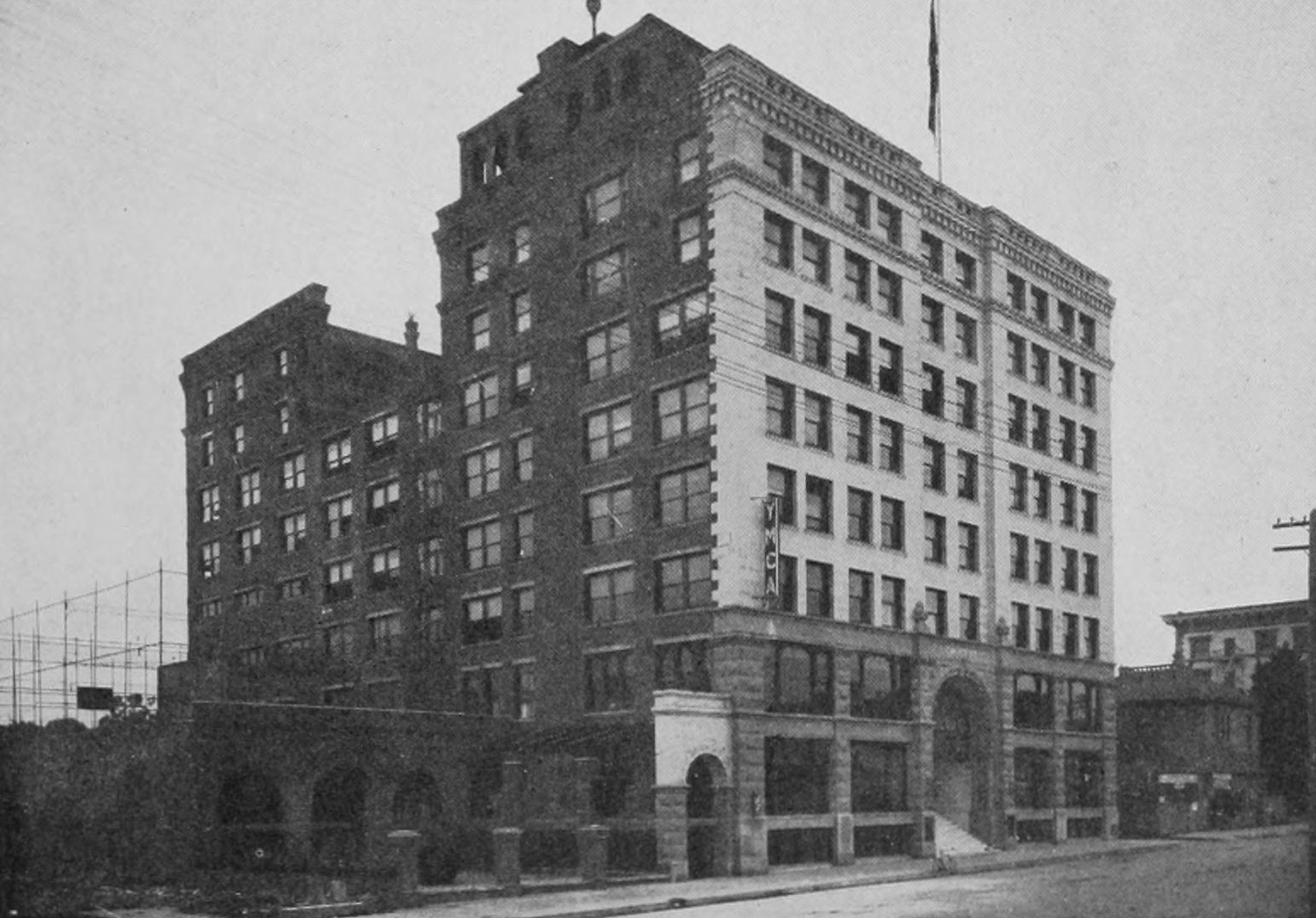
The Y.M.C.A. building on South Hope Street in Los Angeles, its home since 1907, from the book Los Angeles, the Old and the New, 1911. Internet Archive, public domain. Click the picture to see it full size.
The Man From Pasadena Who Collected Odd Guns
E. L. Stevenson was the Los Angeles club’s collector of odd guns, and the Herald loved to write about him. In July 1909 he brought out what the paper called “the queerest gun ever seen in the club.” It had a shotgun barrel and a rifle barrel on the same gun. The rifle barrel kicked like any rifle. But the shotgun barrel, “loaded with a bullet large enough for an elephant, kicked like a runaway switch engine.” A switch engine is a small locomotive that shoves railroad cars around a train yard.
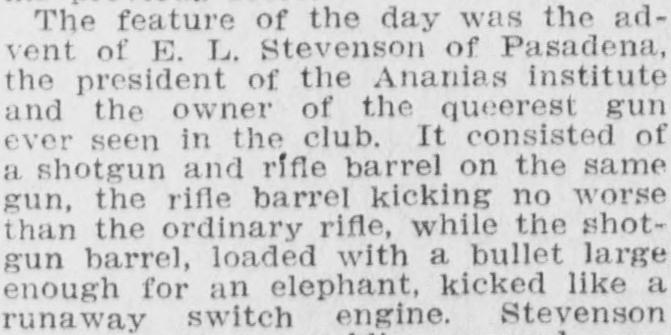
Stevenson’s two-barreled gun. Los Angeles Herald, July 6, 1909, page 8. Library of Congress, Chronicling America. Click the clipping to read it full size.
Stevenson also owned what the Herald called “his famous elephant gun.” With it, the paper said in January 1910, he “used to make wonderful scores on the outdoor range, using a mattress to catch him after each shot with the ferocious weapon.” That was mostly a joke. But a big old gun really does kick, shoving hard against the shooter’s shoulder. The same column said Stevenson “shot excellently” that week, except once, when he “shot on the wrong target, scoring a ten for his shooting partner.”
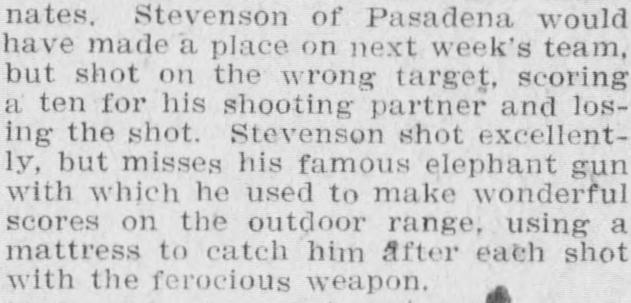
The elephant gun and the mattress. Los Angeles Herald, January 23, 1910, page 31. Library of Congress, Chronicling America. Click the clipping to read it full size.
Who Else Was at the Los Angeles Y.M.C.A. That Night
The Los Angeles Herald printed the scores from that Wednesday night at the Y.M.C.A. E. L. Stevenson’s name is right there, second on the rifle list, with three rifle scores and two pistol scores. H. C. Miles was there too. In June 1909 the Herald said Sergeant Miles was “the oldest man in the California National Guard,” and “some 67 years old and a veteran of the civil war.”
The men shot pistols that night as well as rifles, at a target with a bull’s-eye 2¾ inches across. The picture at the top of this story shows the same kind of pistol shooting, at a bull’s-eye target on the big Sea Girt rifle range in New Jersey in 1908.
Then the column got silly. It announced a “freak shoot” for Sunday, May 8, at the club’s outdoor range in Glendale, with “toy balloons to fire at.” Teams of four would face off, and each man would be out “as his balloon is hit.” The column ended with a warning: “Those residing in the vicinity of the range are hereby notified to move out.”
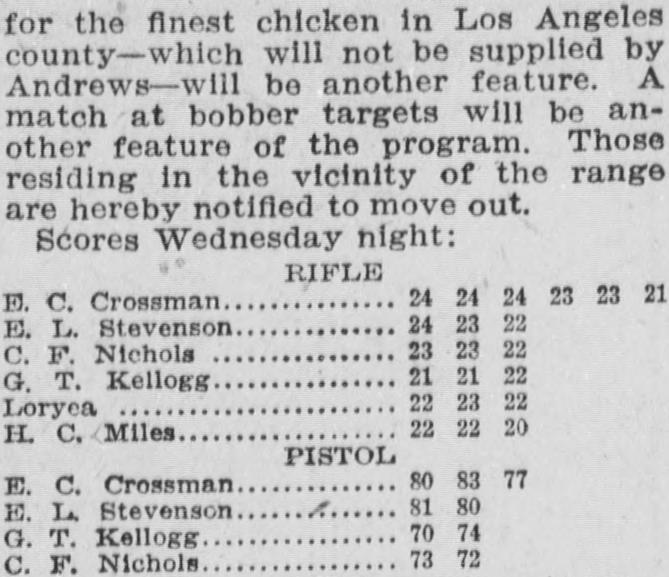
The warning to the neighbors and the night’s scores. Los Angeles Herald, April 23, 1910, page 11. Library of Congress, Chronicling America. Click the clipping to read it full size.
Sunday at the Glendale Range
The Los Angeles club’s outdoor range in Glendale was out in the open, with targets as far as 500 yards away. That is about five football fields. When Sunday, May 8, came, the Herald’s report the next morning said nothing about balloons. Instead, the club shot the first match of the new Pacific Coast Rifle and Revolver League, face to face, against the Southern California Rifles. It lost, 759 to 750.
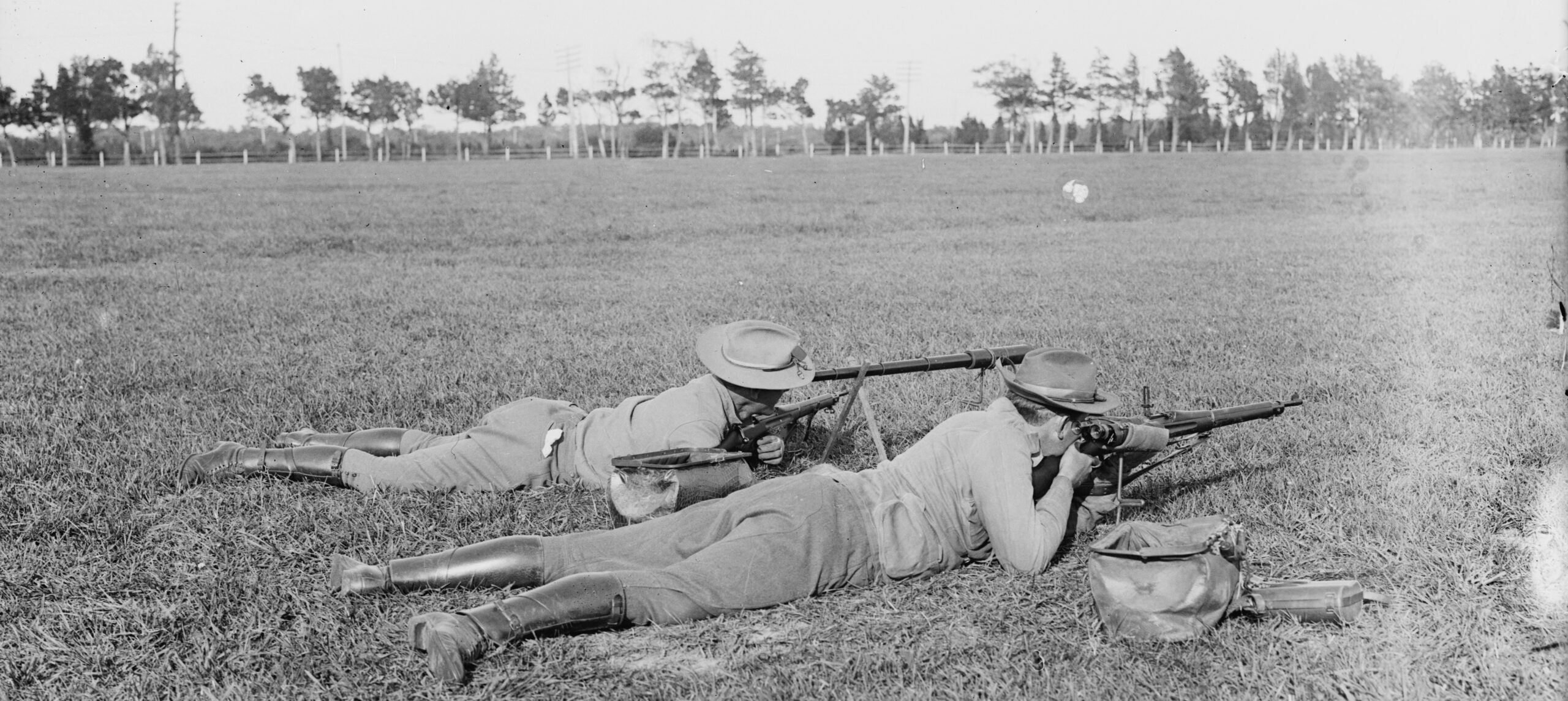
Long-distance target shooting at Sea Girt, New Jersey, 1908, like the club’s at Glendale. Bain News Service, Library of Congress. Click the picture to see it full size.
The Herald had the most fun with the excuses. “Opening up the excuse box is satisfying to the shooters, but does not win matches,” the paper said. Then it printed some of the best ones:
- Kellogg: “I had sickness in my family.”
- Crossman: “I just shot rotten.”
- Gore: “I lost the combination to my shooting bag.”
- Mrs. Crossman: “The sun was spoiling my complexio.”
Yes, a woman was on the firing line in 1910. Mrs. Crossman shot at the 500-yard target and started off with “twenty-three for her first five shots,” out of 25. A club member named Umsted brought lunch for everyone and broke up the shoot by “opening up the baked beans.” Families came along, and the report closed on a happy note: “The kids state they had a fine time.”
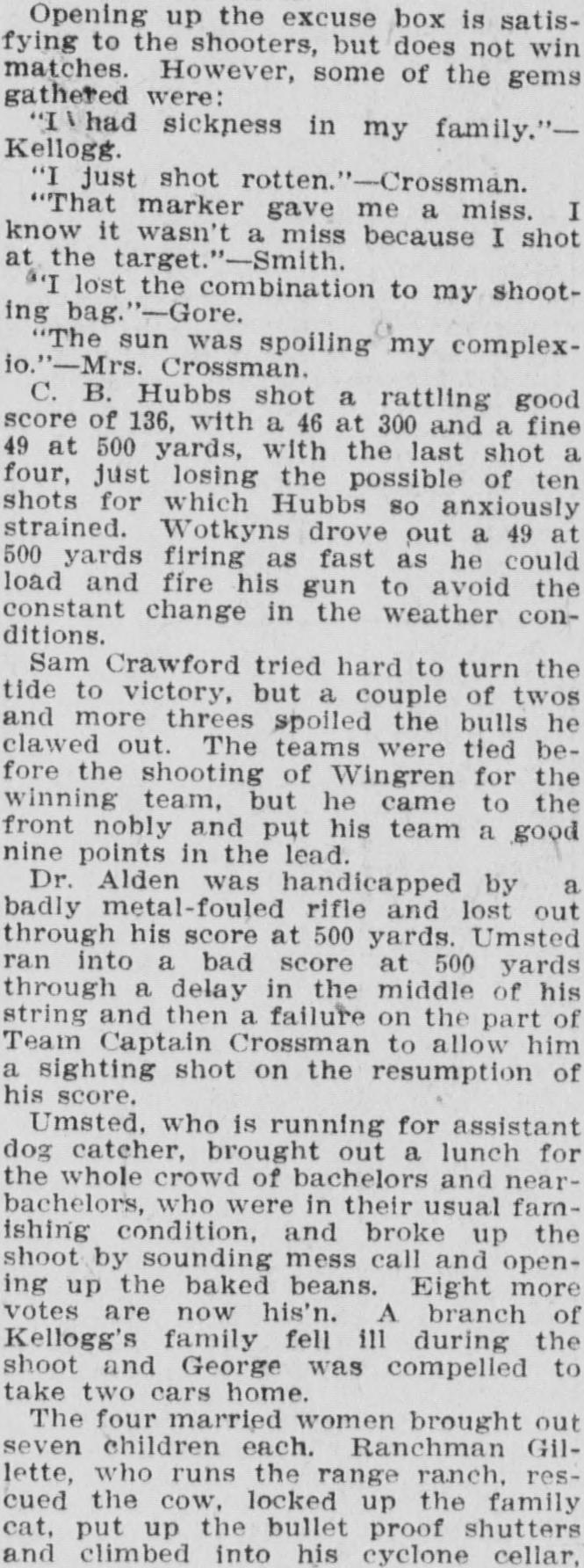
The excuse box. Los Angeles Herald, May 9, 1910, page 8. Library of Congress, Chronicling America. Click the clipping to read it full size.
What Food Cost in Los Angeles in 1910
On the same Los Angeles Herald page as the gospel-meeting story, Young’s Market Co., at 450 South Broadway, ran an ad for “Meat Bargains!” A milk-fed hen cost 25 cents a pound. Veal cutlets were 15 cents a pound, and the market’s own ham loaf was 20 cents. Two 10-cent loaves of kosher bread sold together for 15 cents. And “Fancy Sacramento Asparagus” was 5 cents a pound, or “6 pounds for 25c.”
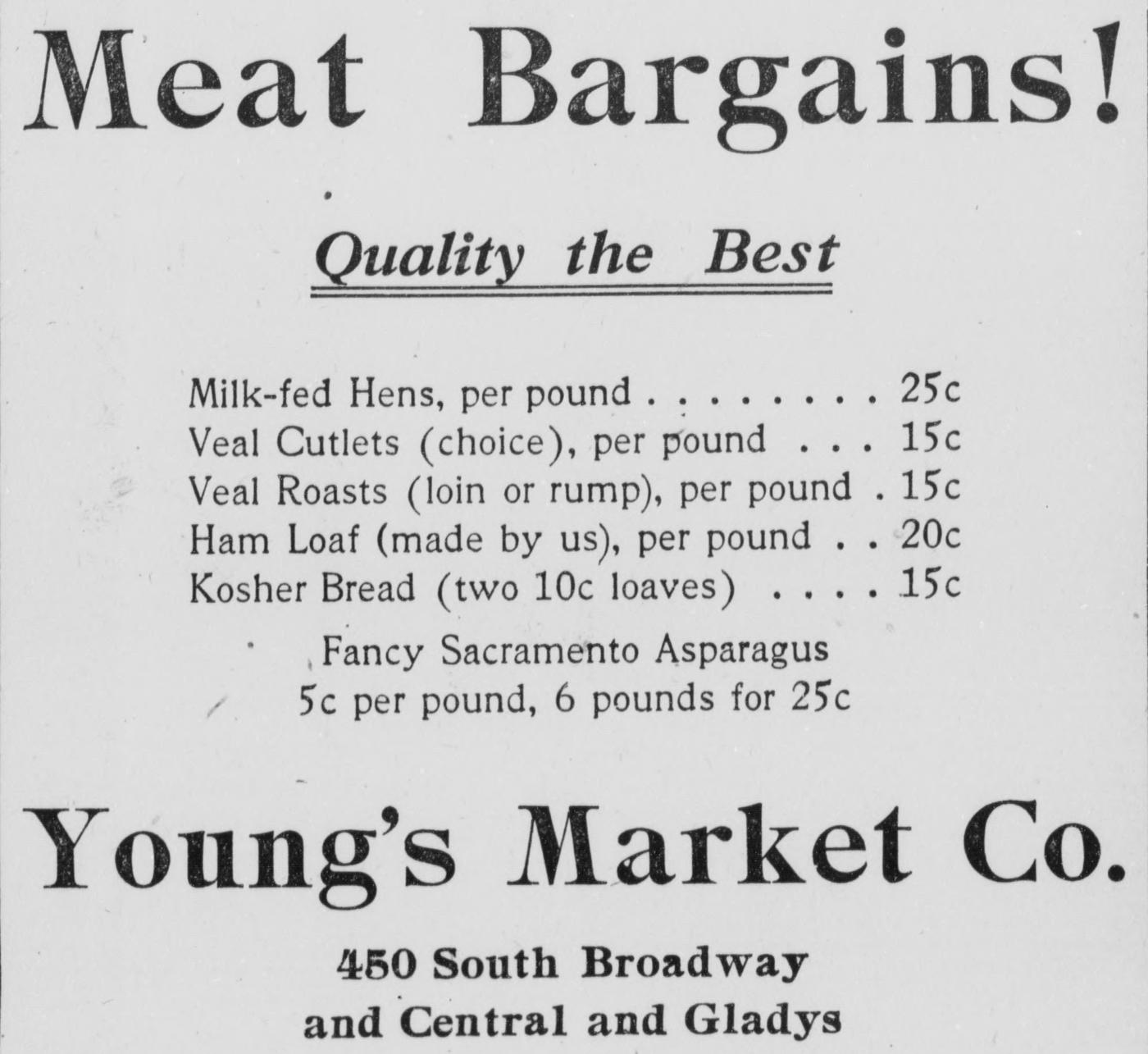
Young’s Market Co. ad, Los Angeles Herald, April 23, 1910, page 11. Library of Congress, Chronicling America. Click the clipping to read it full size.
Stevenson Kept Coming Back to the Los Angeles Range
The gospel meeting won that Wednesday night in Los Angeles, eighteen to one. But it didn’t scare off E. L. Stevenson. In September 1910 the Herald said the club would soon start indoor shooting again, partly “for the benefit of E. L. Stevenson of Pasadena, who refuses to shoot Sundays, but who will take three different cars and walk seventeen blocks to get a chance to shoot in the indoor series.” In 1910, “cars” in a sentence like that meant streetcars.
So the man who would not shoot on a Sunday rode three streetcars and walked seventeen blocks to shoot on a weeknight. The paper didn’t say which gun he planned to bring. For the sake of the gospel meeting on the third floor, let’s hope it was a quiet one.
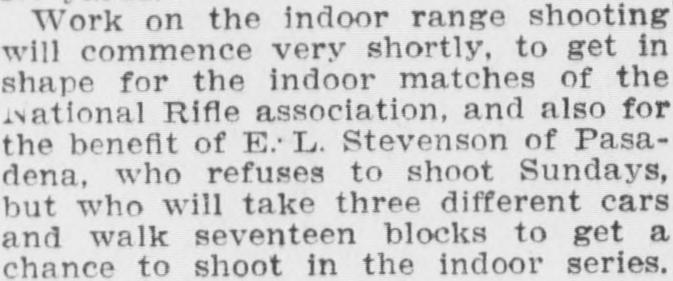
Los Angeles Herald, September 26, 1910, page 6. Library of Congress, Chronicling America. Click the clipping to read it full size.
Where We Found It
We found the gospel-meeting night in only one paper, the Los Angeles Herald, in its joking, unsigned column about the rifle club. Its names and scores match the club’s other Herald reports from 1909 and 1910.
Sources
- “Rifle and Revolver Experts in Practice,” Los Angeles Herald, Los Angeles, California, April 23, 1910, page 11: Library of Congress page scan. The Young’s Market Co. ad is on the same page.
- Indoor league rules, the unfinished Y.M.C.A. range and Stevenson’s elephant gun: Los Angeles Herald, January 23, 1910, page 31, Library of Congress page scan.
- Stevenson’s two-barreled gun: Los Angeles Herald, July 6, 1909, page 8, Library of Congress page scan.
- Sergeant Miles: Los Angeles Herald, June 21, 1909, page 7, Library of Congress page scan.
- The Glendale match and the excuse box: “Riflemen Are Victorious,” Los Angeles Herald, May 9, 1910, page 8, Library of Congress page scan.
- Stevenson and the indoor series: Los Angeles Herald, September 26, 1910, page 6, Library of Congress page scan.
- Y.M.C.A. building on South Hope Street: Los Angeles, the Old and the New, 1911, page 19, Internet Archive. Published 1911, public domain.
- Photo: “Shooting at Sea Girt,” 1908, Bain News Service, Library of Congress. No known restrictions on publication.
- Cover photo: “Revolver range, Sea Girt,” 1908, Bain News Service, Library of Congress. No known restrictions on publication.
- Newspaper pages printed before 1931 are in the public domain.