In the fall of 1911, people in Honolulu, Hawaii, were talking about a young man who said he could fly. They saw his picture in a flying helmet “with ear flaps to keep out the wind,” with goggles and puttees, the cloth wraps fliers wore on their legs. He sat in the seat of a brand-new biplane. He called himself H. Kenneth Gordon, aviator, and he was going to circle over Diamond Head.
He never did. Months later The Hawaiian Gazette summed it up: Gordon “rose no higher than that seat and the biplane never left the floor.” The floor was in a Honolulu garage. The plane belonged to a local man who had built it with two friends. And the name Gordon belonged to nobody at all.
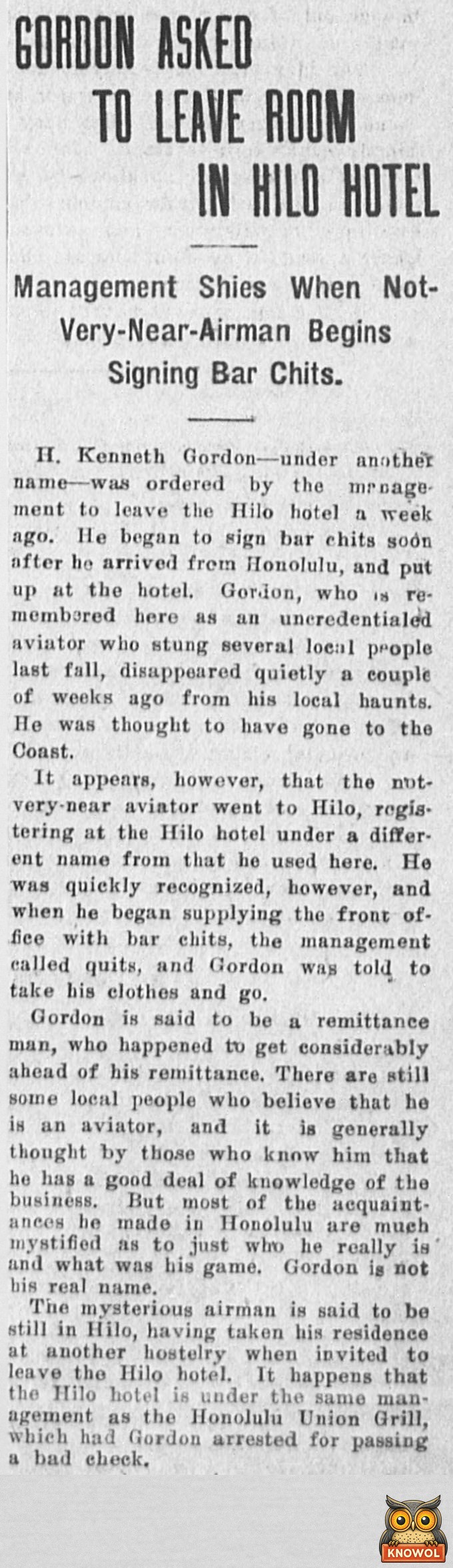
“Gordon Asked to Leave Room in Hilo Hotel,” The Hawaiian Gazette, Honolulu, Tuesday, March 26, 1912, page 5. Library of Congress, Chronicling America. Click the clipping to read it full size.
A Flier Steps Off the Ship in Honolulu
H. K. Gordon landed in Honolulu in November 1911, off the steamship Mongolia. The Hawaiian Star said he was “a demonstrator of the Curtiss machines.” Glenn Curtiss built some of the best-known airplanes in America, so that was a big claim. The paper said he would “remain here about six weeks, when he will depart for Australia.”
Airplanes were still new and rare in Hawaii, where the American flier J. C. “Bud” Mars had flown one at Moanalua, just outside the city, at the start of 1911. A real flier in town was big news.
Gordon made friends fast, and he offered to teach a member of the National Guard to fly, for free. “I’m not looking for any glory and I don’t want any medals,” he said. “I don’t even want you to put my name in black type.” By black type he meant bold print in the newspaper. He also began planning a Christmas air meet with the Elks lodge, with army-style stunts and searchlights from Fort Ruger.
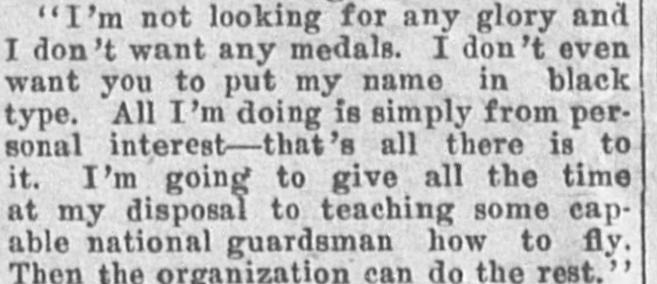
Gordon’s offer to the National Guard. The Hawaiian Gazette, November 24, 1911, page 2. Library of Congress, Chronicling America. Click the clipping to read it full size.
The Gazette later called him “an unusually good talker” who “talked aviation like an old-timer at the game.” He was, in the paper’s words, “much entertained and even lionized in Honolulu.”
The Plane Built in a Honolulu Garage
Gus Schaefer of Honolulu had never flown a plane. Then he watched Bud Mars fly at Moanalua, and, as the Evening Bulletin put it, “Schaefer got the flying fever.” In January 1911 he and two friends, W. Eddy and G. I. Brown, began building their own Curtiss-style biplane at the Royal Hawaiian Garage. A boat builder named Walker shaped the wooden frame.
By September the plane weighed about 800 pounds, and its wings stretched 30½ feet from tip to tip. The Hawaiian Star noted, “Schaefer has had no previous flying experience.” The builders planned to test it at Leilehua, an open army field in the middle of the island of Oahu, “free from tricky air currents.”
In October, twenty boys met at the new Y.M.C.A. building to plan model planes for a contest run by the Evening Bulletin. Schaefer came too, and he brought “a beautifully constructed model of his big machine” and gave the boys tips on “the quality of varnished silk and bamboo” for model building. The paper said he “may appear over the roofs of Honolulu any day now.”
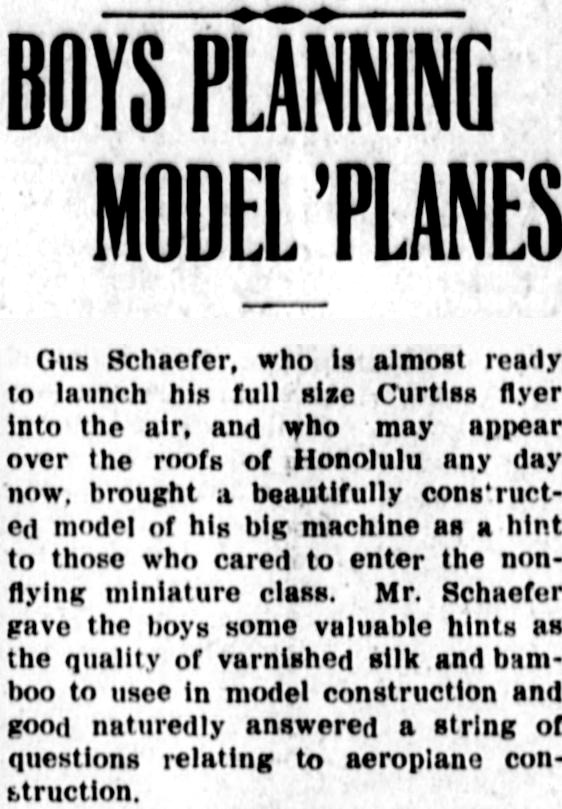
Gus Schaefer helps Honolulu boys with their model planes. Evening Bulletin, Honolulu, October 18, 1911, page 6. Library of Congress, Chronicling America. Click the clipping to read it full size.
When the man from the Mongolia came to see Schaefer’s plane, he loved it. “I was simply astounded at the perfection of the machine,” Gordon said. He agreed to buy it for $4,800, a fortune in 1911. The Star added one more detail: “Incidentally he borrowed $35 from Schaefer.”
A Telegram From San Francisco
The Elks lodge in Honolulu wanted to know more about its star flier. Someone sent a question to San Francisco, and on December 9, 1911, a telegram came back from a member of the Bohemian Club there. Telegrams cost money by the word, so it was short:
“Aviator Emmet Gordon now flying in New York. Your party probably ex-chauffeur. His only connection aviation unsuccessful attempt to fly at Presidio.”
A chauffeur was a man paid to drive other people’s cars, and the Presidio is an army post in San Francisco. In short, Honolulu’s Gordon was probably a driver who had once tried to fly and failed.
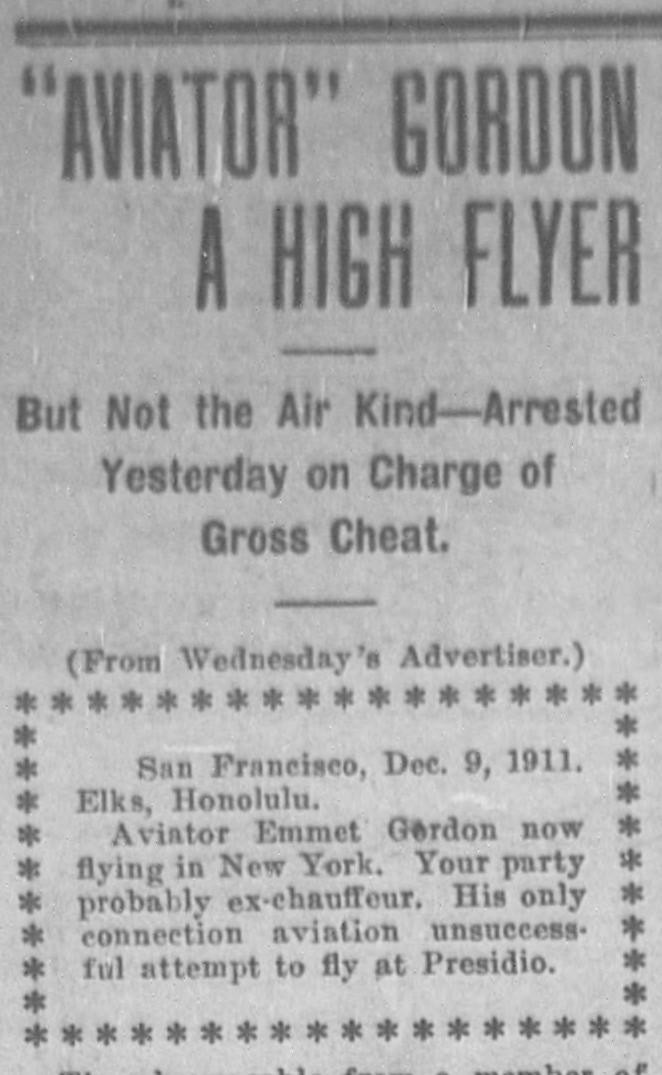
The telegram from San Francisco. The Hawaiian Gazette, December 15, 1911, page 2. Library of Congress, Chronicling America. Click the clipping to read it full size.
“Gordon to Surely Fly”
On the afternoon of Tuesday, December 12, 1911, Honolulu’s Evening Bulletin ran a cheerful story headlined “GORDON TO SURELY FLY.” It quoted him: “I certainly won’t leave Honolulu after all this talk without doing some flying.”
At almost the same hour, a Honolulu detective arrested him. The Gazette said the arrest was “almost simultaneous” with the cheerful story. The charge was “gross cheat,” the old legal name for cheating someone on purpose. Gordon had paid with a check for $15.00, and there was no money behind it. The Gazette called the whole affair “one of the strangest bunco games ever worked in Honolulu,” using an old word for a swindle.
A friend paid his bills, and Gordon kept right on talking. “I never heard of an Emmet Gordon as a licensed pilot. I am a licensed pilot,” he told the Hawaiian Star. When people asked to see his papers, he had an answer ready. “What good are credentials to an aviator, anyway? He can’t fly with credentials.”
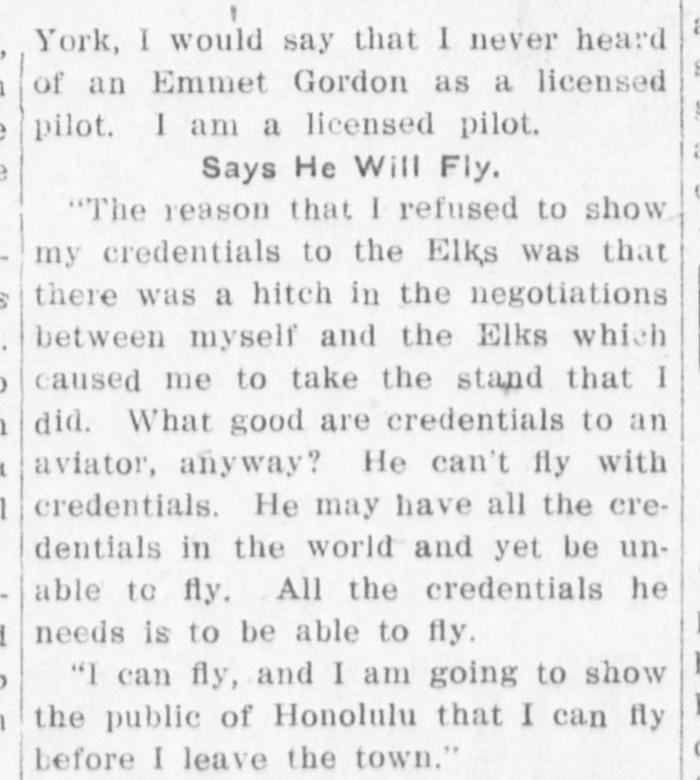
“What good are credentials to an aviator, anyway?” The Hawaiian Star, December 13, 1911, page 1. Library of Congress, Chronicling America. Click the clipping to read it full size.
Honolulu’s morning paper, the Advertiser, cabled the Aero Club in New York, which gave out pilot licenses. The answer came back that afternoon: “Gordon not licensed.”
On December 27, Judge Monsarrat found Gordon guilty and fined him $50 and costs. The check had gone to John Romaines, manager of the Union Grill. Gordon said he had written it thinking that by the time it reached the bank, he would have the money. The prosecutor, Mr. Brown, said that from what he could learn, Gordon “was rather a fine fellow.” But “This little community,” he added, “must be protected from shady check transactions.”
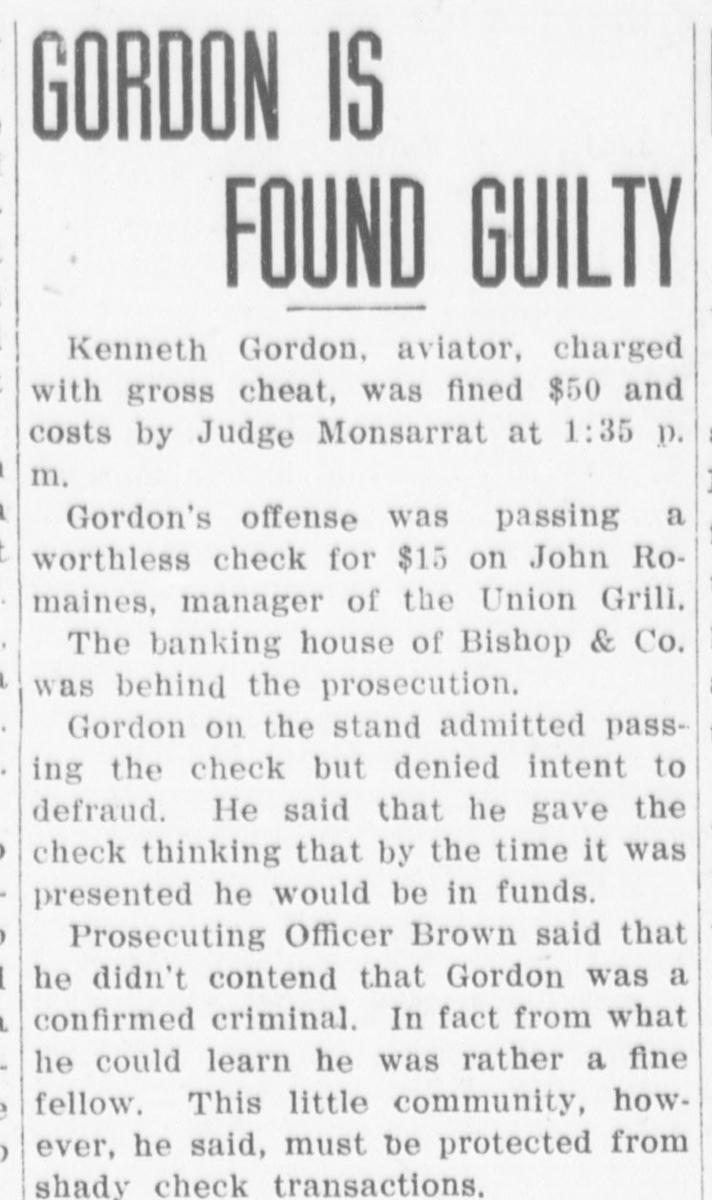
“Gordon Is Found Guilty.” The Hawaiian Star, December 27, 1911, page 8. Library of Congress, Chronicling America. Click the clipping to read it full size.
Told to Leave a Hotel in Hilo, Hawaii
In March 1912, Gordon quietly slipped out of Honolulu. People thought he had sailed for the mainland. Instead he turned up in Hilo, Hawaii, on the Big Island, using a different name.
He checked into the Hilo hotel and soon began signing bar chits, the little slips guests signed instead of paying, as a promise to pay later. Somebody recognized him right away. “When he began supplying the front office with bar chits, the management called quits, and Gordon was told to take his clothes and go.”
The Gazette told the story on March 26, 1912. It called him the “not-very-near aviator.” It said he was “a remittance man, who happened to get considerably ahead of his remittance.” That meant a man living far from home on money his family mailed to him, who had spent it before it came. It added, “Gordon is not his real name.” Some people in Honolulu still believed he could fly.
Then came the best part. “It happens that the Hilo hotel is under the same management as the Honolulu Union Grill, which had Gordon arrested for passing a bad check.” Of all the hotels in Hawaii, he had picked the one run by the same people he had already cheated.
Plain Peter Grimes of Scranton, Pennsylvania
On July 26, 1912, The Hawaiian Gazette in Honolulu finally printed his real name: Peter Archbold Gordon Grimes, “just plain Grimes,” of Scranton, Pennsylvania, where “he was a drug clerk.” Back home he had written checks worth “about $50” with no money in the bank. Then he “departed one night by the light of the moon.” He drifted to Shanghai, Hong Kong and San Francisco before he reached Honolulu.
A Honolulu man named W. O. Phillips was shown the picture and knew him at once. “Why, he couldn’t run an automobile, much less fly an aeroplane,” Phillips said.
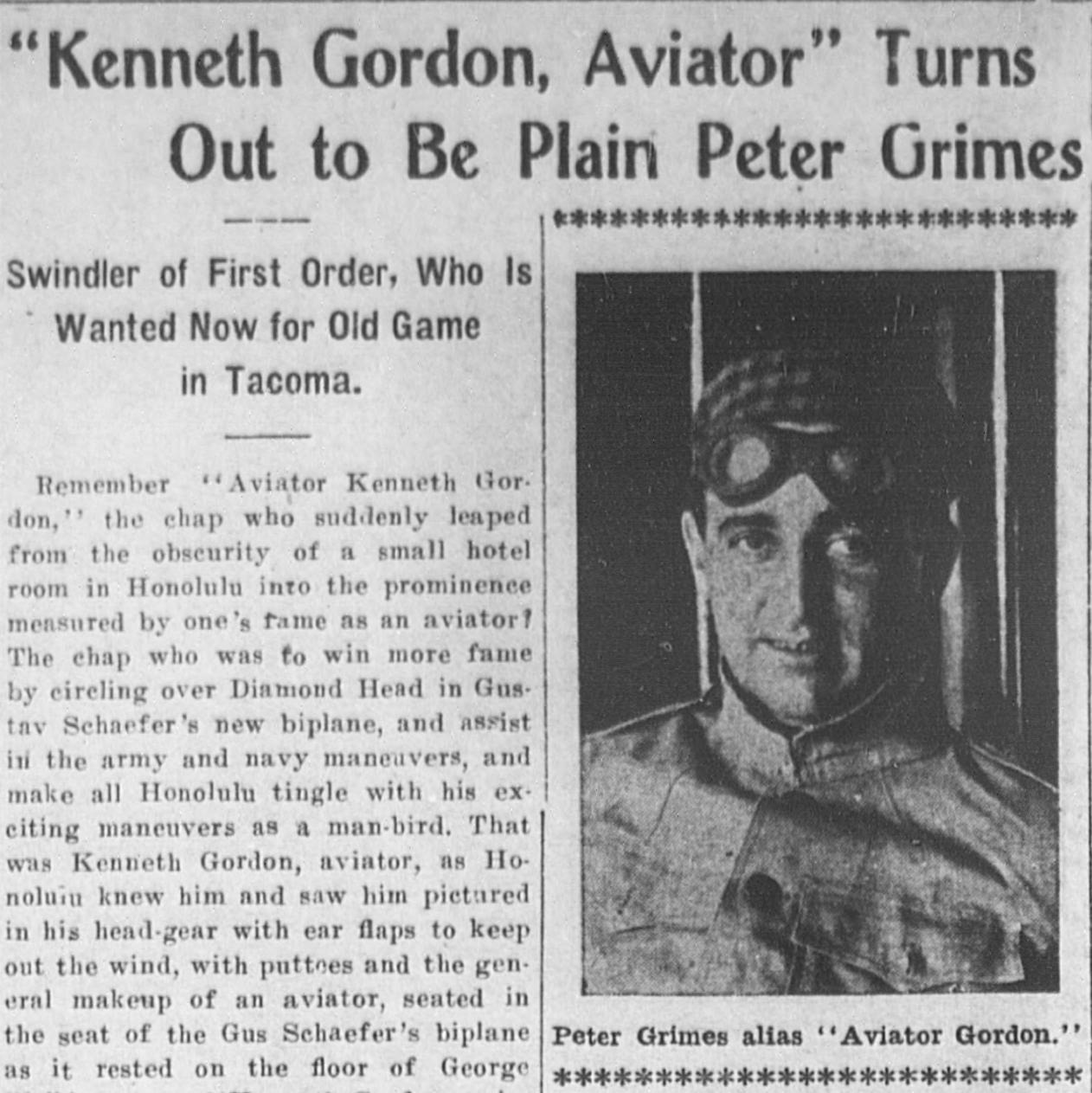
“Kenneth Gordon, Aviator” in his flying cap and goggles. The Hawaiian Gazette, July 26, 1912, page 6. Library of Congress, Chronicling America. Click the clipping to read it full size.
That summer he turned up in Washington state, still close to airplanes and still writing checks. On July 10, 1912, The Tacoma Times reported that “James K. Gordon, manager for Capt. James V. Martin, the aviator,” was wanted for “passing a bogus check for $25” to pay for a room at the Y.M.C.A. The Gazette said it was the same man.
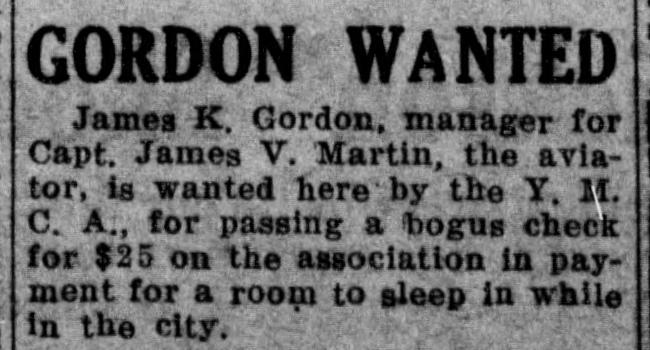
“Gordon Wanted.” The Tacoma Times, Tacoma, Washington, July 10, 1912, page 7. Library of Congress, Chronicling America. Click the clipping to read it full size.
The Garage Plane Flew Anyway
Back on Oahu, Gus Schaefer’s plane did not need Gordon. On Sunday, December 31, 1911, it went up at Leilehua. The pilot was Burton Dryer, a sailor from the Navy cruiser West Virginia. The Hawaiian Star said “he had made a successful flight.” Then he went up again to give an exhibition flight, and the plane fell. Dryer hurt his hip and his foot, and one wing was smashed.
Two weeks later the Bulletin had good news. Dryer was “almost completely recovered,” and “in another day or so he will be able to report for duty.” “I’ve worked on the plane for a whole year,” Schaefer said, “and if it had proved a failure I would be inclined to let the thing go for a while, but it acted so well for the short time that it was in the air that I want to go on with it.”
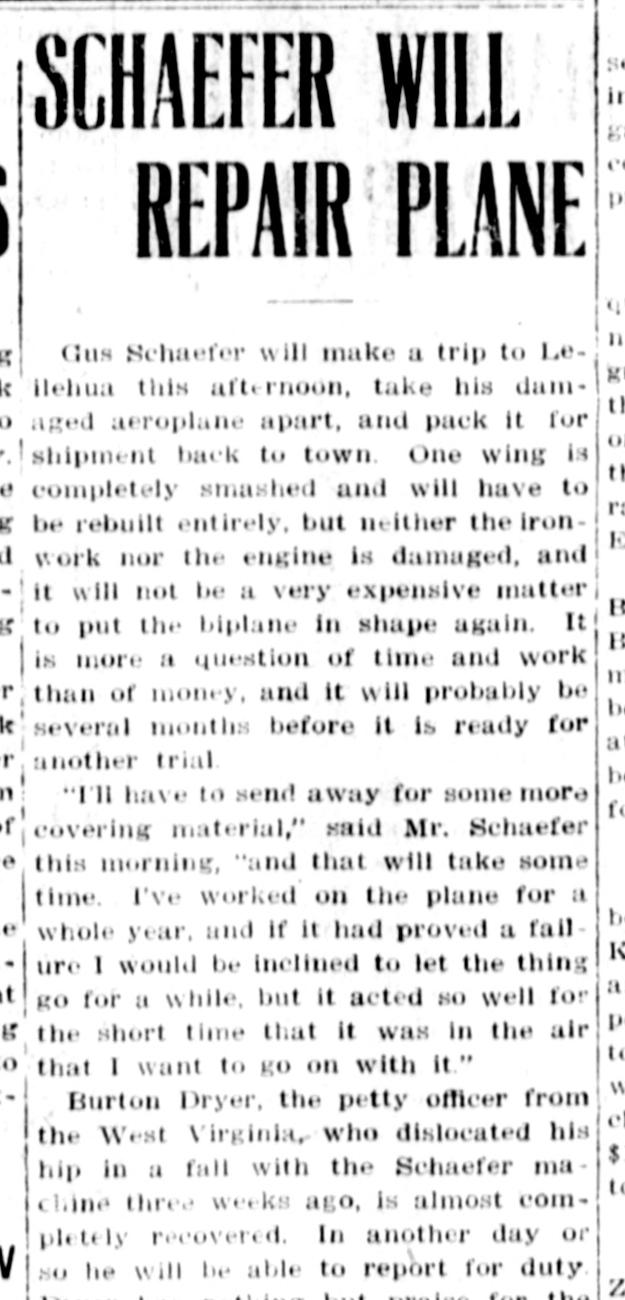
“Schaefer Will Repair Plane.” Evening Bulletin, Honolulu, January 13, 1912, page 9. Library of Congress, Chronicling America. Click the clipping to read it full size.
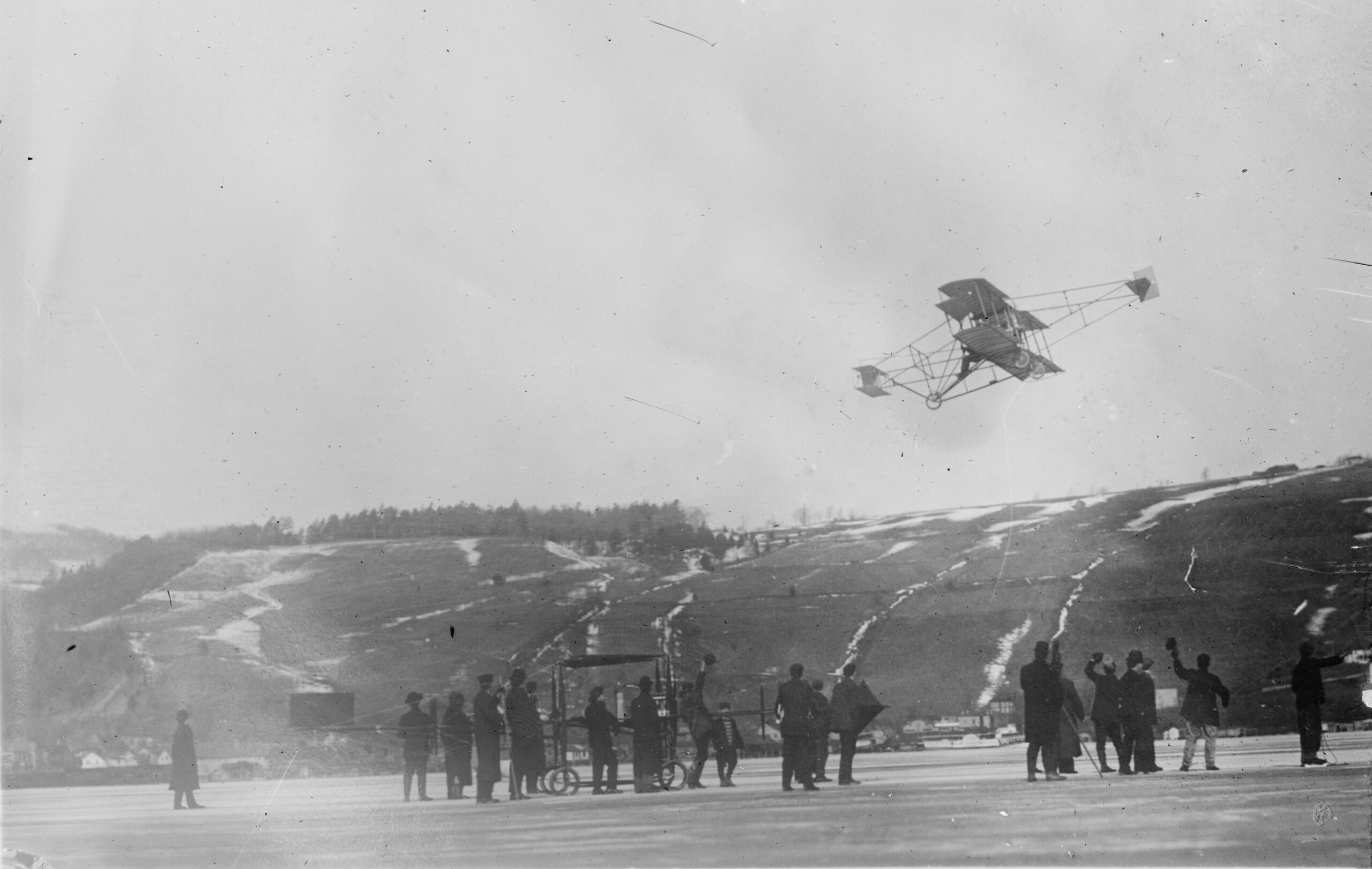
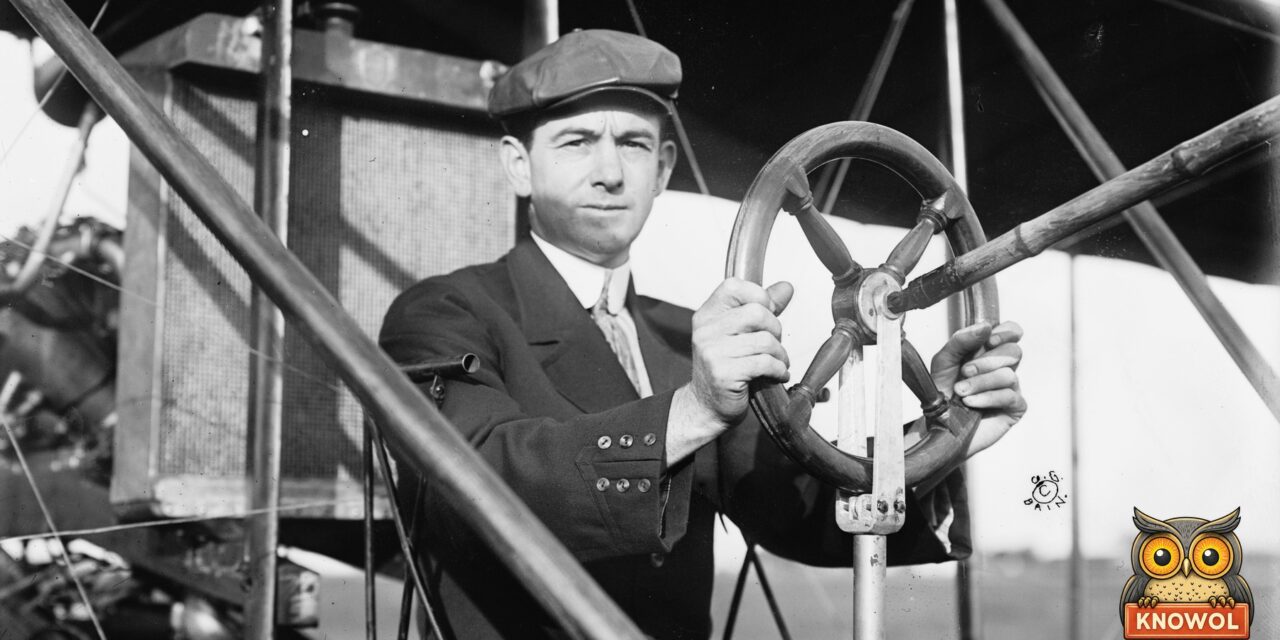
Bud Mars flying a Curtiss biplane like the one Gus Schaefer copied, about 1910 (place not named). Bain News Service, Library of Congress. Click the picture to see it full size.
The picture at the top of this story shows the real flier, J. C. “Bud” Mars, at the wheel of a Curtiss biplane about 1910. His flights at Moanalua were what gave Gus Schaefer the flying fever.
In May 1912 the Star heard that an army air squadron would be based in Hawaii, and it could not resist one last joke. “Too bad ‘Aviator’ Gordon went away,” it said. “Had he remained he might have enlisted and flown something else beside the coop.” To fly the coop means to run away, and that was the only flying Gordon ever did.
Sources
- “Gordon Asked to Leave Room in Hilo Hotel,” The Hawaiian Gazette, Honolulu, March 26, 1912, page 5: Library of Congress page scan.
- Gordon arrives on the Mongolia: The Hawaiian Star, November 17, 1911, page 3, Library of Congress page scan.
- Gordon’s offer to the National Guard: The Hawaiian Gazette, November 24, 1911, page 2, Library of Congress page scan.
- “Simply astounded” at Schaefer’s plane: The Hawaiian Gazette, November 28, 1911, page 3, Library of Congress page scan.
- Schaefer’s biplane: The Hawaiian Star, September 6, 1911, page 1, Library of Congress page scan; Evening Bulletin, March 18, 1911, page 10, Library of Congress page scan.
- “Boys Planning Model ‘Planes”: Evening Bulletin, October 18, 1911, page 6, Library of Congress page scan.
- “Gordon to Surely Fly”: Evening Bulletin, December 12, 1911, page 9, Library of Congress page scan.
- The $4,800 deal, the $35 loan and “What good are credentials”: The Hawaiian Star, December 13, 1911, page 1, Library of Congress page scan.
- The telegram and the arrest: “‘Aviator’ Gordon a High Flyer,” The Hawaiian Gazette, December 15, 1911, page 2, Library of Congress page scan.
- “Gordon not licensed”: “Aero Club Does Not Know Gordon,” The Hawaiian Gazette, December 15, 1911, page 3, Library of Congress page scan.
- The arrest by wire: “Aviator Arrested in Honolulu,” Evening Star, Washington, D.C., December 13, 1911, page 2, Library of Congress page scan.
- “Gordon Is Found Guilty”: The Hawaiian Star, December 27, 1911, page 8, Library of Congress page scan.
- The fall at Leilehua: The Hawaiian Star, January 1, 1912, page 1, Library of Congress page scan.
- “Schaefer Will Repair Plane”: Evening Bulletin, January 13, 1912, page 9, Library of Congress page scan.
- The “coop” joke: The Hawaiian Star, May 9, 1912, page 4, Library of Congress page scan.
- “Gordon Wanted”: The Tacoma Times, July 10, 1912, page 7, Library of Congress page scan.
- “‘Kenneth Gordon, Aviator’ Turns Out to Be Plain Peter Grimes”: The Hawaiian Gazette, July 26, 1912, page 6, Library of Congress page scan.
- Photo: “J.C. Mars in Curtiss Aeroplane,” about 1910, Bain News Service, Library of Congress. No known restrictions on publication.
- Cover photo: “J.C. Mars,” about 1910, Bain News Service, Library of Congress. No known restrictions on publication.
- Newspaper pages printed before 1931 are in the public domain.