One summer night in 1905, the beach cottages of Madison, Connecticut, filled with screams. First one girl shrieked, then another, until the noise “swelled into a chorus and aroused the whole colony.” Every young woman who’d gone on that day’s picnic had climbed into bed and found a live bullfrog waiting for her. The prankster was the President’s son.
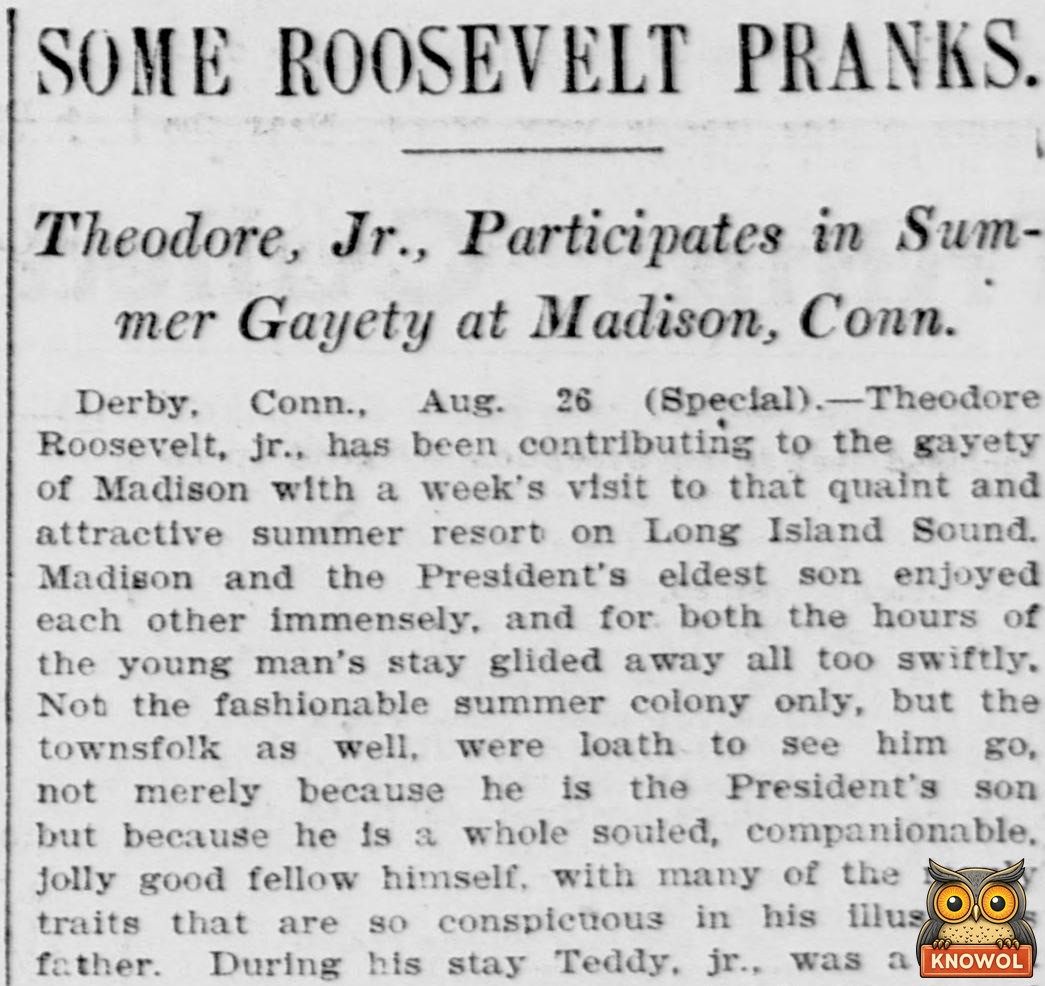
“Some Roosevelt Pranks.” New-York Tribune, New York, New York, August 27, 1905. Library of Congress, Chronicling America. Click the clipping to read it full size.
The President’s son comes to town
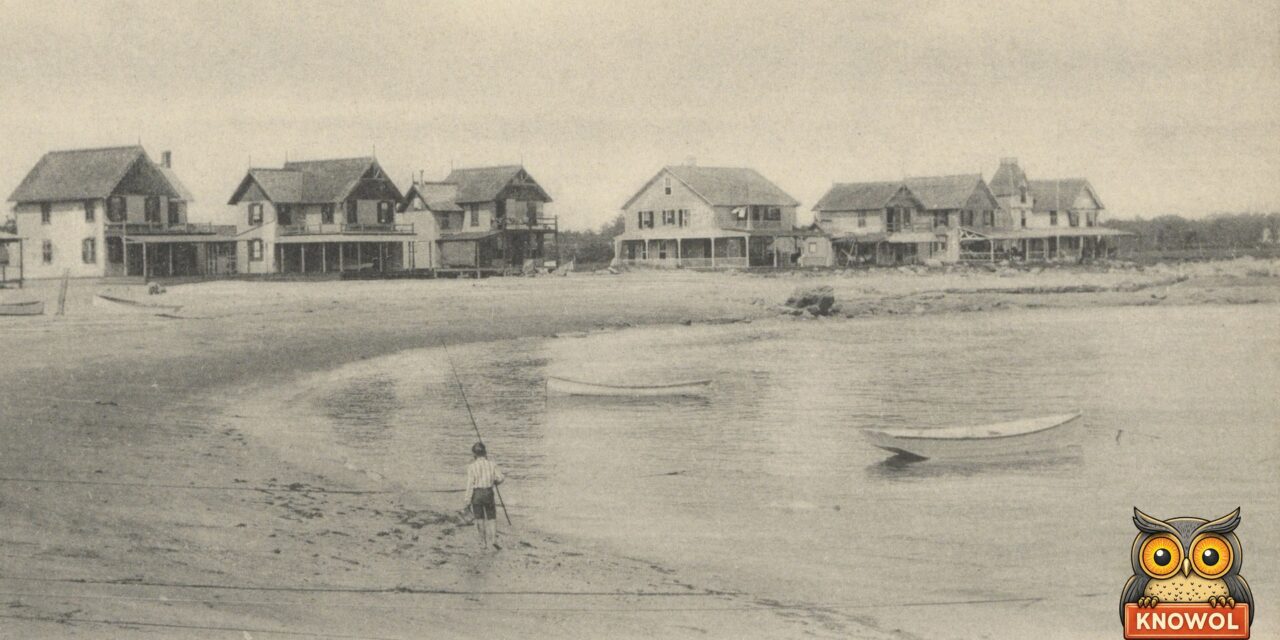
Theodore Roosevelt Jr. was 17 that summer. People called him Teddy, just like his famous father, President Theodore Roosevelt. He spent a week in Madison, a summer resort town on Long Island Sound, as a guest at the cottage of Mr. and Mrs. E. S. Martin of New York. The cover picture shows Madison’s beach cottages on a postcard printed that same year.
The New-York Tribune said the whole town hated to see him go, “not merely because he is the President’s son but because he is a whole souled, companionable, jolly good fellow himself.” He was also full of tricks. The paper said all of Madison was still laughing about his jokes weeks later.
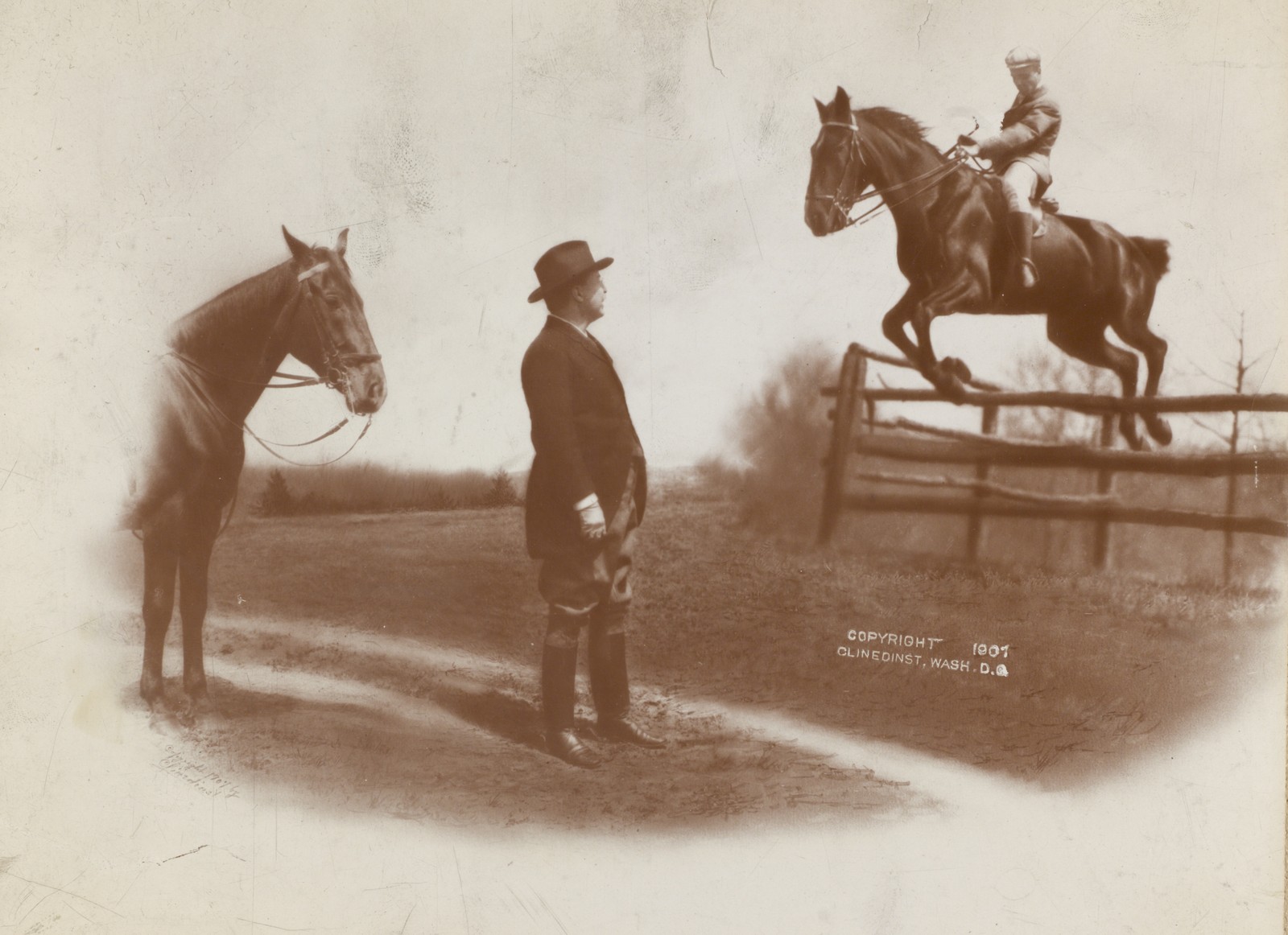
President Theodore Roosevelt and, jumping a fence on horseback, his son Theodore Jr., in a picture made in 1907, two years after the Madison summer. Photo by B. M. Clinedinst. Library of Congress. Click the picture to see it full size.
The cakewalk
The biggest party of the week was a costume party in Teddy’s honor at the cottage of Mrs. Marion Wilcox of New York. The main event was a cakewalk. That was a strutting dance contest where couples paraded with high, proud steps and fancy arm moves, and judges picked the best pair. The prize was a cake. The dance began among enslaved Black people on Southern plantations, who used it to make fun of their enslavers’ stiff, fancy manners. By 1905 it was a party craze all over the country.
Teddy took it seriously. When he heard there’d be a cakewalk, a New Haven paper said, “he at once went into training for the event,” practicing his strut. He also told his hostess he’d only try for the prize if there was “a fair field and no favor.” In other words, nobody could go easy on him just because his dad was the President.
Twelve couples danced to a band of mandolins and guitars. Teddy and his partner were doing great “when Teddy suddenly went down.” He’d “put his foot through a defective board,” which means a broken board in the floor. Friends helped “the dismayed youth to his feet,” and he wasn’t hurt. When the dance ended, Teddy made up for his fall in true Roosevelt style. He “turned a somersault and a handspring.” The judges gave the cake to Teddy and his partner, “and the verdict of all was that they had won on their merits.”
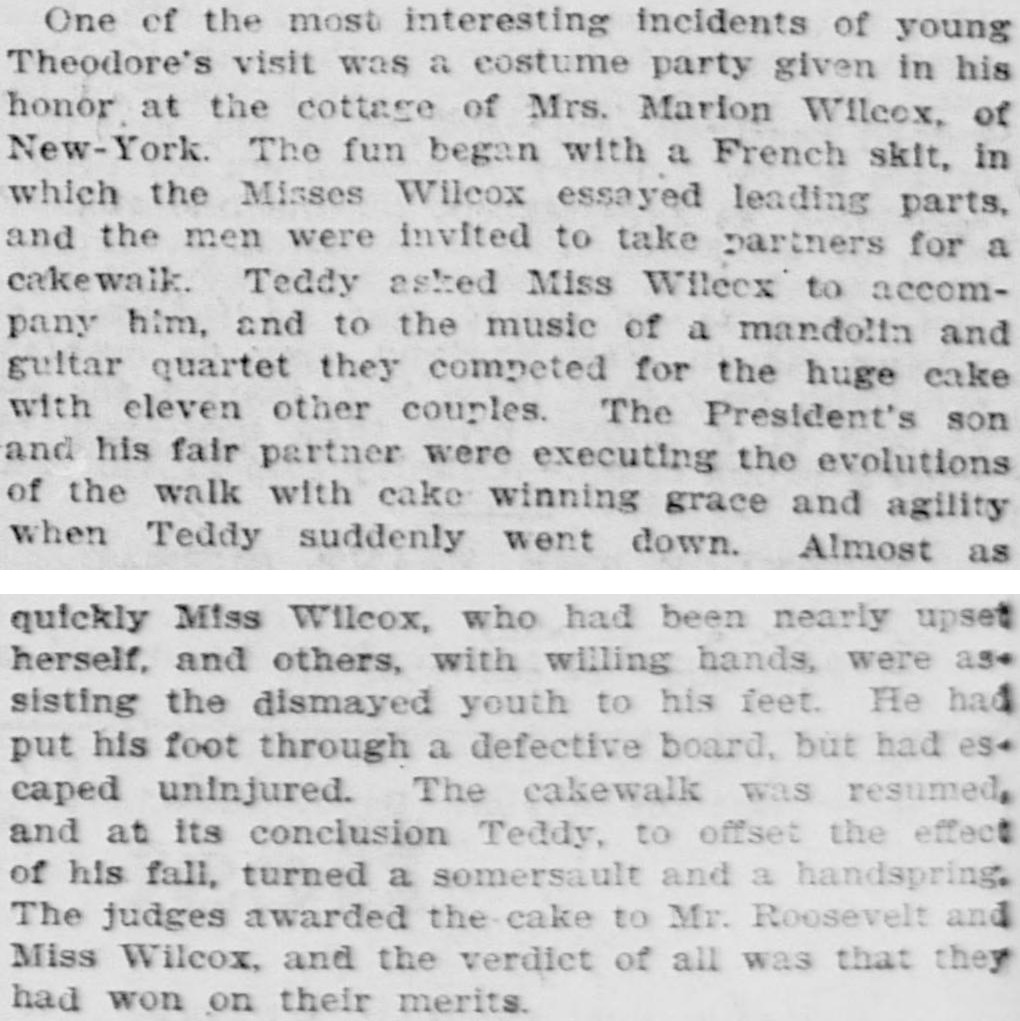
The cakewalk, as the New-York Tribune told it. New-York Tribune, New York, New York, August 27, 1905. Library of Congress, Chronicling America. Click the clipping to read it full size.
The bullfrog trick
At another party, Teddy posed as a statue, “but could not repress a fatal smile.” He also joined “a merry company of fifty” hunting for a parrot hidden in a garden, and lost it to another guest after “a short, sharp struggle.”
Then came the picnic. Just before everyone headed home, Teddy went missing. When the others got back, he greeted them with “a plausible explanation,” which means an excuse that sounded true. Nobody thought more about it. That night he asked for one last song before bed, “Oh, the Bullfrog on the Bank,” and sang it “with a vim unusual even in a Roosevelt.” Then everyone said good night.
“A few minutes later there began a succession of feminine shrieks,” the Tribune reported. Each young woman from the picnic “had found in her bed a bullfrog that had become lively upon being disturbed.” The young men got frogs too. And who rushed in to help carry the frogs back outside? Teddy himself.
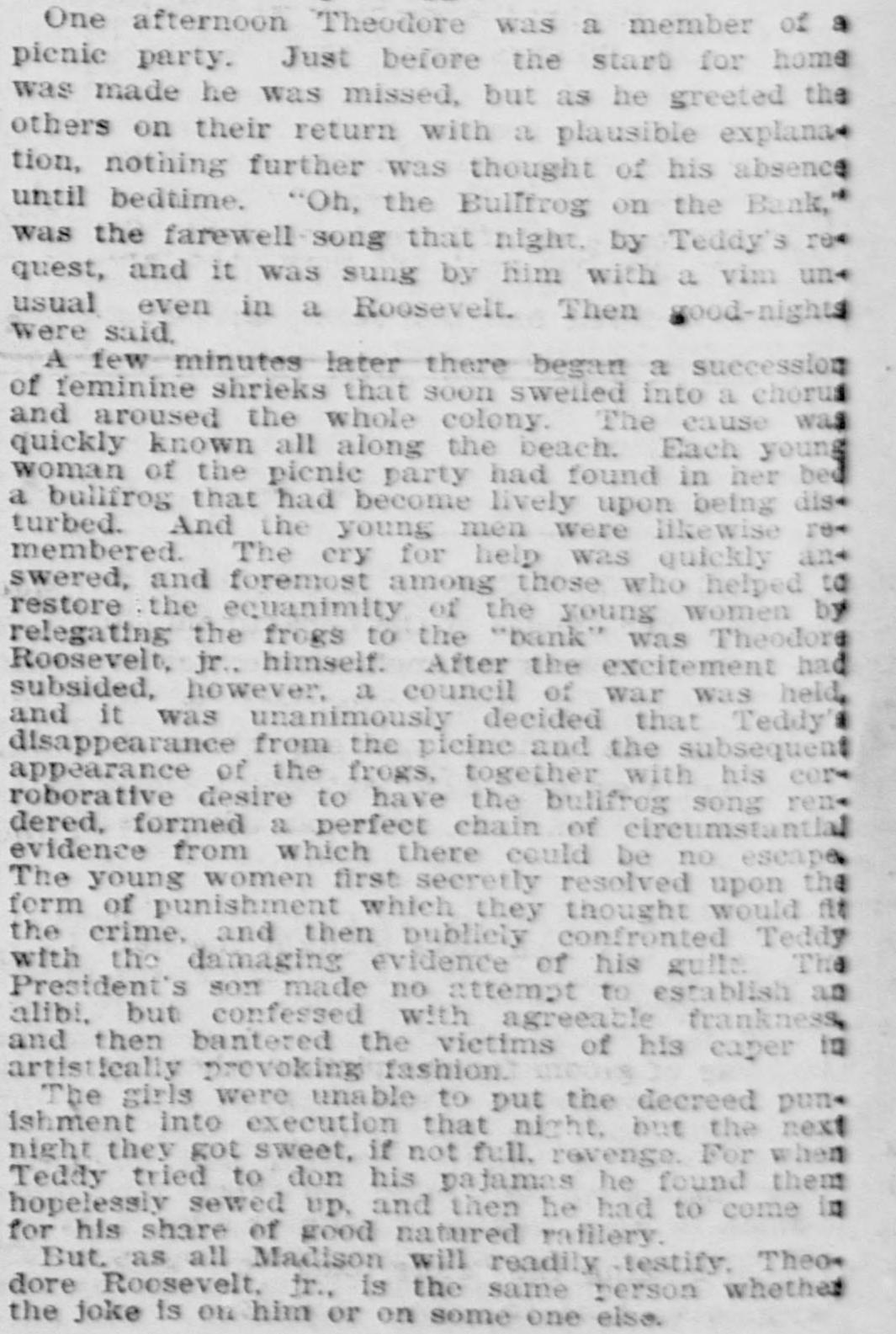
The night of the bullfrogs. New-York Tribune, New York, New York, August 27, 1905. Library of Congress, Chronicling America. Click the clipping to read it full size.
Case closed
The girls held “a council of war” and played detective. They had three clues. Teddy had disappeared from the picnic, frogs had turned up in their beds, and he’d begged for the bullfrog song. Together, the Tribune said, that made “a perfect chain of circumstantial evidence,” meaning clues that all pointed the same way.
When they faced him with it, Teddy didn’t make excuses. He “confessed with agreeable frankness” and then teased them about it. The girls got even the next night. When Teddy went to put on his pajamas, “he found them hopelessly sewed up.”
Three papers, three partners
Here’s the strange part. The newspapers couldn’t agree on who danced with Teddy. A New Haven paper said he picked “the prettiest girl in Madison, Miss Martin, the daughter of his host.” The Tribune said his partner was a Miss Wilcox. News of the cakewalk even reached Lexington, Missouri, where the local paper teased, “If Teddy is not more careful to keep clear of public attention he may incur the serious displeasure of his father.”
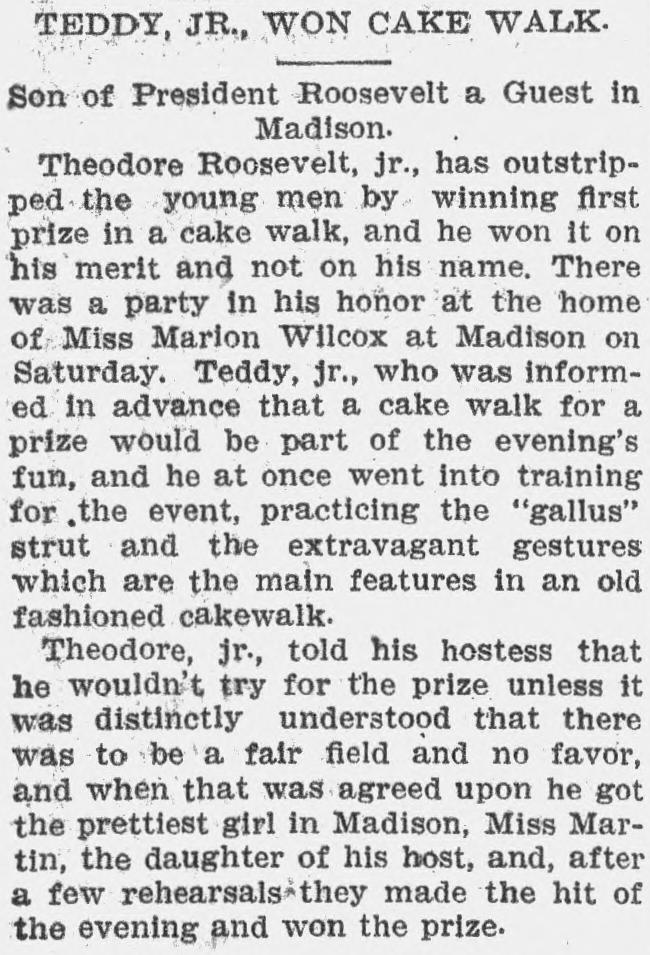
“Teddy, Jr., Won Cake Walk.” The Morning Journal and Courier, New Haven, Connecticut, August 8, 1905, page 5. Library of Congress, Chronicling America. Click the clipping to read it full size.
Then the story kept traveling. By December, a brand-new version was going around Madison, and newspapers called it “the grocery-store tale.” In this one, a girl named Miss Inez Sanchez played a trick on Teddy. During the cakewalk she “led her partner to a trap door,” and he went “tumbling among tin pans and cracker boxes into the cellar.” A few days later, the tale said, Teddy got even by putting frogs in her bed.
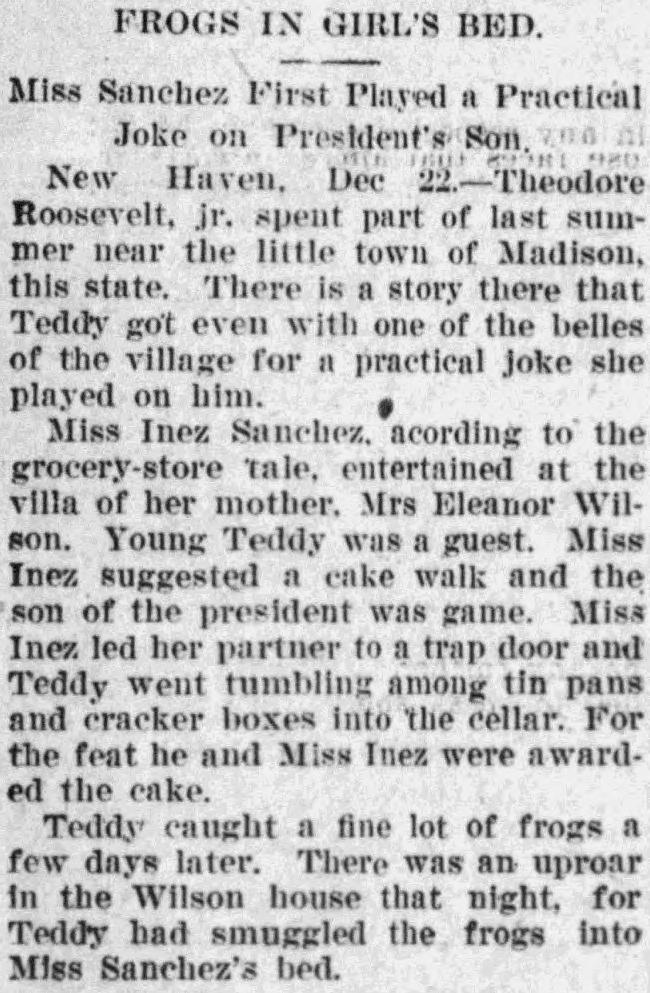
“Frogs in Girl’s Bed.” The Waterbury Evening Democrat, Waterbury, Connecticut, December 22, 1905, page 5. Library of Congress, Chronicling America. Click the clipping to read it full size.
Papers in Waterbury, Connecticut, and Washington, D.C., printed the new version. None of the summer reports mention an Inez Sanchez or a trap door. In four months, a broken board had turned into a trap door, and frogs for a whole picnic party had turned into revenge on one girl. It was like a game of telephone played by a whole town. The one thing everyone agreed on was how Teddy took a joke. As the Tribune put it, he was “the same person whether the joke is on him or on some one else.”
Sources
- New-York Tribune (New York, New York): August 27, 1905 (“Some Roosevelt Pranks”).
- The Morning Journal and Courier (New Haven, Connecticut): August 8, 1905, page 5 (“Teddy, Jr., Won Cake Walk”).
- The Lexington Intelligencer (Lexington, Missouri): August 12, 1905, page 4.
- The Waterbury Evening Democrat (Waterbury, Connecticut): December 22, 1905, page 5 (“Frogs in Girl’s Bed”).
- The Washington Times (Washington, D.C.): December 23, 1905, page 3 (“T. Roosevelt, Jr., Put Frogs in Bed”).
- All newspaper images: Library of Congress, Chronicling America.
- Cover: “Cottages along Beach, Madison, Conn.,” postcard, copyright 1905 by the Rotograph Co., Library of Congress, no known restrictions on publication.
- President Roosevelt and son, Theodore Jr.: photo by B. M. Clinedinst, 1907, Library of Congress, no known restrictions on publication.