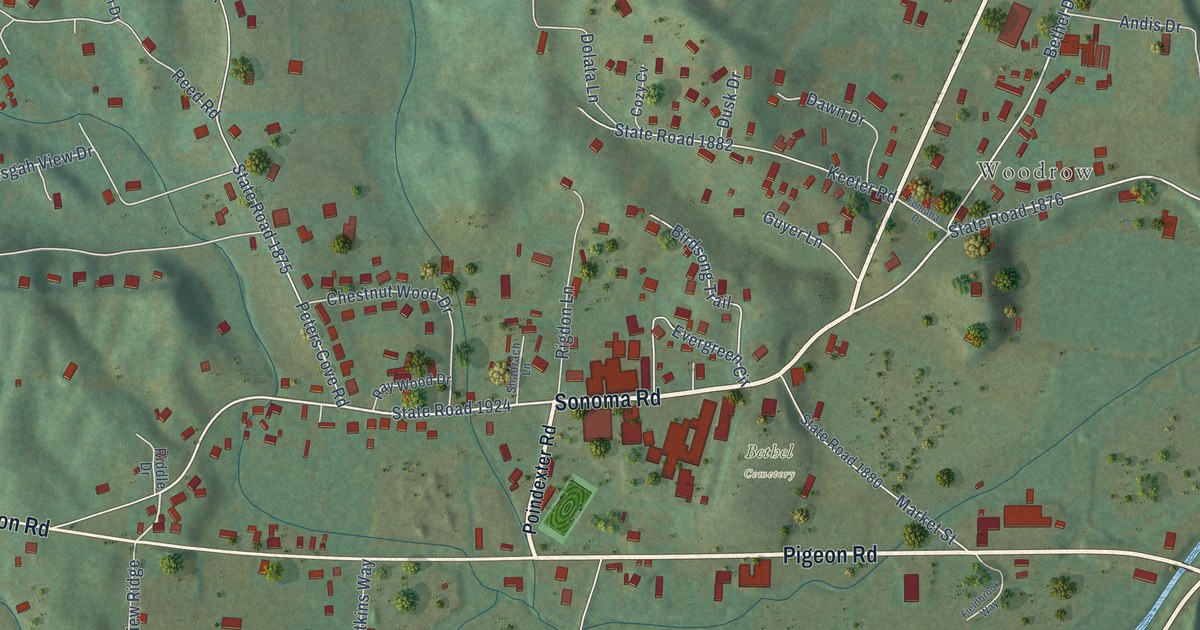
One night early in 1855, a young woman named Marinda slipped out of her boarding house in Rockfish, a cotton-mill village near Fayetteville, North Carolina. Everyone in the house was asleep. She left her clothes behind. She took the path along the edge of the pond, past the little sand beach at its head, and walked through the woods to the main road.
By morning she was gone, and Rockfish was “thrown into a whirl of excitement.” Marinda worked in the village’s cotton factory. Mill hands back then were called operatives, and she was “one of the operatives of the factory.”
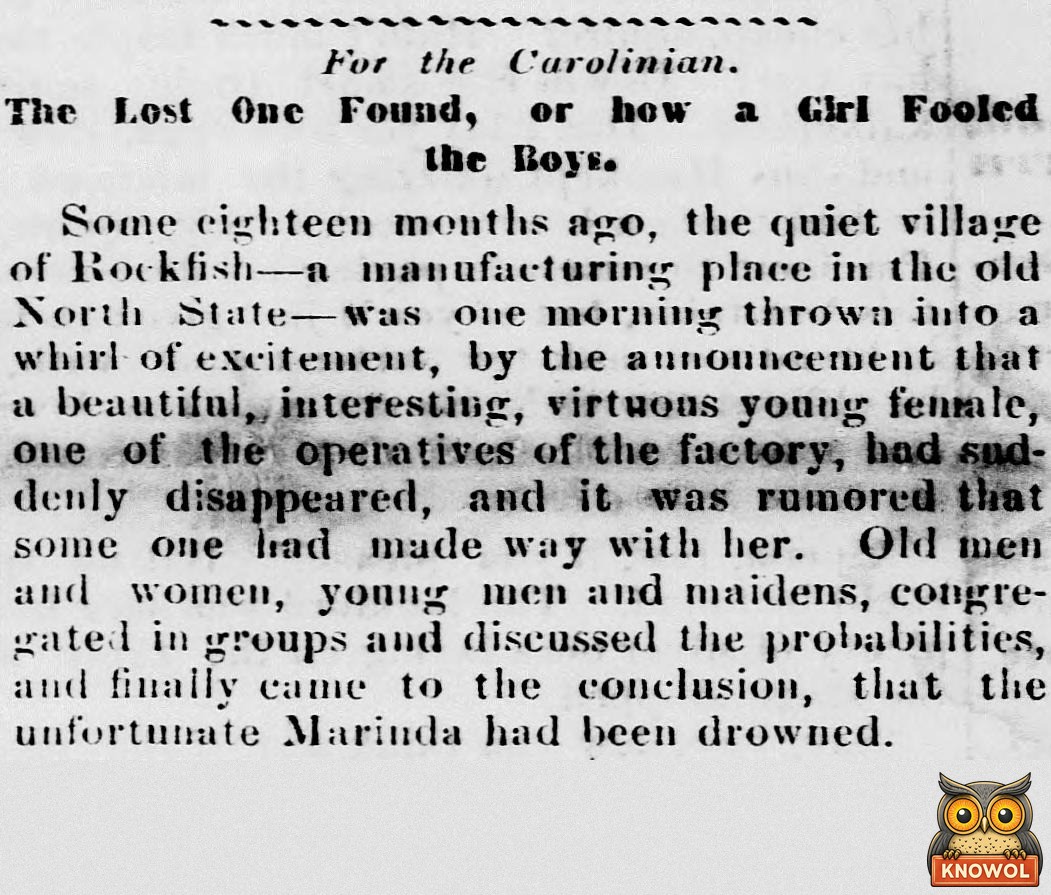
The North-Carolinian, Fayetteville, North Carolina, August 9, 1856, page 2. Library of Congress, Chronicling America. Click the clipping to read it full size.
That clipping is the start of a letter printed in Fayetteville’s own paper, The North-Carolinian, a year and a half later. It was signed only “M. A. H.” Its headline gives away the ending, and nobody has ever said it better: “The Lost One Found, or how a Girl Fooled the Boys.”
The Day Rockfish Village Searched the Pond
In Rockfish, North Carolina, people followed Marinda’s trail. “She was tracked to a beautiful sand-beach near the head of the pond, and there all further trace of her was lost.” Neighbors searched the “dark waters” and found nothing. “Old men and women, young men and maidens, congregated in groups,” the letter said. They decided that “the unfortunate Marinda had been drowned.”
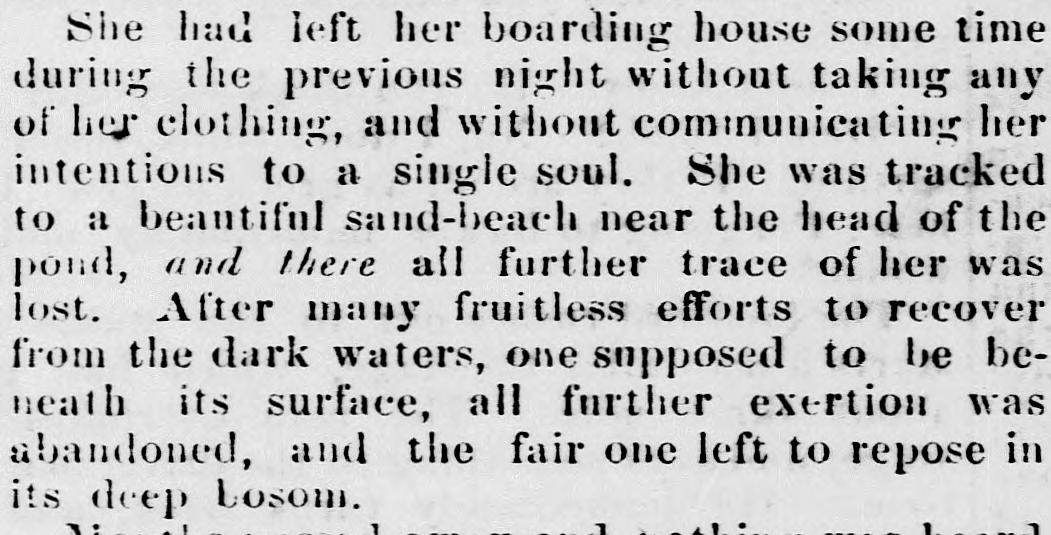
The search at the pond. The North-Carolinian, Fayetteville, North Carolina, August 9, 1856, page 2. Library of Congress, Chronicling America. Click the clipping to read it full size.
The talk did not stop there. Some “busy-bodies,” as the letter called them, even blamed a respected man she had lent money to. The writer called it “slanderous gossip.” Marinda’s friends wore black mourning clothes, called weeds, and then put them away. “A year and a half has passed by,” he wrote.
A Pair of Pants on a Farmhouse Fence
Marinda, the missing mill girl from Rockfish, North Carolina, was never in the pond. The letter-writer told what really happened that night. “It appears she became dissatisfied with her condition, from some cause unnecessary to detail,” he wrote. In plain words, she had her reasons, and he kept them private.
At daylight she was some distance from Rockfish. To hide who she was, she decided to dress as a man. An old way of saying men was “the sterner sex.” Then she saw her chance at a farmhouse: “a pair of pantaloons and some shirts hanging on the fence.” Pantaloons were long pants. She took them and put them on.
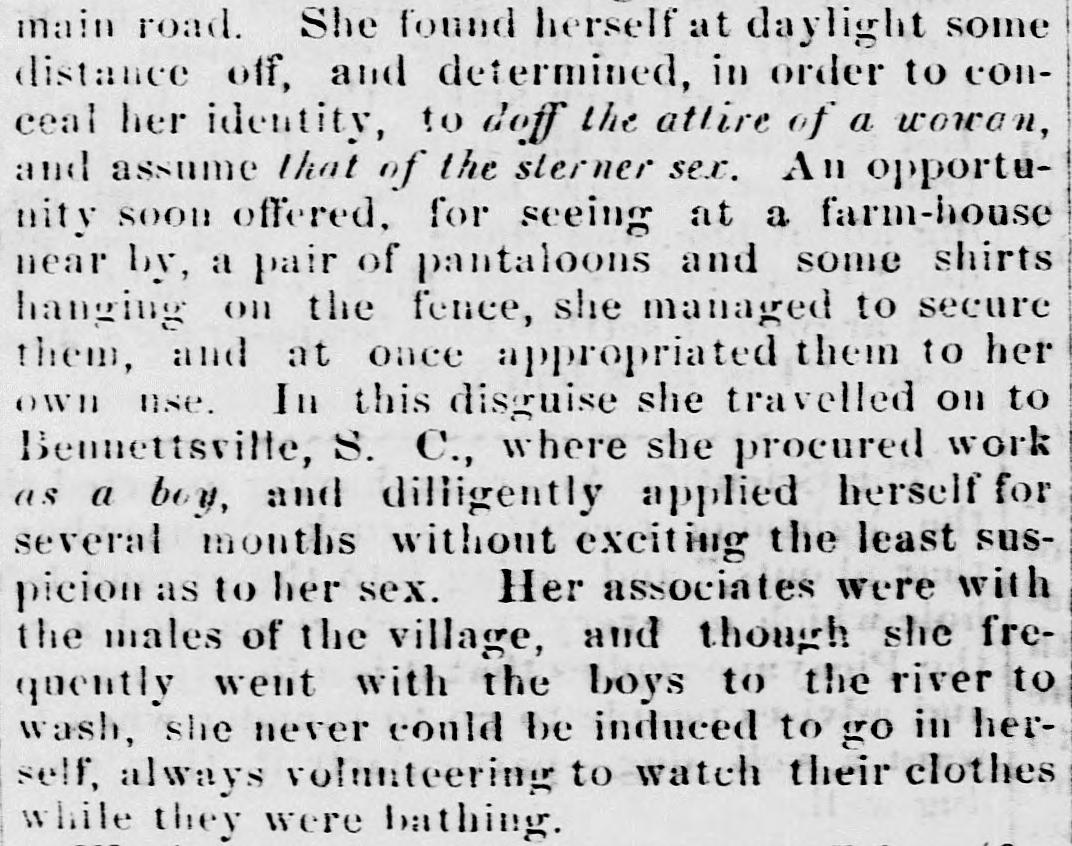
The pantaloons on the fence. The North-Carolinian, Fayetteville, North Carolina, August 9, 1856, page 2. Library of Congress, Chronicling America. Click the clipping to read it full size.
She traveled on to Bennettsville, South Carolina, and got work “as a boy.” Nobody guessed. The boys she worked with went to the river to wash, which meant a swim. She went along every time, but she never went in. She was always “volunteering to watch their clothes while they were bathing.”
John Goes to Cheraw and Charleston, South Carolina
In Bennettsville, South Carolina, Marinda needed a new name, and she picked an easy one. “John (for that was her assumed name),” the letter said. When work ran short in Bennettsville, John moved to Cheraw, South Carolina. She worked there two or three months to save enough money “to carry her to Charleston.”
In Charleston, South Carolina, she came down with a fever. Even with a doctor looking after her, she kept her secret. The letter said she held on to her “incognito,” an old word for a hidden name.
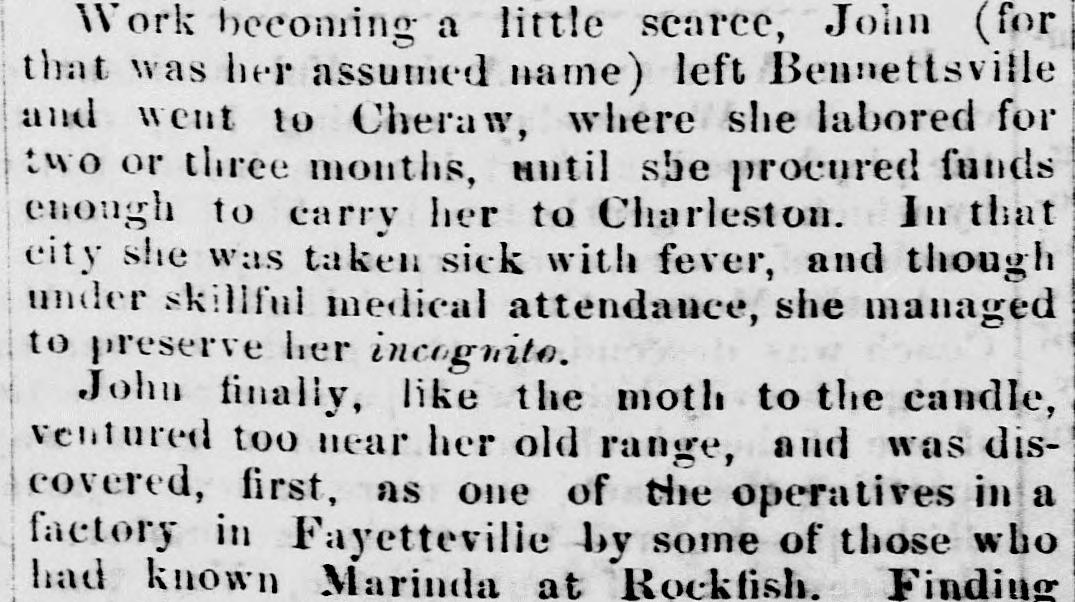
John’s travels. The North-Carolinian, Fayetteville, North Carolina, August 9, 1856, page 2. Library of Congress, Chronicling America. Click the clipping to read it full size.
Then, “like the moth to the candle,” John came back too close to home. She took a job in a factory in Fayetteville, where people from Rockfish knew Marinda’s face. Some of them began to wonder. So she quit and hired out to an old bachelor on a farm some miles from town. She did “faithful man service” on the farm and about the house, and the old man never guessed.
The Governor’s Race Comes to Fayetteville, North Carolina
In the summer of 1856, North Carolina was picking a governor. Governor Thomas Bragg was running again, and John A. Gilmer wanted his job. The two “candidates for Governor” traveled the state together and argued in front of crowds in town after town. The papers called each debate a “discussion.” On July 15, the Western Democrat of Charlotte, North Carolina, wrote that the two men would “close a list of appointments to-morrow, at Fayetteville.”
Women could not vote in North Carolina in 1856. But John could stand in the crowd with the men. Marinda was curious, so she came to town “to hear the discussion between Bragg and Gilmer.” That was her mistake. In the crowd she ran into some of her old acquaintances, and Marinda was “fully recognized.”
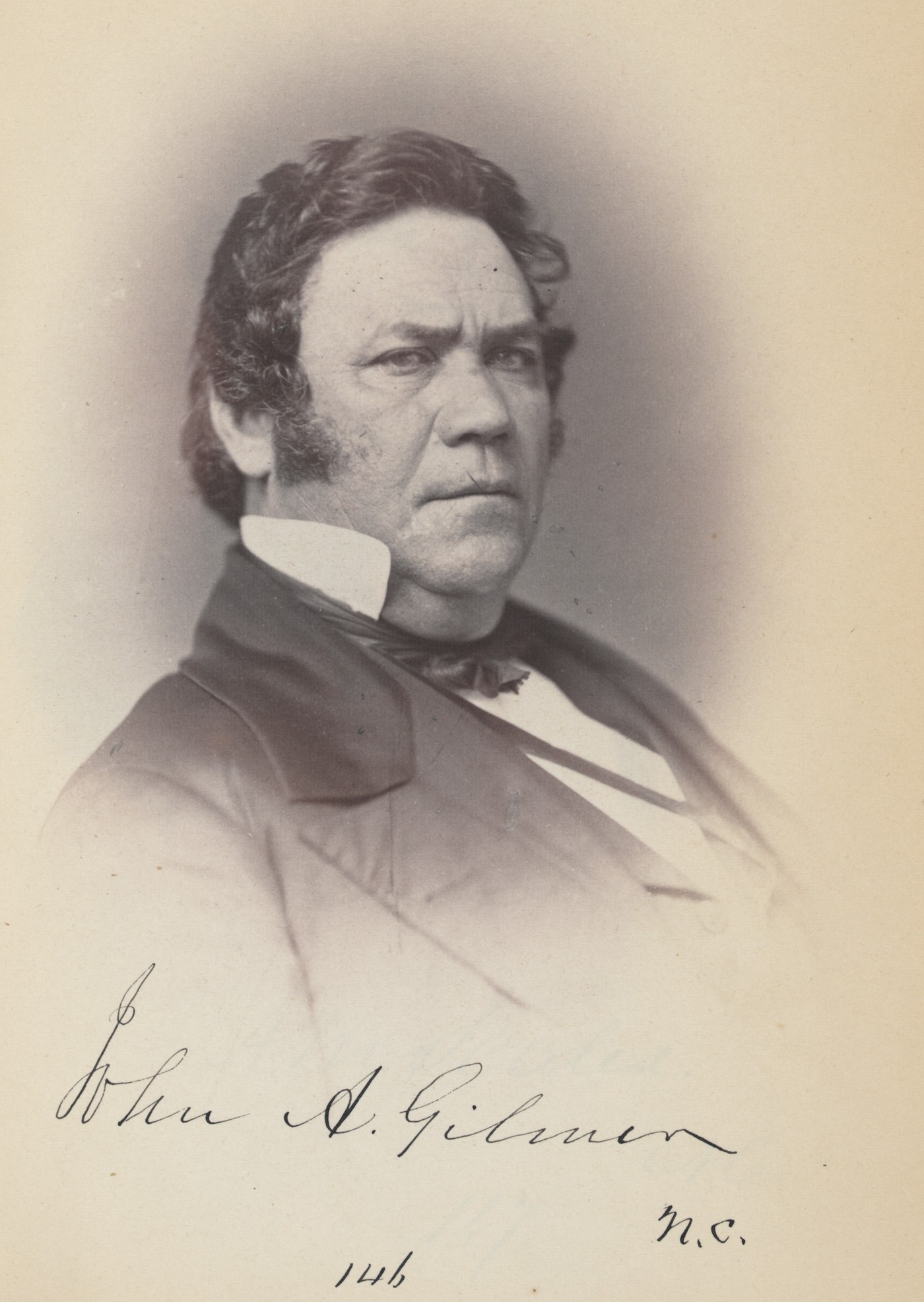
John A. Gilmer, one of the two candidates for governor that Marinda came to hear, photographed by Julian Vannerson in 1859, when Gilmer was in Congress. His signature is under the picture. Library of Congress Prints and Photographs Division. No known restrictions on publication. Click the picture to see it full size.
“The Men Have Much More Fun”
Once Marinda of Rockfish was found in Fayetteville, she promised to dress as a woman again. But she had something to say about it, and M. A. H. passed it along. She said “the men have much more fun than woman.” It would be hard “to sit and listen to the everlasting gossip of the girls, since she has mingled with the men, attended the election and tax-gatherings.”
She had “become interested in politics.” She had “heard the candidates and been hugged and treated so well by them.” Back then, candidates “treated” voters by buying them food and drinks. The men running for governor were not hugging a runaway mill girl from Rockfish. They thought they were shaking hands with a young man named John.
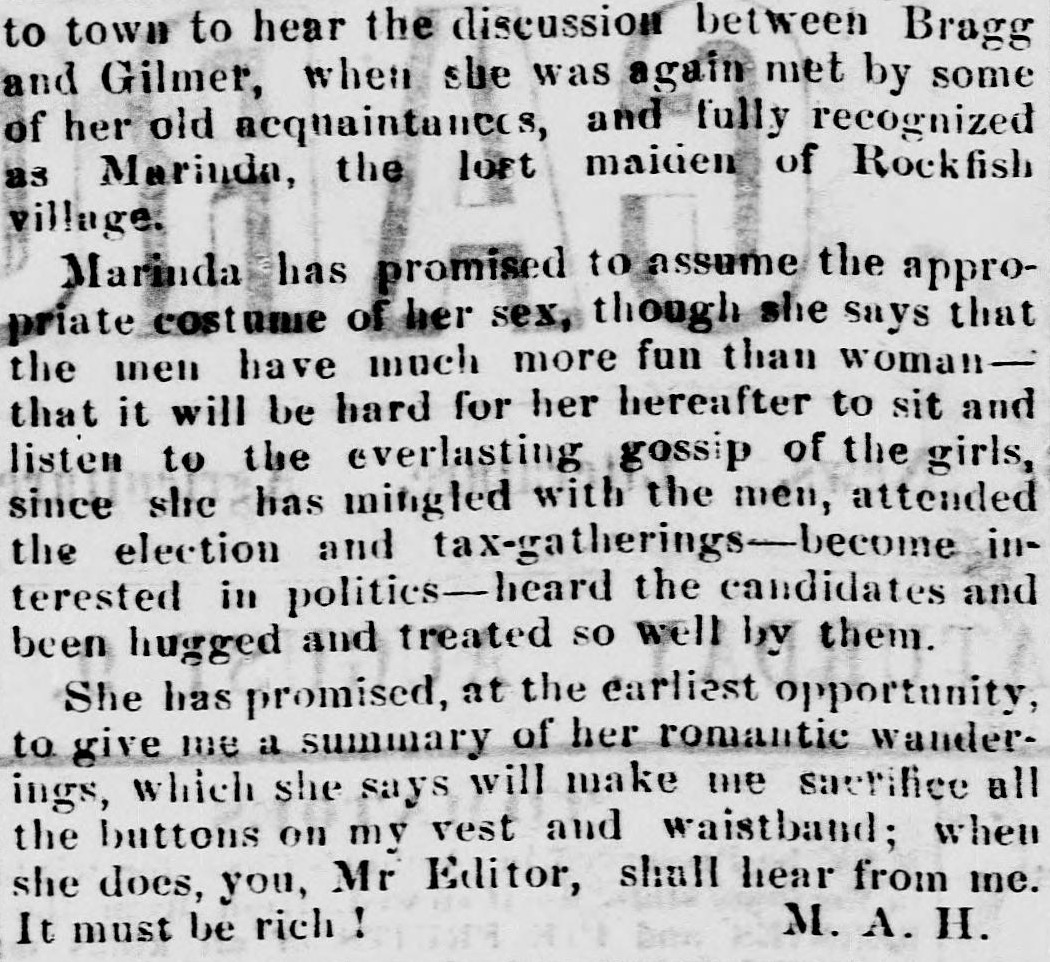
The end of the letter, signed M. A. H. The North-Carolinian, Fayetteville, North Carolina, August 9, 1856, page 2. Library of Congress, Chronicling America. Click the clipping to read it full size.
The letter ended with a promise. Marinda would soon tell the writer the whole story of her “romantic wanderings.” She said it would make him laugh so hard he would “sacrifice all the buttons on my vest and waistband.” He told his editor, “It must be rich!” If that second letter was ever printed, we have not found it.
How Far the Story From Fayetteville Traveled
Only one letter-writer, in Fayetteville’s North-Carolinian, told Marinda’s story, and he never printed her last name. But other papers loved it. On August 19, 1856, the Western Democrat in Charlotte ran it as “A Curious Freak of a Young Girl.” Back then, a freak could mean a sudden, odd idea.
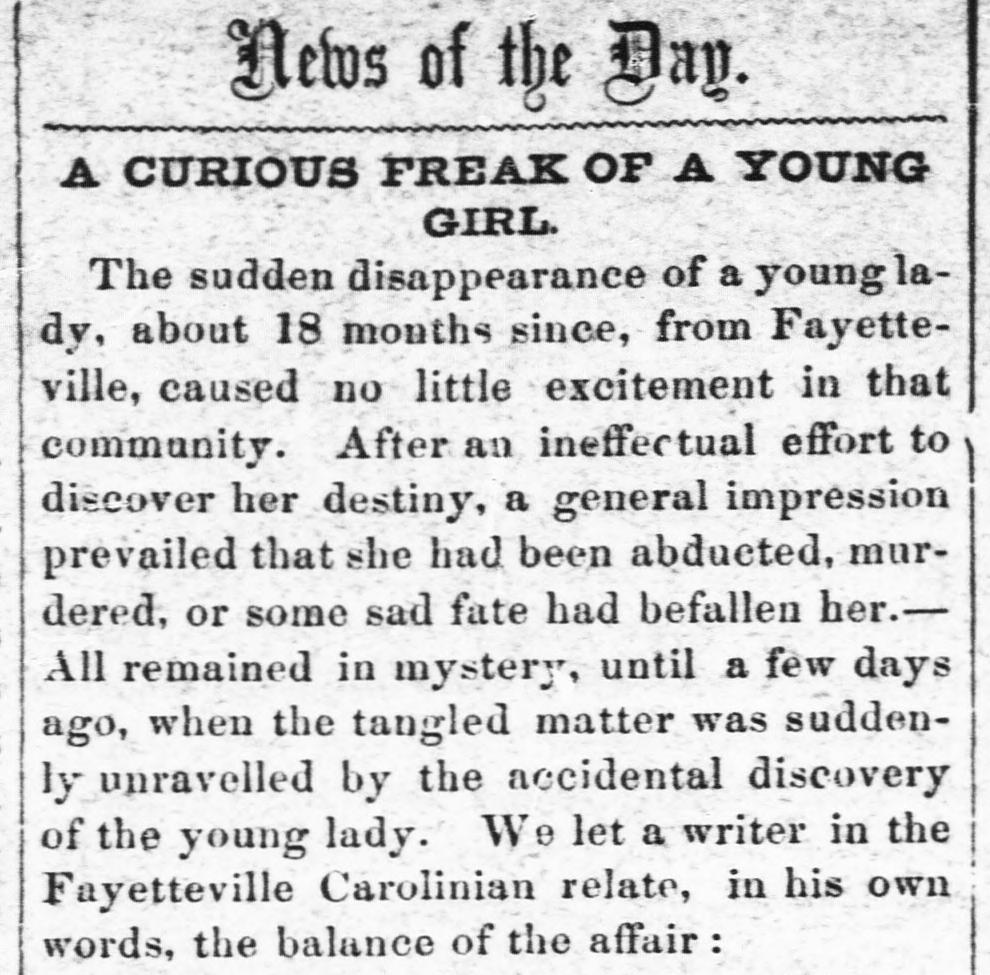
The Western Democrat, Charlotte, North Carolina, August 19, 1856, page 2. Library of Congress, Chronicling America. Click the clipping to read it full size.
On August 22 the Daily Dispatch of Richmond, Virginia, called it “Another Female in Male Apparel.” That word “another” hints that its readers had seen stories like hers before. The Evening Star in Washington, D.C., printed it on August 26.
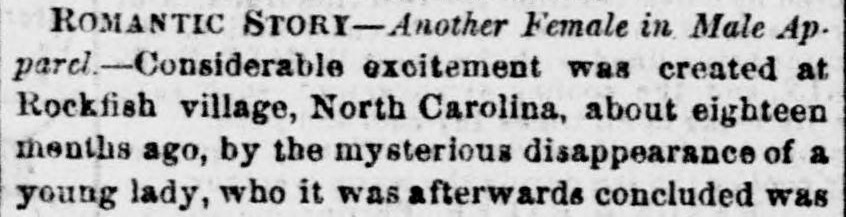
The Daily Dispatch, Richmond, Virginia, August 22, 1856, page 1. Library of Congress, Chronicling America. Click the clipping to read it full size.
By November 12, the story had crossed the whole country. The Nevada Democrat in Nevada City, California, a gold-mining town, printed it as a “Romantic Story.”
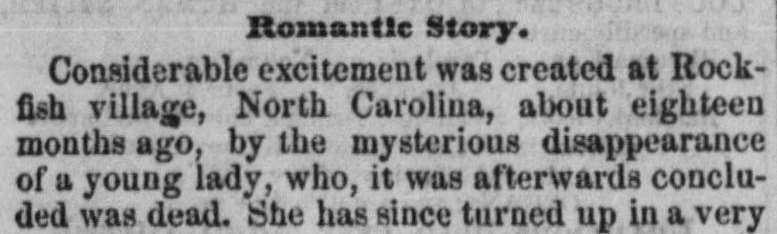
The Nevada Democrat, Nevada City, California, November 12, 1856, page 4. Library of Congress, Chronicling America. Click the clipping to read it full size.
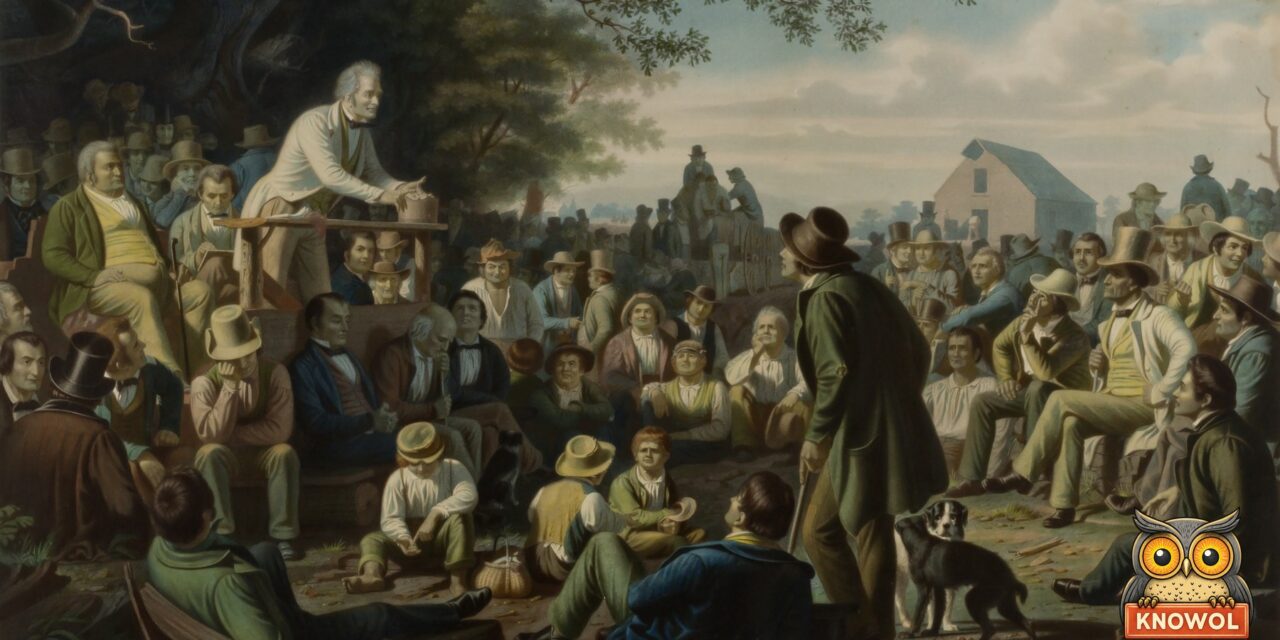
The village that searched its pond for Marinda found her at last in a crowd of men, listening to the two men who wanted to be governor. She had slipped out of Rockfish without taking any of her clothes, taken a pair of pants off a fence, and lived a year and a half as John. Then she came home and had her say. The picture at the top of this page is Stump Speaking, a hand-colored engraving made in 1856 by Louis Adolphe Gautier from a painting by George Caleb Bingham of Missouri. It shows a candidates’ debate of the 1850s, not the one in Fayetteville, but a crowd a lot like the one where Marinda was found.
Sources
- “The Lost One Found, or how a Girl Fooled the Boys,” letter signed M. A. H., The North-Carolinian (Fayetteville, North Carolina), August 9, 1856, page 2. Library of Congress, Chronicling America.
- “The Discussion at Clinton,” The North-Carolinian (Fayetteville, North Carolina), July 12, 1856, page 3 (Bragg and Gilmer, “the candidates for Governor”). Library of Congress, Chronicling America.
- “Messrs. Bragg and Gilmer,” The Western Democrat (Charlotte, North Carolina), July 15, 1856, page 3. Library of Congress, Chronicling America.
- “A Curious Freak of a Young Girl,” The Western Democrat (Charlotte, North Carolina), August 19, 1856, page 2. Library of Congress, Chronicling America.
- “Romantic Story, Another Female in Male Apparel,” The Daily Dispatch (Richmond, Virginia), August 22, 1856, page 1. Library of Congress, Chronicling America.
- Evening Star (Washington, D.C.), August 26, 1856, page 1. Library of Congress, Chronicling America.
- “Romantic Story,” The Nevada Democrat (Nevada City, California), November 12, 1856, page 4. Library of Congress, Chronicling America.
- Guide to the Hall of History of North Carolina (Raleigh, 1914), page 35 (“the Rockfish factory near Fayetteville”). Internet Archive.
- John A. Gilmer, Representative from North Carolina, photograph by Julian Vannerson, 1859, from McClees’ Gallery of Photographic Portraits of the Thirty-Fifth Congress. Library of Congress Prints and Photographs Division. No known restrictions on publication.
- Stump Speaking, hand-colored engraving by Louis Adolphe Gautier after George Caleb Bingham, published by Goupil and Co., 1856 (the cover). Smithsonian American Art Museum, Gift of International Business Machines Corporation. Smithsonian Open Access, CC0.
- The newspapers, book, photograph and print above were all published or made before 1931 and are in the public domain.