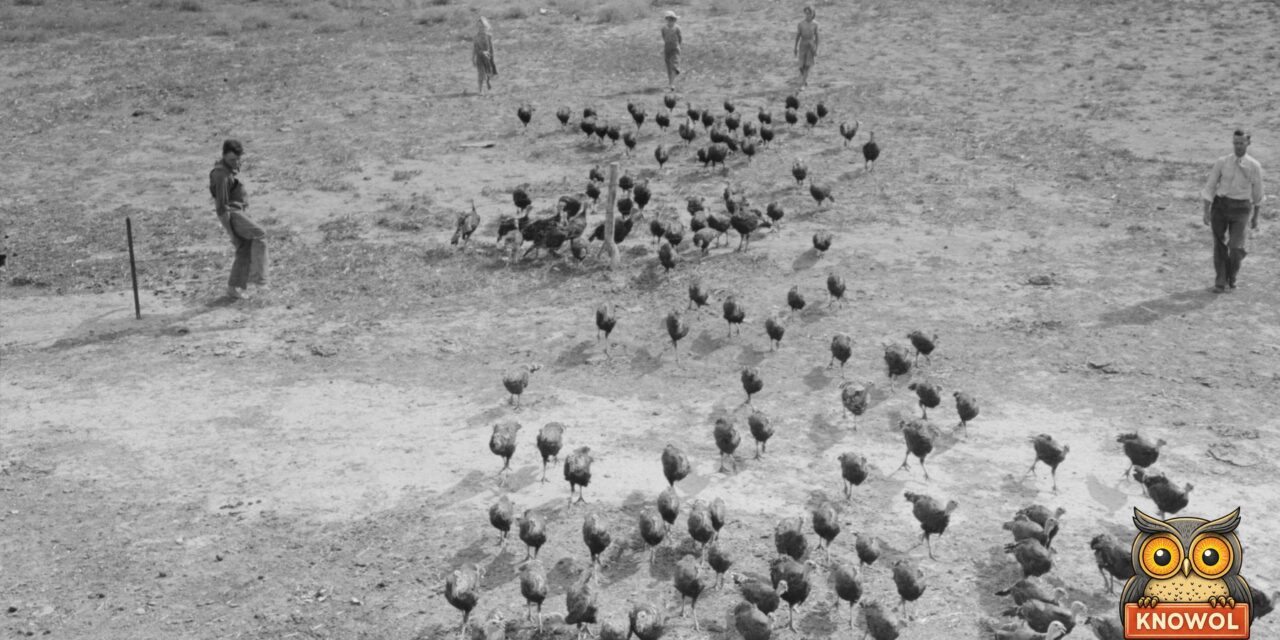
Two days before Thanksgiving in 1912, a brass band marched down the streets of Cuero, Texas. Behind it came the Governor of Texas, riding in an automobile. Behind him came turkeys. Thousands and thousands of turkeys. “More than twenty thousand turkeys trotted through the streets of Cuero to-day,” the New-York Tribune reported on November 27. “The parade was more than two miles long.”
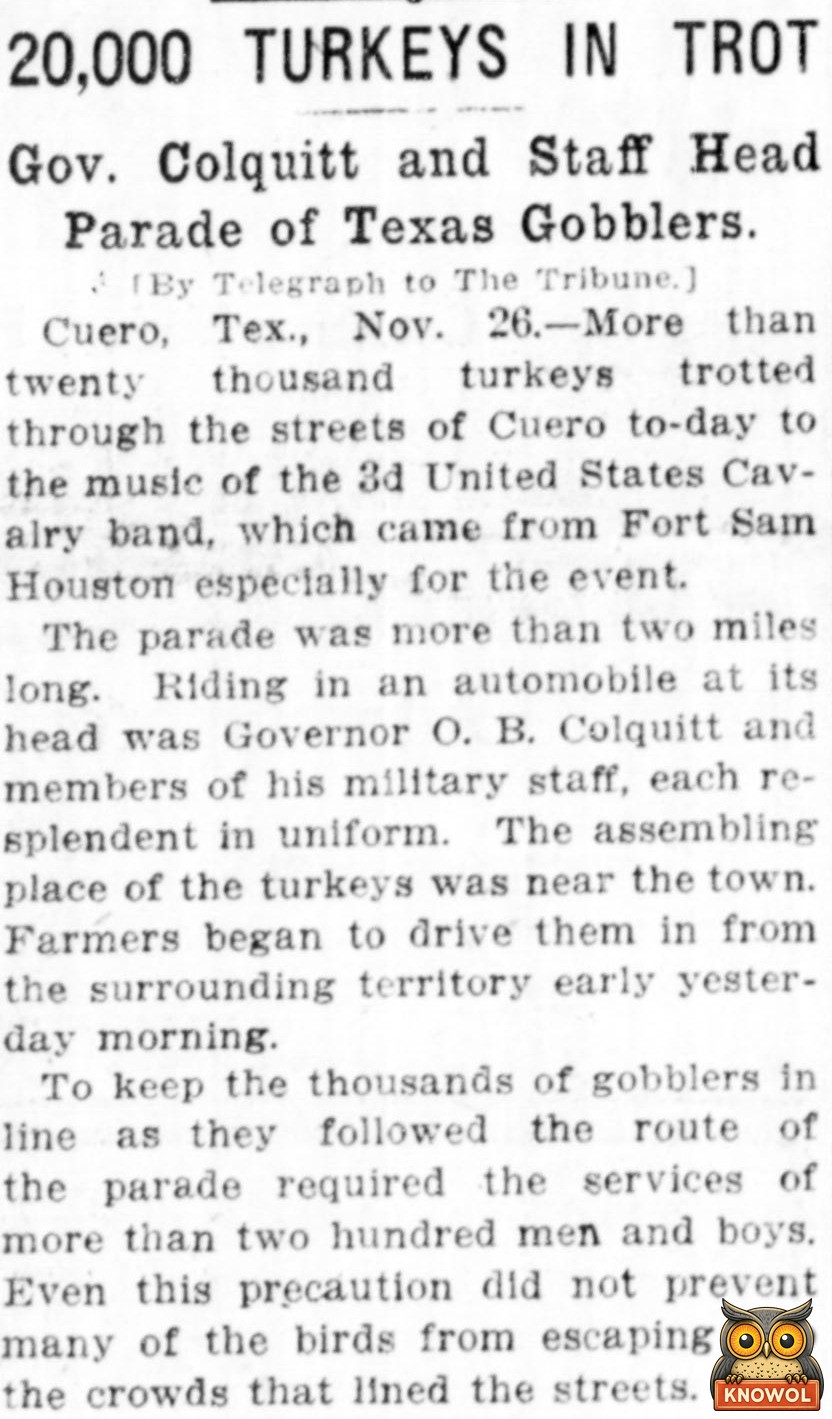
“20,000 Turkeys in Trot.” New-York Tribune, New York, November 27, 1912, page 1. Library of Congress, Chronicling America. Click the clipping to read it full size.
A real turkey trot
In 1912 the “turkey trot” was a wild new dance, and lots of grown-ups thought it was shocking. A Georgia paper joked about that. “Much has been written about condemning it as demoralizing and vicious,” the Dawson News said. Cuero’s turkey trot, though, was “bound to be instructive, inspiring, entertaining and altogether delightful.” The Amarillo Daily News promised it would not be “of the Newport variety.” Newport, Rhode Island, was where rich families threw fancy dances.
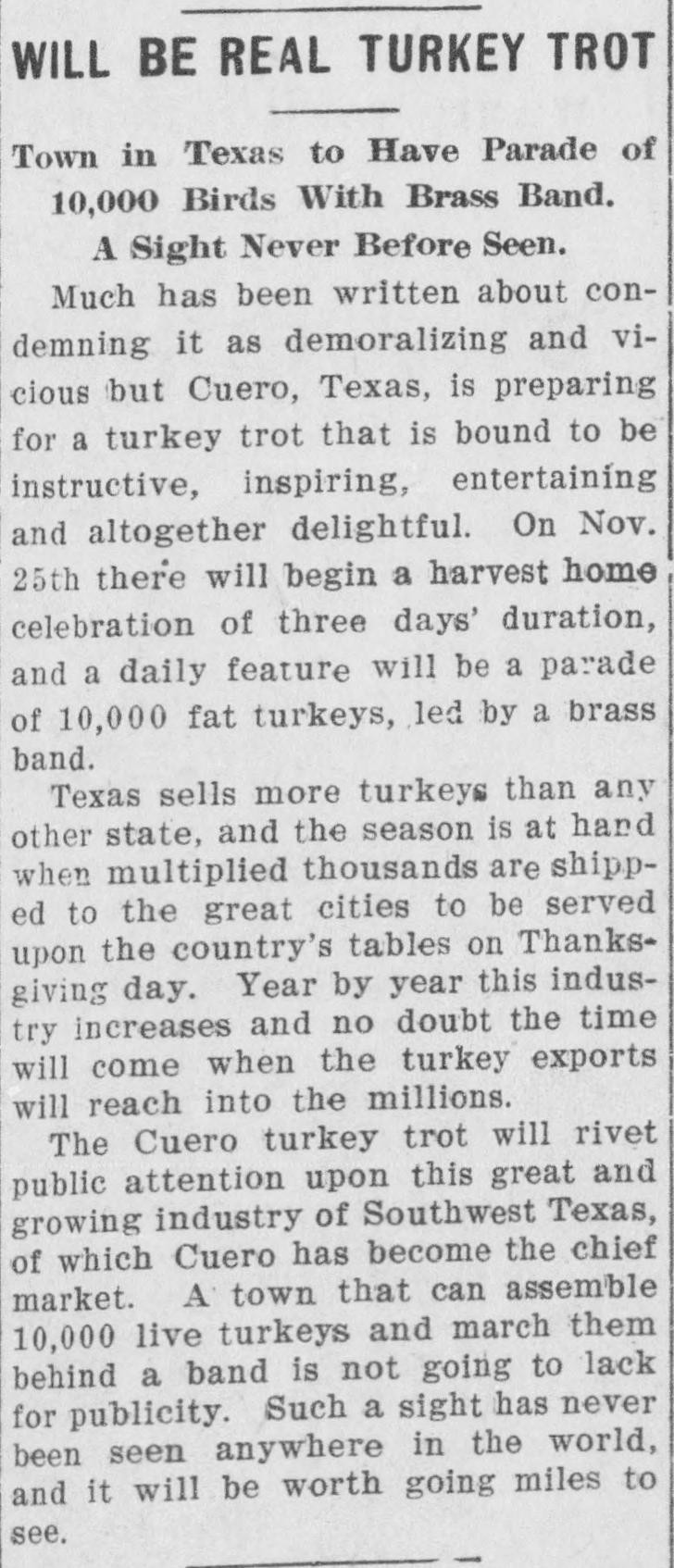
“Will Be Real Turkey Trot.” The Dawson News, Dawson, Georgia, November 19, 1912, page 1. Library of Congress, Chronicling America. Click the clipping to read it full size.
Why Cuero?
Cuero sits in the farm country between San Antonio and the Gulf Coast. “Texas sells more turkeys than any other state,” the Dawson News said, and Cuero had become “the chief market.” Every fall, farmers brought their flocks to town to sell. They didn’t use trucks. “Farmers drive them on horse back by hundreds for shipment,” the Amarillo Daily News explained. To drive animals means to walk them along, the way cowboys moved cattle.
The night before the parade, the town was packed with birds. “Thousands of the turkeys were driven overland many miles,” the Washington Herald wrote, “and to-night the incessant ‘gobble’ is heard all over the city.” Incessant means it never stopped. After the parade, the birds would be “shipped East and North” by train for holiday dinners.
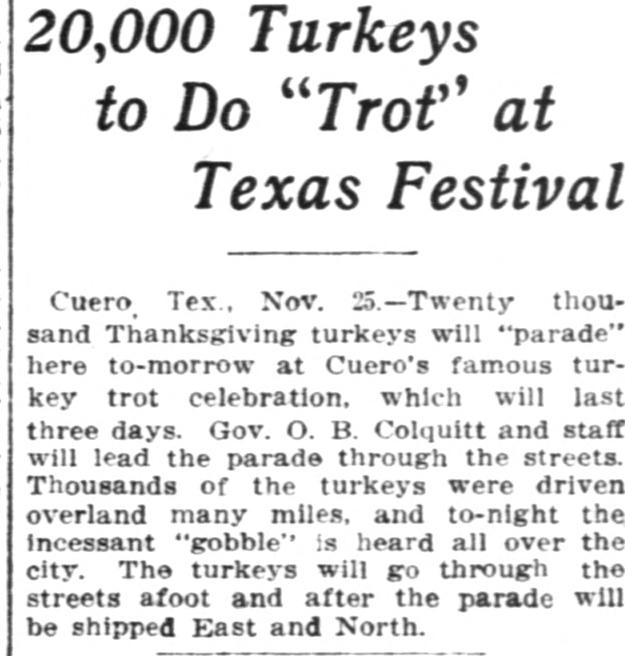
“20,000 Turkeys to Do ‘Trot’ at Texas Festival.” The Washington Herald, Washington, D.C., November 26, 1912, page 3. Library of Congress, Chronicling America. Click the clipping to read it full size.
Parade day
On Tuesday, November 26, the turkeys marched to music from the Army’s 3rd Cavalry band, which came from Fort Sam Houston “especially for the event.” Governor O. B. Colquitt rode at the front with his military staff, “each resplendent in uniform.” Resplendent means dressed up and shining. More than 200 men and boys worked to keep the gobblers in line. It didn’t fully work. The Tribune said “many of the birds” escaped “into the crowds that lined the streets.”
Nobody could agree on how many turkeys there were. The Tribune said more than 20,000. Other papers said 18,000. One said 10,000.
How do you walk a turkey to town?
Turkey drives were old news by 1912. In 1897 the Springfield Republican of Massachusetts remembered the New England drovers, the men who walked flocks to the markets of Boston, Massachusetts. A drover started weeks before Thanksgiving in a far-off town like Keene, New Hampshire. He went farm to farm, buying birds, until his flock held “900 or 1000 turkeys.” Boys signed on “for a copper or two,” meaning a penny or two, to guard against “flank movements on the part of the turkey troops.” That means turkeys sneaking off to the side.
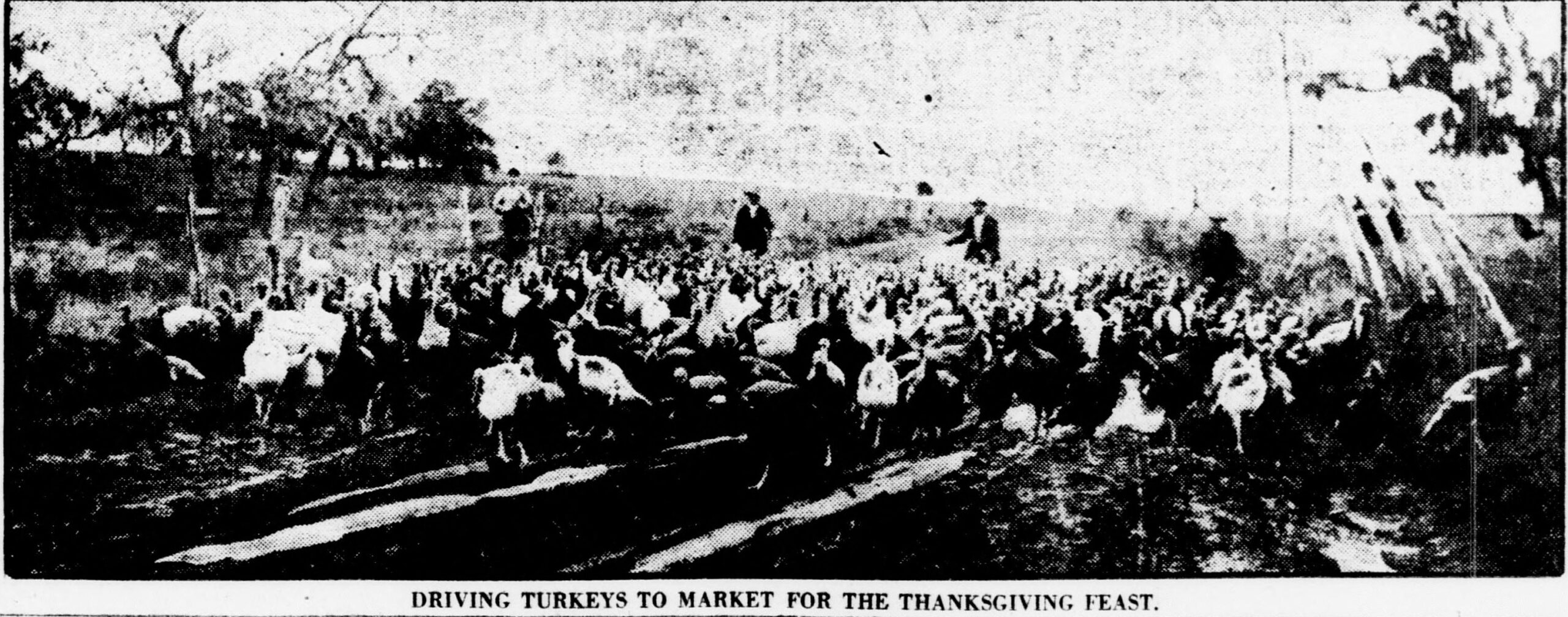
“Driving Turkeys to Market for the Thanksgiving Feast.” The Sunday Star, Washington, D.C., November 22, 1925, page 80. The paper did not say where the photo was taken. Library of Congress, Chronicling America. Click the picture to see it full size.
Turkeys walk slowly. “Six or eight men, it is said, can drive a flock of 1,000 turkeys 10 to 12 miles a day,” the Washington Sunday Star said in 1925. In 1905, Jim Ballard drove 998 turkeys about 50 miles from Buffalo, Missouri, to Springfield, Missouri. He had started with 1,003. Five “managed to get away.”
The biggest rule came at sunset. Turkeys sleep up high, on branches or fence rails. That’s called roosting. An Arkansas paper said driving turkeys is easy “if you will arrange to camp when the turkeys decide to go to roost.” Once they start, you might as well stop, “for roost they will,” the paper warned.
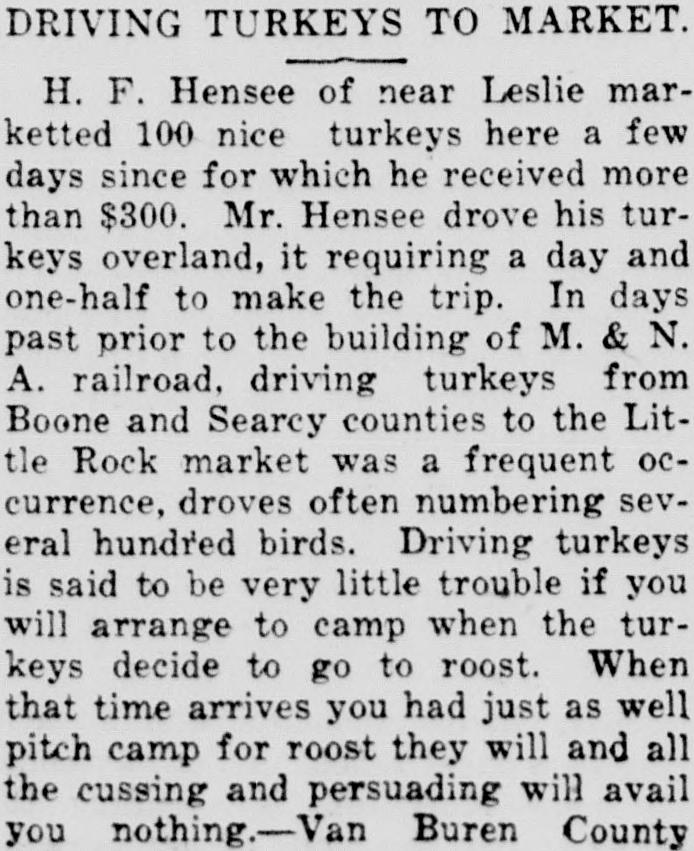
“Driving Turkeys to Market.” The Log Cabin Democrat, Conway, Arkansas, November 19, 1921, page 4, reprinted from the Van Buren County Democrat. Library of Congress, Chronicling America. Click the clipping to read it full size.
The corn-in-the-pockets trick
The 1897 Springfield paper told a story about one of those turkey-guard boys. Turkeys, it said, “follow its leader” blindly. So the boy “punched small holes in his trousers pockets” and filled them with corn. As he walked, “the corn trickled out into the road.”
Then he wandered off “into lanes, over low walls, into brush heaps, and across lots.” A line of turkeys followed him, “much to his great glee.” The drover couldn’t figure out why his birds kept making “blind rushes” off the road. After a season or two, the boy got caught and “given a sound thrashing,” a hard spanking.
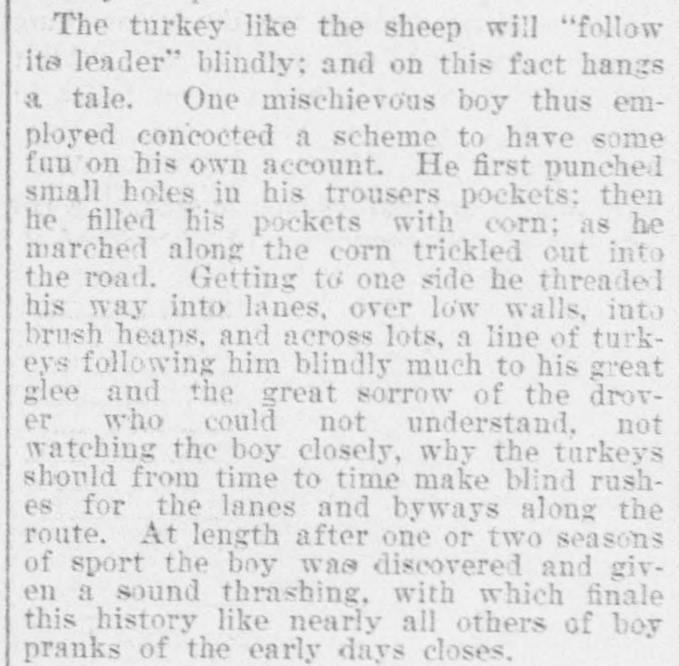
The Springfield Republican, Springfield, Massachusetts, November 26, 1897, page 9. Library of Congress, Chronicling America. Click the clipping to read it full size.
What happened to the turkey trot?
Cuero kept its parade. In 1920 the town sent President Woodrow Wilson the biggest of “the 7,500 which paraded down Main street.” The bird rode to Washington in a coop “modeled after the White house.”
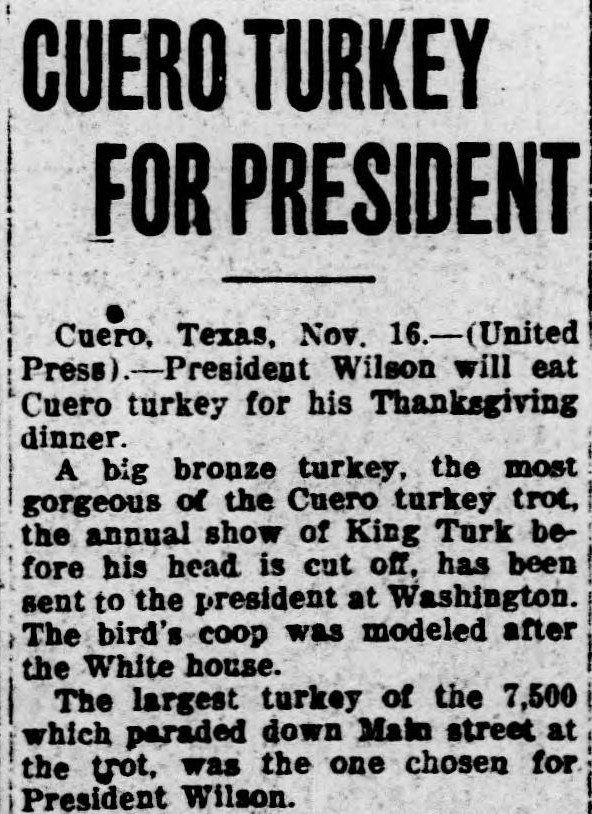
“Cuero Turkey for President.” The Rock Island Argus, Rock Island, Illinois, November 16, 1920, page 1. Library of Congress, Chronicling America. Click the clipping to read it full size.
Times were changing, though. By 1925 most turkeys rode to “dressing plants,” where they were cleaned and plucked for the stores. “Turkey trots were common almost everywhere that the birds were grown,” the Sunday Star said, “but these celebrations are no longer held.” In 1931, during the Great Depression, Cuero called its trot off. “There was no proud parade of plumage to the blare of brass bands as formerly,” a news service reported. Plumage means feathers.
The town never forgot, though. When a government photographer came through in 1940, he wrote that Cuero’s “annual turkey run in the fall has received national publicity.” Today Cuero holds a fall festival called Turkeyfest, with a turkey race against birds from Worthington, Minnesota.
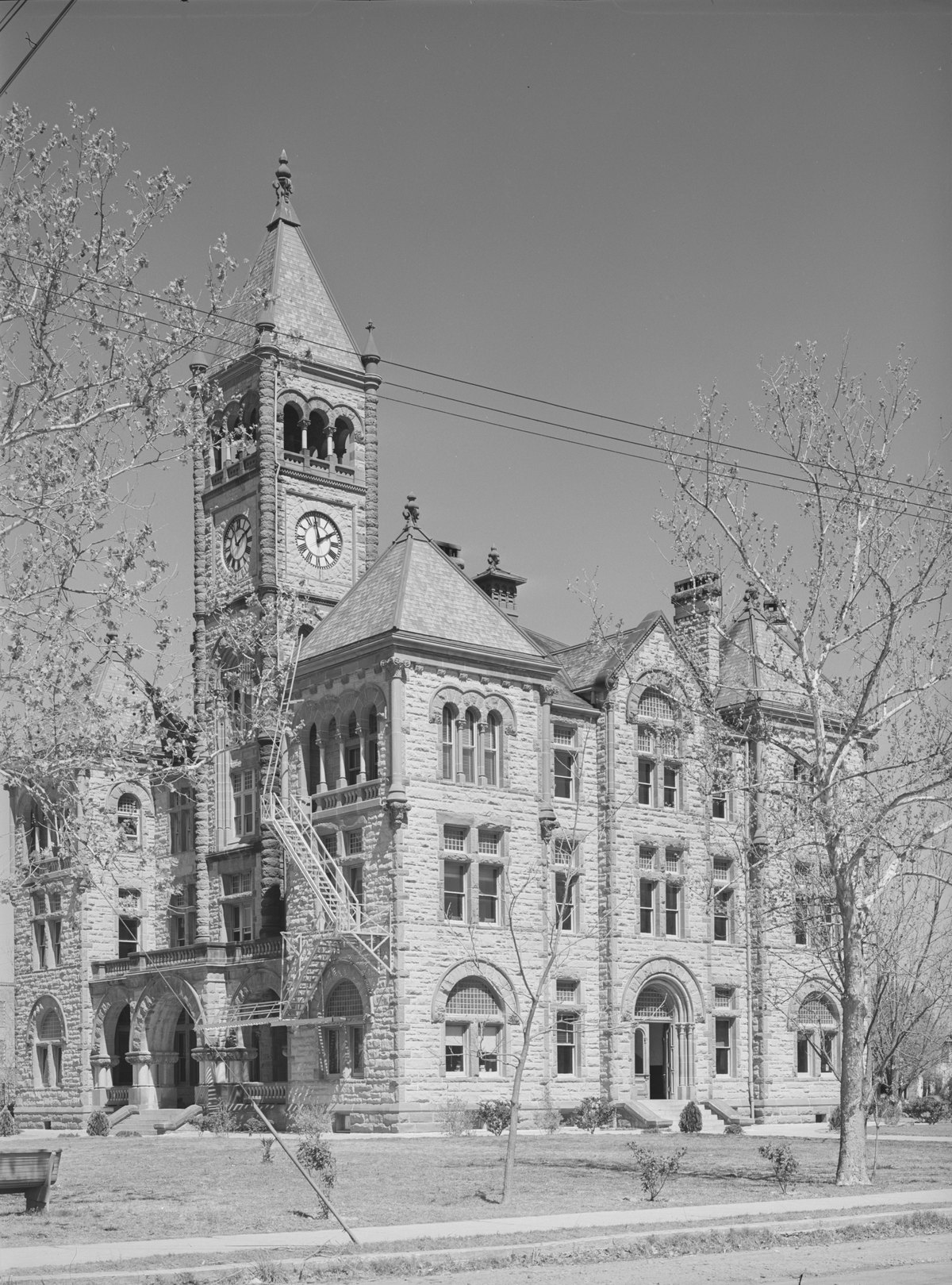
Courthouse, Cuero, Texas, 1940. Photo by Russell Lee for the Farm Security Administration. Library of Congress. Click the picture to see it full size.
Sources
- New-York Tribune (New York): November 27, 1912, page 1 (“20,000 Turkeys in Trot”).
- The Washington Herald (Washington, D.C.): November 26, 1912, page 3 (“20,000 Turkeys to Do ‘Trot’ at Texas Festival”).
- The Dawson News (Dawson, Georgia): November 19, 1912, page 1 (“Will Be Real Turkey Trot”) and November 29, 1912, page 1 (“Eighteen Thousand Turkeys March”).
- Amarillo Daily News (Amarillo, Texas): November 24, 1912, page 13 (“Governor to Lead Cuero Turkey Trot”).
- The Springfield Republican (Springfield, Massachusetts), weekly edition: November 26, 1897, page 9 (the New England turkey drovers and the corn trick).
- Abilene Weekly Reflector (Abilene, Kansas): November 30, 1905, page 2 (Jim Ballard’s 998 turkeys, from Springfield, Missouri).
- The Log Cabin Democrat (Conway, Arkansas): November 19, 1921, page 4 (“Driving Turkeys to Market”).
- The Rock Island Argus (Rock Island, Illinois): November 16, 1920, page 1 (“Cuero Turkey for President”).
- The Sunday Star (Washington, D.C.): November 22, 1925, page 80 (turkey trots, drives and the photo).
- The Indianapolis Times (Indianapolis, Indiana): November 6, 1931, page 1 (“Texas Turkeys Strut to Doom”).
- Russell Lee, “Courthouse, Cuero, Texas,” 1940, Library of Congress, no known restrictions on publication.
- All newspaper images: Library of Congress, Chronicling America. Published 1897 to 1925.
- Cover: Russell Lee, “Driving in a flock of turkeys, Schoenfeldt farm,” Sheridan County, Kansas, 1939, Library of Congress, no known restrictions on publication. It shows a Kansas farm family, not Cuero.