
A Housatonic valley town on the New York line, home to the Schaghticoke reservation, the covered bridge at Bulls Bridge and the granite stack of Kent Furnace, where iron was made for most of the 1800s.
Kent on the map
Click the map to look closer.
Kent today
By KNOWOL
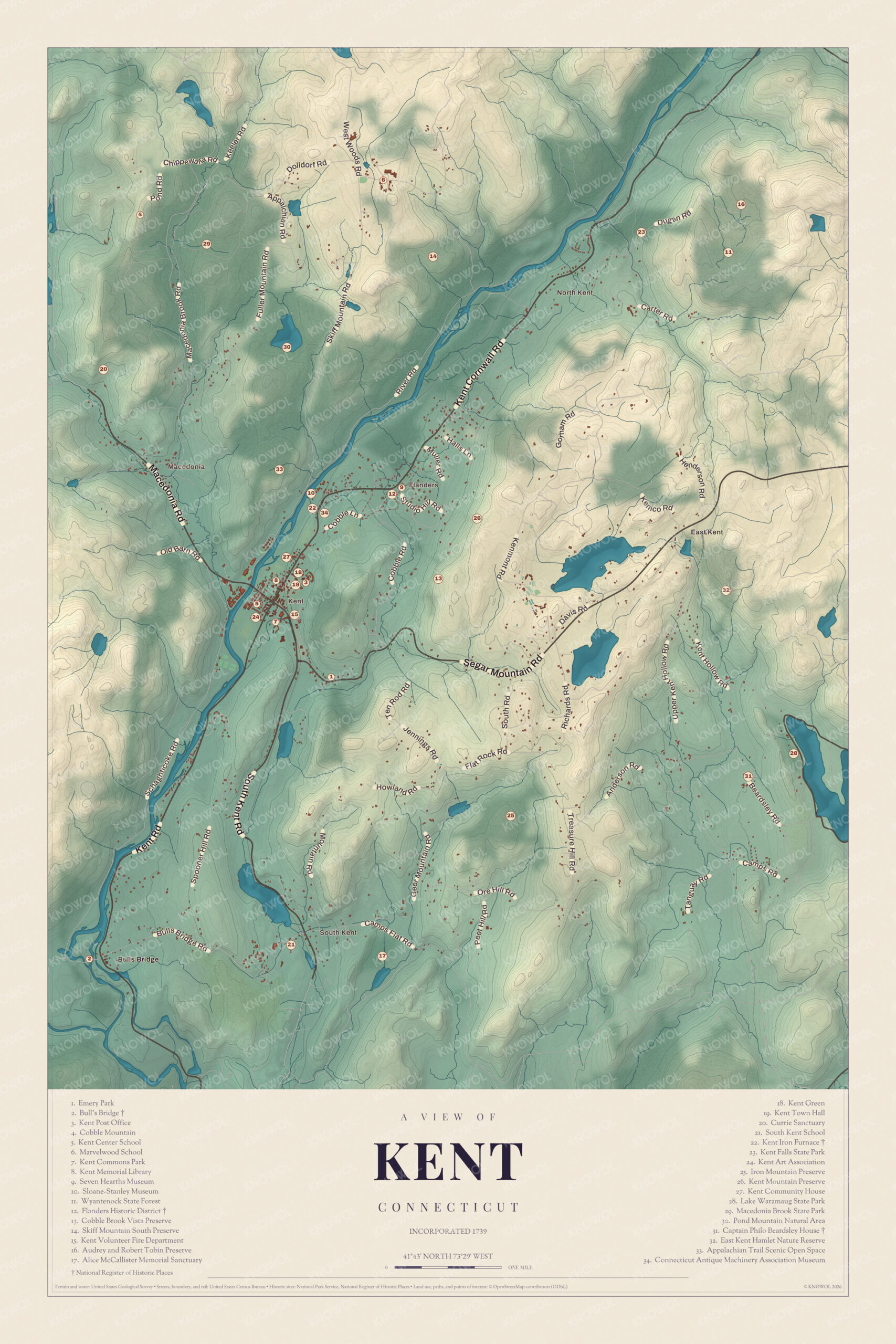
Shaded hills from the ridges above Flanders and North Kent down the Housatonic valley to Bulls Bridge, every street, and a guide of 34 numbered landmarks with the National Register sites marked.2
The story of Kent
Iron at Bulls Bridge
In 1826 a blast furnace went up beside the falls at Bulls Bridge, and for years it was the busiest place in Kent. Probably 200 men worked at the furnace and on the roads, and ore came fifteen miles from Clove in Dutchess County, with as many as twenty-one teams arriving in a line. The pig iron was carted to Poughkeepsie for $5 a ton, and people said it was fully equal to Scotch iron, the best known of its day. During the Civil War its iron went into ironclad ships, and the works were called the Monitor Iron Works. Back then about sixty children went to the Bulls Bridge school. By 1897 there were twelve, and the furnace was a ruin by the river.67
Scatacook on the Housatonic
The Schaghticoke reservation is part of Kent, and its story here is older than the town's. A Kent history of 1897 tells how Gideon Mauwehu, a Pequot leader, looked down from a mountain west of the Housatonic, saw a valley full of fish and game, and moved his family there. Others joined him from up and down the river, and the settlement was called Scatacook. Moravian missionaries came in 1742, and Mauwehu and more than a hundred of his people were baptized. By about 1752 settlers had taken nearly all their planting grounds, and the colony set aside about two hundred acres along the river, held only at its pleasure. Today the Schaghticoke reservation covers about 400 acres west of the river, held in trust by the state.891011
Rum for the meetinghouse
Kent was sold before it was settled. The colony auctioned the township's shares at the court house in Windham, and each buyer had to build a house at least eighteen feet square and clear six acres before his deed was good. The first settlers met for worship in the upstairs room of Daniel Comstock's building, which was also his store and his house. The church was organized in 1741 with eleven men, and fifty-three more joined before the year was out. When the frame of the first meetinghouse was ready in April 1742, the town voted six gallons of rum to raise it. It stood in Flanders, the first center of town, which once had a tavern, a grist mill, a wagon shop and a tannery.12131415
Through the years
23 moments from 1736 to today.
- 1736People from the New Milford band join Gideon Mauwehu's settlement at Scatacook.8
- 1738The colony sells the township's shares at auction, and the Assembly names it Kent.12
- 1739Settlers arrive, and Nathaniel Slosson builds his homestead in Flanders.16
- 1741The church is organized with eleven men, and Cyrus Marsh becomes the first pastor.14
- 1742The town votes six gallons of rum to raise the frame of its first meetinghouse.14
- 1742Moravian missionaries begin preaching at Scatacook.9
- 1744Schaghticoke speakers promise colonial commissioners to keep the covenant chain bright.17
- 1752The Assembly grants the Schaghticoke about two hundred acres along the Housatonic.10
- 1760Jacob Bull and his son Isaac build the first bridge at Bulls Bridge.3
- 1781Josiah Beardsley gives his farm and its saltbox house to his son Philo.18
- 1826Kent has three blast furnaces making 60 to 70 tons of pig iron a week.19
- 1826Iron making begins at the Kent Iron Furnace above the river.20
- 1840sA railroad stop opens to the south, and business moves from Flanders to the present village.16
- 1842The covered bridge at Bulls Bridge is built with a Town lattice truss.3
- 1860sThe Bulls Bridge furnace is called the Monitor Iron Works for its iron in ironclad ships.7
- 1881The Kent Water Company builds a reservoir east of the Cobble for $16,000.21
- 1892Kent Furnace goes out of blast for the last time.22
- 1898The old furnace buildings are in use as tobacco sheds.22
- 1906Rev. Frederick Herbert Sill opens Kent School on September 29.23
- 1918Macedonia Brook State Park opens on land from the White Memorial Foundation.1
- 1919The White Memorial Foundation gives the land for Kent Falls State Park.2
- 1969The Stanley Works gives Eric Sloane's studio and tool collection to the state.20
- 1972Bull's Bridge is listed on the National Register.3
Places to see
The numbers match the landmark guide printed on the 2026 map.
- 2Bull's BridgeBull's Bridge Road. Covered bridge of 1842.
- 9Seven Hearths MuseumFlanders. Run by the Kent Historical Society.Visit their website
- 10Sloane-Stanley MuseumNorth of the village. Eric Sloane's studio and tools.Visit their website
- 12Flanders Historic DistrictRoute 7 at Cobble Road. Kent's first center.
- 18Kent GreenKent village. Beside the town hall and post office.
- 21South Kent SchoolSpooner Hill. Boys' boarding school near South Kent.Visit their website
- 22Kent Iron FurnaceNorth of the village. Granite stack, iron made 1826 to 1892.Visit their website
- 23Kent Falls State ParkNortheast. Falls dropping 250 feet.Visit their website
- 29Macedonia Brook State ParkNorthwest. More than 2,300 acres of woods.Visit their website
- 34Connecticut Antique Machinery Association MuseumNorth of the village. Steam engines and a narrow gauge railroad.Visit their website
On the National Register
All 4 places in Kent on the National Register of Historic Places that still stand today, oldest first, and why each one matters.5
-
Flanders Historic District
Kent's first center, a cluster of late 1700s and early 1800s houses where Route 7 meets Cobble Road and Studio Hill Road. It lost its business to the new village when a railroad stop opened to the south in the 1840s. Its twelve main buildings include five Federal houses and three from colonial times.16
-
Capt. Philo Beardsley House
A well-preserved saltbox with its central chimney, oak floorboards and paneled parlor still in place. Josiah Beardsley gave the farm to his son Philo, a militia captain, in 1781, with the house already standing.18
-
Kent Iron Furnace
A 32-foot granite blast furnace, laid without mortar, that made pig iron from 1826 to 1892, mostly for building railroads. It was rebuilt as a hot blast furnace in 1846 and enlarged in 1870, and it stands on the grounds of the Eric Sloane Museum.20
-
Bull's Bridge
A single-lane wooden covered bridge with a Town lattice truss, where Jacob and Isaac Bull built the first bridge in 1760. It is one of three public highway covered bridges left in Connecticut and one of two still open to cars.3
In their words
“For there is no place to the loving heart like home, and no homes like the first home.”
History of Kent, Connecticut, 189724
“The crack of the whips of so many drivers is gone and the charm of the town now lies in its quietness and solitude.”
History of Kent, Connecticut, 1897, remembering the ore teams24
“We are very glad that we are all united in one covenant chain; we are resolved that it shall not rust, and will therefore wind it with beaver skins.”
Schaghticoke speakers to colonial commissioners, 1744, as printed in History of Kent, Connecticut, 189717
Nearby towns
Sources
- Kent, Connecticut, Wikipedia
- Map of Kent, Connecticut in 2026, KNOWOL (USGS elevation, Census Bureau roads)
- Bull's Bridge, Wikipedia
- History of Kent, Connecticut (1897), on the Kent iron mine, Internet Archive
- National Register of Historic Places listings in Litchfield County, Connecticut, Wikipedia
- History of Kent, Connecticut (1897), on the Bulls Bridge furnace, Internet Archive
- History of Kent, Connecticut (1897), on the Monitor Iron Works, Internet Archive
- History of Kent, Connecticut (1897), on Gideon Mauwehu and Scatacook, Internet Archive
- History of Kent, Connecticut (1897), on the Moravian mission, Internet Archive
- History of the Indians of Connecticut from the earliest known period to 1850 (1852), Internet Archive
- Schaghticoke people, Wikipedia
- History of Kent, Connecticut (1897), on the sale of the township, Internet Archive
- History of Kent, Connecticut (1897), on Daniel Comstock's meeting room, Internet Archive
- History of Kent, Connecticut (1897), on the first church and meetinghouse, Internet Archive
- History of Kent, Connecticut (1897), on Flanders, Internet Archive
- Flanders Historic District, Wikipedia
- History of Kent, Connecticut (1897), on the 1744 council, Internet Archive
- Capt. Philo Beardsley House, Wikipedia
- Green's Connecticut annual register and United States calendar (1826), Internet Archive
- Eric Sloane Museum and Kent Iron Furnace, Wikipedia
- History of Kent, Connecticut (1897), on the Kent Water Company, Internet Archive
- The Connecticut magazine (1899), on Kent Furnace, Internet Archive
- Genealogical and family history of the state of Connecticut (1911), on Frederick Herbert Sill, Internet Archive
- History of Kent, Connecticut (1897), preface, Internet Archive