
The Immigrant City, built from scratch in the 1840s around the Great Stone Dam on the Merrimack, where workers from dozens of nations ran the mills, lived through the Pemberton collapse of 1860 and stood together in the Bread and Roses strike of 1912.
Then and now
The same town 172 years apart. Click either map to look closer.
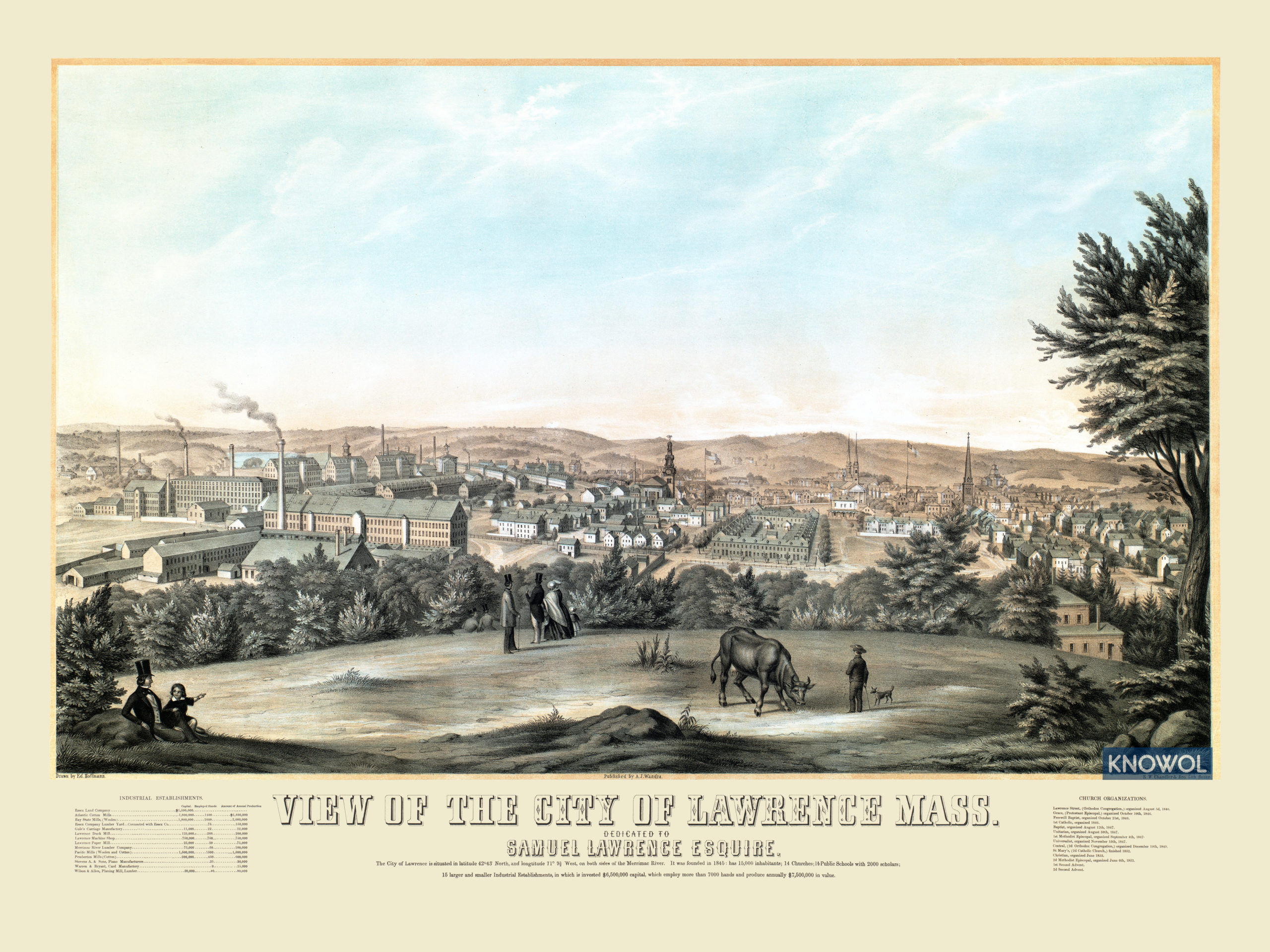
The view from Prospect Hill
By Ed Hoffman, A.J. Wandra and S.W. Chandler & Bro.
The young city seen from Prospect Hill, dedicated to Samuel Lawrence, with a directory of 14 major companies, the Pemberton Mill among them, and 14 churches with the dates they were organized.5
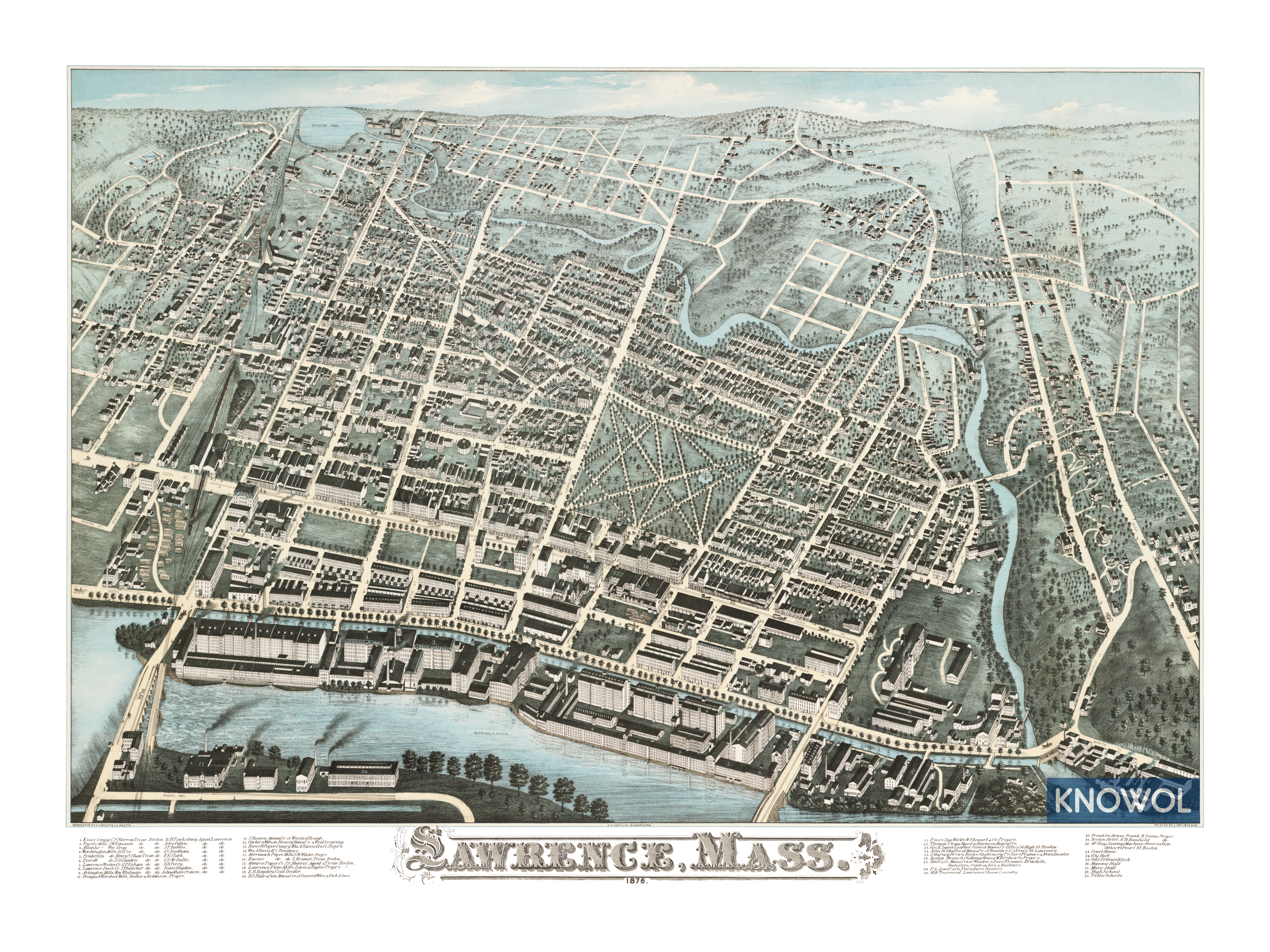
The bird's-eye view of 1876
By J.C. Hazen
Lawrence from above with its street names, the canals on both banks of the Merrimack, and landmarks including the Essex Company, Pacific Mills, Lawrence Duck Company, Merrimack Paper Mills, Lawrence Flour Mills, Franklin House and Masonic Hall.6
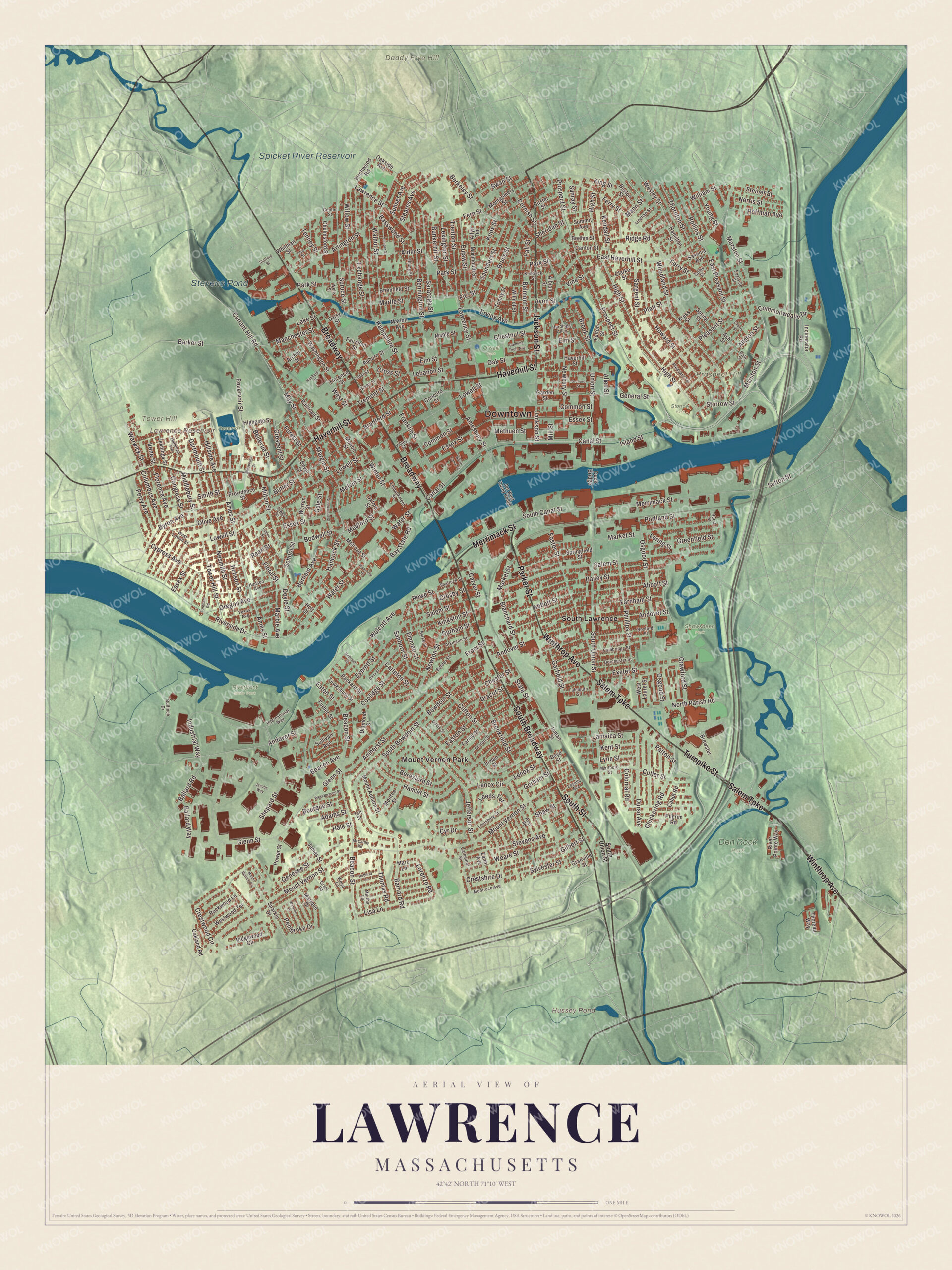
Lawrence today
By KNOWOL
Shaded relief on both banks of the Merrimack, from Tower Hill to Mount Vernon, with Broadway, Haverhill Street and the Salem Turnpike, Prospect Hill, Daddy Frye Hill, Stevens Pond and the Spicket River Reservoir.3
The story of Lawrence
The day the Pemberton fell
The Essex Company built the Pemberton Mill in 1853 as the pride of the new city. It stood by itself between the canal and the river, five stories tall and 284 feet long, so wide it was probably the widest mill in New England, and it cost $800,000. On January 10, 1860, at thirteen minutes before five in the afternoon, it fell without warning while hundreds of people, many of them Irish women and children, were at work inside. The official count was 88 dead. Investigators blamed weak cast-iron columns. Lawrence answered with its hands. For a week the church sewing circles sewed for the families, and at the Lawrence Street church fifteen or twenty women made more than a thousand yards of cloth into sheets and shirts. Mill workers in Manchester sent $81.7891
Bread and Roses
In January 1912 a new state law cut the work week, and the mills cut pay to match. Workers walked out, starting at the Everett Mills, and soon more than twenty thousand people from more than 51 nationalities were on strike. Few believed a workforce that spoke so many languages, many of them women, could hold together, but it did, through two bitterly cold months. Families sent hundreds of their children to stay with sympathetic households in New York, New Jersey and Vermont, and Congress held hearings. The owners settled, with raises of up to 20 percent for workers in Lawrence and across New England. A state history written in 1927 put it simply: the strike was won because people were badly underpaid and their working conditions were unbearable.103111
A city built at Bodwell's Falls
Before there was a Lawrence there were farms, a few families like the Bodwells, who lived where the Spicket meets the Merrimack by 1693, and a crossroads in South Lawrence with two taverns and a country store. Early in 1843 Daniel Saunders imagined a dam across the river at Bodwell's Falls. The first stone was laid on September 19, 1845, and the dam, 900 feet long, was done in 1848 at a cost of $525,773.36. The new town got a library almost at once, and Abbott Lawrence gave $1,000 for its books. Samuel Lawrence had bricks stamped with his name and his wife Alison's, and one of them is still set in the Appleton Street side of City Hall.12132141516
Through the years
23 moments from 1642 to today.
- 1642Land north of the Merrimack is bought from the Pennacook sachems for the Haverhill settlement.1
- 1655A blockhouse in Shawsheen Fields, now South Lawrence, is the first settlement inside today's city.1
- 1693Henry Bodwell is living where the Spicket River meets the Merrimack.12
- 1775Col. Thomas Poor, whose farm later becomes the city farm, leads fifty North Andover men at Lexington and Concord.13
- 1832Mount Zion Church meets in the Prospect Hill schoolhouse and holds the area's first Christmas service.17
- 1843Daniel Saunders comes up with the idea of damming the Merrimack.2
- 1845The Essex Company is incorporated, and the first stone of the Great Stone Dam is laid on September 19.2
- 1847Lawrence becomes a town, and the Franklin Library, seed of the public library, is incorporated.14
- 1848The Great Stone Dam and the North Canal are finished.18
- 1853Lawrence becomes a city, and the Essex Company builds the Pemberton Mill.7
- 1854A view of the young city is drawn from Prospect Hill.5
- 1860On January 10 the Pemberton Mill collapses with hundreds of workers inside.1
- 1867Napoleon III awards the Pacific Mills a prize of 10,000 francs.19
- 1872French Canadians build St. Anne's Church at Haverhill and Franklin streets.1
- 1876J.C. Hazen publishes his bird's-eye view of Lawrence.6
- 1892Robert Frost graduates from Lawrence High School.3
- 1896The 157-foot High Service Water Tower goes up on Tower Hill.20
- 1912The Bread and Roses strike begins in January and holds through two cold months.10
- 1912In October about thirty thousand people march in a Flag Day parade.21
- 1918Leonard Bernstein is born in Lawrence on August 25.3
- 1918The First World War ends; nearly 200 Lawrence men have died in it.22
- 1924On July 17 hailstones as big as baseballs break hundreds of windows.23
- 1995Malden Mills burns, and its owner keeps paying the workers while it is rebuilt.1
Places to see
Places worth a visit in Lawrence today.
- Great Stone DamBroadway, Route 28. Built 1845 to 1848 at Bodwell's Falls.
- Lawrence Heritage State ParkDowntown, by the canal. Mill workers' story in an 1840s boarding house.Visit their website
- Everett MillsNorth Canal. Where the 1912 strike began.
- High Service Water TowerTower Hill. Brick tower of 1896, 157 feet tall.
- Tower HillNorthwest corner. Highest point in Lawrence, about 240 feet.
- Prospect HillNortheast. Hill neighborhood where Lebanese families settled.
- St. Anne's ChurchHaverhill and Franklin streets. French Canadians' first church, 1872.
- Sacred HeartSouth Broadway. St. Anne's mission church in South Lawrence.
- Den Rock ParkNear the North Andover line. Traces of ancient farming found here.
- Mount Vernon ParkSouthern edge. Neighborhood along the city's southern edge.
On the National Register
All 24 places in Lawrence on the National Register of Historic Places that still stand today, oldest first, and why each one matters.4
-
Great Stone Dam
Built across Bodwell's Falls between 1845 and 1848, 900 feet long and 35 feet high, it powered the canals and mills that made the city. It was the largest dam in the world when it was built.16
-
Essex Company Machine Shop
Also called the Stone Mill, it was built in 1846 at the head of the canal to make machinery for the Essex Company and its tenant mills, and in 1850 employed 400 people. It is 404 feet long and one of the few buildings left from the company's original works.24
-
Bellevue Cemetery
Laid out in 1847 as the city's first cemetery, in the winding, park-like rural cemetery style, with a small strip in Methuen. With the reservoir park beside it, it is part of the largest open space in Lawrence.25
-
Mechanics Block Historic District
Back-to-back rows of brick rowhouses built by the Essex Company in 1847 as housing for skilled mill workers.26
-
North Canal
The canal itself, dug by the Essex Company and finished with the dam in 1848, carried the Merrimack's water to the mills. It was listed on its own in 1975, before the wider mill district.27
-
North Canal Historic District
The North Canal Historic District of Lawrence, Massachusetts, encompasses the historic industrial heart of the city. It is centered on the North Canal and the Great Stone Dam, which provided the waterpower for its many mill complexes.18
-
Grace Episcopal Church
The site on which it as built has been used for religious facilities since 1846, around the time of Lawrence's founding. This simple Gothic Revival stone structure was built in 1852, replacing an earlier wooden chapel, and was enlarged in 1892.28
-
Arlington Mills Historic District
A 75-acre mill complex straddling the Lawrence and Methuen line, begun by the Arlington Mills Company in 1865 and by 1925 one of the largest textile works in Massachusetts. Its 23 buildings include an 1896 wool-combing mill 750 feet long.29
-
High Service Water Tower and Reservoir
The reservoir was built in 1874 to 1875 for the city's water supply, and the 157-foot brick tower by George G. Adams followed in 1896. It gave Tower Hill its name.20
-
Buildings at 24 to 30 Summer St.
A row of three-story brick rowhouses in the Second Empire style, built in 1877.30
-
Downtown Lawrence Historic District
The civic and commercial heart of the city, with City Hall and the Essex County Courthouse facing Campagnone Common and brick commercial blocks of 1880 to 1920 along Essex Street.31
-
Essex Company Offices and Yard
Headquarters of the Essex Company, which built the dam and founded the city. Built in 1883 to 1884, it now houses the Lawrence History Center and its Immigrant City Archives.32
-
Old Public Library
The Richardsonian Romanesque structure was built in 1892 to a design by George G. Adams, a leading architect of public buildings in New England.33
-
John R. Rollins School
A three-story Richardsonian Romanesque school of 1892 on Prospect Hill, named for John R. Rollins, who served as mayor and superintendent of schools. It is still a school.34
-
Engine House No. 6
Built in 1895 to 96 to a design by John Ashton, the Colonial Revival brick building is the oldest firehouse building in the city, and its design was used in the development of other city fire stations. Shuttered by budget cuts in 2009, it was reopened in 2012, and continues to serve its original purpose.35
-
Blakeley Building
It is the only well-preserved 19th century remnant of a streetscape that extended for the entire block. The four story Classical Revival building was built in 1898 for Richard Barlow, at that time completing the block between Franklin and Hampshire Streets.36
-
Sacred Heart Parish Complex
Five buildings of 1899 to 1936 on South Broadway, begun as St. Anne's mission to French Canadians in South Lawrence, including a Gothic Revival church of multicolored granite.37
-
Wood Worsted Mill
Built in 1906 to 1909 for the American Woolen Company, it is 1,300 feet long, six stories high and held 17 miles of aisles. Locals called it the eighth wonder of the world. Parts of the complex were taken down in 2009, but the main building stands.38
-
American Woolen Company Townhouses
The American Woolen Company Townhouses are a collection of brick townhouses built c. 1907 by the American Woolen Company in Lawrence, Massachusetts. They were part of a program of company-built housing between 1906 and 1910 that included the nearby American Woolen Mill Housing District.39
-
Daniel Saunders School
A two-story Classical Revival school of 1931 named for Daniel Saunders, a founder of the city, built on the site of an earlier school lost to fire. It now houses homeless families.40
-
American Woolen Mill Housing District
The American Woolen Mill Housing District is a residential historic district at 300 to 328 Market Street in Lawrence, Massachusetts. It consists of nine three story multiunit tenements built in the first decade of the 20th century.41
-
Gleason Building
A six-story Richardsonian Romanesque block of brick and brownstone on Essex Street, built by William Oswald to Arthur F. Gray's design, with the city's first hydraulic elevator.42
-
Arlington-Basswood Historic District
The Arlington, Basswood Historic District encompasses a substantial residential development project of the Arlington Mills Company in Lawrence, Massachusetts. Roughly bounded by Lawrence, Alder, Arlington, and Juniper Streets, the district includes 89 properties, most of which are triple-deckers or other multiunit housing.43
-
Jackson Terrace Historic District
Jackson Terrace, located on the east side of Camapgnone Common, was developed as a residential extension of the Common, with a small central park area ringed by residences. The houses that line it are distinctive renditions of Italianate, Second Empire, and Queen Anne architecture.44
In their words
“It was not the I. W. W. which won in Lawrence; it was the fact that men were grossly underpaid and that working conditions were unbearable.”
Commonwealth history of Massachusetts, 1927, on the 1912 strike11
“Merrimack River which flows through city turns more spindles than any other stream on earth.”
History of Lawrence, Massachusetts, 192423
“The city is noted for the large percentage of working people who own their homes.”
History of Lawrence, Massachusetts, 192445
Nearby towns
Sources
- Lawrence, Massachusetts, Wikipedia
- Massachusetts of today (1892), on the Great Stone Dam, Internet Archive
- Map of Lawrence, Massachusetts in 2026, KNOWOL (USGS elevation, Census Bureau roads)
- National Register of Historic Places listings in Lawrence, Massachusetts, Wikipedia
- View of Lawrence, Massachusetts from 1854, restored by KNOWOL
- Map of Lawrence, Massachusetts from 1876, restored by KNOWOL
- Essex Institute Historical Collections, on the collapse of the Pemberton Mill, Internet Archive
- The Lawrence calamity (1860), bound with Sanitary survey of the town of Lawrence, Internet Archive
- The Lawrence calamity (1860), on the relief work, bound with Sanitary survey of the town of Lawrence, Internet Archive
- 1912 Lawrence textile strike, Wikipedia
- Commonwealth history of Massachusetts (1927), on the 1912 strike, Internet Archive
- The Essex antiquarian (1897), on Henry Bodwell, Internet Archive
- Lawrence yesterday and today (1845-1918) (1918), on the South Lawrence crossroads, Internet Archive
- History of Lawrence, Massachusetts, with war records (1924), on the Franklin Library, Internet Archive
- Lawrence yesterday and today (1845-1918) (1918), on the Lawrence brick in City Hall, Internet Archive
- Great Stone Dam, Wikipedia
- History of Lawrence, Massachusetts, with war records (1924), on Mount Zion Church, Internet Archive
- North Canal Historic District, Wikipedia
- History of Lawrence, Massachusetts, with war records (1924), on the Pacific Mills, Internet Archive
- High Service Water Tower and Reservoir, Wikipedia
- Municipal history of Essex County in Massachusetts (1922), on the 1912 Flag Day parade, Internet Archive
- History of Lawrence, Massachusetts, with war records (1924), on the World War, Internet Archive
- History of Lawrence, Massachusetts, with war records (1924), on the 1924 hailstorm and Lawrence in a nutshell, Internet Archive
- Essex Company Machine Shop, Wikipedia
- Bellevue Cemetery, Wikipedia
- Mechanics Block Historic District, Wikipedia
- North Canal, Wikipedia
- Grace Episcopal Church, Wikipedia
- Arlington Mills Historic District, Wikipedia
- Buildings at 24 to 30 Summer St., Wikipedia
- Downtown Lawrence Historic District, Wikipedia
- Essex Company Offices and Yard, Wikipedia
- Old Public Library, Wikipedia
- John R. Rollins School, Wikipedia
- Engine House No. 6, Wikipedia
- Blakeley Building, Wikipedia
- Sacred Heart Parish Complex, Wikipedia
- Wood Worsted Mill, Wikipedia
- American Woolen Company Townhouses, Wikipedia
- Daniel Saunders School, Wikipedia
- American Woolen Mill Housing District, Wikipedia
- Gleason Building, Wikipedia
- Arlington-Basswood Historic District, Wikipedia
- Jackson Terrace Historic District, Wikipedia
- History of Lawrence, Massachusetts, with war records (1924), on the city's industries, Internet Archive