
The largest town in Connecticut by land area, a Housatonic River town that grew up along one of the longest greens in the state and packed the valley's tobacco leaf for cigar wrappers.
Then and now
The same town 144 years apart. Click either map to look closer.
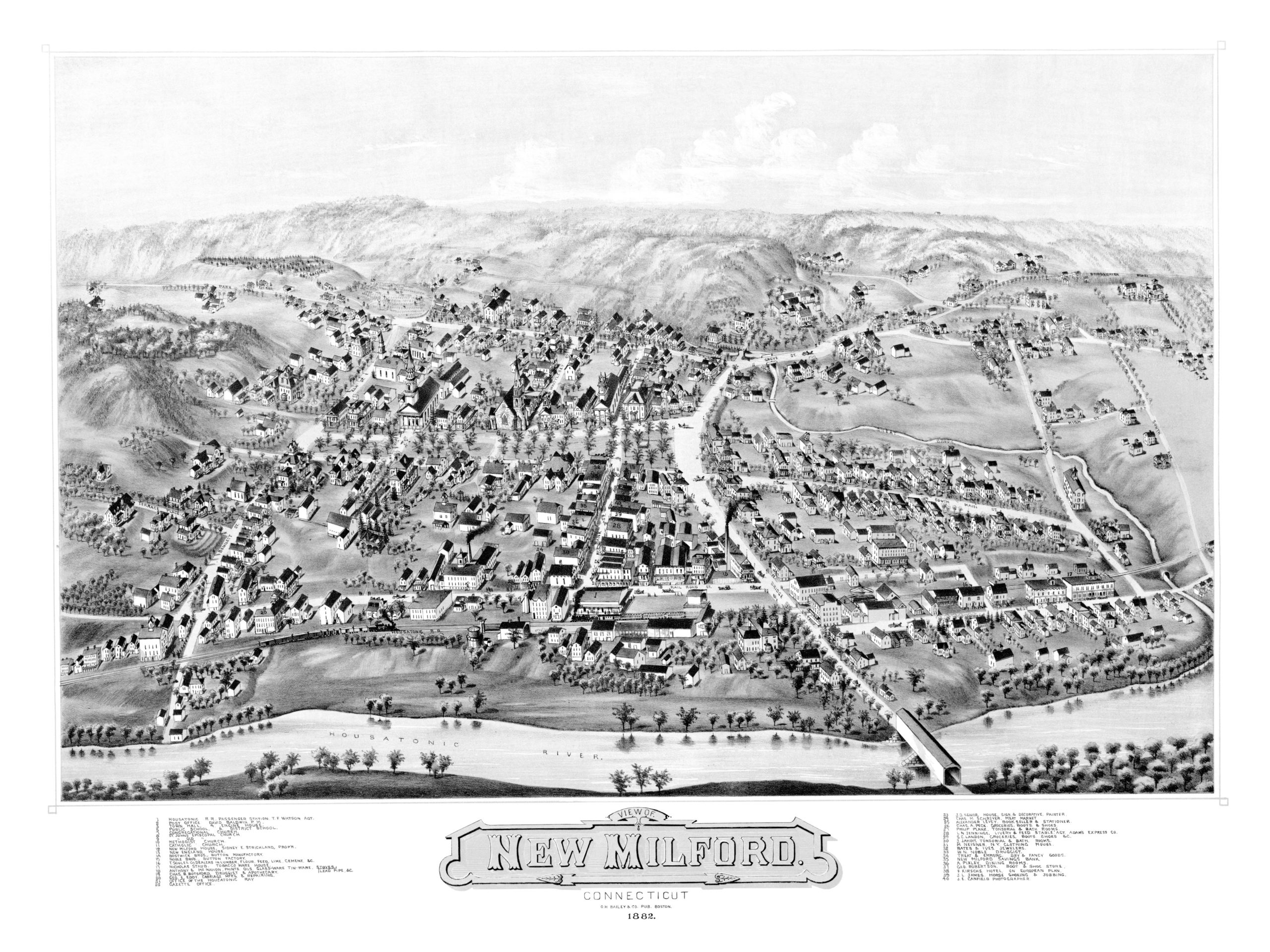
The bird's-eye view
By O.H. Bailey
New Milford drawn as if from the sky, with its street names and old landmarks, among them the Housatonic Railroad Station, the Noble Brothers Button Factory, Botsford's druggist and apothecary, Schreyer's meat market and the New Milford Savings Bank.4
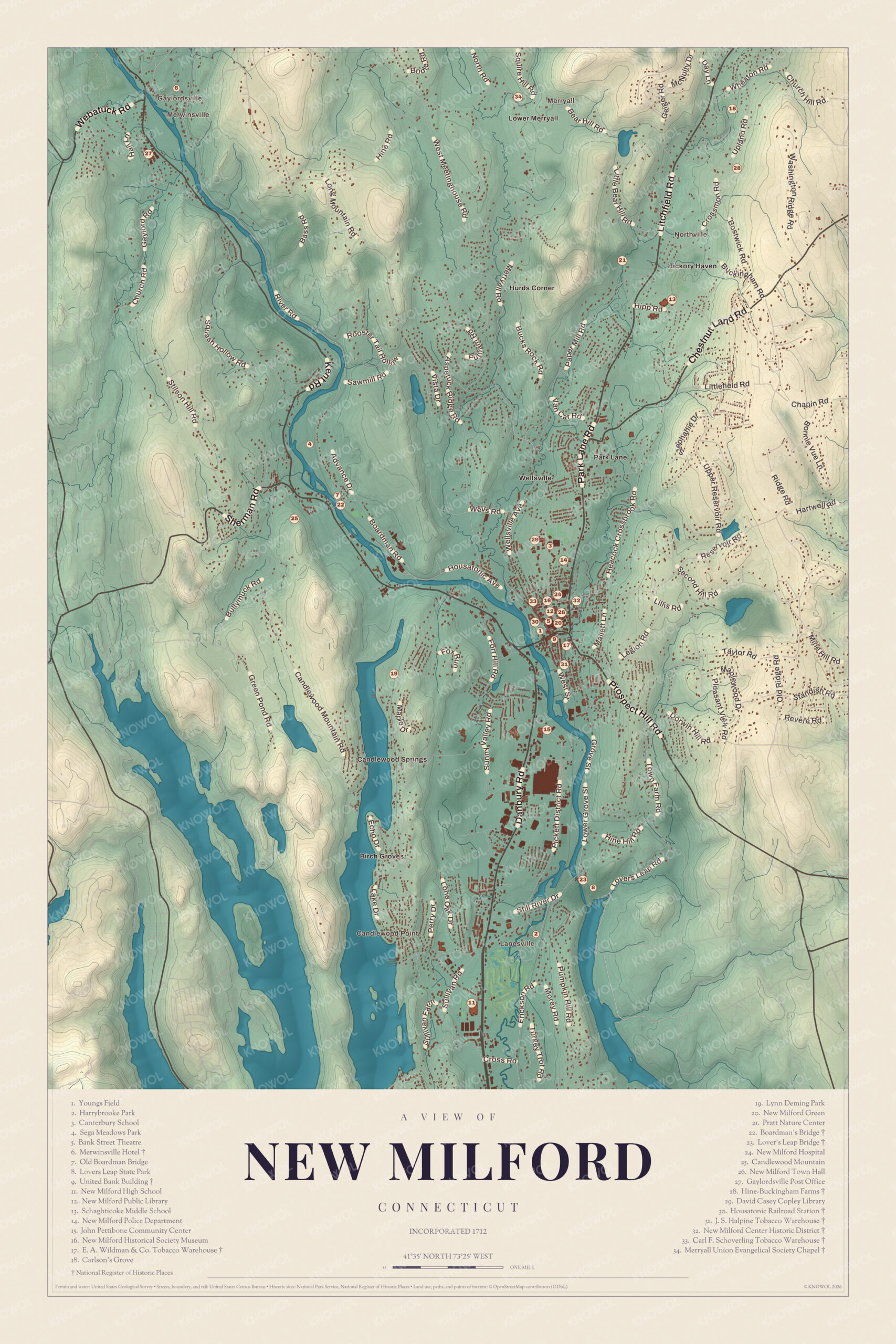
New Milford today
By KNOWOL
Shaded hills from Gaylordsville in the northwest down to the Candlewood Lake Club, every street, villages like Merryall, Northville, Wellsville and Lanesville printed by name, and a guide of 33 numbered landmarks with the National Register sites marked.5
The story of New Milford
The falls at Metichawon
Before there was a New Milford, the country along this stretch of the Housatonic was called Wyantenock, and its center was the falls the native people called Metichawon. Every spring the lamprey eels came swarming up the river and tried in vain to climb the cascade, so it was a fine place to fish. Near the bank stood the great wigwam of the sachem Weraumaug, built of poles and covered with bark, its smooth inner side painted with beasts, birds, fishes and insects by an artist sent from a distant sachem. Buyers from Milford paid for the township in 1703. Long after the native families had moved away, they kept their right to the fishing place at the falls, and came down from Stockbridge every year to fish for lampreys.678
Roger Sherman's New Milford
In 1707 John Noble Sr. came down from Westfield, Massachusetts, with his eight-year-old daughter, Sarah, and John Bostwick's family came the same year. Bostwick's son Daniel was the first boy born here. Roger Sherman arrived in 1743, a young man who had learned shoemaking from his father. In New Milford he kept a country store with his brother, surveyed land for eighteen years, started publishing almanacs in 1750 and was admitted to the bar in 1754. He moved to New Haven in 1761 and went on to sign both the Declaration of Independence and the Constitution. The Town Hall stands on the lot where his house was, and in 1897 the Roger Sherman Chapter unveiled a tablet to him there.19101112
Tobacco, hats and the railroad
The Housatonic Railroad reached New Milford in 1840, and the blocks between the green and the tracks filled with stores. In the far northwest, Sylvanus Merwin bought land in the railroad's path and got the trains to stop at his new hotel for meals. Tobacco became the crop that brought in ready cash. Farmers worked a few acres of leaf from April to September, and in the fall and winter the warehouses sorted and packed it for cigar wrappers. By World War I the town had twelve packing and warehouse operations. Hat making started in 1881, and by 1891 New Milford also made carbonized stone, sewer pipe, pottery and silica paints. Warehouses on Bridge Street, West Street and Wellsville Avenue still stand.1314151617
Through the years
25 moments from 1703 to today.
- 1703Buyers from Milford purchase the township from Papetoppe and other native proprietors for sixty pounds in money and twenty in goods.8
- 1705The Indian Fields, across the river from the village, are sold to John Mitchell of Woodbury.18
- 1707John Noble Sr. and his eight-year-old daughter, Sarah, become the first English settlers.1
- 1707John Bostwick's family follows, and his son Daniel becomes the first boy born in New Milford.9
- 1712After twelve families petition the General Assembly, the town is organized.1
- 1716Daniel Boardman is ordained minister of the Congregational church.1
- 1717About this year John Griswold builds the town's first mill, in what's now Lanesville.19
- 1722The North Purchase adds the northern end of the town.20
- 1743Roger Sherman, a young shoemaker from Massachusetts, moves to New Milford.10
- 1768The Connecticut Journal reports that a shop in town has been turning out fake New York bills and Spanish dollars.21
- 1770St. John's Episcopal Church becomes one of only three Episcopal churches in the colony established by law.22
- 1788About this year the first Baptist church in Litchfield County is organized in New Milford.23
- 1812A strange and malignant fever breaks out in New Milford and rages for months.24
- 1837Dr. George Taylor of New Milford takes up homeopathy, five years before the first homeopath settles in Hartford County.25
- 1840The Housatonic Railroad opens, and stores fill the blocks between the green and the tracks.13
- 1843The Merwinsville Hotel opens for the first trains, which stop there for meals.14
- 1870The E. A. Wildman tobacco warehouse goes up on Bridge Street.16
- 1871The Village Improvement Society is founded. It becomes the model for more than three hundred others.3
- 1881Hat making starts in New Milford.15
- 1882O.H. Bailey draws his bird's-eye view of the village.4
- 1886The Housatonic Railroad builds the station on Railroad Street.26
- 1893The New Milford Power Company is chartered to harness the Housatonic.27
- 1895The Berlin Iron Bridge Company builds the Lover's Leap Bridge.28
- 1897A tablet to Roger Sherman is unveiled on the Town Hall, which stands on the site of his home.12
- 1902On May 5, fire destroys the New England House and two banks at Bank and Main Streets. The United Bank Building rises in their place.29
Places to see
The numbers match the landmark guide printed on the 2026 map.
- 6Merwinsville HotelGaylordsville. A railroad hotel of 1843.Visit their website
- 7Old Boardman BridgeBoardman Road. An iron lenticular truss of 1888.
- 9United Bank BuildingBank Street. Built after the fire of 1902.
- 17E. A. Wildman & Co. Tobacco WarehouseBridge Street. The oldest tobacco warehouse in town.
- 20New Milford GreenDowntown. One of the longest greens in the state.
- 23Lover's Leap BridgeLovers Leap State Park. An ornate iron bridge of 1895.
- 26New Milford Town HallDowntown. On the site of Roger Sherman's house.
- 30Housatonic Railroad StationRailroad Street. The station of 1886.
- 33Carl F. Schoverling Tobacco WarehouseWellsville Avenue. Known locally as the Flatiron Building.
- 34Merryall Union Evangelical Society ChapelLower Merryall. Carpenter Gothic chapel of 1890.
On the National Register
All 13 places in New Milford on the National Register of Historic Places that still stand today, oldest first, and why each one matters.2
-
Hine-Buckingham Farms
Two neighboring family farms worked from the 1700s into the 1900s, with a house of about 1760 built by Daniel Hine. Today it's Hunt Hill Farm, home to The Silo, and much of the land is town conservation land.30
-
John Glover Noble House
A fine brick Federal house built by a descendant of one of the town's founders, with bricks from the family brickyard and iron from the family ironworks. Edna Ferber called it "the most beautiful in America."31
-
New Milford Center Historic District
The civic and commercial heart of the town, around one of the state's longest town greens. After the railroad came in 1840, the blocks between the green and the tracks grew into a busy business district of brick and stone.13
-
Merwinsville Hotel
Sylvanus Merwin bought land in the railroad's path and made it stop at his hotel for meals and name the station for him. It's believed to be one of the oldest hotels in the country built for a railroad stop.14
-
E. A. Wildman & Co. Tobacco Warehouse
The oldest of the town's surviving tobacco warehouses, built by one of the first commercial packers. Its rear section is a rare rural packing barn moved here in 1901.16
-
Merritt Beach & Son Building
Built for a lumber and hardware firm founded in 1857, with a hardware store downstairs, tobacco storage on the second floor and a public hall on the third. It's one of the town's oldest commercial buildings.32
-
Housatonic Railroad Station
Built when New Milford was a busy tourist town and the valley's center for packing tobacco. It took passengers until about 1970 and now holds the chamber of commerce.26
-
Boardman's Bridge
A wrought-iron lenticular truss by the Berlin Iron Bridge Company and one of three of its kind left in the state. It replaced a wooden toll bridge swept away in the flood of 1854, and it's been closed since 1985 while the town works to reopen it for people on foot.33
-
Merryall Union Evangelical Society Chapel
The town's best example of Carpenter Gothic, built so country families didn't have to travel to the center for services. It still holds summer services.34
-
Lover's Leap Bridge
One of the last iron bridges the Berlin Iron Bridge Company made, and a particularly ornate one, with urn finials and rosettes. It's been open only to people on foot since 1977.28
-
Carl F. Schoverling Tobacco Warehouse
Known locally as the Flatiron Building, it was described as one of the most advanced tobacco warehouses in the country when it was built, and it still has an early elevator once powered by a water pump.35
-
J. S. Halpine Tobacco Warehouse
The largest surviving tobacco warehouse in the region, used for sorting and curing leaf until the business ended in the late 1930s. It's homes now.36
-
United Bank Building
A Classical Revival bank by Wilson Potter, built for two banks after the fire of May 5, 1902 burned the New England House and both of their old buildings. It faces the green from the top of Bank Street.29
In their words
“The modern town of New Milford is in many respects a remarkable one.”
The Connecticut Magazine, 189915
“The village of New Milford consists of about 60 dwelling houses and 5 mercantile stores.”
John Warner Barber, Connecticut Historical Collections, 183621
Nearby towns
Sources
- New Milford, Connecticut, Wikipedia
- National Register of Historic Places listings in Litchfield County, Connecticut, Wikipedia
- A History of the Old Town of Stratford and the City of Bridgeport, Samuel Orcutt, 1886, Internet Archive
- Bird's-eye view of New Milford, 1882, restored by KNOWOL
- Map of New Milford, Connecticut in 2026, KNOWOL (USGS elevation, Census Bureau roads)
- History of the Indians of Connecticut, John W. De Forest, 1851, Internet Archive
- History of the Indians of Connecticut, John W. De Forest, 1871 edition, Internet Archive
- History of the Indians of Connecticut, John W. De Forest, 1871 edition, the 1703 purchase, Internet Archive
- A Biographical History of the County of Litchfield, Payne Kenyon Kilbourne, 1851, Internet Archive
- The History of Connecticut, G. H. Hollister, 1855, Internet Archive
- Chapter Sketches, Connecticut Daughters of the American Revolution, 1901, Internet Archive
- Chapter Sketches, Connecticut Daughters of the American Revolution, 1901, the Sherman tablet, Internet Archive
- New Milford Center Historic District, Wikipedia
- Merwinsville Hotel, Wikipedia
- The Connecticut Magazine, October 1899, New Milford by Dwight C. Kilbourn, Internet Archive
- E. A. Wildman & Co. Tobacco Warehouse, Wikipedia
- Register and Manual of the State of Connecticut, 1891, Internet Archive
- History of the Indians of Connecticut, John W. De Forest, 1851, the Indian Fields sale, Internet Archive
- The History of Ancient Wethersfield, Connecticut, Volume II, 1904, Internet Archive
- Connecticut Historical Collections, John Warner Barber, 1836, quoting Stanley Griswold's 1801 sermon, Internet Archive
- Connecticut Historical Collections, John Warner Barber, 1836, the village of New Milford, Internet Archive
- The Episcopal Church and Early Ecclesiastical Laws of Connecticut, 1908, Internet Archive
- The Historical, Statistical and Industrial Review of the State of Connecticut, 1884, Internet Archive
- Historical Records of the Town of Cornwall, Litchfield County, 1904, Internet Archive
- The Memorial History of Hartford County, 1886, Internet Archive
- New Milford station, Wikipedia
- The Bench and Bar of Litchfield County, Connecticut, 1709-1909, Internet Archive
- Lover's Leap Bridge, Wikipedia
- United Bank Building, Wikipedia
- Hunt Hill Farm (Hine-Buckingham Farms), Wikipedia
- John Glover Noble House, Wikipedia
- Merritt Beach & Son Building, Wikipedia
- Old Boardman Bridge, Wikipedia
- Merryall Union Evangelical Society Chapel, Wikipedia
- Carl F. Schoverling Tobacco Warehouse, Wikipedia
- J. S. Halpine Tobacco Warehouse, Wikipedia