
The City of Presidents on Quincy Bay, where Captain Wollaston's party landed in 1625, John Adams, John Quincy Adams and John Hancock were born, and West Quincy granite rode the Granite Railway toward Bunker Hill.
Then and now
The same town 149 years apart. Click either map to look closer.
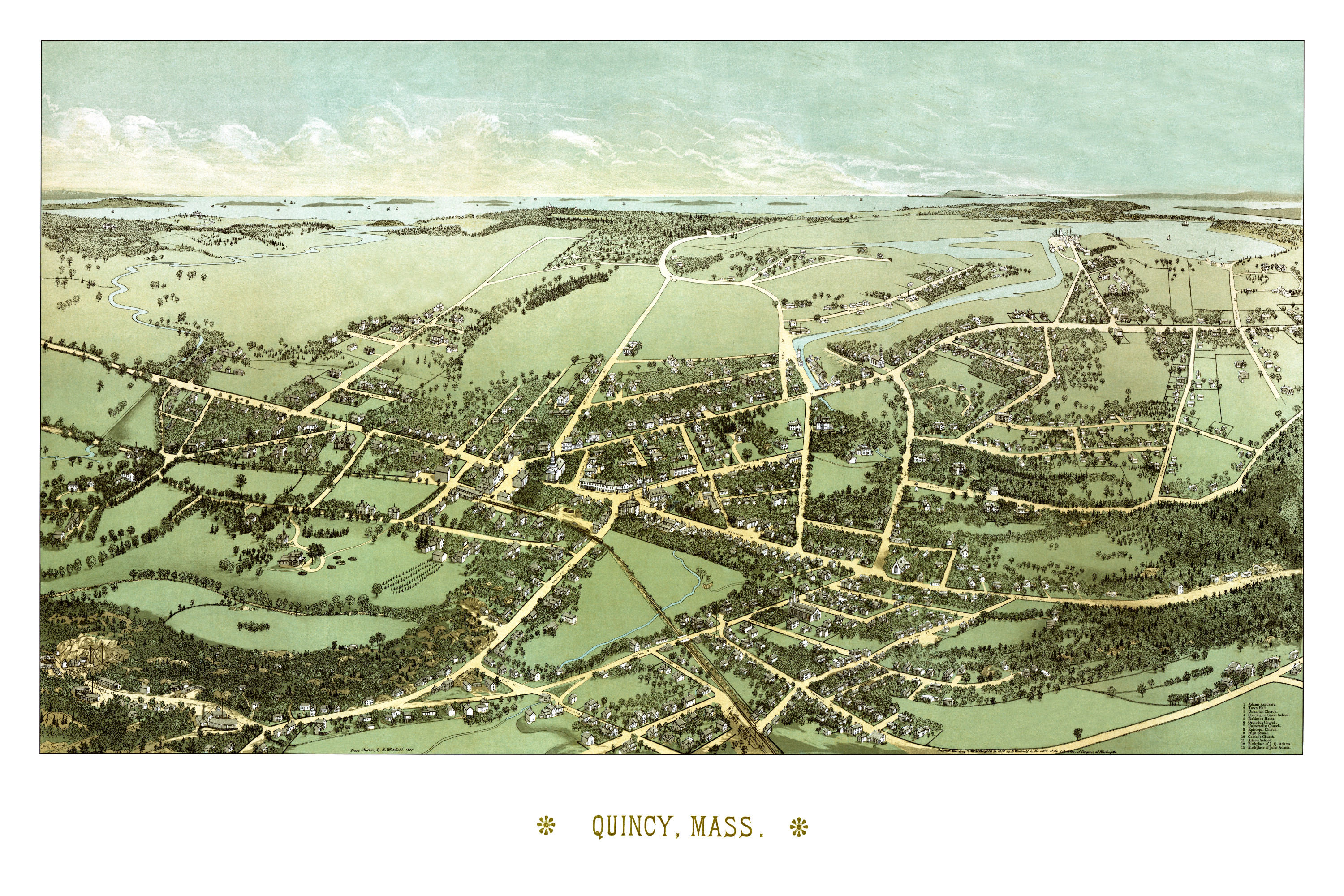
The bird's-eye view of 1877
By Edwin Whitefield
Quincy drawn as if from the sky, with its street names and landmarks including Adams Academy, the town hall, the Unitarian church, the Coddington Street School, the Robinson House, the Adams School and the birthplaces of John Adams and John Quincy Adams.3
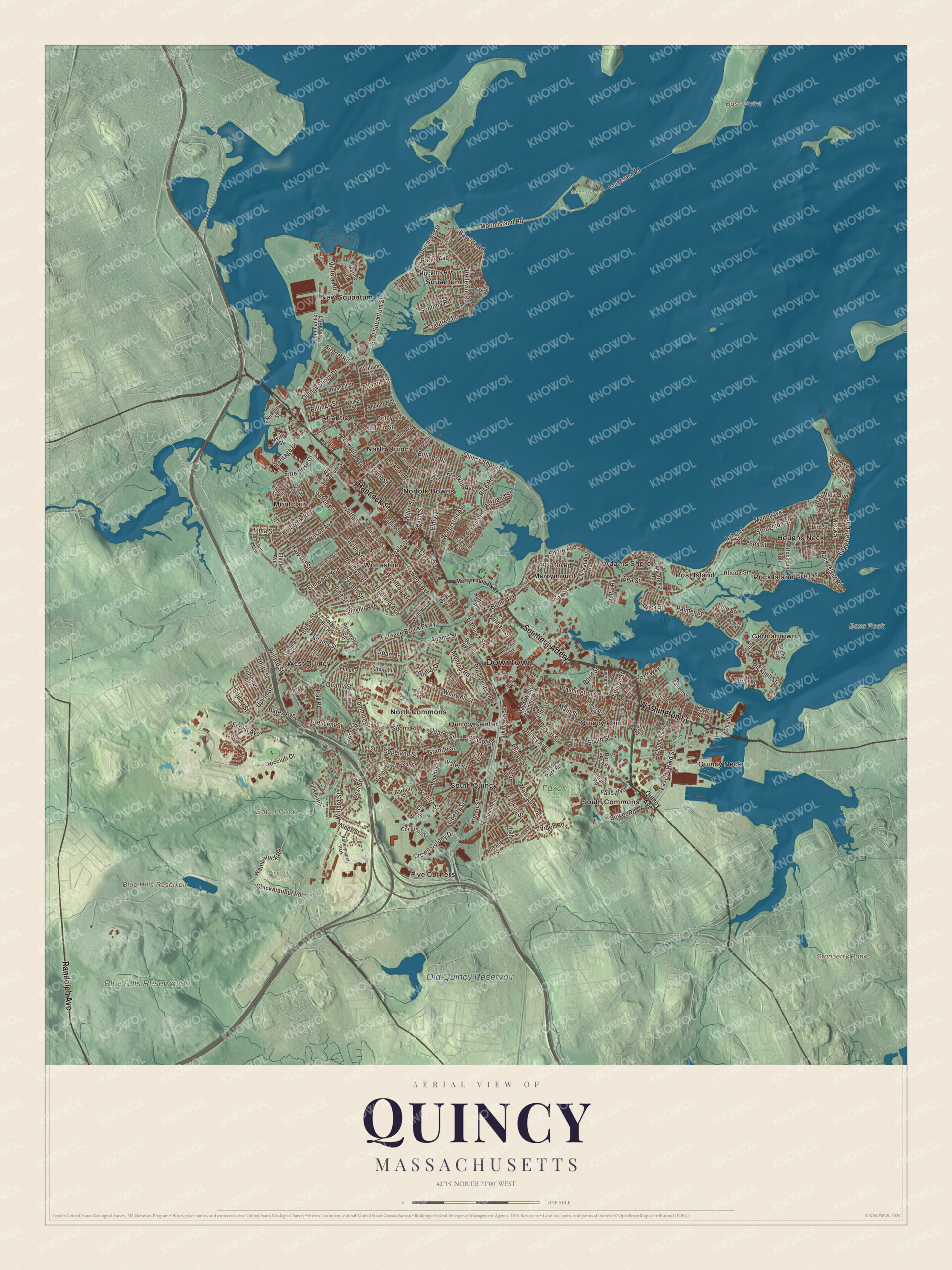
Quincy today
By KNOWOL
Hancock Street, Washington Street, Quincy Avenue, Randolph Avenue, Falls Boulevard and Bower Road across the city, with Houghs Neck, Merrymount, Germantown, Cranberry Pond and the Blue Hills Reservation.4
The story of Quincy
When the old meetinghouse came down
For ninety-six years the wooden meetinghouse of 1732 stood on the training field in the middle of town. Its seats were hinged, lifted when people stood to pray and dropped afterward with such a bang that young Mrs. Josiah Quincy, on her first Sunday, feared the church was falling. In 1822 John Adams left the town granite quarries, asking that a stone temple be built from them. The new church rose right beside the old one, so close that the old tower had to go. In March 1828 it sold at auction to John Spear for seventy dollars. Henry Wood paid three dollars and twenty-five cents for the vane and ball and set them on his barn, and on April 14 the cupola came down with a loud crash.5678
The Farms, the Woods and the Old Fields
Before Quincy filled in with houses, its corners had plainer names. When Thomas Crane was a boy, around 1800, Atlantic was the Farms, Wollaston was a cow pasture, West Quincy was a wilderness called the Woods, and Quincy Point, the Old Fields, had no road through it until 1812. Earlier still, the Massachusetts Fields, the planting grounds of the Native people, covered today's Atlantic and Norfolk Downs. In spring the streams ran so thick with alewives that the first settlers said you could cross on their backs dry-shod. At a cove in Squantum an archaeologist later found a freshwater spring, a big shell heap and many tools, and placed the sachem's home there. Along the shore, salt works ran for more than two hundred years.91011
Granite and ships
Quincy's stone and its shipyards carried the town's name a long way. In 1826 the Granite Railway was built to haul stone from a Quincy quarry to the Neponset River, bound for the Bunker Hill Monument, and it's often called the first commercial railroad in the country. By the 1890s there were 140 Quincy firms making granite monuments. Shipbuilding came even earlier. The first vessels were built at Ship Cove on Quincy Neck, mostly for fishing, and in 1789 the ship Massachusetts, which an 1890 gazetteer calls the largest in the country at the time, was built at Germantown. A century later the Fore River Shipyard built the carrier Lexington and the battleship Massachusetts, and the Thomas W. Lawson, the only seven-masted schooner ever built, came from Quincy too.1121314
Through the years
25 moments from 1625 to today.
- 1625Captain Richard Wollaston's party sets up a trading post at Passonagessit and names it Mount Wollaston.1
- 1627Myles Standish arrests Thomas Morton, who had renamed the post Ma-re-Mount.1
- 1636Atherton Hough is granted the neck that still carries his name, for a farm and orchard.4
- 1640The land becomes part of the new town of Braintree.1
- 1644John Winthrop Jr.'s iron furnace begins work in what is now West Quincy.15
- 1665Wampatuck, son of the sachem Chickatawbut, deeds the land here to Samuel Bass, Thomas Faxon and others.16
- 1686Edmund Quincy II builds the first house of what is now the Dorothy Quincy Homestead.17
- 1708The North Precinct of Braintree is set off, roughly today's Quincy.1
- 1735John Adams is born in the saltbox house on Franklin Street.18
- 1738Braintree's town meeting refuses Col. John Quincy's request to excuse his son Norton from serving as constable.19
- 1767John Quincy Adams is born in the house next door.20
- 1770Col. Josiah Quincy builds his country house overlooking Quincy Bay.21
- 1778John Adams sails for France from Houghs Neck to avoid the British.4
- 1789The ship Massachusetts, called the largest in the country, is built at Germantown.14
- 1792Quincy becomes a town, named for Col. John Quincy of Mount Wollaston.1
- 1812Quincy Point, known as the Old Fields, finally gets a road through it.9
- 1826The Granite Railway is built to carry Quincy granite for the Bunker Hill Monument.1
- 1828The stone church is finished, and the old meetinghouse tower sells at auction for seventy dollars.7
- 1844The granite town hall goes up in Quincy Center.22
- 1865A National Sailors' Home for aged and disabled Navy sailors is built north of Mount Wollaston.23
- 1877Edwin Whitefield publishes his bird's-eye view of Quincy.3
- 1882H. H. Richardson's Thomas Crane Public Library is dedicated.24
- 1888Quincy becomes a city.1
- 1893The Metropolitan Parks Commission buys the Blue Hills lands for public recreation.4
- 1952Richard Koch starts the Flag Day parade, now the longest-running in the country.1
Places to see
Places worth a visit in Quincy today.
- United First Parish ChurchQuincy Center. The Old Stone Church of 1828.Visit their website
- Thomas Crane Public LibraryQuincy Center. H. H. Richardson's library of 1882.Visit their website
- City HallQuincy Center. The granite town hall of 1844.
- Fore River ShipyardQuincy Point. Where the Lexington was built.
- United States Naval Shipbuilding MuseumFore River. Home of the warship USS Salem.Visit their website
- Quincy Quarries ReservationWest Quincy. The old granite quarries, now parkland.Visit their website
- Blue Hills ReservationSouth and west. Close to a quarter of Quincy's land.Visit their website
- Chickatawbut HillBlue Hills. The city's high point, 517 feet.
- Houghs NeckQuincy Bay. Where John Adams sailed for France.
- MerrymountQuincy Bay shore. Site of the 1625 settlement.
On the National Register
20 of the 99 places in Quincy on the National Register of Historic Places that still stand today, oldest first, and why each one matters. See the full list of National Register places in Quincy.2
-
Quincy Homestead
National Historic Landmark
Edmund Quincy II built the first house here in 1686 on a large family property. The Dorothy Quincy Homestead is now a museum, open occasionally to the public.17
-
United First Parish Church (Unitarian) of Quincy
National Historic Landmark
The congregation was gathered in 1639, and its granite church was built in 1828 by stonecutter Abner Joy to designs by Alexander Parris. John Adams, John Quincy Adams and their wives lie in its crypt.8
-
Quincy Town Hall
The granite town hall of 1844 in Quincy Center, still the seat of the city's government.22
-
Adams National Historic Site
Adams National Historical Park preserves the homes of five generations of the Adams family, from 1720 to 1927, including Peacefield and the Stone Library, built in 1870 to hold John Quincy Adams's books.25
-
Salem Lutheran Church
The church was built in 1894 to serve a growing congregation of Scandinavians who had come to Quincy to work in its granite quarries. The stones for this granite Gothic Revival church building were hauled and dressed by members of the congregation.26
-
Fore River Club House
It is a long 1+1⁄2-story wood-frame structure, with rectilinear eyebrow dormers on the water-facing roof. The Shingle-style clubhouse was built in 1917 by the Fore River Shipyard as a recreation center for its employees.27
-
John Quincy Adams Birthplace
National Historic Landmark
The saltbox house where John Quincy Adams, the sixth president, was born in 1767. His parents lived here while John Adams worked on the Declaration of Independence and the Revolution.20
-
John Adams Birthplace
National Historic Landmark
The saltbox house where John Adams, the second president, was born in 1735. It stands on the same property as his son's birthplace and is part of Adams National Historical Park.18
-
Moswetuset Hummock
Moswetuset Hummock is a Native American site and the original name of the tribe (Mosetuset) in the region named Massachusetts after them. The wooded hummock in Squantum, Massachusetts, is formally recognized as historic by descendants of the Ponkapoag people.28
-
Thomas Crane Public Library
National Historic Landmark
H. H. Richardson's Romanesque library of 1882, paid for by the Crane family in memory of Thomas Crane, a stone contractor who got his start in the Quincy quarries. Richardson counted it among his most successful civic buildings.24
-
Quincy Granite Railway
A surviving stretch of the Granite Railway, built to carry Quincy granite to a dock on the Neponset River for the Bunker Hill Monument. It is popularly called the first commercial railroad in the United States.29
-
Quincy Granite Railway Incline
The incline on Mullin Avenue is part of the Granite Railway, built to carry Quincy granite to the Neponset River for the Bunker Hill Monument. The old quarries around it are now the Quincy Quarries Reservation.30
-
Adams Academy
National Historic Landmark
John Adams provided in an 1822 deed of trust for a school on the site of John Hancock's birthplace. The boys' academy opened in 1872 and closed in 1908, and its Ware and Van Brunt building has long been home to the Quincy Historical Society.31
-
Josiah Quincy House
National Historic Landmark
Col. Josiah Quincy's country house on the family's Lower Farm, with the oldest known surviving hipped monitor roof in the former colonies. During the Revolution he watched the British fleet in Boston Harbor from its attic windows.21
-
John Winthrop, Jr. Iron Furnace Site
The site of the first iron blast furnace in what became the United States, run by John Winthrop Jr. from 1644 to 1653. West Quincy was then part of Braintree, so old books call it Braintree Furnace.15
-
Lyon's Turning Mill
James Lyon's mill of 1893 to 1894 turned granite into columns and spheres on giant lathes and employed about 80 workers until 1907. The quarry on the site dates to about 1825.32
-
Hancock Cemetery
Founded about 1640, it is the only tangible remainder of the area's early settlement. John Adams, John Quincy Adams and their wives were buried here before they were moved to the crypt of the United First Parish Church.33
-
Christ Church
The parish first met in 1689 and is believed to be the oldest continuously active Episcopal parish in Massachusetts. Its church of 1874 replaced two earlier churches lost to fire.34
-
House at 92 Willard Street
The House at 92 Willard Street in Quincy, Massachusetts, is believed to be the only granite house ever built in the city, which is well known for its granite quarries. The house is located in West Quincy, near its famous granite quarries, and was built in the 1830s.35
-
Woodward Institute
Dr. Ebenezer Woodward's will of 1869 set up a girls' school to match the Adams Academy. It opened in 1894 in this Queen Anne building and is still the Woodward School for Girls.36
In their words
“The fame of Quincy granite is world-wide. Quincy to-day is a bright star in the galaxy of Massachusetts municipalities.”
Massachusetts of today, 189237
“Quincy was to him always a haven of rest and refreshment.”
Charles Francis Adams Jr. on Thomas Crane, at the dedication of the Crane Memorial Hall, 18829
“No ship could come in without being seen from thence.”
History of Norfolk County, 1884, on Mount Wollaston38
Nearby towns
Sources
- Quincy, Massachusetts, Wikipedia
- National Register of Historic Places listings in Quincy, Massachusetts, Wikipedia
- Historic bird's eye view of Quincy, MA from 1877, restored by KNOWOL
- Map of Quincy, Massachusetts in 2026, KNOWOL (USGS elevation, Census Bureau roads)
- History of Braintree, Massachusetts (1639-1708), the north precinct of Braintree (1708-1792) and the town of Quincy (1792-1889) (1891), Internet Archive
- Three episodes of Massachusetts history (1892), Internet Archive
- Historical sketch of the Old Church, Quincy, Mass. (1864), Internet Archive
- United First Parish Church (Unitarian) of Quincy, Wikipedia
- Address of Charles Francis Adams, Jr., and proceedings at the dedication of the Crane Memorial Hall, at Quincy, Mass., May 30, 1882 (1883), Internet Archive
- Quincy, Massachusetts: historical information with route map (1921), Internet Archive
- History of Norfolk County, Massachusetts (1884), on Squantum and the first settlers, Internet Archive
- History of Plymouth, Norfolk and Barnstable counties, Massachusetts (1928), Internet Archive
- A history of old Braintree and Quincy, with a sketch of Randolph and Holbrook (1878), Internet Archive
- A gazetteer of the state of Massachusetts, with numerous illustrations (1890), on Germantown, Internet Archive
- John Winthrop, Jr. Iron Furnace Site, Wikipedia
- A gazetteer of the state of Massachusetts, with numerous illustrations (1890), on Mount Wollaston and the 1665 deed, Internet Archive
- Quincy Homestead, Wikipedia
- John Adams Birthplace, Wikipedia
- History of Norfolk County, Massachusetts (1884), on Norton Quincy, Internet Archive
- John Quincy Adams Birthplace, Wikipedia
- Josiah Quincy House, Wikipedia
- Quincy Town Hall, Wikipedia
- King's handbook of Boston harbor (1888), Internet Archive
- Thomas Crane Public Library, Wikipedia
- Adams National Historic Site, Wikipedia
- Salem Lutheran Church, Wikipedia
- Fore River Club House, Wikipedia
- Moswetuset Hummock, Wikipedia
- Quincy Granite Railway, Wikipedia
- Quincy Granite Railway Incline, Wikipedia
- Adams Academy, Wikipedia
- Lyon's Turning Mill, Wikipedia
- Hancock Cemetery, Wikipedia
- Christ Church, Wikipedia
- House at 92 Willard Street, Wikipedia
- Woodward Institute, Wikipedia
- Massachusetts of today, a memorial of the state, historical and biographical (1892), Internet Archive
- History of Norfolk County, Massachusetts (1884), on Mount Wollaston, Internet Archive