
Old Rumney Marsh, the center of colonial Chelsea until it left as North Chelsea in 1846, where the oak frame of a 1710 meetinghouse still stands on Beach Street, a tide mill became Slade's spice mill, and the long town beach is considered the oldest public beach in the country.
Revere on the map
Click the map to look closer.
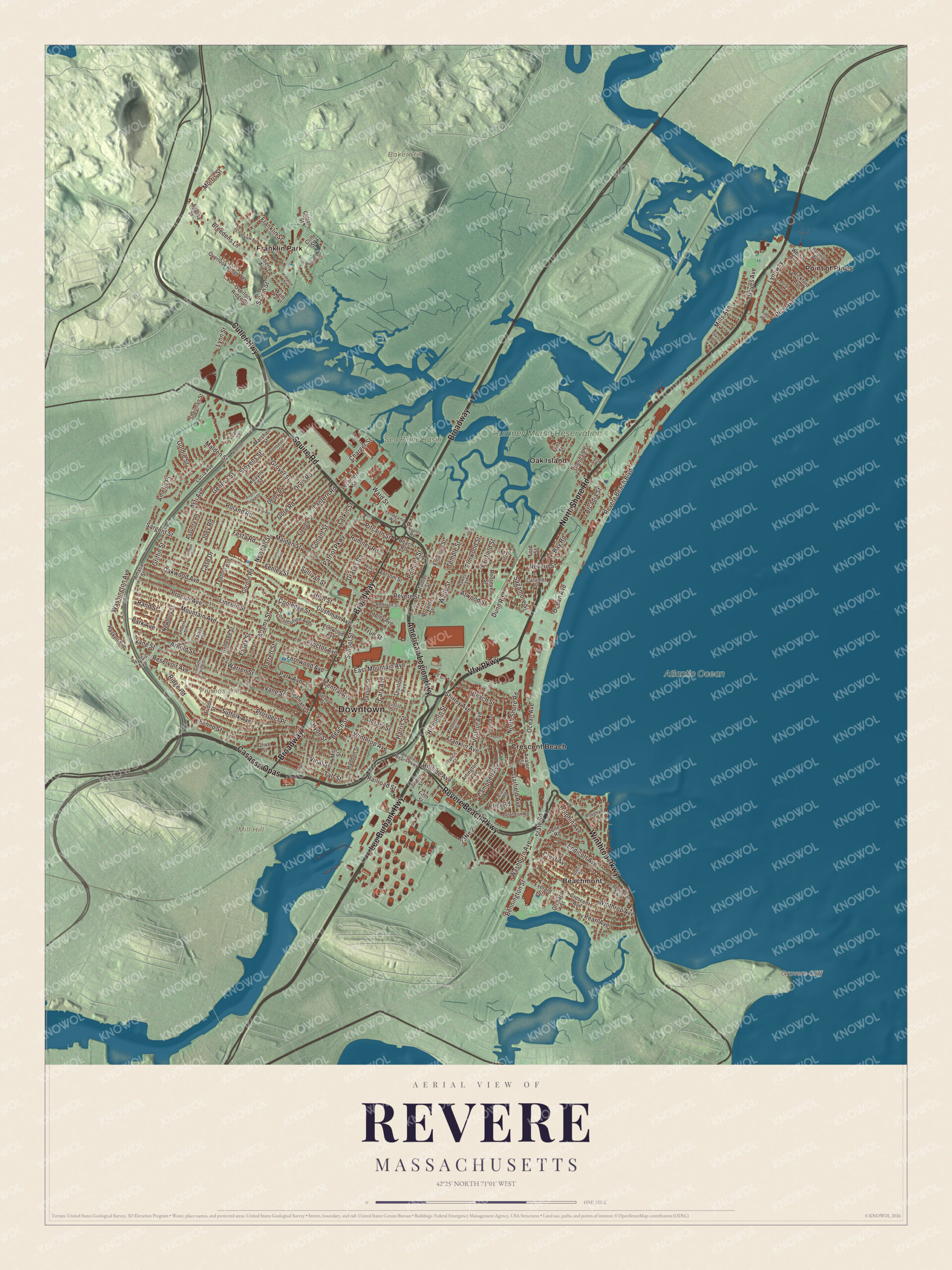
Revere today
By KNOWOL
Revere Beach Parkway, Winthrop Parkway, VFW Parkway, Lee Burbank Highway, Squire Road and North Shore Road across the city, with Beachmont, Point of Pines, Oak Island, the Rumney Marsh Reservation, Baker Hill, Fennos Hill and Mill Hill, drawn from USGS elevation data and Census Bureau streets.2
The story of Revere
Raising the meetinghouse
In July 1710 the farm families of Rumney Marsh raised a meetinghouse of their own, on a lot the Hasey heirs gave beside the town road, helped by a hundred pounds from Boston. Before that, going to church meant a long trip to the water side and an uncertain ferry to Boston. Samuel Sewall, the Boston diarist, rode out for the raising, drove a pin, and had a very good treat at Mr. Cheever's. The building served the town as well as the church: Chelsea held its town meetings there until a brick schoolhouse went up in 1805, and the old records show meetings adjourned now and then to Hawks's Tavern on School Street. The oak frame of that 1710 meetinghouse still stands inside the old Church of Christ on Beach Street.5678
The town that almost kept the name Chelsea
For about a century the center of Chelsea was here, at old Rumney Marsh. A one-story brick schoolhouse built in 1805, where Central Avenue now meets Beach Street, was for twenty-seven years the only school in what is now Chelsea and Revere, and town meetings were held in it too. On election days, families in the Centre took the voters from the Ferry district and Pullen Point home to dinner. Then the Ferry district boomed. In 1839 forty-three of its voters asked to be set off as a town, and the meeting put the question off. Warren Fenno later wrote that if it had passed, this part of town would have kept the name Chelsea. Instead the Centre left in 1846 as North Chelsea, and in 1871 it became Revere.972
A beach for everyone
Revere Beach belonged to the public long before the state took it over. In 1765 a Chelsea town committee reported that the sand everyone called Chelsea Beach was the town's property, and the next March the committee paid about eleven shillings into the town treasury, taken for sand that outsiders had carried off. A century later the trains came. The Narrow Gauge was built along the shore in 1875, and in 1881 the Eastern Railroad ran a rival branch from Oak Island around by the beach and Point of Pines. In 1885 Massachusetts veterans held their first statewide reunion at Point of Pines. In 1896 the beach opened as the first public beach in the country, and in 1916 alone the Narrow Gauge carried twenty million passengers.101112113
Through the years
25 moments from 1634 to today.
- 1634Rumney Marsh, Winnisimmet and Pullen Point are annexed to Boston.1
- 1641The first county road in North America crosses the marsh, from the Winnisimmet ferry to Salem.2
- 1688Increase Mather slips away by night in a boat from Newgate's Landing, near today's Slade's Mill, and sails for England.14
- 1700Boston sets up a free school at Rumney Marsh to teach reading, writing and ciphering.15
- 1710The Rumney Marsh meetinghouse is raised on July 10, and Samuel Sewall drives a pin.5
- 1735About this year the corn mills that later became Slade's Mills begin grinding at Rumney Marsh.16
- 1739Rumney Marsh, Winnisimmet and Pullen Point become the town of Chelsea, with Rumney Marsh as its center.1
- 1765A Chelsea town committee reports that Chelsea Beach, today's Revere Beach, is the town's property.10
- 1775The Battle of Chelsea Creek is fought, when most of old Chelsea's people live in what is now Revere.17
- 1805A one-story brick schoolhouse goes up where Central Avenue now meets Beach Street, and town meetings move into it.9
- 1835The town builds a 60 by 40 foot town hall on the Salem Turnpike.18
- 1839Voters of the Ferry district ask to be set off as their own town, and the meeting puts it off.7
- 1846North Chelsea is incorporated as a town.2
- 1852Pullen Point leaves to become the town of Winthrop.2
- 1871North Chelsea takes the name Revere, after Paul Revere.1
- 1875The Boston, Revere Beach and Lynn Railroad, the Narrow Gauge, is built along the shore.13
- 1880The public library opens in the town hall on November 6 with 507 volumes.7
- 1881The Eastern Railroad's beach branch, from Oak Island around by Point of Pines, is first used on July 2.11
- 1885Massachusetts veterans hold their first statewide reunion at Point of Pines.12
- 1886Revere's gardeners grow 40,000 bushels of onions.3
- 1896Revere Beach opens as the first public beach in the United States.1
- 1897The town hall burns on January 19, and a new one is dedicated in 1899.18
- 1903The Carnegie library is dedicated on November 18.19
- 1915Revere's first mayor takes office on January 4.2
- 1992Revere Beach officially reopens in May after years of rebuilding.2
Places to see
Places worth a visit in Revere today.
- Revere BeachEastern shore, Eliot Circle to Point of Pines. Considered the oldest public beach in America.Visit their website
- Point of PinesNorth end of Revere Beach. Neighborhood with its own private beach.
- BeachmontEasternmost neighborhood, by Orient Heights. Between the boulevard and East Boston.
- Oak IslandNear Point of Pines. Neighborhood beside the city's marshes.
- Rumney Marsh ReservationRevere and Saugus. A 600-acre salt marsh state park.Visit their website
- Rumney Marsh Burying GroundButler Street. The first burying ground of old Chelsea.Visit their website
- Revere Public LibraryBeach Street. Carnegie library, opened in 1903.Visit their website
- Shirley AvenueShirley Avenue neighborhood. The city's most ethnically diverse neighborhood.
- Squire RoadWest Revere. Business street of plazas and hotels.
- Kelly's Roast BeefRevere Beach. Roast beef sandwiches on the beach since 1951.
On the National Register
All 9 places in Revere on the National Register of Historic Places that still stand today, oldest first, and why each one matters.4
-
Rumney Marsh Burying Ground
The first burying ground of old Chelsea, which took in today's Revere, Chelsea and Winthrop. Its first documented burial was in 1693 and its last in 1929, and Joshua Cheever deeded the land to the town in 1751.20
-
Church of Christ
Inside this Shingle style building, which took its present look about 1888, stands the oak timber frame of the 1710 Rumney Marsh meetinghouse, one of the oldest such frames to survive. Masonic organizations used it from 1919 to 1982, and it now holds professional offices.8
-
Slade Spice Mill
A tide mill on Mill Creek, first built for the community to grind its corn, it became the mill of the D. and L. Slade spice company. It burned and was rebuilt more than once but keeps some of its early timbers, and it was converted to apartments in 2004.21
-
Revere Beach Reservation Historic District
Revere Beach, more than three miles long, opened on July 12, 1896 as the first public beach in the nation, after the Metropolitan Park Commission moved the railroad tracks off the sand and removed hundreds of buildings, following Charles Eliot's design.22
-
Mary T. Ronan School
The 2+1⁄2-story Classical Revival style brick building was built in 1896, during a period of rapid growth in the city's Beachmont neighborhood. It was eventually renamed in honor of one of its early principals.23
-
Revere City Hall and Police Station
City Hall, a brick Colonial Revival building designed by Greenleaf and Cobb, was built in 1897 to 1898 on roughly the site of the 1835 town hall, which burned in 1897. Senator Henry Cabot Lodge gave the oration when its cornerstone was laid, and the police station beside it served for about a hundred years.24
-
Winthrop Parkway, Metropolitan Parkway System of Greater Boston
The parkway, built between 1909 and 1919 and now designated as part of Route 145, runs for about 0.75 miles (1.21 km), from Eliot Circle (the junction with the Revere Beach Parkway and Revere Beach Boulevard) southeast to the Revere-Winthrop line. Acquisitions for its construction represent the last public purchase of oceanfront lands in Revere.25
-
Immaculate Conception Rectory
This Colonial Revival rectory served Immaculate Conception parish until 1993, when it was traded to the city for land across Beach Street. It now houses the Revere History Museum, run by the volunteer Revere Society for Cultural and Historical Preservation.26
-
Revere Beach Reservation
Listed in 2003, this expanded the 1998 Revere Beach historic district along Revere Beach Boulevard, from Eliot Circle to Northern Circle.27
In their words
“I do not know whether this was because the church was cold or that they needed something to cheer the inner man in the distressing times in which they lived.”
Warren Fenno, chairman of the library trustees, on town meetings adjourned to Hawks's Tavern, 19037
“We are justly proud of our public buildings and this beautiful edifice is a fit companion to the rest.”
Dr. B. A. Andrews, chairman of the selectmen, accepting the new Carnegie library, 190319
“Revere is famous for its beautiful beach, which is several miles long, lying between Winthrop and Nahant”
Guide to metropolitan Boston, 190128
Nearby towns
Sources
- Revere, Massachusetts, Wikipedia
- Map of Revere, Massachusetts in 2026, KNOWOL (USGS elevation, Census Bureau roads)
- Transactions of the Essex Agricultural Society (1886), on Revere's onion crop, Internet Archive
- National Register of Historic Places listings in Suffolk County, Massachusetts, Wikipedia
- A documentary history of Chelsea, vol. 2 (1908), on the raising of the 1710 meetinghouse, Internet Archive
- A documentary history of Chelsea, vol. 2 (1908), on going to church from Rumney Marsh, Internet Archive
- Dedication of the new library building, Revere, Mass. (1903), Warren Fenno's history of the town and its library, Internet Archive
- Church of Christ, Wikipedia
- Dedication of the new library building, Revere, Mass. (1903), on the town's early schools, Internet Archive
- A documentary history of Chelsea, vol. 1 (1908), on Chelsea Beach as town property, Internet Archive
- Essex Institute historical collections, on the Narrow Gauge and the Eastern Railroad's beach branch, Internet Archive
- Journals of the encampment proceedings of the Department of Massachusetts, Grand Army of the Republic, 1881 to 1887 (1902), on the 1885 Point of Pines reunion, Internet Archive
- Municipal history of Essex County in Massachusetts (1922), on the Narrow Gauge railway, Internet Archive
- A documentary history of Chelsea, vol. 1 (1908), on Increase Mather's escape in 1688, Internet Archive
- The history of Malden, Massachusetts, 1633-1785 (1899), on the Rumney Marsh free school, Internet Archive
- A documentary history of Chelsea, vol. 2 (1908), on the Rumney Marsh corn mill and Slade's Mills, Internet Archive
- A documentary history of Chelsea (1908), on Chelsea Neck and the Battle of Chelsea Creek, Internet Archive
- Dedication of the new library building, Revere, Mass. (1903), on the town halls of 1835 and 1899, Internet Archive
- Dedication of the new library building, Revere, Mass., November 18, 1903, Internet Archive
- Rumney Marsh Burying Ground, Wikipedia
- Slade Spice Mill, Wikipedia
- Revere Beach Reservation Historic District, Wikipedia
- Mary T. Ronan School, Wikipedia
- Revere City Hall and Police Station, Wikipedia
- Winthrop Parkway, Metropolitan Parkway System of Greater Boston, Wikipedia
- Immaculate Conception Rectory, Wikipedia
- Revere Beach Reservation, Wikipedia
- Guide to metropolitan Boston (1901), on Revere, Internet Archive