
A hilltop town at the center of Massachusetts, carved from the twelve-mile Naquag purchase, where Burgoyne's captured soldiers spent the summer of 1778 and Rufus Putnam planned the settlement of Ohio at his own fireside.
Rutland, Massachusetts on the map
Click the map to look closer.
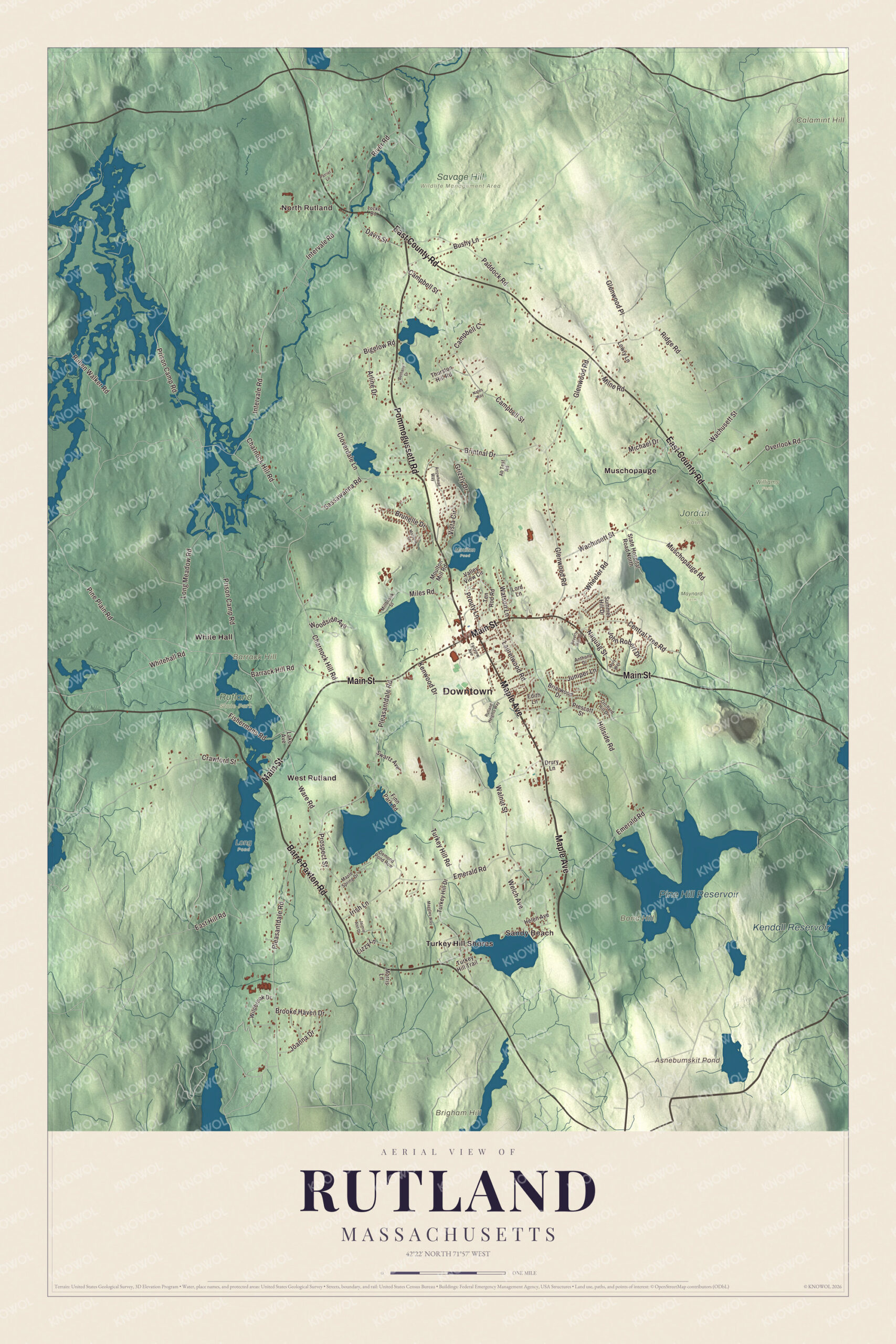
Rutland today
By KNOWOL
The hilltop town at the center of the state, with Main Street, East County Road, Barre Paxton Road and Turkey Hill Road, Barrack Hill, Asnebumskit Pond and Pine Hill Reservoir, and the villages of North Rutland, Muschopauge and West Rutland.6
The history of Rutland, Massachusetts
The farmhouse where Ohio was planned
In May 1781 Rufus Putnam, the engineer whose timber frames had fortified Dorchester Heights, bought one of Colonel John Murray's confiscated farms in Rutland. Murray had represented the town for twenty years before a crowd of hundreds came to force him off the royal council in 1774, and he left by a back road. On a winter evening in January 1786, Putnam and his old comrade General Benjamin Tupper sat before the great fireplace in the farmhouse and talked over their plans for the Ohio country. The next day they signed a call, dated Rutland, inviting the officers and soldiers of the late war to form an Ohio Company. In 1788 Putnam led the settlers who founded Marietta, and about fifty people from Rutland followed. In 1898 the Sons of the Revolution put a bronze tablet on the house.789105116
Burgoyne's soldiers on Barrack Hill
After Burgoyne's army surrendered at Saratoga, the government chose Rutland as a safe place to hold part of it. Captain Thomas Reed built a barracks 120 feet long and two stories high, with twenty-four rooms, inside a picket fence twelve feet high, just over a mile west of the meeting-house. The 1874 gazetteer puts the camp on Barrack Hill. The first brigade marched in on April 17, 1778, and stayed the summer before the prisoners were moved south. Officers boarded in private houses, kept horses and paid their bills, and three of them married Rutland women. Jonas Reed remembered German soldiers with long wooden pipes coming back from the farms, their wives carrying knapsacks full of potatoes. The barracks later served as a house, a store, a card factory and a tavern, and the guard house stood until 1888.121314
Life on the height of land
Rutland sits on the height of land in the middle of the state. The 1889 county history said that on a clear day you could see church spires in fourteen towns from the center, and that rain falling on the east side of William C. Temple's barn ran to the Merrimack, while rain on the west side ran to the Connecticut. Muschopauge Lake, where the 1686 deed began, is fed only by springs and was found in places to be nearly a hundred feet deep. The hills and the air drew summer guests to the Muschopauge House, which opened in 1884 with nearly four hundred feet of piazza. When the state planned a hospital for consumptives, most of the doctors and scientists it asked chose Rutland, and in 1898 the first state sanatorium in the country opened here.41516171819
Rutland, Massachusetts through the years
25 moments from 1686 to today.
- 1686On December 22, five Native men who claim the land deed a tract twelve miles square, called Naquag, to Henry Willard and his partners for twenty-three pounds.3
- 1713On February 23 the General Court confirms the grant, if sixty families settle within seven years, and names the town Rutland.3
- 1716Settlers begin clearing the land, and within four years they number fifty families.20
- 1719Families move in, and the first boy born in the settlement, to Moses and Eunice How on September 23, is given a hundred acres.21
- 1722The six miles square is incorporated as the town of Rutland, and the first legal town meeting is held on the last Monday of July.2
- 1723On August 14, in the war with the Eastern Indians, raiders kill the Rev. Joseph Willard, the first minister, and two sons of Deacon Joseph Stevens, and carry two more to Canada.22
- 1733The town hires its first schoolmaster, and the next year it builds its first two schoolhouses.23
- 1743The ten-rod street through the center is confirmed to the town as a common forever.24
- 1759In 1759 or 1760 a soldier's dog carries smallpox into the meeting-house, and several people who catch it die and are buried on their farms.25
- 1762An addition to the old minister's parsonage opens as a tavern, kept as a wayside inn for more than a hundred years.17
- 1766On May 23 the town celebrates the repeal of the Stamp Act with a bonfire and skyrockets.26
- 1774A crowd of about five hundred, joined on the way by nearly a thousand more, marches to Rutland to make Colonel John Murray give up his seat on the royal council.9
- 1775Fifty young men volunteer under Captain Thomas Eustis, and Benjamin Read is killed at Bunker Hill.27
- 1778On April 17 the first brigade of Burgoyne's captured army reaches the new barracks and stays the summer.12
- 1781Rufus Putnam buys one of Murray's confiscated farms and makes his home in Rutland.7
- 1786Putnam and Benjamin Tupper sign a call dated Rutland, January 10, that leads to the Ohio Company.10
- 1788Putnam leads the first settlers to Marietta, Ohio, and about fifty people from Rutland go west.5
- 1790The census counts 1,072 people; card making is newly set up, and potash making is carried on very largely.28
- 1794Betsey Bowen, later the famous Madame Jumel, comes to town with her family and lives in a cabin on Goose Hill.29
- 1799The Sixth Massachusetts Turnpike is chartered, and local men build it through Rutland for pay in turnpike shares.30
- 1830On February 28 the meeting-house burns; its replacement burns in 1849, and the present church is dedicated in 1850.31
- 1879A soldiers' monument of Vermont marble is dedicated on July 3 before the largest crowd the town had ever seen.32
- 1884The Muschopauge House, a summer hotel for about a hundred guests, opens in June on the site of the old parsonage.17
- 1894A crowded October meeting with Senator George F. Hoar starts the fund to buy the Putnam house, and the Rutland Historical Society grows out of the day.33
- 1898The state sanatorium for tuberculosis opens on Rutland Heights, the first state sanatorium in the country.6
Places to see in Rutland, Massachusetts
Places worth a visit in Rutland today.
- General Rufus Putnam House344 Main Street. Where the Ohio Company was planned.
- Town commonRutland Center. 1,200 feet above sea level.
- Central TreeCentral Tree Road. Marks the state's geographic center.
- Barrack HillWest of the Center. Burgoyne's captured troops camped here in 1778.
- MuschopaugeNear the Holden line. Spring-fed lake where the 1686 deed began.
- North RutlandEast Branch of the Ware River. Old mill village on the river.
- West RutlandBy Long Pond. Mill village of satinets and baskets.
- Rutland State ParkWhitehall Pond. 300 acres, with a beach and boat ramp.Visit their website
- Midstate TrailMeets the state park trails. Hiking trail across central Massachusetts.Visit their website
Rutland on the National Register of Historic Places
All 1 places in Rutland on the National Register of Historic Places that still stand today, oldest first, and why each one matters.35
-
Gen. Rufus Putnam House
National Historic Landmark
Built between 1760 and 1765 by John Murray, a Loyalist official who fled in 1774. The state confiscated it, and General Rufus Putnam bought it in 1781 and lived here until 1788, when he left to lead the Ohio Company settlers who founded Marietta, Ohio. It became a National Historic Landmark in 1972 for its link with Putnam.34
Rutland in their words
“But he had larger plans in mind. The town constable of Rutland was planning an empire.”
Senator George F. Hoar on Rufus Putnam, quoted in Historic towns of New England, 189936
“Old Rutland might well be called the Montpellier of Massachusetts.”
Edwin D. Mead, Historic towns of New England, 1899, on the town's healthful air37
“And they are a peaceable, happy, flourishing people.”
Peter Whitney's history of Worcester County, 1793, as reprinted in Jonas Reed's history of Rutland, 183638
Towns near Rutland, Massachusetts
Sources for the history of Rutland
- Rutland, Massachusetts, Wikipedia
- The history of the county of Worcester (1793), by Peter Whitney, on the incorporation of Rutland, Internet Archive
- History of Worcester County, Massachusetts (1889), Charles R. Bartlett's Rutland chapter, on the Indian deed and the grant of 1713, Internet Archive
- History of Worcester County, Massachusetts (1889), on Rutland's height and Muschopauge Hill, Internet Archive
- A history of Rutland, Worcester County, Massachusetts (1836, reprinted 1879), by Jonas Reed, on the families who went to Ohio, Internet Archive
- Map of Rutland, Massachusetts in 2026, KNOWOL
- History of Worcester County, Massachusetts (1889), on General Rufus Putnam, Internet Archive
- History of Worcester County, Massachusetts (1889), on Colonel John Murray, Internet Archive
- The Loyalists of Massachusetts and the other side of the American Revolution (1910), on Colonel John Murray, Internet Archive
- History of Worcester County, Massachusetts (1889), on Putnam, Tupper and the Ohio Company, Internet Archive
- Register of members of the Society of Sons of the Revolution in the Commonwealth of Massachusetts (1899), on the Putnam house tablet of 1898, Internet Archive
- History of Worcester County, Massachusetts (1889), on the barracks for Burgoyne's army, Internet Archive
- A history of Rutland, Worcester County, Massachusetts (1836, reprinted 1879), by Jonas Reed, on Burgoyne's troops at Rutland, Internet Archive
- A gazetteer of the state of Massachusetts (1874), on Rutland and Barrack Hill, Internet Archive
- History of Worcester County, Massachusetts (1889), on the brooks of Rutland, Internet Archive
- History of Worcester County, Massachusetts (1889), on Muschopauge Lake, Internet Archive
- History of Worcester County, Massachusetts (1889), on the parsonage tavern and the Muschopauge House, Internet Archive
- Historic towns of New England (1899), Edwin D. Mead's chapter Old Rutland, on the choice of Rutland for the state hospital, Internet Archive
- Annual report of the Sharon Sanitarium (1925), on the State Sanatorium at Rutland, Internet Archive
- History of Worcester County, Massachusetts (1879), on the first settlement of Rutland, Internet Archive
- History of Worcester County, Massachusetts (1889), on the first settlers and the first boy born, Internet Archive
- History of Worcester County, Massachusetts (1889), on the raid of August 1723, Internet Archive
- History of Worcester County, Massachusetts (1889), on Rutland's first schools, Internet Archive
- History of Worcester County, Massachusetts (1889), on the ten-rod road and the common, Internet Archive
- A history of Rutland, Worcester County, Massachusetts (1836, reprinted 1879), by Jonas Reed, on the smallpox, Internet Archive
- Proceedings of the Massachusetts Historical Society, second series, volume 10 (1896), the diary of John Rowe, on the Stamp Act repeal at Rutland, Internet Archive
- History of Worcester County, Massachusetts (1889), on Rutland in the Revolution, Internet Archive
- The history of the county of Worcester (1793), by Peter Whitney, on Rutland's ponds, people and trades, Internet Archive
- History of Worcester County, Massachusetts (1889), on Betsey Bowen, later Madame Jumel, Internet Archive
- A history of Rutland, Worcester County, Massachusetts (1836, reprinted 1879), by Jonas Reed, on the Sixth Massachusetts Turnpike, Internet Archive
- History of Worcester County, Massachusetts (1889), on Rutland's meeting-houses, Internet Archive
- History of Worcester County, Massachusetts (1889), on the soldiers' monument, Internet Archive
- Historic towns of New England (1899), Edwin D. Mead's chapter Old Rutland, on saving the Putnam house, Internet Archive
- Gen. Rufus Putnam House, Wikipedia
- National Register of Historic Places listings in Worcester County, Massachusetts, Wikipedia
- Historic towns of New England (1899), Edwin D. Mead's chapter Old Rutland, quoting Senator Hoar on Rufus Putnam, Internet Archive
- Historic towns of New England (1899), Edwin D. Mead's chapter Old Rutland, on the town's air, Internet Archive
- A history of Rutland, Worcester County, Massachusetts (1836, reprinted 1879), by Jonas Reed, quoting Whitney's 1793 county history, Internet Archive